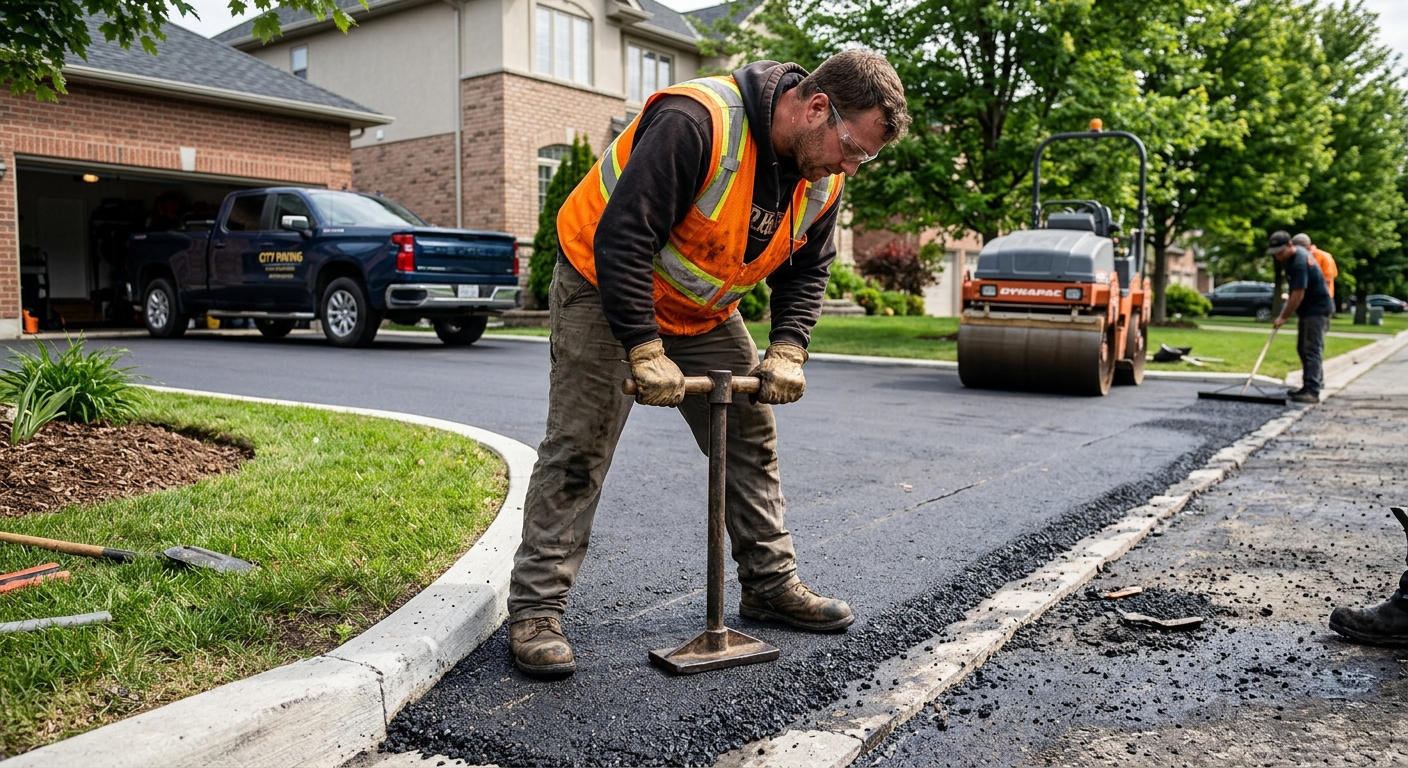
Driveway paving costs in Huntingdon — 2026
In Huntingdon County, where 55.8% of homes are single-family and the homeownership rate clocks in at 57.3% (U.S. Census Bureau, ACS 2024), driveway upkeep is a core part of property maintenance. Most bills come due in neighborhoods around Huntingdon Borough, where the post‑War housing stock now pushes past its original pavement life. The ground here is classic Juniata Valley: shale and limestone subgrade means thicker bases are not optional if you want a surface that stays put more than a few winters.
Pricing between two quotes in Huntingdon rarely comes down to the asphalt or concrete you see. Whether you’re paying closer to $3,300 or $8,400 for asphalt, the real cost is buried—literally—in what’s under your tires. That’s excavation, aggregate base, compaction, drainage, and haul time from plants in Altoona or Lewistown. If one job comes in much cheaper, it’s probably betting you won’t notice what’s missing from the base, not the surface.
| Service |
Best for |
Lifespan |
Price range |
| Asphalt — full replacement with new base |
failed base, structural cracking |
20–30 yrs |
$3,300–$8,400 |
| Asphalt overlay / resurfacing |
sound base, surface cracking only |
8–15 yrs |
$1,400–$4,200 |
| Sealcoating — single application |
preventive maintenance on sound asphalt |
2–4 yrs |
$175–$650 |
| Concrete — new installation |
long service life, low maintenance |
30–50 yrs |
$4,700–$11,000 |
| Crack filling and patching |
isolated cracks under a quarter inch |
1–3 yrs |
$200–$800 |
| Gravel driveway |
rural, budget, long runs |
5–10 yrs with upkeep |
$900–$3,500 |
Estimates for a typical Huntingdon driveway. Square footage and base condition drive these figures more than material choice.
The paving season in north-central Pennsylvania
In north-central Pennsylvania, paving season isn’t a convenient suggestion—it’s a hard limit. Hot-mix asphalt has to be installed in warm weather because it cools rapidly; below about 50°F, the mix stiffens too soon and you’re left with a brittle, porous surface that won’t last through Huntingdon’s 2 °F winter design temperature. That’s not just science talk—it’s why local asphalt plants near Altoona and Lewistown simply shut down for the winter. If you call for paving in January, there are no materials coming.
Concrete projects face their own cutoff. Concrete requires above-freezing temps for days while it cures, or you gamble with surface spalling. In practice, paving in Huntingdon starts as early as late April (with some risk) and wraps up by the first or second week of November at the latest. When the ground is frozen, nothing happens but shoveling.
That spring and early fall shoulder season is where you’ll find contractors with open schedules—and sometimes better pricing. Expect the highest demand, and full booking, from mid-June through September. If a crew offers to pave your driveway in late November or after a run of freezing nights, they’re either taking desperate work or banking you won’t care what the job looks like in three years. Asphalt laid cold or fast-cured concrete both mean short-lived driveways.
Permits and approvals for paving in Huntingdon
Most routine driveway resurfacing in rural Huntingdon County does not require a permit if you aren’t changing the footprint or touching a public road connection. That saves a call for many homeowners. But the minute you touch the driveway’s approach—where your drive meets a township or state-maintained road—you’re into permit territory. Smithfield Township, for example, requires permits for any new or repaired driveway that connects to township or state roads. For approaches connecting to Pennsylvania state highways, you’ll need a Highway Occupancy Permit, which is issued by PennDOT District 2‑0, not by your local borough or township.
If your project expands the paved area, keep stormwater in mind: adding pavement can trigger runoff management requirements or create headaches with neighboring properties. Even if not spelled out in code, sending drainage onto the neighbor invites problems and possible liability.
Always verify that your contractor holds a Home Improvement Contractor (HIC) registration with the Pennsylvania Office of Attorney General at hic.attorneygeneral.gov. Employers must carry workers’ compensation; check compliance at WCAIS (wcais.pa.gov). Contracts over $500 require written terms under the Home Improvement Consumer Protection Act and include a three business-day right of cancellation.
Widening, extending or adding a parking pad
Projects that go beyond simple replacement—like widening for a second car, extending to a detached garage, or adding a turnaround—bring in a few extra steps for Huntingdon homeowners. Any new footprint means cutting into undisturbed soil, where driveway longevity depends on proper base preparation over that shale and limestone subgrade. These edges, where new asphalt meets old, become permanent weak points and need more than a basic tack coat to avoid future cracks.
Expanding a driveway can also brush up against impervious-surface limits, since additional pavement alters how stormwater runs off your property. In most of Huntingdon County, pushing pavement closer to a lot line or connecting to a township or state road triggers local permitting—Smithfield Township is a frequent example where driveway work needs a township permit, and approaches to state highways run through PennDOT.
Plan for more excavation, a new base, and it’s wise to check with your township office before your contractor brings in equipment. If anyone tells you to “just pave over the grass,” you should keep your cash in your pocket.
Reading a driveway proposal
A good paving proposal in Huntingdon details the work, not just the outcome you see. It starts with an exact measurement of square footage—don’t accept “about,” get a number. Next comes excavation: will they remove soft or organic subsoil, and is disposal included? For the base, demand specifics on aggregate type (often 2A modified stone here) and depth in inches. Compaction is critical, and it must be done in several lifts, not all at once.
The asphalt section should break out what type, how many courses, and the compacted thickness of each layer. Ask about edge treatment along your driveway—simply butt-ending against a lawn is a shortcut you’ll regret, especially with shale settling around the Juniata. Grading and drainage control, directing water away from structures and neighbors, often separates a pro from a cut-rate crew.
Cleanup—restoring the disturbed lawn edge or grading gravel shoulders—should be detailed too. Payment terms should state a modest deposit and the balance on completion, with a clear warranty in writing. Read the fine print: most “warranties” don’t cover cracking, which is the thing that drives most replacements.
| Line item |
What to look for |
Red flag if… |
| Area |
measured square footage stated |
eyeballed or absent |
| Excavation |
depth and disposal included |
'we'll pave over it' |
| Base |
aggregate type and depth in inches |
'proper base' |
| Compaction |
method, and done in lifts |
not mentioned |
| Asphalt |
courses and compacted depth |
'3 inches' unqualified |
| Drainage |
slope and water direction stated |
silent |
| Warranty |
what is covered and what is excluded |
verbal only |
| Payment |
modest deposit, balance on completion |
full cash up front |
Base preparation: the part you pay for and never see
When you see a smooth, just-finished driveway in Huntingdon, the work that matters most is already buried. Every driveway starts from the bottom: the subgrade (the native soil), then a compacted aggregate base, topped with asphalt. The limestone and shale subgrade along the Juniata River valley is not naturally stable. That’s why a thicker aggregate base—at least 6–8 inches of 2A modified stone, well compacted—should be standard here. Anything less, and you’re gambling with settlement and cracks within a few winters.
Freeze-thaw is your real enemy. As Huntingdon regularly drops to 2 °F, water in the soil freezes and expands, lifting the driveway in spots. When the thaw comes, the unsupported asphalt or concrete cracks from beneath. Only a well-compacted, deep base with proper drainage stands a chance. Skimping on excavation (especially on post-war fill soils), thin aggregate layers, or rushed compaction leaves you with a nice-looking driveway that hides ruin for the first year or two.
It’s easy for a low bidder to take shortcuts here—you’ll never see missed compaction or shallow base before signing the check. By year three, frost heave and rutting show up like clockwork. Demand these facts in writing: base depth in inches (not “proper base”), aggregate type, and that compaction was performed in lifts, meaning each layer of stone was compacted separately before another was added. This is not the glamorous part of driveway work, but in Huntingdon’s freeze-thaw alley, it’s the only thing that separates a 25-year surface from a 5-year headache.
Which surface survives Huntingdon winters
Asphalt and concrete behave very differently under Huntingdon’s freeze-thaw assault. Asphalt wins points for flexibility—it flexes with the ground when the subgrade moves, tolerating the winter-spring cycle without cracking immediately. That’s important here, where deep freezes and heavy snows (40 psf design load) are routine. Concrete is durable and long-lived when it survives, but it’s rigid: repeated cycles of freezing and thawing, plus de-icing salt used liberally each winter, cause spalling and scaling rather than true cracks. In a heavy-salt county like ours, that’s the most common reason concrete driveways fail long before their technical lifespan.
Concrete costs more up front but can last decades—if you keep salt off it. That means switching to sand or chloride-free de-icers, a commitment most owners admit they won’t keep. Asphalt needs more frequent maintenance, especially sealcoating, but is far more forgiving of winter’s abuse. For some rural sites, gravel is easiest to refresh and will never crack, though it can rut. Pavers are the high-budget option that flex with settling but are labor-intensive to install.
| Option |
Installed cost |
Maintenance |
Freeze-thaw performance |
Lifespan |
| Asphalt — new install |
$3,300–$8,400 |
sealcoat every 3–4 yrs |
excellent, flexes |
20–30 yrs |
| Asphalt — overlay |
$1,400–$4,200 |
same |
good if base is sound |
+8–15 yrs |
| Concrete |
$4,700–$11,000 |
low, avoid de-icing salt |
fair, spalls with salt |
30–50 yrs |
| Pavers |
$7,500–$11,000 |
individual units replaceable |
good, settles gradually |
25–50 yrs |
| Gravel |
$900–$3,500 |
top-dress every 2–3 yrs |
excellent drainage |
indefinite with upkeep |
Frequently asked questions — driveway paving in Huntingdon
Are pavers worth the cost in north-central Pennsylvania?
Pavers are a premium option in the Huntingdon area, with installation typically running $7,500–$11,000 for a standard driveway. The main advantage is durability: individual pavers can be replaced if damaged, and the surface handles freeze-thaw cycles better than solid concrete because sections can flex with soil movement. Pavers also drain well, which limits icing. The main drawbacks are up-front cost and the added labor (and expense) if your subgrade is shale and limestone, which requires more preparation. For homes aiming to boost curb appeal or those on slopes where water drainage is an issue, pavers are a solid investment. But for many Huntingdon homeowners, a quality asphalt or concrete driveway is more cost-effective for the next 20–30 years.
What are the signs of a failing driveway base?
In Huntingdon County, a failing base often reveals itself as alligator cracking (a pattern of small, interconnected cracks), sudden dips or sinking in parts of the driveway, heaving along edges after winter, and potholes that keep reappearing no matter how often they’re patched. Water pooling after rains (instead of draining off) is another warning. These problems show up sooner here due to frequent heavy snows and freeze-thaw cycles. At this stage, surface fixes like overlays aren’t enough—the only repair is a full base replacement, which typically costs $3,300–$8,400 for asphalt. Don’t let anyone talk you into a quick patch if these deeper issues show; you’ll just be paying again next year.
When is the best time of year to pave in Huntingdon?
The prime window for driveway paving in Huntingdon is from late April (when the ground has thawed and daytime highs hit the 50s) to late October. Asphalt plants near Altoona and Lewistown supply the mix, but they close completely in the winter, so material is only available in season. You’ll get the best results scheduling your project during this period, with the sweet spot being May through September when weather is reliably warm and dry. Crews can sometimes squeeze jobs into early November if the forecast is friendly, but after that, the risk of a poor cure and early failure rises. Most local contractors book up quickly for the summer, so if you want a new driveway at a reasonable price—say, within the $3,300–$8,400 range for asphalt—plan ahead and get on a reputable crew’s calendar early.
How much does driveway paving cost in Huntingdon?
Driveway paving prices here depend heavily on base condition, access, and size—not just the surface material. For a standard asphalt driveway, expect a total between $3,300–$8,400 for a full replacement with a new aggregate base. Most typical jobs in Huntingdon Borough land in the $5,100 ballpark, with wider or unusually long rural drives climbing higher. Asphalt overlay or resurfacing, if your base is sound, is less—typically $1,400–$4,200. Concrete driveways are a bigger investment, running $4,700–$11,000. Sealcoating, which is essential maintenance here, is much less—about $175–$650. Cheap quotes usually mean someone is skipping steps under the surface.
What does compaction in lifts mean?
Compaction in lifts is a construction practice critical to lasting driveway work in Huntingdon. Instead of dumping all the aggregate or asphalt down at once, the crew lays it in thin layers—usually 3–4 inches for stone base—then thoroughly compacts each layer before adding the next. This prevents air pockets and uneven settling, both of which are worse on our local shale and limestone soils. Proper compaction is what separates a driveway that lasts decades from one that cracks and sags after just a couple of winters. Without this step, even a new asphalt job costing $3,300–$8,400 can show ruts or fail in three years. Always insist on written specifications stating base depth and that compaction will be performed in lifts.
How many freeze-thaw cycles does Huntingdon get?
While there’s no exact count published for Huntingdon, north-central Pennsylvania homes experience dozens of freeze-thaw cycles every late fall through early spring. These repeated swings between above and below freezing are what stress driveways most here. Each cycle allows water to enter cracks or the base, freeze and expand, then shrink when it thaws—leading to lift, heave, and eventual cracking. That’s why driveways here, especially atop shale and limestone subgrade, need a deeper base and sound drainage. Any paving contractor not addressing this reality (the main reason prices for base work land at $3,300–$8,400 for asphalt replacements) is likely to leave you with early failures.
How much does a concrete driveway cost in Huntingdon?
For Huntingdon County, the cost to install a new concrete driveway typically runs $4,700–$11,000, with most homes around Huntingdon Borough coming in near the $7,500 mark. This higher cost compared to asphalt is thanks to the extensive base preparation needed for local limestone and shale soils, and the cost of concrete itself—plus travel surcharges from regional plants. Concrete has the advantage of longevity, but salt damage is a real risk in our winters. If your heart is set on concrete, budget for quality base work, consider options for snow management that avoid salt, and know that neighbors are paying about the same in town.
Can I cancel a paving contract I signed at my door?
Yes—if the contract is for more than $500 and was signed in person, such as at your own front door in Huntingdon County, Pennsylvania’s Home Improvement Consumer Protection Act gives you a three business-day right to cancel, no questions asked. The contractor must provide written notice of this right with your contract. This is your legal safeguard against high-pressure sales. Never hand over a large deposit or let work begin until this cooling-off window has passed, especially on jobs in the $3,300–$8,400 range for typical driveways. If a contractor won’t provide this cancellation notice, that’s a reason not to sign, not just in Huntingdon but statewide.
How often should I sealcoat my driveway in Huntingdon?
In the northern Pennsylvania climate, sealcoating should be applied every 3–4 years to maintain an asphalt driveway’s surface against sun, water, and winter salt. With our long, snow-prone winters, sealcoating prevents surface water penetration and extends asphalt lifespan, delaying the need for costly overlays or replacements. In Huntingdon, you’ll pay roughly $175–$650 for each application, depending on driveway size and perimeter. If your contractor tries to sell you on yearly sealcoating, that’s unnecessary in this region and actually risks buildup and peeling. Stick with the 3–4 year schedule for the best value.