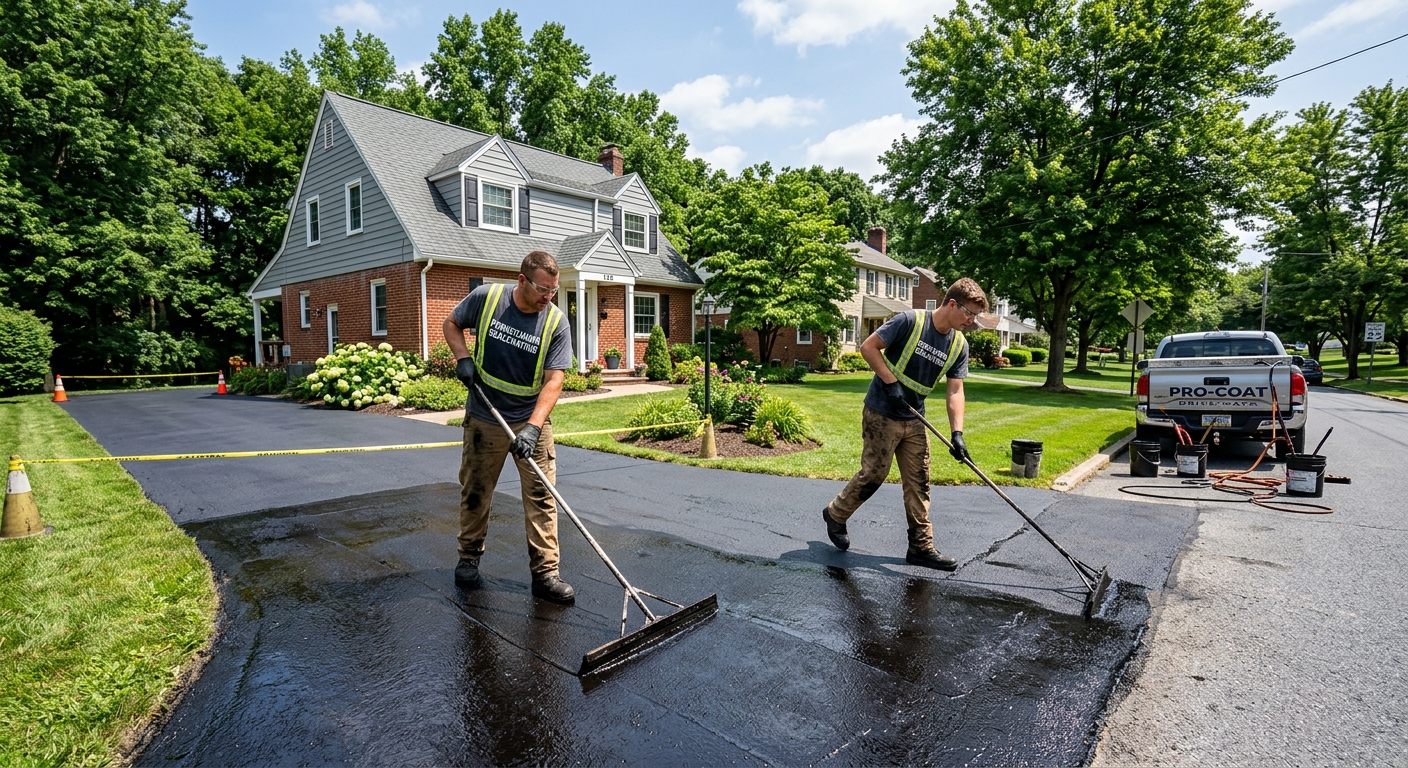
What a new driveway costs in South Middleton
For South Middleton homeowners—where 79.7% of households own and nearly 68% of homes are single-family detached—a driveway isn’t just a nice-to-have: it’s a regular, measurable expense. Most homes here were built after 1960, meaning many driveways are now well into the years when base failure, edge drop, or deep cracks rear up. The region’s pronounced freeze-thaw cycles and underlying limestone karst soils mean base preparation and water management drive cost differences more than the actual asphalt or concrete. Two bids might differ by several thousand dollars, and, almost always, the difference is hidden underground in the thickness, quality, and compaction of the base—not in the visible top layer.
The prices below come from typical South Middleton driveway projects, from simple sealcoating to a full tear-out and rebuild. When reviewing bids, remember: the “full replacement” includes new excavated stone base, not just fresh asphalt over old issues. If you own a wide, post-1960s driveway, as many do in Hampden or Silver Spring Townships, expect quotes toward the higher end, especially if widening or adding base repairs.
| Service |
Best for |
Lifespan |
Price range |
| Asphalt — full replacement with new base |
failed base, structural cracking |
20–30 yrs |
$3,600–$9,400 |
| Asphalt overlay / resurfacing |
sound base, surface cracking only |
8–15 yrs |
$1,550–$4,700 |
| Sealcoating — single application |
preventive maintenance on sound asphalt |
2–4 yrs |
$200–$750 |
| Concrete — new installation |
long service life, low maintenance |
30–50 yrs |
$5,200–$12,500 |
| Crack filling and patching |
isolated cracks under a quarter inch |
1–3 yrs |
$200–$800 |
| Gravel driveway |
rural, budget, long runs |
5–10 yrs with upkeep |
$900–$3,500 |
Estimates for a typical South Middleton driveway. Square footage and base condition drive these figures more than material choice.
What a real paving quote contains
A real paving quote for South Middleton is detailed: every major component is broken out so you can compare apples to apples. First is the measured square footage—never trust a quote that just "eyeballs" the number. It should state the excavation depth, note how much existing material will be hauled off, and specify the exact type and depth (in inches) of the new stone base. Compaction must be described, including whether it’s completed in lifts. The asphalt itself should list the number of courses (layers), their mix types, and the true compacted depths—since loose depth is meaningless when cold weather hits. Look for a plan for the edges, how drainage and slope will be managed, and a cleanup plan that includes restoring the lawn or landscaping right up to the edge.
The payment schedule should be reasonable: a modest deposit (not more than the cost of initial materials), the rest on completion. The warranty must spell out what it does not cover—most exclude cracking, which surprises many people. If you get a one-line total with no details, you have no way to compare it, and that is the single most common way folks in Cumberland County pay for a thicker-looking driveway and get less than they thought.
| Line item |
What to look for |
Red flag if… |
| Area |
measured square footage stated |
eyeballed or absent |
| Excavation |
depth and disposal included |
'we'll pave over it' |
| Base |
aggregate type and depth in inches |
'proper base' |
| Compaction |
method, and done in lifts |
not mentioned |
| Asphalt |
courses and compacted depth |
'3 inches' unqualified |
| Drainage |
slope and water direction stated |
silent |
| Warranty |
what is covered and what is excluded |
verbal only |
| Payment |
modest deposit, balance on completion |
full cash up front |
Numbers, not adjectives
It is easy to get pulled into shopping only by price, but in South Middleton, what keeps a driveway stable is not the material brand or the contractor’s handshake—it’s the numbers spelled out in the contract. Your quote should state, in inches and by material type, the full assembly: how deep the excavation will go, the depth and type of the compacted stone base, and the compacted (not loose!) thicknesses of each asphalt layer. Compaction done “in lifts” is essential, especially where limestone subgrade and freeze-thaw cycles demand a properly built foundation to prevent cracking and heaves. “We’ll put down three inches” means nothing unless you ask, “Three inches after compaction, or before?”—because you lose a big portion of thickness when the roller makes its passes.
Our region’s freeze-thaw cycles and the potential for sinkholes in karst soils mean you need more robust specs than you’d need south of the Mason-Dixon. Demand numbers before you write a check. Here’s what to require in writing from every bidder:
- Measured square footage
- Excavation depth into subgrade (in inches or feet)
- Aggregate base type (such as 2A limestone) and depth after compaction
- Base compaction method and number of lifts
- Binder course (asphalt base layer) mix type and compacted thickness
- Surface course (wear layer) mix type and compacted thickness
- Seam detail at old/new interface if expanding
- Edge treatment—straight, sloped, or supported with stone
- Drainage plan: slope direction and discharge point
- Cleanup and lawn restoration, in writing
Beyond replacement: layout changes
Many South Middleton homeowners—especially those in Hampden and Silver Spring Townships—find themselves needing more parking, a turnaround, or a path to a new detached garage. These projects go beyond a simple resurfacing or replacement. As soon as you change the footprint, you’re building over undisturbed ground, so a new compacted stone base must be built from the subgrade up, not just patched into the old. Where the new section meets the original, that seam becomes a permanent weak spot for cracking or settlement, especially in our region’s freeze-thaw cycle.
Changing the layout can also involve local rules: impervious-surface limits may restrict how wide or long your paved area can be, and most municipalities set minimum setbacks from property lines. In Carlisle Borough, expanding the paved area almost always triggers a permit from the Codes Office; in surrounding townships the rules depend on the office, but new construction almost always requires notification or permitting. If you’re adding a driveway entrance onto a state route, PennDOT District 8-0 controls the approach permit; township approaches use local offices. Stormwater must stay on your property—a paved driveway that sheds water onto your neighbor’s yard creates liability, permit or not. Getting these rules wrong costs more to fix than it does to check up front.
Driveway permits, approaches and stormwater rules
For most homeowners in South Middleton and throughout Cumberland County, repaving an existing asphalt driveway—without changing the footprint—rarely requires a building permit, especially in township jurisdictions like Silver Spring. That means you can often move forward with a simple overlay or resurface without dealing with the codes office. If you’re in Carlisle Borough, or planning to expand or construct a new paved surface, this does typically trigger a permit from the Borough Codes Office.
What surprises most: your driveway’s approach—where it meets a public road—needs its own permit, and not always from the same people. For approaches onto state roads, you must get a Highway Occupancy Permit from PennDOT District 8-0. Approaches to township roads go through your local township office. Skip this step and you risk enforcement (and possibly repair bills) later.
Adding surface (making more area impervious) may also bring stormwater or runoff requirements. Plus, Pennsylvania law makes you liable if your new driveway sends runoff directly to a neighbor—permits don’t shield you from that.
Finally, before signing anything, verify your paving contractor holds a valid Home Improvement Contractor (HIC) registration from the Pennsylvania Office of Attorney General (check at hic.attorneygeneral.gov), and confirm their workers’ compensation coverage with WCAIS (wcais.pa.gov). Don’t skip this step; it’s your legal protection if someone is injured on your job.
How often should a South Middleton driveway be sealed?
Sealcoating is a regular line on every South Middleton paver’s price list, but most information about it is written by companies who want to sell you an annual service. Here’s what actually matters in this region: sealcoating protects the asphalt’s binder from sun and chemical exposure, hides stains, and improves curb appeal. It does not add structural strength, does not fix cracks, and won’t save a driveway with a failed base. If you have significant cracking or sinking, spend your money on patch or repair, not on cosmetic coating.
The part few say out loud: sealing too often causes more problems than it solves. Excess layers build up, they can trap moisture and volatiles (especially if applied before the new asphalt has fully cured), and those layers will eventually crack, peel, and make even regular maintenance harder. A good interval in South Middleton is every 2–4 years; sealcoating more often is only good for the contractor’s wallet. Always let new asphalt cure for one full season before sealing, or you’ll lock in soft spots and shorten its life.
Crack filling, particularly before winter, matters more than an extra coat of sealer. Proper crack fill—using hot-poured material, not cold-pour from a jug—actually keeps water out of the base. A proper sealcoat application involves cleaning and hand squeegeeing the material, not just a quick spray-on. Expect to pay $200–$750 for a single application; if it’s suspiciously cheaper, you’re probably getting water-diluted material that won’t last past one winter. Spend on real prep, not just shine.
What's under the asphalt matters more than the asphalt
In South Middleton and throughout Cumberland County, the most important part of your driveway is the part you never see: the stone base and the compacted subgrade beneath the asphalt. Every layer performs a function: the subgrade provides a stable foundation, the compacted aggregate base distributes the weight of vehicles, and the asphalt protects everything below from water and weather. If the supporting layers are thin, loosely compacted, or skipped altogether—common where cost-cutting is hidden—no amount of premium asphalt will save you from heaving, cracks, or potholes within a few years.
Our local soils, especially around Carlisle and Mechanicsburg, are limestone karst, which can shift, settle, or even form sinkholes with time and water infiltration. Add in pronounced freeze-thaw cycles—which we get several times every winter—and you have a recipe for heaving: water in the subgrade freezes, expands, and lifts the slab unevenly. As soon as it thaws out, the slab settles, but never quite back in the same way, leading to surface cracks that reflect flaws in the layers below. That’s why you need a thicker, well-compacted base here than in milder parts of the country.
Cheap quotes are always cheap for the same reasons: minimal excavation, laying new asphalt over a broken or inadequate base, skipping or lightly compacting the stone, not working “in lifts,” or re-using old stone without adding enough new. None of this is visible on the job’s last day, but it always shows up by year three. Insist on the following figures in writing: excavated depth (often 8–12 inches in these soils), aggregate type (local 2A limestone is standard), base compacted in layers (“lifts”), and a binder plus a separate surface asphalt course, both with compacted thicknesses. Don’t get talked out of these details—they’re what you’re actually paying for.
Frequently asked questions — driveway paving in South Middleton
What causes driveway cracks in South Middleton?
Our climate plays a leading role. In South Middleton, with its pronounced freeze-thaw cycles and limestone-based soils, cracks usually stem from movement in the base and subgrade below. When water infiltrates the stone base or underlying soil, it expands dramatically when frozen—that process is called frost heave. Repeated cycles of freezing and thawing put stress on the asphalt, creating both surface (alligator) cracks and deeper structural fissures. In older driveways, base compaction was often subpar, especially for the wider post-1960 installations common here, so minor flaws multiply over 10–20 winters. Other causes include poor edge support, heavy vehicles parked in one spot, and missed maintenance (like letting minor cracks go unfilled over winter). Quick patching or a fresh overlay can buy time—costing between $1,550–$4,700—but without fixing drainage or the base, cracks return.
How do I verify a paving contractor in Pennsylvania?
In Pennsylvania, you have two essential tools for protecting yourself as a South Middleton homeowner. Start by verifying Home Improvement Contractor (HIC) registration with the Pennsylvania Office of Attorney General at hic.attorneygeneral.gov. This registry is required for any project over $500, and it’s your base line against scams or uninsured operators. Second, confirm the contractor’s workers’ compensation coverage using the state’s WCAIS portal (wcais.pa.gov)—all employers must have this, and you don’t want to be the test case if an injury occurs on your job. Be wary of anyone unwilling to supply both numbers. For anything involving excavation, drainage, or base installation (work that often runs $3,600–$9,400), these checks matter as much as any written warranty. Municipal business licenses aren’t required for driveways in Cumberland County, so don’t be misled if that gets mentioned.
How much does a concrete driveway cost in South Middleton?
In South Middleton, a concrete driveway will cost more than asphalt up front, but trade off with low maintenance for decades. For a standard residential driveway, expect to pay between $5,200–$12,500 in 2026, with most installations landing near $8,300. These costs cover a new installation with formwork, rebar or wire mesh reinforcement, and a proper compacted base beneath. Concrete lasts longer (30–50 years if poured and jointed properly), resists the kind of rutting common in asphalt, and handles repeated plowing and salting better. That said, salt can still eat away at concrete, so consider sealing exposed surfaces. If you get a much lower bid, check the base and jointing specs—skimping there causes slab cracking, especially in our region’s prone-to-settling subgrade.
How far ahead should I book a paver in South Middleton?
Demand in South Middleton varies, but mid-to-late spring and early fall are always packed as homeowners try to finish driveways before holidays or winter. For any significant project—especially full replacements or expansions (costing $3,600–$9,400)—you should start requesting quotes 4–8 weeks in advance. Good local contractors get booked early, particularly after wet springs that expose driveway issues everywhere, and late summer storms sometimes add to the backlog. If you’re aiming for a specific completion window, such as before school starts or the first freeze, don’t wait. Minor sealcoating or patch work (under $800) can usually be squeezed in on short notice, but comprehensive jobs require more planning. Booking early also gives you time to verify references and permits.
What does compaction in lifts mean?
Compaction “in lifts” means installing the stone and asphalt base in multiple, thinner layers (often 3–4 inches at a time), then compacting each layer before the next is placed. In South Middleton, with our limestone subgrade and regular freeze-thaw conditions, this matters: it’s the difference between a base that’s strong and one that settles or shifts. A single thick layer can’t be compacted evenly, so voids and soft spots form—those turn into dips and cracks within a few winters. For a standard asphalt driveway (costing $3,600–$9,400 for a full rebuild), you want to see both the stone base and each asphalt course specified by compacted thickness. If a contractor promises deep coverage but says “all at once,” you should expect problems over time. Always demand that each lift is rolled and checked before the next goes down.
What is the difference between crack filling and sealcoating?
Crack filling and sealcoating are related but very different. Crack filling targets only the joints or cracks, typically with a hot-poured flexible material that binds to the asphalt and blocks water from seeping to the base. This is preventive maintenance, especially vital before a South Middleton winter, and typically runs $200–$800 depending on the length and size of cracks. Sealcoating, by contrast, is a thin surface treatment (usually black) meant to slow oxidation, shield from fluids, and boost curb appeal. It does not fill or seal cracks wider than about a hair’s breadth—if those go untreated, water will get through and freeze, accelerating failure under the region’s frequent thaw cycles. For best results, crack fill before sealcoating, not instead of. Don’t let a surface sealer be sold as a structural fix; it never is.
How much does driveway paving cost in South Middleton?
Paving costs depend mostly on the surface area and the base condition, not the top layer material. In South Middleton, expect a full replacement with a new compacted base to cost between $3,600–$9,400 in 2026. If your existing base is sound, resurfacing (overlay) runs $1,550–$4,700. Sealcoating costs much less at $200–$750 per application. Concrete is higher, ranging from $5,200–$12,500 for a new install. Remember, quotes that only state the surface details without excavation or compaction specs should be questioned—the quality of what’s underneath is what delivers a driveway that lasts in Cumberland County’s soil and climate. Always compare quotes by base thickness and prep, not just tonnage or brand.
How many freeze-thaw cycles does South Middleton get?
South Middleton sits squarely in Pennsylvania’s south-central climate band, experiencing pronounced freeze-thaw cycling through late fall, winter, and early spring. Though exact cycles vary with the winter, it’s common to see ground freeze and thaw 20, 30, or more times each season. This has a bigger impact on driveways here than in much of the country: every cycle of freezing expands water in the subgrade, lifting and then dropping the slab as it thaws. Over time, this process causes heaving, edge drop, and reflective surface cracking. The high homeownership rate in South Middleton means homeowners carry the maintenance and repair costs directly—so ensuring a robust base (for which $3,600–$9,400 is typical) is the only defense. Annual maintenance, especially crack fill, goes a long way to reduce the long-term damage from these cycles.
Asphalt or concrete for a South Middleton driveway?
Both asphalt and concrete have their place in South Middleton, but the right choice depends on your priorities. Asphalt, at $3,600–$9,400 for full replacement, is more forgiving of settling and easier to repair if you develop cracks from our region’s shifting limestone subgrade. It warms up and clears snow faster, which helps in our moderate-snowfall winters, but it also needs periodic sealing and crack repair. Concrete, while pricier at $5,200–$12,500, lasts longer (30–50 years with proper care) and can handle heavier vehicles without rutting. However, it’s less tolerant of shifting soils and will show its cracks sooner if the base isn’t perfect, and winter salt shortens its life if not sealed. For most owners of wide, post-1960s driveways, asphalt is the more cost-effective option—unless very low maintenance or decorative finishes are your main priorities.