Adams paving prices by scope — 2026
Adams Township, with its high homeownership rate (88.9%) and a landscape dominated by single-family homes (64.8%), sees driveway paving as a practical investment and a necessity for most properties. In this part of Butler County, what drives the difference between two paving quotes isn’t just the surface material, but the unseen work underneath—the base prep and drainage corrections—which can make or break lifespan.
Our region’s heavy freeze-thaw cycle and subgrade of glacial till and shale mean shortcuts below the asphalt or concrete, not skimping on thickness, are often why one driveway outlasts the other by a decade. Many homes built during the 1990s–2000s boom in Adams Township are reaching the age where full replacement is needed—patches and overlays help only if the base is stable. Don’t let a low price sway you if the prep details aren’t spelled out, because shoddy base work leads to rutting and potholes well before the surface itself has worn thin.
| Service |
Best for |
Lifespan |
Price range |
| Asphalt — full replacement with new base |
failed base, structural cracking |
20–30 yrs |
$4,000–$10,000 |
| Asphalt overlay / resurfacing |
sound base, surface cracking only |
8–15 yrs |
$1,700–$5,100 |
| Sealcoating — single application |
preventive maintenance on sound asphalt |
2–4 yrs |
$225–$800 |
| Concrete — new installation |
long service life, low maintenance |
30–50 yrs |
$5,600–$13,500 |
| Crack filling and patching |
isolated cracks under a quarter inch |
1–3 yrs |
$200–$800 |
| Gravel driveway |
rural, budget, long runs |
5–10 yrs with upkeep |
$900–$3,500 |
Estimates for a typical Adams driveway. Square footage and base condition drive these figures more than material choice.
What you need before paving in Adams
For most repaving or asphalt overlay jobs in Adams Township, a building permit is not required if you are staying within the current footprint of your driveway. This matches Butler Township’s common practice, where resurfacing without altering the driveway’s width or layout is typically permit-free. But don’t overlook the driveway approach—where your drive meets the roadway. If you’re installing a new driveway, widening, or changing the approach—especially onto a state road—permits usually come from PennDOT District 10. For work connecting to local roads, Adams Township’s own permitting office handles the review.
Whenever you expand a driveway, stormwater rules may apply. More impervious surface means more runoff, and excessive water directed toward a neighbor’s property is a liability even if you have a permit in hand. If your paving job increases runoff, you could be required to manage water on-site or submit a drainage plan—good practice, even if not formally required, and often cheaper to address before work starts.
Pennsylvania law requires any paving contract over $500 to be in writing, and your contractor must hold Home Improvement Contractor registration from the Pennsylvania Office of Attorney General—double-check at hic.attorneygeneral.gov. If the crew has employees, workers’ compensation coverage is mandatory (verify at WCAIS: wcais.pa.gov). Never accept vague answers on these basics.
Which surface survives Adams winters
Adams winters are defined by repeated freeze-thaw cycles and winter temperatures that drop as low as 8 °F. Here, the clay and shale subgrade means frost heave and water movement under driveways are real problems every year. Asphalt handles this abuse better than anything else: its flexibility lets it flex and settle without breaking apart when the ground shifts. That’s why most driveways in Adams’ single-family subdivisions were put in as asphalt, and why overlays can usually buy you more time if the base is still sound.
Concrete is tougher in theory and, when installed right and kept away from de-icing salt, can last up to 50 years. But salt use is routine in western Pennsylvania, and that’s concrete’s enemy—spalling, pitting, and scaling ruin the surface ten or fifteen years in on an unlucky winter. Unless you are disciplined about using alternatives to salt, in Adams the extra life is rare in practice and the up-front cost is much higher.
Pavers can work and are repairable, but the soils here settle and shift; for tight budgets or rural locations, gravel drains well, but demands annual upkeep.
| Option |
Installed cost |
Maintenance |
Freeze-thaw performance |
Lifespan |
| Asphalt — new install |
$4,000–$10,000 |
sealcoat every 3–4 yrs |
excellent, flexes |
20–30 yrs |
| Asphalt — overlay |
$1,700–$5,100 |
same |
good if base is sound |
+8–15 yrs |
| Concrete |
$5,600–$13,500 |
low, avoid de-icing salt |
fair, spalls with salt |
30–50 yrs |
| Pavers |
$9,000–$13,500 |
individual units replaceable |
good, settles gradually |
25–50 yrs |
| Gravel |
$900–$3,500 |
top-dress every 2–3 yrs |
excellent drainage |
indefinite with upkeep |
The honest case for and against sealcoating
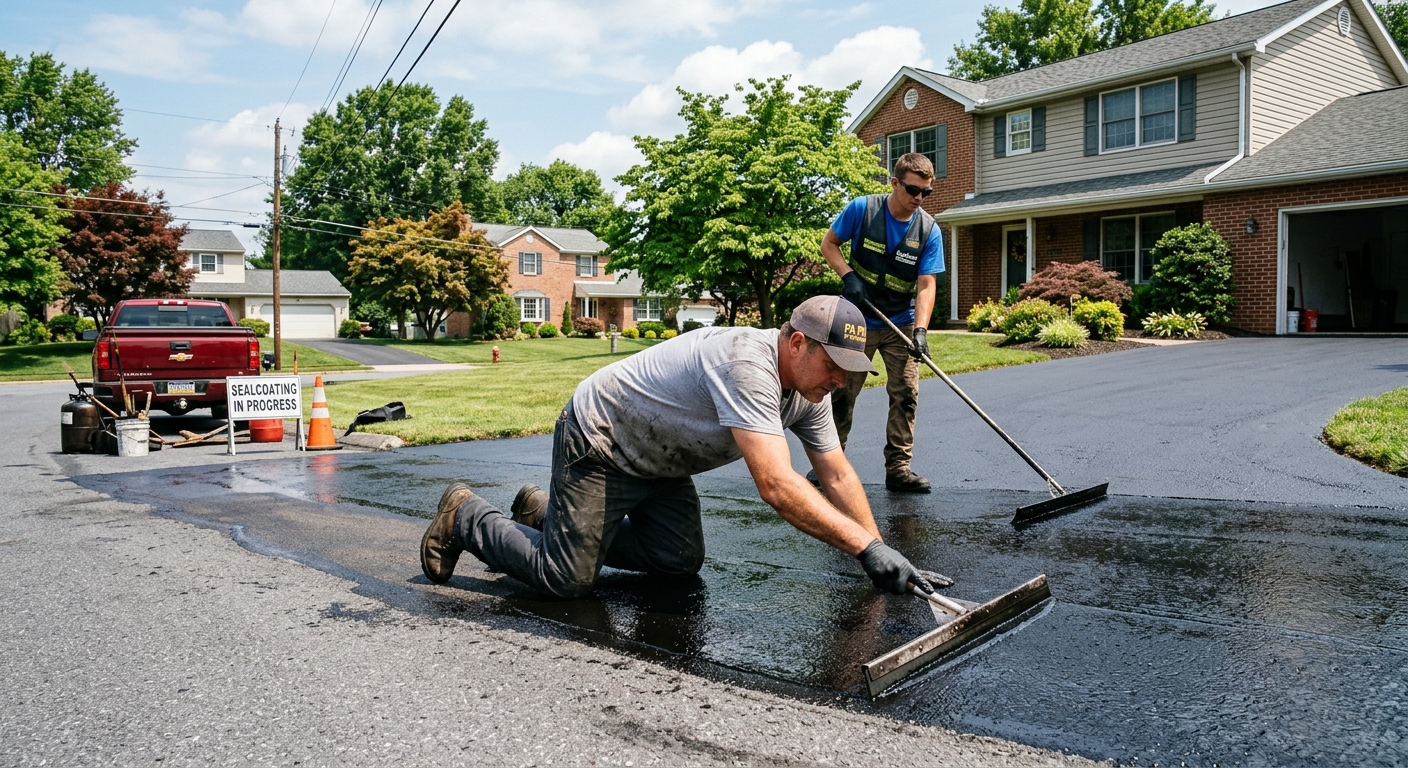
Sealcoating is a visible, affordable option in Adams, but not a miracle fix. It’s best used as routine maintenance on healthy asphalt, not as a solution for serious problems. Sealcoating shields the surface from oxidation and the slow breakdown caused by gas, oil, or lawn chemicals, and—just as important for curb appeal—restores a newer, darker appearance. But it does not add any real structural strength or mend cracks, and it won’t keep a driveway intact if the base is washing out or heaving every winter.
It’s common for residents here to overdo it. Sealing more often than every three or four years can backfire by building up brittle layers that crack and peel. New asphalt actually needs time to cure (typically 3–12 months) before its first seal, or the trapped oils will bubble and shorten its life. The job should be careful—cracks cleaned and filled beforehand, edges brushed, and never just a thin spray for show.
Don’t be lured by a suspiciously cheap price. Below $225, you are likely getting a splash-and-dash coat that wears off by the next spring. Spending in the $225–$800 range for a typical driveway gets a proper application, but don’t expect it to heal big cracks or buy major time on an aging surface. If your base has failed, save your money and address the cause, not the cosmetics. Crack filling, when done well, actually extends the lifespan far more than sealcoating alone.
Getting thirty years out of a driveway
In Adams, the longest-lasting driveways aren’t those that get sealed most often, but those where small issues are handled promptly and stormwater is managed. The single action with the biggest payoff is crack filling: water reaching the aggregate base through even a hairline will, in our heavy freeze-thaw cycles, expand and heave the whole structure. Edge support is a close second—don’t let vehicles break down the sides into your yard. Good grading and free-draining gutters move water away, keeping the base dry all year.
Avoid point loads, like using jack stands or dumpsters, that punch through the surface. For new asphalt, it’s crucial to let it cure—don’t park on it or turn wheels sharp while stationary for at least a week in Adams’ climate. When winter hits, use sand, calcium chloride, or magnesium chloride for ice—never sodium chloride on concrete, as it speeds up spalling. On asphalt, de-icers are less of a chemical issue, but rapid freeze-thaw cycling from repeated melting and refreezing remains a concern for both materials. Fixing drainage poorly will cost more in the long run than any fancy maintenance product.
Local soil, drainage and driveway lifespan
Adams Township sits on a mix of glacial till and shale-derived subgrade, and that dictates your driveway’s lifespan as much as any material choice. Clay and glacial till hold water, leading to more frost heave every winter. Shale can compact, but it also directs water sideways, sometimes undermining the edge of a driveway if the base wasn’t built up thick enough. Unlike the sandier soils found only a bit further west, these conditions demand more excavation and deeper aggregate—skimping here is a false economy.
The standard 36-inch frost depth in southwestern Pennsylvania drives this: thin, two-inch “overlays” over the old driveway are only a temporary fix if you’re sitting on soft, frost-prone ground. Many Adams driveways from the 1990s and early 2000s boom were put in fast and light; if you’re seeing early rutting, potholes, or odd settlement, your original base was probably minimal and it’s now time for a full-depth rebuild. Proper drainage—both at the surface and below—is non-negotiable in Adams if you want more than ten good years from your driveway.
Numbers, not adjectives
Most Adams homeowners compare quotes by price first, but in this trade, specifications are your best shield against disappointment. Don’t accept “we’ll put down three inches” without numbers—what matters is how deep after compaction, not just how thick it looks when new. Ground here is prone to frost heave and rutting, so our aggregate and asphalt depths need to be more robust than you’ll see in milder climates. And with clay and glacial till underfoot, compaction—done in lifts—is the step that separates thirty-year driveways from ones that fail in ten.
A proper quote lays out each layer: excavation, the base stone (which should be sized and measured), how each lift is compacted (not just rolled once), and whether the asphalt itself meets Pennsylvania DOT mixes. Edge treatment matters because unsupported asphalt will break down within a few freeze-thaw cycles. If you don’t see these numbers on paper, you’re likely paying for work that will vanish beneath the first Adams winter.
- Excavation depth (inches below finished grade)
- Aggregate base depth (after compaction)
- Aggregate type and gradation
- Number of compaction lifts for base
- Asphalt binder course thickness (compacted)
- Asphalt surface course thickness (compacted)
- Asphalt mix type/designation
- Edge support or confinement method
- Drainage provisions or cross-slope (inches per foot)
- Warranty terms and coverage period
Frequently asked questions — driveway paving in Adams
What does sealcoating cost in Adams?
Sealcoating a driveway in Adams typically costs between $225–$800 per application, depending mostly on size and the prep work needed beforehand. While smaller jobs can hit the lower end, a proper job is never just a quick spray; edges are brushed and cracks are addressed first. If you see offers significantly below $225, be skeptical—it’s likely a thin application that won’t last even a year through Adams’ tough winter cycle. Investing in a thorough sealcoating every three or four years (not annually) is usually enough to prolong the look and slightly slow the fading of your asphalt, but don’t expect miracles. Spend your money on timely crack filling first if your maintenance budget is limited here in Butler County.
Does sealcoating fix cracks?
No, sealcoating does not properly fix cracks in Adams or anywhere in Pennsylvania—the emulsion is too thin and flexible to fill and stabilize cracks, especially with our freeze-thaw cycles. All sealcoating does is provide a surface-level coating; cracks, especially those wider than a hairline, will telegraph right through. What keeps water out and extends the life of your drive here is crack filling: a hot or cold pour filler should be used on anything over a sixteenth of an inch wide. For comparison, crack filling in Adams often costs between $200–$800 depending on size and prep. Professional crack repair, not a cosmetic seal, is what prevents water from reaching the base and saves you from much bigger repairs down the line.
What slope does a driveway need for drainage?
In Adams, driveways are typically installed with a minimum cross slope of 1/4 inch per foot (about 2%), which meets best drainage practices in western Pennsylvania’s clay and glacial till soils. This is enough to keep water moving toward swales or the street, avoiding puddling and base saturation that can cause heaving in freeze-thaw conditions. When you’re talking with local paving crews, ask them to state the intended slope explicitly—anything less, and standing water could reduce the lifespan even of a high-quality job. For long driveways or those close to neighboring properties, drainage may need to be managed onsite as part of your contract, with costs ranging from simple grading to engineered solutions in the $900–$3,500 range for rural gravel drives.
Are there stormwater rules on paving in Adams?
Yes, Adams Township and other Butler County municipalities increasingly tie paving permits and approvals to stormwater management. Whenever you extend or widen your driveway, you’re creating more impervious surface, which means more runoff. Even if a permit isn’t required for simple repaving, you’re still responsible if new flows hit your neighbor’s property—liability is real, and local codes can require on-site solutions or a formal drainage plan. Permits for the driveway approach (especially on state roads) will often check these requirements. While the paperwork isn’t overly burdensome for a typical sized home drive, costs can range from upgrades during the main paving ($100) to professionally managed stormwater corrections in the $900–$3,500 ballpark for large, exposed runs.
What are the signs of a failing driveway base?
In Adams, the first signs of base failure are rutting (especially twin tire tracks), potholes that reappear after patching, and large alligator-style cracking patterns. On asphalt installed in the 1990s and early 2000s subdivision boom, this is often the result of minimal base—when water reaches the subgrade and freezes, you’ll see bulges or settling. No amount of sealcoating will address these issues. If repairs keep failing or new cracks return each spring, the solution is usually a full base rebuild, which for a standard driveway here is $4,000–$10,000. Small surface cracks or sun-faded asphalt, in contrast, can be managed with overlays or maintenance—not full replacement.
How long does a driveway installation take?
For a typical single-family driveway in Adams, a full asphalt replacement with new base usually takes two to three days from excavation to finished surface, weather permitting. This includes a day for digging out the old surface and base, a day for new stone and compaction, and another for paving and final rolling. Concrete driveways may need a day or two more to allow for cure time before it’s ready for traffic. If you’re considering an overlay, these can sometimes be done in a single day, but only if the base is in good shape. Larger or complex projects are longer, especially if drainage corrections are involved, with overall costs running from $4,000–$10,000 for asphalt to $5,600–$13,500 for concrete, including all prep work.
Does Adams have local asphalt plants?
Yes—a real advantage in Adams and the rest of Butler County is proximity to local quarries and asphalt plants along the Route 8 and Route 422 corridors. This keeps trucking distances short, helps ensure hot material is fresh on arrival, and holds prices down compared to locations farther from supply. Paving companies based in the Pittsburgh northern growth area rely on these plants for quick turnaround, meaning driveway work in Adams can often be scheduled with less weather risk, especially for jobs in the typical $4,000–$10,000 full replacement price range.
Can I pave over my existing driveway?
In Adams, paving an asphalt overlay over the existing driveway surface is possible if—and only if—the base underneath is solid and there’s no deep rutting, heaving, or widespread alligator cracking. An overlay saves cost since there’s less excavation (typically $1,700–$5,100), but it won’t fix sub-base problems; any existing issues will come back through in a few years, especially with our winter freeze-thaw. A contractor who suggests an overlay without checking the condition of the base is cutting corners. Full replacement, while more expensive, is often a better long-term fix in the 1990s–2000s subdivisions now reaching replacement age.
How much does driveway paving cost in Adams?
For a typical Adams home, a new asphalt driveway with a rebuilt base usually falls in the $4,000–$10,000 range, with most falling around $6,200 for a standard suburban size. Overlays, which use the existing base but lay down a fresh top, run between $1,700–$5,100. Concrete, though longer-lasting, comes in higher at $5,600–$13,500. Upgrades like drainage corrections or thicker stone bases may nudge you to the top of the band, but shortcuts at the base usually cost more in repairs down the line. Always insist on a written quote outlining each layer and method, not just a lump sum.