What a new driveway costs in East Cocalico
In East Cocalico, where over 77% of homes are single-family and the homeownership rate stands at more than 84% (U.S. Census Bureau, ACS 2024), driveways aren't a sideline—they're a standard homeowner responsibility. Most properties here have driveways built before 1980, meaning many are now candidates for major repairs or replacement. Our region’s pronounced freeze-thaw cycles test any paving job, especially when local soil lets water work its way below the surface. That’s where lasting performance (and most of the price difference between two bids) is decided—out of sight, in the layers you can’t see once the blacktop’s down.
The cheap bid often means corners cut on subgrade and base, or skipping essential drainage corrections that keep water from destroying your new surface three winters later. Pricing at the top end often reflects thicker stone bases, more asphalt, and carefully rebuilt transitions—things that show up years down the road in fewer cracks and less patching. Below are what you can expect for common driveway services around East Cocalico:
| Service |
Best for |
Lifespan |
Price range |
| Asphalt — full replacement with new base |
failed base, structural cracking |
20–30 yrs |
$3,700–$9,400 |
| Asphalt overlay / resurfacing |
sound base, surface cracking only |
8–15 yrs |
$1,550–$4,700 |
| Sealcoating — single application |
preventive maintenance on sound asphalt |
2–4 yrs |
$200–$750 |
| Concrete — new installation |
long service life, low maintenance |
30–50 yrs |
$5,200–$12,500 |
| Crack filling and patching |
isolated cracks under a quarter inch |
1–3 yrs |
$200–$800 |
| Gravel driveway |
rural, budget, long runs |
5–10 yrs with upkeep |
$900–$3,500 |
Estimates for a typical East Cocalico driveway. Square footage and base condition drive these figures more than material choice.
How to vet a paving contractor in East Cocalico
In East Cocalico, most paving complaints start with a low bid that comes with missing details: a non-local address, borrowed equipment, or no track record. The first step is to verify the contractor’s Home Improvement Contractor (HIC) registration at the Pennsylvania Attorney General’s site (hic.attorneygeneral.gov), which is required for any job over $500. For larger outfits with crews, confirm active workers’ compensation coverage through the WCAIS system (wcais.pa.gov). Because local asphalt and aggregate are sourced from nearby quarries and plants in Lancaster County, a legitimate contractor can immediately tell you which supplier they use. If they can't, you’re probably not dealing with someone who does the work themselves. Most important, check for references from jobs at least three years old. That's how you find out if their work holds up.
- Check HIC registration status at the state site
- Confirm business address in or near Lancaster County, not a PO box or just a cell
- Ask which local asphalt plant or quarry supplies their jobs
- Look for owned equipment — not rented for the day
- References from driveways done 3+ years ago, ideally in East Cocalico or Lancaster County
- Proof of workers’ compensation for any crew, even small ones
- Written, detailed quote with thickness and material spelled out
- Name on trucks, not just magnetic signs
- Photographs of both recent and older completed work
- Insurance certificate, issued directly to you
- Ability to clearly explain drainage plan and base preparation
Red flags: pushy sales tactics, one-day “specials,” a non-local phone prefix, or a contractor who can’t or won’t show registration and insurance. If they won’t put specs in writing, look elsewhere.
How to tell if the base is gone
The condition of your driveway base is what determines whether any investment in the surface will last. No matter what you hear from a contractor, you can spot most base problems yourself first. Alligator cracking that spreads like a reptile’s back is the signature of a failed base—these cracks always come back if you only resurface. Isolated, narrow cracks that run mostly straight or spider here and there suggest surface aging, which can be maintained for a while with repairs and sealcoating. Birdbaths and depressions that hold water point to movement in the soil or compacted stone underneath, not just superficial problems. Edges that crack and crumble show the driveway wasn’t built with proper lateral support. Potholes mean water has reached the base and started the failure process from below.
If a contractor recommends an overlay without physically probing or coring the base, move on—you’re spending good money over a broken foundation. You’ll see those cracks reflected right back within a year or two.
| What you see |
Likely cause |
Right fix |
Cost |
| Isolated cracks under 1/4 inch |
surface aging |
crack fill and seal |
$200–$750 |
| Alligator cracking over a wide area |
base failure |
full replacement |
$3,700–$9,400 |
| Depressions holding water |
subgrade movement |
excavate and rebuild that area |
$3,700–$5,700 |
| Crumbling edges |
no edge support |
edge repair, consider curbing |
$400–$1,500 |
| Potholes |
water into the base |
full-depth patch, then assess |
$250–$900 |
| Faded but sound surface |
oxidation only |
sealcoat |
$200–$750 |
Permits and approvals for paving in East Cocalico
In most Lancaster County townships, including East Cocalico, you do not need a building permit to repave or resurface an existing private driveway that doesn’t alter the driveway’s public connection or add impervious area. That point saves homeowners a lot of paperwork and delay—though if your driveway ties into a state-maintained road, or you’re changing the apron where your drive meets the street, a separate permit from the appropriate authority will be required. In Lancaster city, for example, new driveway approaches and curb cuts are handled by the City of Lancaster Bureau of Engineering, while PennDOT steps in for state routes.
Note that expanding your driveway substantially, which increases impervious surface, could trigger stormwater management requirements. Regardless of permits, channeling runoff onto a neighbor’s property will create a liability issue fast. Protect yourself by discussing drainage up front. For all projects over $500, the contractor must provide a written contract under the Home Improvement Consumer Protection Act, and you can verify their HIC registration at hic.attorneygeneral.gov. For any crew, even part-timers, workers’ compensation coverage is mandatory by Pennsylvania law, and can be looked up at wcais.pa.gov.
Numbers, not adjectives
The best way to protect your investment on a new driveway in East Cocalico is to shop by numbers, not descriptions. The most important specs aren’t what you see on top—they’re the depths and materials under the surface. Any decent quote here should spell out: how deep the excavation goes (so you know the whole frost line is taken into account), how much and what type of aggregate base is used, how it’s compacted (and whether it’s done in lifts), plus precise asphalt layer depths after compaction—not just “three inches,” which could mean anything. If you don’t have these specifications, you’re at risk of paying for shortcuts hidden below ground.
Our regional ground freezes to 30 inches, and freeze-thaw cycles drive water into any flaw. That’s why paving here requires deeper, well-compacted stone bases and thicker asphalt layers than milder climates. A quote that skips on base or compaction is a paper guarantee only. Demand these figures in writing before you sign:
- Excavation depth (inches below finished grade)
- Aggregate base depth and material (e.g., 6–8" of PennDOT 2A stone)
- Compaction method (plate compactor, vibratory roller) and passes
- Number of lifts for base and asphalt layers
- Binder course depth, as compacted
- Surface (wear) course depth, as compacted
- Asphalt mix designation (e.g., ID-2 or Superpave)
- Edge treatment (tapered, butt-jointed, or with a curb)
- Surface grade and runoff angle
- Joint and apron detail for street connection
If a contractor says “three inches” without specifying before or after compaction, ask for clarification. Three laid, compacted correctly, is firm—three loose is gone by next decade’s thaw.
The paving season in south-central Pennsylvania
Paving in East Cocalico isn’t just about picking a warm day—here, the season is dictated by hard climate limits. Asphalt must be placed and compacted while it’s hot—if it cools below the working temperature (which can happen fast with our 12 °F winter design lows), it won’t bond or compact, leaving you with a driveway that’s weak and full of voids. Local asphalt plants around Lancaster County follow this seasonality: they stop producing hot-mix once frost becomes regular, making material physically unavailable through much of the winter. Concrete is equally touchy, needing above-freezing temps to cure without surface scaling or internal cracking.
The best window for lasting driveway jobs in East Cocalico is typically April through early November. Spring and fall offer decent crew availability and bona fide value, but the prime summer months mean high demand—and sometimes a premium price. If you’re offered a paving slot in late November or early March, be very skeptical. Sometimes these are the crews that couldn’t fill their calendar, but more often, the result is a surface that doesn’t last past the first or second winter freeze-thaw cycle. Planning ahead, and scheduling work when both crew and quality materials are available, pays off for decades.
Grading and water management on a East Cocalico driveway
Here in East Cocalico, driveway failures are usually traced straight back to poor water management, not the surface. Our freeze-thaw cycle quickly exploits any ponding or slow drainage: water seeps through, freezes in the stone or clay below, then expands and heaves the asphalt or concrete. Good grading isn’t “extra”—it’s the foundation for durability.
Every driveway needs a minimum slope of about 2% (a quarter-inch per foot) away from the house and toward an outlet to keep the surface drained. Crowning—a slight peak in the center—can work on wider runs, while a consistent cross-slope is better for single-car drives. Properties where the driveway naturally pitches toward a garage or low spot may need trench or channel drains set at the threshold, with water piped to daylight (where water can exit above ground safely) or a dry well if the site allows. Heavy clay soil, common in some Lancaster County areas, holds water at the base, so extra attention to base depth, stone drainage layers, and outlets is needed. Never direct runoff onto a neighboring property: not only is this bad practice, it can land you in a legal dispute regardless of what permits you hold. Always talk through drainage with your contractor before any work starts.
Frequently asked questions — driveway paving in East Cocalico
What causes concrete to spall or flake in East Cocalico?
Spalling or flaking concrete in East Cocalico almost always comes down to winter exposure and poor finishing. When the top layer is overworked or water is brought to the surface during finishing, it sets up thin and weak. After a few cycles of freezing and thawing—which is common in our region—surface water saturates the pores and then expands as it freezes, causing the thin layer to break apart. The use of deicing salts only speeds this up by promoting more frequent freeze-thaw cycles. Using air-entrained concrete mix designed for freeze-thaw resistance, along with proper finishing and curing above 40°F, helps prevent this problem. The cost to remove and replace spalled concrete areas starts at $5,200–$12,500 if you need a full driveway redo, so prevention is far better than repair.
Why are paving quotes in East Cocalico so different from each other?
In East Cocalico, the biggest reason for gaps between paving quotes is what’s under the surface. One crew might quote only a thin overlay on your cracked drive, skipping proper base repairs, which makes for a low price but a short lifespan. Another might include full excavation, hauling off the old base, and using local limestone for a thicker, well-compacted foundation—worth more upfront but much longer lasting. Local material supply costs can also shift prices, especially if you live farther from the Lancaster plants. A legitimate full-depth asphalt job on a typical driveway comes in at $3,700–$9,400, while a skim-coat job could cost far less but fail within a few winters. Always compare the scope—depths, materials, drainage—not just the number at the bottom.
Are door-to-door pavers a problem in East Cocalico?
Yes, East Cocalico still gets its share of door-to-door paving offers, especially in spring and fall. These crews are almost never registered with the Pennsylvania Attorney General for home improvement work over $500 and often cannot provide a local business address or references from past work in the county. They frequently pressure homeowners with “leftover asphalt” stories and one-day-only prices, and they rarely provide proper written contracts or valid insurance. If you bite, the work is likely to be thin, poorly compacted, and gone fast—leaving you with no recourse. A legitimate paving job, even for a small patch, starts at about $200–$750 for sealcoating or minor repairs, and should always include references and state-mandated paperwork.
What does compaction in lifts mean?
Compaction in lifts is the only reliable way to build a durable driveway in East Cocalico’s climate. It means installing the stone base and asphalt in layers—each one called a “lift”—then compacting each separately before adding the next. For example, rather than dumping all the stone at once and rolling it, a crew will install the base in two or three lifts of 3–4 inches each, compacting fully between each pass. The same holds for asphalt: two-inch lifts are standard here because our freeze-thaw cycles demand solid density. This process prevents future settlement, rutting, and water infiltration. Expect any full-depth asphalt replacement to specify total and per-lift thickness in the quote, with a realistic local range of $3,700–$9,400 depending on area and prep.
How often should I sealcoat my driveway in East Cocalico?
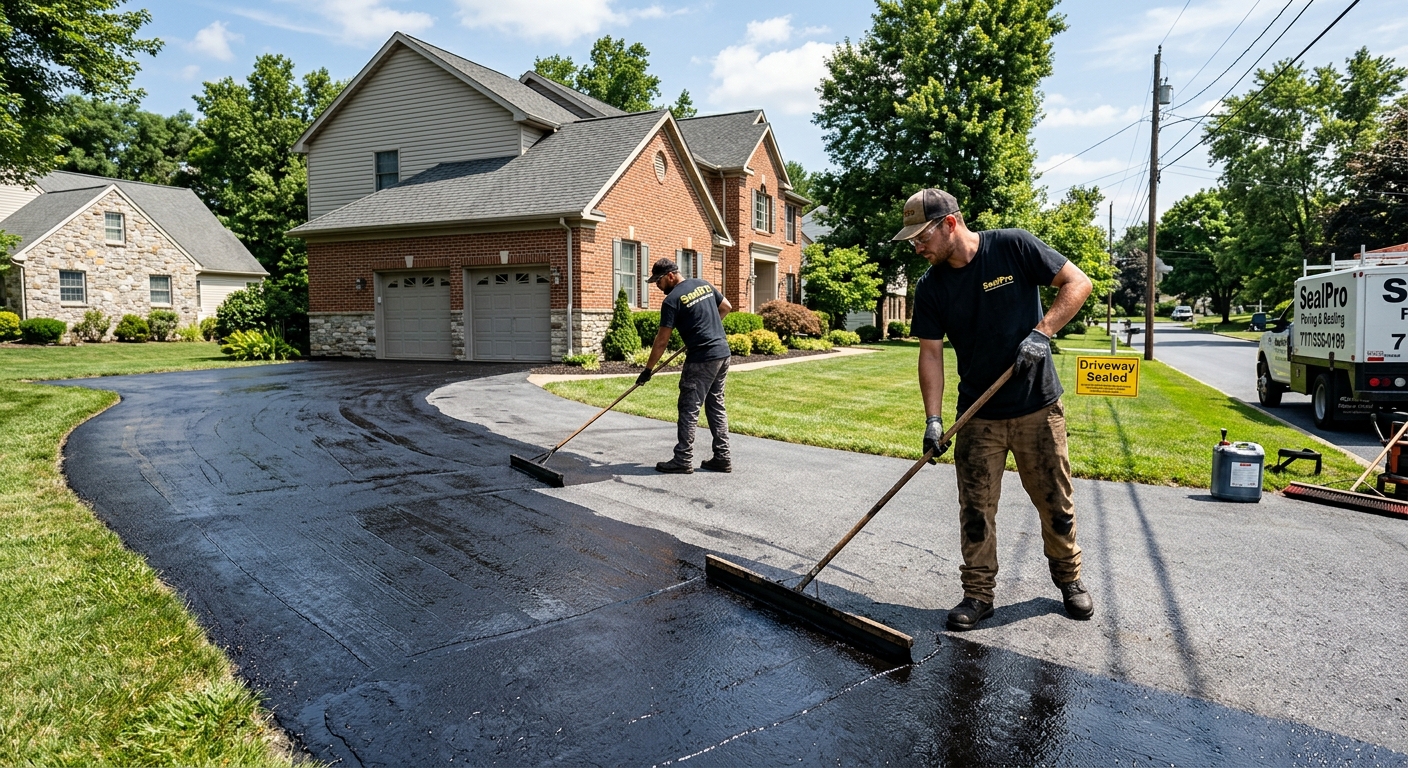
Given our winter weather and regular freeze-thaw cycling in East Cocalico, sealcoating an asphalt driveway every two to four years is usually best. If the surface looks gray and dry but isn’t seriously cracked, sealcoating helps preserve it by blocking water and UV, which delay larger repairs. However, over-sealing is almost as bad as never sealing—it can lead to peeling and premature failure, especially on driveways that get little sun. Single sealcoat applications in this area run between $200–$750, with many averaging about $425. Don’t let anyone talk you into annual sealing unless heavy traffic or unusual wear truly demands it.
How long does a driveway installation take?
A standard asphalt driveway replacement in East Cocalico, including excavation and new base, usually takes two to four days from start to finish. Removing the old pavement, prepping the base, and letting each lift of material settle—especially with our climate’s freeze-thaw cycles—is critical for long-term performance. Concrete jobs can take a bit longer because the slab must cure: plan for four to six days before you can park on it, longer if the weather’s cool or damp. Rush jobs can lead to settlement, cracking, or improper curing. For reference, full asphalt replacements locally run $3,700–$9,400; concrete installations are more, both in cost and in required downtime after pouring.
Is gravel a cheaper option in East Cocalico?
Yes, gravel driveways remain a budget-friendly alternative for longer, rural driveways around East Cocalico. The upfront installation is much lower—typically $900–$3,500—and repairs are inexpensive. However, gravel washes away under heavy rain, needs regrading every year or two, and may not keep dust down unless you add stone dust or a binder. Snowplowing can also push gravel into the yard, adding another annual task. For short urban drives, asphalt or concrete is almost always the more practical choice in the long term, but gravel is still sensible for large, lightly used areas outside the township centers.
Can I cancel a paving contract I signed at my door?
Absolutely, and Pennsylvania law is clear on this. Under the Home Improvement Consumer Protection Act (HICPA), any home improvement contract over $500—including paving—signed at your home can be canceled within three business days, no questions asked. You must get a written contract; if it doesn't include a cancellation notice, it’s an immediate red flag. To avoid problems, send your cancellation in writing—email or certified mail both work. Even if work has started, as long as you act within three days, you can back out. For comparison, a legitimate sealcoating or patching contract in East Cocalico would be in the $200–$800 range, and you should never feel pressured to sign on the spot.
Asphalt or concrete for a East Cocalico driveway?
In East Cocalico’s climate, both asphalt and concrete have their place, but the decision comes down to budget, long-term goals, and maintenance willingness. Asphalt is less expensive upfront—typical installations here are $3,700–$9,400—and deals better with freeze-thaw movement, but needs sealcoating and crack repair every few years. Concrete costs more initially—$5,200–$12,500—but offers a longer lifespan with less routine care. However, poorly installed concrete can spall in our winters, so extra attention to mix and curing is vital. For most homeowners, asphalt is a practical, cost-effective solution, but if you want low long-term maintenance and don’t mind the upfront spend, concrete is justifiable here.