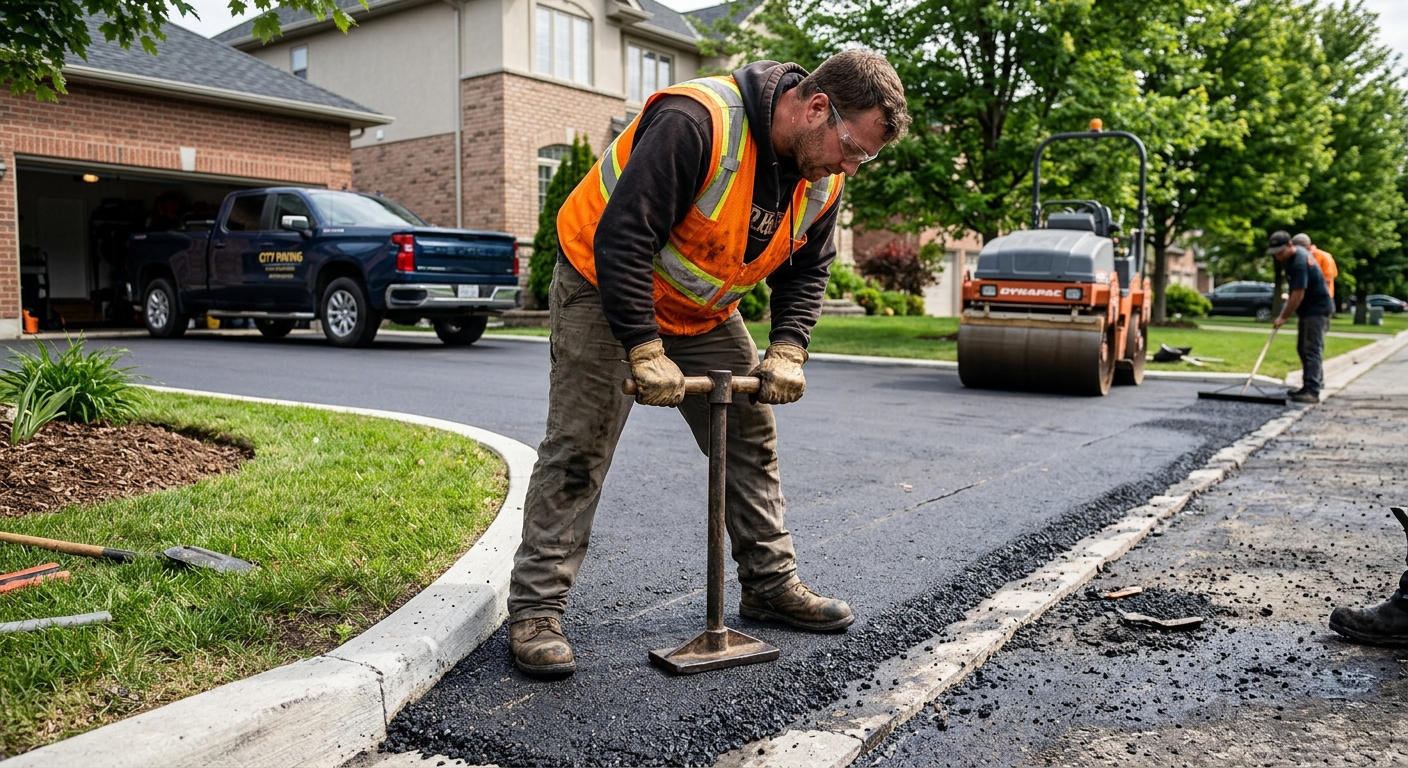
What a new driveway costs in Castle Shannon
In Castle Shannon, driveway replacement is a real concern for many homeowners. With a 57.8% homeownership rate and over half (53.7%) of homes being single-family dwellings, a driveway is one of the more visible investments you will make as a property owner. Most driveways here were poured or paved before 1980 (U.S. Census Bureau, ACS 2024), and the region's harsh freeze-thaw cycles, heavy clay and shale subgrade, and hilly terrain mean driveways in this part of Allegheny County simply do not last as long as some national averages suggest. Full replacement is common once old bases begin to heave and settle.
The most important thing to know: in this market, most of the price difference between two quotes is buried where you can't see it—under the asphalt itself. It comes down to how deep crews excavate, how much and what kind of aggregate they use, and how thoroughly they compact. Local contractors know the clay and shale hillside soils need extra base and care, but you can't see that once the surface goes down. Bargain quotes in Castle Shannon typically shortchange the base, not the surface.
| Service |
Best for |
Lifespan |
Price range |
| Asphalt — full replacement with new base |
failed base, structural cracking |
20–30 yrs |
$3,300–$8,500 |
| Asphalt overlay / resurfacing |
sound base, surface cracking only |
8–15 yrs |
$1,400–$4,300 |
| Sealcoating — single application |
preventive maintenance on sound asphalt |
2–4 yrs |
$200–$650 |
| Concrete — new installation |
long service life, low maintenance |
30–50 yrs |
$4,700–$11,500 |
| Crack filling and patching |
isolated cracks under a quarter inch |
1–3 yrs |
$200–$800 |
| Gravel driveway |
rural, budget, long runs |
5–10 yrs with upkeep |
$900–$3,500 |
Estimates for a typical Castle Shannon driveway. Square footage and base condition drive these figures more than material choice.
Reading a driveway proposal
Every Castle Shannon driveway replacement starts with a quote, but not all quotes are created equal. The details matter: a thorough proposal will spell out the measured square footage (never just ‘standard two-car’), the excavation and proper disposal plan, and the type plus depth of aggregate base. On our clay and shale hillsides, base depth can’t be skipped. Pay attention to how the crew describes compacting—multiple lifts, not just a quick run of a roller. For asphalt, you should see specified courses (like base and top) with compacted thickness. Edge treatment is also critical here with sloped yards, since exposed edges fail faster.
Grading and drainage are non-negotiable for our freeze-thaw climate; water should be directed away from your garage, house, and neighbor’s property. Restoration of turf or landscaping along the driveway edge shows attention to detail. Payment terms matter—expect a modest deposit and full payment only upon completion. Finally, a written warranty is standard, but don’t expect it to cover cracks; most paving warranties in this market are short and cover only major surface defects or workmanship issues.
If a contractor hands you a single number with no breakdown or explanation, you can’t compare that quote to anyone else’s—and that’s the easiest way to pay too much for a job that skimps on the only part that really counts: what’s under the pavement.
| Line item |
What to look for |
Red flag if… |
| Area |
measured square footage stated |
eyeballed or absent |
| Excavation |
depth and disposal included |
'we'll pave over it' |
| Base |
aggregate type and depth in inches |
'proper base' |
| Compaction |
method, and done in lifts |
not mentioned |
| Asphalt |
courses and compacted depth |
'3 inches' unqualified |
| Drainage |
slope and water direction stated |
silent |
| Warranty |
what is covered and what is excluded |
verbal only |
| Payment |
modest deposit, balance on completion |
full cash up front |
Permits and approvals for paving in Castle Shannon
Repaving or resurfacing an existing driveway in Castle Shannon—provided it stays within the same boundaries—usually does not require a building permit. That removes one layer of hassle for most homeowners. However, if you plan to modify or replace the driveway approach (the section where it meets the public road), you’ll need a permit, and it might not come from where you expect. Approaches connecting to state routes require a Highway Occupancy Permit from PennDOT District 11-0, not the borough. For driveways that involve the sidewalk, curb, or apron in the public right-of-way of larger municipalities in Allegheny County, you should check if a permit is needed locally.
Expanding a driveway or changing its footprint can trigger stormwater management rules. Increasing the impervious surface area means you may need to address how much water runs off your property and in which direction—runoff directed onto a neighbor’s lot makes you responsible, with or without a permit. Grading must be handled carefully to avoid drainage disputes in Castle Shannon’s hilly terrain.
Any contract over $500 must be with a contractor registered as a Home Improvement Contractor (HIC) with the Pennsylvania Office of Attorney General—always verify at hic.attorneygeneral.gov. Allegheny County contractors are also required by law to carry workers’ compensation, verifiable through the WCAIS system at wcais.pa.gov. Insist on proof up front; legitimate contractors expect this question.
The honest case for and against sealcoating
Sealcoating is widely advertised in Castle Shannon, but you deserve the full story before spending your money. Sealcoating does a few things well. It shields asphalt from sun-driven oxidation and spilled fuel or oil, slowing down the loss of the binder that holds your drive together. It also gives a fresh, black finish that can make a patchy old driveway look new for a couple of years.
That’s where the benefits end. Sealcoating doesn’t add any structural strength. If your driveway is already cracking due to a failing base or severe alligatoring, sealing it will hide the problem for a season, not solve it. Too-frequent sealing, a common mistake in Allegheny County, can actually hurt more than help: stacked layers crack and peel, and new asphalt sealed before it has fully cured can trap oils that need to escape. Every-other-year is reasonable; anything more often is waste.
Proper crack filling matters more than sealcoating. The right method uses hot-applied rubber to bridge cracks wider than a sixteenth of an inch, keeping water from reaching the base and making freeze-thaw cycles less damaging—far more important here than a thin coat of sealer. If a sealcoat quote in Castle Shannon comes in at the bottom of the band ($200–$650), expect a fast spray with almost no material landing in the cracks, and certainly no weeds or dirt removed first.
Sealcoating is best viewed as cosmetic maintenance. If your base is sound and you time it right, you’ll get the look with a little extra protection—but it won’t extend a bad driveway’s life.
Why you can't pave in February
Paving crews in Castle Shannon shut down for most of the winter, and it’s not just habit—it’s physics. Hot-mix asphalt needs to reach your driveway at 275–300 °F and be compacted before it cools below 185 °F, otherwise it will never bond and will ravel or wear out in just a few seasons. Below that threshold, which winter temperatures here regularly hit—our winter design temp is 8 °F—mix cools too fast and becomes unworkable. For concrete, the minimum required temperatures are higher than what our January or February climate allows, and concrete poured onto frozen ground can spall or heave come spring.
Local asphalt plants in the Pittsburgh area close for the winter, making fresh hot-mix simply unavailable for several months. Even if you found a crew willing to pave mid-winter, they can’t get the material. Trying to force a pour or a paving job outside season is a recipe for driveway failure. That’s why the main paving season here stretches from April through October, sometimes slipping into early November during mild years. Spring and fall shoulder seasons may offer the best scheduling flexibility and prices, while peak summer means longer waits and higher demand.
If someone offers to pave your driveway in Castle Shannon before buds show on the trees—or far into November—pause and ask why no reputable local paving contractor would take that risk with their own reputation.
Getting thirty years out of a driveway
Longevity for a Castle Shannon driveway depends more on care than the initial pour. The single biggest thing you can do is fill cracks as soon as they open—even a quarter-inch gap lets water reach the base, and in our deep-freeze climate (36-inch frost depth, heavy freeze-thaw), water in the base is the enemy. Edges need real support, not a strip of soil—undermined edges are where most driveways fail here, especially on our sloped lots.
Keep water moving away from the drive by maintaining slope and clearing debris. Avoid point loads—jack stands, dumpsters, or snowplow blades parked on the surface crush the base below and leave permanent scars. For newly paved asphalt, wait at least three days before parking and avoid turning wheels while stationary until the surface has fully cured (typically two weeks during a Castle Shannon summer).
For de-icing, salt is tough on concrete (it accelerates surface failure), while with asphalt, the main issue is repeated melt and refreeze cycles that pry open even tiny cracks. Alternatives like calcium chloride are gentler on concrete, but cost much more. Sand does not melt ice, but it adds traction and stays put between plow passes. Aim to remove snow promptly to minimize ice, and use salt only when truly necessary.
Beyond replacement: layout changes
Many Castle Shannon households look beyond a simple driveway swap to match changing needs—adding a second parking lane, extending to a new garage, or replacing a gravel run. Each of these projects means new paving over undisturbed ground. That requires a proper new base, not just a thin overlay. The border between new and old pavement will always be a weak spot—if you connect new pavement to old, expect a visible seam and plan for earlier maintenance at that joint.
Expanding a driveway in Allegheny County isn’t just a paving job. Adding a turnaround or widening the approach pushes you up against setback rules and local impervious-surface limits, both driven by stormwater control. Permits for driveway approaches connecting to state roads (managed by PennDOT District 11-0) or impacting the sidewalk/curb may be needed. Any expansion must handle water properly—draining onto a neighbor’s property here creates liability regardless of permit status, making professional grading and proper swales essential on our hilly lots.
If a paving company tells you expansion is “just a little more work” than a replacement, they are skipping over the most expensive (and important) part: careful excavation and a strong, new base.
Frequently asked questions — driveway paving in Castle Shannon
Are there stormwater rules on paving in Castle Shannon?
In Castle Shannon and throughout Allegheny County, stormwater management is a real issue. If you expand your driveway or add new paving that increases impervious surface, runoff has to be considered—both from a regulations standpoint and common-sense neighbor relations. While most repaving within a current footprint does not trigger extra requirements, adding a parking pad or widening can mean you must handle and direct increased runoff, possibly with swales or an infiltration trench. Never direct water onto a neighbor’s property; you are responsible for any runoff damage, permit or not. Larger expansions may be reviewed by the local code authority, especially if you are close to property lines or the public right-of-way. Plan for professional grading and budget from $3,300–$8,500 for a full replacement if you’re doing more than resurfacing—you’ll want it done right to avoid headaches later.
Are door-to-door pavers a problem in Castle Shannon?
Door-to-door paving crews are not uncommon around Castle Shannon, especially during the busy paving season. These outfits often pressure homeowners with claims of "leftover asphalt" and low, today-only prices. While not every roaming crew is a scam, many use undertrained labor, poor materials, and cut corners on base prep—the part you can't see. Rarely do they provide a proper contract as required by the Home Improvement Consumer Protection Act or have a valid Home Improvement Contractor (HIC) registration. The low prices they advertise might start under $1,400–$4,300 for an overlay, but the work won't last. Always check registration at hic.attorneygeneral.gov and ask for proof of workers' compensation insurance. Established, local contractors stake their reputation on long-term work and are easy to verify.
Is gravel a cheaper option in Castle Shannon?
Gravel can be a cost-effective choice for certain Castle Shannon driveways—especially longer, rural runs or properties with challenging access for heavy equipment. Installation is much cheaper, typically ranging from $900–$3,500 depending on length and materials, and unlike asphalt or concrete, it doesn’t require hot-mix plants. However, gravel driveways need frequent grading, regular top-ups, and good drainage—our clay and shale soils mean poorly drained gravel will rut, wash away, or develop deep puddles. For small suburban lots, gravel is less popular, but for budget-conscious or steep approaches where paving would be risky, it's a useful option. Just know you’re trading low up-front cost for steady yearly upkeep.
Are pavers worth the cost in southwestern Pennsylvania?
Concrete or stone pavers are attractive but rare for driveways in Castle Shannon. While they deliver a high-end look and allow for spot repairs, the up-front investment is several times higher than asphalt or poured concrete, easily running triple the cost of a standard installation—well above the $4,700–$11,500 band for concrete. Our climate's heavy freeze-thaw cycles and clay-rich subsoil mean pavers require a thick, well-compacted aggregate base and proper edge restraints to avoid settling and heaving. If budget is a concern, pavers aren’t the answer for a driveway here. But for shorter entrance walks or decorative borders, they hold up and can boost curb appeal.
What does an asphalt overlay cost in Castle Shannon?
In Castle Shannon, an asphalt overlay—sometimes called resurfacing—is best suited for driveways with a mostly sound base but worn or cracked surface. Overlay runs from $1,400–$4,300 for a typical residential drive, depending on square footage. This process involves cleaning, repairing localized damage, and applying a new layer of asphalt over the existing pavement. It's less expensive than a full replacement (which can cost $3,300–$8,500), but the base must be stable and free of major structural failures. Overlay won’t solve drainage problems or bad subgrade—if those exist, the overlay is a temporary fix and you’ll need a full rebuild sooner rather than later. Always have a qualified contractor check the base first, not just the surface.
Does sealcoating fix cracks?
Unfortunately, sealcoating is not a fix for cracks in a Castle Shannon driveway. Sealcoating provides a thin, protective surface that slows oxidation and makes your asphalt look fresh, but it will not bridge or fill existing cracks—especially those wider than hairline. In fact, if cracks are sealed without being cleaned and filled with hot rubber or a proper patch, water will still find its way in and undermine the base, causing more rapid failure. Crack filling is a separate service and usually costs between $200–$800 depending on the area to be treated. The best approach is to fill cracks as they appear, then sealcoat as routine maintenance once every couple years. Sealing unfilled cracks is mostly cosmetic and won’t add real value or protection.
What does compaction in lifts mean?
Proper compaction in lifts is key to a long-lasting driveway in Castle Shannon, given our heavy clay and shale soils. When paving, the contractor should spread and compact the stone base in several thin layers, called lifts, not all at once. Each lift—usually 2–4 inches—gets packed down before the next is added. This prevents soft spots and ensures the entire base is dense and stable. The same method applies to asphalt: multiple thin layers compact much better than one thick pour, especially on our steeper driveways. If a proposal only mentions “three inches” with no detail, that’s a red flag for a rushed job. A detailed approach is more labor, but helps your driveway reach the upper end of its lifespan—protecting your $3,300–$8,500 investment.
How long should an asphalt driveway last in Castle Shannon?
With good preparation, sound drainage, and routine maintenance, a new asphalt driveway in Castle Shannon can last 20 to 30 years. The range is wide because our hills and freeze-thaw cycles are tough on anything paved after a wet winter, and base prep makes all the difference. Filling cracks right away, keeping edges protected, and handling water runoff are what separate a 12-year driveway from a 25-year one. A typical full replacement runs $3,300–$8,500. Overlay surfaces, done on a sturdy base, will get you 8–15 years. Shortcuts on compaction and base thickness—or using too little aggregate on the clay soil—shorten service life dramatically. Ask for a detailed quote and specifics on base depth, not just a low price.
How long before I can drive on a new asphalt driveway?
In Castle Shannon, you can usually walk on a new asphalt driveway the next day, but it’s wise to wait at least three full days before driving on it. During summer months, when ambient temperatures are high, the surface may remain soft for up to a week, especially on thicker pours. Turning your wheels while stationary, parking heavy vehicles, or setting stands or dumpsters on the surface before it cures will cause gouging and early failures. For best results, allow as much curing time as practical—ideally, two full weeks before heavy use—though most contractors include limited access after three days in their instructions. You’ve invested $3,300–$8,500: giving it time to set will help that new pavement last its full potential in our freeze-thaw climate.