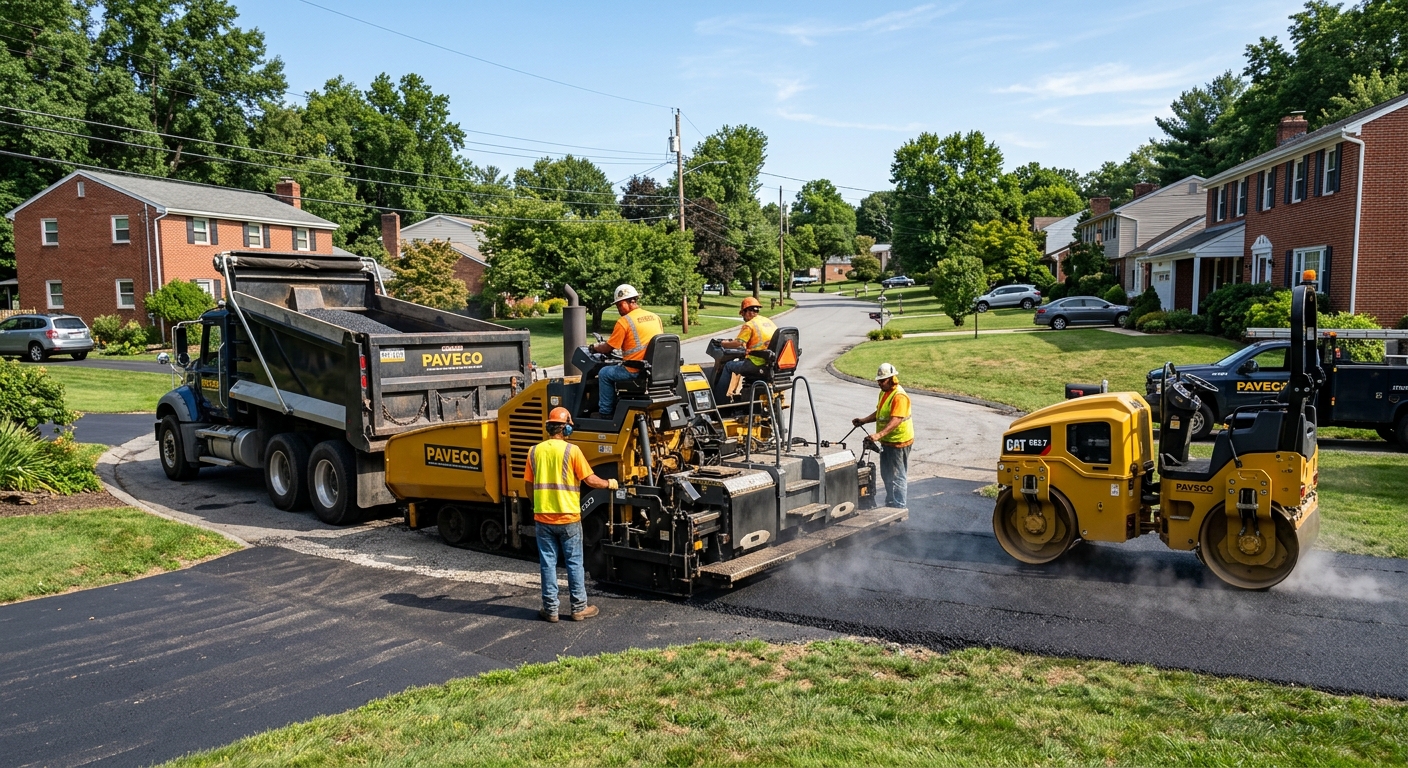
What a new driveway costs in Collier
In Collier, where 62.6% of homes are single-family and the homeownership rate is a strong 85.5% (U.S. Census Bureau, ACS 2024), most driveways are privately owned, longer, and subject to the kind of soil and weather conditions that drive up long-term maintenance costs. Southwestern Pennsylvania’s heavy freeze-thaw cycles and hillside clay or shale subgrades mean driveway construction here deals with challenges that aren’t visible once the top layer is down. That’s why, in Collier, most of the price difference between two paving quotes is buried where you can’t see it—in the thickness and compaction of the base layers below the asphalt, in correct drainage, and in how well the crew prepares for those winter conditions.
Surface material is important, but it’s only one part of the cost. Two bids for asphalt might look similar, yet one might only replace the top layer, skipping needed excavation or base repair. A "cheap" job might result in cracks or heaving within a few winters. On the other hand, paying for detailed prep and adequate depth can extend a driveway’s life by a decade or more—well worth it in a region where the base fails faster than the pavement. Here’s what typical costs look like for Collier:
| Service |
Best for |
Lifespan |
Price range |
| Asphalt — full replacement with new base |
failed base, structural cracking |
20–30 yrs |
$3,700–$9,600 |
| Asphalt overlay / resurfacing |
sound base, surface cracking only |
8–15 yrs |
$1,600–$4,800 |
| Sealcoating — single application |
preventive maintenance on sound asphalt |
2–4 yrs |
$200–$750 |
| Concrete — new installation |
long service life, low maintenance |
30–50 yrs |
$5,300–$12,500 |
| Crack filling and patching |
isolated cracks under a quarter inch |
1–3 yrs |
$200–$800 |
| Gravel driveway |
rural, budget, long runs |
5–10 yrs with upkeep |
$900–$3,500 |
Estimates for a typical Collier driveway. Square footage and base condition drive these figures more than material choice.
What to put in a Collier paving contract
In Collier, the smartest homeowners know that a driveway bid is only as solid as the details in writing. Don’t shop on price alone—focus on the precise specifications, especially here on Allegheny County’s hilly, clay-rich ground, with its notorious freeze-thaw cycles. Any contractor can promise “three inches of asphalt,” but unless you specify whether that’s compacted thickness, you might get less than you paid for. As asphalt and aggregate compact under rollers, up to 20–25% can disappear—so always ask for thickness “compacted,” not “as laid.”
Because of southwestern Pennsylvania’s clay and shale soils, frost heave is a threat—water in these soils freezes, expands, and lifts driveways, causing cracking. This means base preparation and correct depths matter here in Collier far more than in a milder climate. Contracts should spell out every layer’s depth, every compaction method, and all the products used. If the contractor doesn’t specify these details—or gets defensive when you ask—you probably aren’t getting what you pay for.
- Excavation depth (in inches) to solid subgrade
- Aggregate base type (limestone or approved gravel) and compacted depth — typically 6–8 inches here
- Base compaction in lifts (not all at once), with roller type specified
- Compaction method and equipment listed by weight or type
- Asphalt binder course: compacted thickness (often 2–2.5 inches)
- Asphalt surface course: compacted thickness (typically 1.5 inches)
- Asphalt mix designation and supplier
- Edge treatment (angled, thickened, or with extra aggregate support)
- Drainage direction, sled or laser-checked (to avoid pooling or runoff onto neighbors)
- Exact clean-up and material disposal plan
What's under the asphalt matters more than the asphalt
If you want a driveway to last in Collier, it pays—literally—to care more about what’s under the surface than what’s on top. The full assembly has three key layers: the natural subgrade, a compacted aggregate base (crushed limestone in this area), and finally the asphalt itself. Each layer is only as strong as the one below. In this hilly, clay-and-shale Allegheny County ground, the red flag is always frost heave—water in the soil freezes and expands, lifting whole sections unevenly and cracking the surfacing from below. If you don’t have good drainage and a thick, compacted base, you’ll see cracks, waves, or sunken spots within just a few western Pennsylvania winters.
This is where the lowest quote almost always cuts corners. Without enough excavation, contractors may skip removing wet, weak, or heaving soil. Instead, some will lay new asphalt over a soft or cracked base—or use only 2–3 inches of aggregate, compacted lightly if at all. You won’t see the shortcut on the day it’s paved, but in year three, the cracks and dips will tell the story. By then, repairs mean starting over.
In Collier’s conditions, a reliable spec is 6 to 8 inches of compacted 2A limestone base—done in 2–3 lifts with heavy roller compaction, not just a single dump and flatten. The asphalt itself: 2–2.5 inches of binder course, plus 1.5 inches of fine surface mix, compacted thickness. Drainage should be shaped right to prevent water from pooling or running onto adjacent properties. All of these must be put in writing. If the proposal says only “proper base” or “3 inches of asphalt,” ask for specifics—or get a better quote. Don’t pay for what you can’t verify; pay for what you can measure.
Sealcoating: what it does and what it doesn't
In Collier, driveways face hard winters, and fresh sealcoating makes old asphalt look new again. But don’t confuse looks for longevity. Sealcoating protects asphalt from UV rays, oxidation, and stains from gas or oil. It’s a real benefit—especially after a patch or resurfacing job—and regular sealing can help keep the binder strong. What it doesn’t do: fix cracks, add any real structure, or rescue a driveway whose base is already failing. If your pavement is alligator-cracked or sunken, no sealer will buy you more than a fresh-looking surface for a season.
It’s also a mistake to overdo it. Sealing too frequently, or slapping on a coat every year, just builds up brittle layers that will crack and peel—turning routine upkeep into a mess. New asphalt needs to cure and lose its volatiles before sealing, or you’ll trap fumes and cause early surface problems. A realistic interval for sealcoating in Collier is every 2–4 years, not annually. If someone tells you otherwise, they’re selling—not advising. For a $200–$750 price tag, what matters is a thick coat, applied with squeegee, after filling all cracks—not a rushed spray or a “special deal” from a door-hanger crew.
Crack filling, though, is the real longevity booster. By sealing out water before it seeps into the base, you prevent freeze-thaw damage better than sealcoating alone. So if you have to choose between a budget on crack fill or a bargain sealer, money spent on real crack repair is always the better value for a Collier driveway.
Getting thirty years out of a driveway
The longest-lasting Collier driveways don’t just happen; they’re maintained. The single best thing you can do is fill cracks before water and freeze-thaw cycles break up the base. When cracks are caught early—before they're more than a quarter inch wide—simple crack filling will beat out a hasty sealcoat every time and usually runs just $200–$800 per patching cycle. Keep drive edges supported; unsupported edges let base crumble and asphalt shear off. Drain water off, never across, the driveway, and keep downspout outlets pointed away—water always finds its way down through tiny defects, especially on the hillside and clay soils common west of Pittsburgh.
Let new asphalt cure for a week in Collier weather before parking vehicles or turning front wheels when stationary. On concrete, minimize salt use: most residential mixes don’t withstand heavy salt, which can cause scaling. On asphalt, salts aren’t as chemically damaging, but using them in freeze-thaw weather encourages ice to melt and refreeze, which is what causes expansion-related cracking. Sand or calcium chloride are alternatives, but both come with higher costs than rock salt—usually not justified unless you have especially slick slopes or want to avoid damage at all costs.
In Allegheny County, freeze-thaw cycles are a given—the difference between a driveway that lasts thirty years and one that fails in ten is routine, basic care and keeping water moving.
What you need before paving in Collier
If you’re repaving your driveway in its existing footprint on private property in Collier Township, there’s no separate right-of-way permit process to worry about—unlike in the City of Pittsburgh or for work that affects public sidewalks or curbs. But if your project involves modifying the driveway approach (where your drive meets a state road), you’ll need a Highway Occupancy Permit from PennDOT District 11-0. This is a separate process from any local permits and can surprise homeowners. Failing to secure this for approach work can trigger fines and, more importantly, force a costly tear-out if your new apron interferes with drainage or plow operations.
Be mindful of stormwater. Adding new hard surfaces or widening your driveway might land you in the crosshairs of local stormwater regulations—runoff that worsens a neighbor’s property leads to liability, permit or not. It’s always smart to confirm your plan routes water away from property lines, and never toward public sidewalks or streets—especially on Collier’s hilly terrain where sheet runoff is a neighborhood sore point.
Pennsylvania law requires paving contractors taking contracts over $500 to have Home Improvement Contractor registration through the Office of Attorney General—verify at hic.attorneygeneral.gov. Every legitimate company must also carry valid workers’ compensation insurance, which you can check independently with the state’s WCAIS system (wcais.pa.gov). Don’t just take a contractor’s word, especially in Allegheny County’s busy paving market.
Reading a driveway proposal
A solid paving proposal in Collier spells out the details that make bids comparable, apples to apples. Start with the measured square footage—this should match your driveway, not just a guess. Look for excavation: if removal and disposal of the old material aren’t listed, you might just get a patch job, not a rebuild. Next, the spec should call for the type and depth (in inches) of crushed aggregate base, plus compaction in lifts—lazy crews will gloss over this, but it’s what separates a 30-year driveway from a three-year headache. The asphalt itself should be broken out by layers, each with compacted thickness—not just “three inches.” Was drainage addressed? Slope and water direction should be clear. Payment should be mostly due on completion, with a small deposit upfront. Warranties in paving are usually limited, often not covering cracking—even though that’s what most people want covered. If the proposal is one line with a total and no specs, it’s worthless for comparison—this is the most common way homeowners in Collier overpay for underbuilt driveways.
| Line item |
What to look for |
Red flag if… |
| Area |
measured square footage stated |
eyeballed or absent |
| Excavation |
depth and disposal included |
'we'll pave over it' |
| Base |
aggregate type and depth in inches |
'proper base' |
| Compaction |
method, and done in lifts |
not mentioned |
| Asphalt |
courses and compacted depth |
'3 inches' unqualified |
| Drainage |
slope and water direction stated |
silent |
| Warranty |
what is covered and what is excluded |
verbal only |
| Payment |
modest deposit, balance on completion |
full cash up front |
Frequently asked questions — driveway paving in Collier
How thick should asphalt be for a residential driveway in Collier?
For Collier, a residential asphalt driveway requires more thickness than you might read about for milder climates. Because of the area’s heavy freeze-thaw cycles and the common shale or clay subgrade, a typical specification is 6 to 8 inches of compacted 2A limestone base, with 2 to 2.5 inches of compacted binder asphalt, topped by at least 1.5 inches of compacted surface course. That means your full asphalt depth, after the steamroller has passed, should total about 3.5 to 4 inches—not including base. Anything less risks premature cracking and heaving after a few winters. Given the cost of replacement here—$3,700–$9,600—it's wise to get the depth and compaction in writing from your contractor and verify it as the job proceeds.
Can I pave over my existing driveway?
Sometimes. In Collier, resurfacing or overlaying is a cost-effective fix for driveways with a sound base and only surface cracks. If your driveway is structurally solid—no major depressions, heavy alligator cracking, or frost heave issues—a professional overlay will get you another 8–15 years for a price in the range of $1,600–$4,800. But if the base or subgrade is soft, patched, or heaved, an overlay just buries the problem. In this area’s climate, neglecting base repairs almost always leads to early failure. If a contractor says it’s “fine to pave over,” make sure they check the driveway thickness, core samples, or at least probe the base for soft spots, or you’ll end up buying a full replacement much sooner.
When can I seal a brand new asphalt driveway?
In Collier, you need to let new asphalt cure before applying the first sealcoat. Usually, it takes three to six months depending on the season—longer in cool and damp conditions. Sealing too early traps volatile oils and results in a soft or peeling surface. Many contractors push for sealing after just a few weeks, but local conditions absolutely call for patience. When done at the correct interval, a single application costs $200–$750 and helps prevent UV and chemical damage. But hold off until the color has faded slightly from deep black to dark gray, which signals it’s cured and ready for sealant.
Why are paving quotes in Collier so different from each other?
There’s plenty of competition among paving contractors in Allegheny County—Collier included—thanks to abundant local asphalt plants and a dense market. Quotes can swing wildly because most costs are in base prep, excavation, aggregate, and compaction—none of which the average homeowner can see after the job is done. It’s easy for a crew to skip removing soft base or to use too little aggregate, shaving costs by thousands. In this area, a “cheap” quote is often the one cutting corners on those buried steps, meaning you’ll likely pay $3,700–$9,600 again much sooner for a proper replacement. Always get written specs for every layer and compaction step.
How much does a concrete driveway cost in Collier?
In Collier, a new concrete driveway installation typically runs between $5,300–$12,500 depending on size, slope, and prep needed. Concrete lasts longer than asphalt—30 to 50 years with basic care—but that longevity costs up front. The higher cost here reflects hilly sites, the need for thicker slabs in the freeze-thaw climate, and increased aggregate to prevent movement on the clay or shale found across Allegheny County. Don't be tempted by prices well under the average unless you see proof the contractor is building to handle the region’s winters.
How long does a driveway installation take?
In Collier, a standard tear-out and replacement of a single-family driveway usually takes two to three days start-to-finish. Day one is for demolition and base prep, with time for inspection of the subgrade—especially important with clay and shale subsoils. Actual asphalt placement is generally done in a single day, but an additional cure day may be needed before foot or vehicle traffic returns. Weather delays, especially in spring and fall, are common. If your project is a simple asphalt overlay, it can often be done within one day and at a lower cost ($1,600–$4,800), but skipping a curing period exposes you to future cracking.
Can I cancel a paving contract I signed at my door?
Yes, as a Collier homeowner, you have a three-business-day right of cancellation on any home improvement contract over $500, under Pennsylvania’s Home Improvement Consumer Protection Act. This right is non-waivable; contractors must provide written notice of this right in your contract. If a crew pressures you for an immediate start or a big upfront deposit, watch out—especially with driveways, where quick, high-pressure sales can lead to regret. If you cancel, any money must be refunded. A legitimate contract for a project such as a $3,700–$9,600 driveway replacement will always include this information up front.
Why are my driveway edges crumbling?
In Collier, crumbling at the edges is common—especially given hilly terrain and clay subgrade typical across Allegheny County. Most often, edge failure is caused by a lack of proper aggregate support or traffic running right up to (and sometimes off) the edge. Asphalt laid thin at the margins, or with no extended base, cannot support weight the way the interior does. Seasonal freeze-thaw cycles make the issue worse: once water gets into a cracked edge and freezes, that edge breaks away quickly. Asphalt patching or edge rebuilding runs about $200–$800 per section, but in severe cases, a partial replacement is the only real fix. Prevent it by keeping vehicles off the margin and asking for written specs on edge thickening before your next paving job.
How many freeze-thaw cycles does Collier get?
Southwestern Pennsylvania, including Collier, is known for heavy freeze-thaw activity. It’s common to see dozens of freeze-thaw cycles every winter, as temperatures hover above and below 32°F. This high cycle count accelerates cracking and heaving of driveways—especially on clay or shale slopes. It’s the main reason local driveways demand deeper aggregate bases than in southern areas, and why cheap overlays almost never last the full 8–15 years. For a Collier driveway replacement costing $3,700–$9,600, budgeting for thick, compacted base and excellent drainage is the smartest investment against all those freeze/thaw swings.