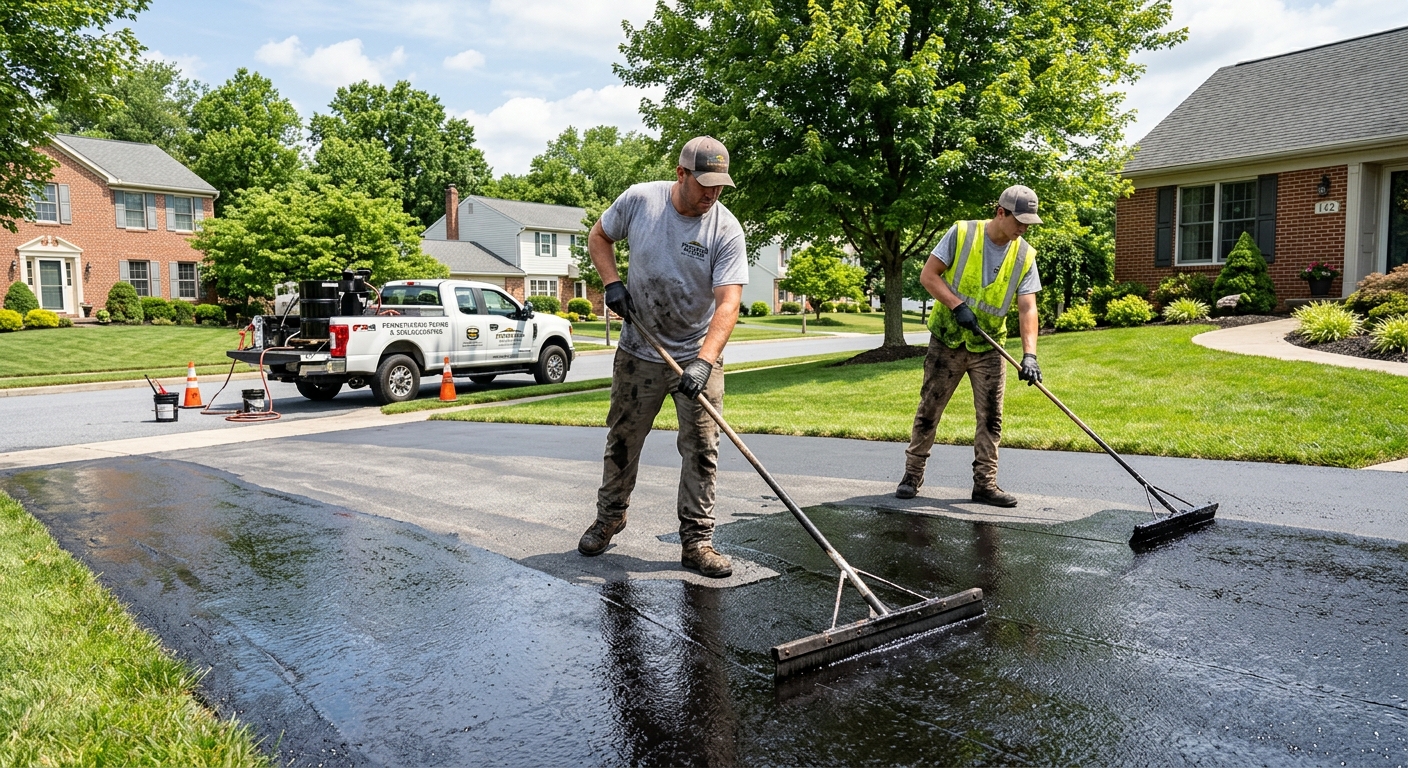
East Whiteland paving prices by scope — 2026
In East Whiteland, where over half of homes are detached single-family and the homeownership rate sits at 60.0% (U.S. Census Bureau, ACS 2024), driveway paving is a routine property upkeep expense. Most driveways here were built decades ago, and many are now due for full-depth replacement rather than another quick overlay. What most homeowners don’t see is that the price difference between two paving quotes is rarely about the asphalt on top—it’s what’s buried beneath that matters most. Base preparation, drainage grading, and thicknesses are what you’re paying for (or not), and failures down the road almost always trace to shortcuts underground.
East Whiteland sees moderate freeze-thaw cycles. Combined with subgrade over limestone and dolomite, this means driveways here need a strong aggregate base—far more than you might get away with in a milder climate. If your driveway is settling, heaving, or cracking even after patching, your issue is likely below the surface. Skimping on what you can’t see is where most homeowners are burned on price.
| Service |
Best for |
Lifespan |
Price range |
| Asphalt — full replacement with new base |
failed base, structural cracking |
20–30 yrs |
$4,200–$10,500 |
| Asphalt overlay / resurfacing |
sound base, surface cracking only |
8–15 yrs |
$1,800–$5,400 |
| Sealcoating — single application |
preventive maintenance on sound asphalt |
2–4 yrs |
$250–$850 |
| Concrete — new installation |
long service life, low maintenance |
30–50 yrs |
$6,000–$14,500 |
| Crack filling and patching |
isolated cracks under a quarter inch |
1–3 yrs |
$200–$800 |
| Gravel driveway |
rural, budget, long runs |
5–10 yrs with upkeep |
$900–$3,500 |
Estimates for a typical East Whiteland driveway. Square footage and base condition drive these figures more than material choice.
How often should a East Whiteland driveway be sealed?
Sealcoating is commonly marketed as a must-do annual ritual, but that advice is more profitable for the seller than the homeowner. In East Whiteland, sealcoating serves a genuinely useful role: it slows down the oxidation of the asphalt binder, shields against oil and fuel drips, and restores the surface’s fresh black look. It does not, however, add any structural strength or fix an existing problem—sealcoating cannot rescue a driveway with base issues or deep cracks.
What rarely gets said is that sealing too often actually harms the surface. Over-application, especially done annually, leaves a thick skin that can crack and peel off in sheets, trapping moisture and causing further damage. The first application should wait until new asphalt has cured—usually a full season—so that oils have a chance to escape. After that, every three to four years is a reasonable interval for most East Whiteland driveways, unless the surface shows clear signs it needs it sooner.
Crack filling is more important than sealcoating for driveway longevity. Open cracks let in water, which, especially with East Whiteland’s freeze-thaw cycles, leads to rapid failure below the surface. Proper crack filling uses a hot-applied rubberized material—not cold pour—so ask what your contractor uses. Also, a real sealcoating job is done with brushes or squeegees to work material into pores and edges; a quick spray-on coat, which is common at the low end of the price band ($250–$850), is little more than a cosmetic refresh and won’t last a full season.
If you get a quote that seems suspiciously cheap, you’re likely getting water-based material sprayed on thin—and you’ll see it washing off and peeling within a year. Spend money on real crack repair, and be measured about sealing. In East Whiteland, every three to four years is enough for most asphalt driveways.
The specifications to demand in writing
If you want your new East Whiteland driveway to last, look past the price to the job specifications—and demand them in writing. Pennsylvanian freeze-thaw cycles and the limestone subgrade in this region require greater depth and more rigorous site work than in milder climates, or your driveway will start cracking and heaving years before it should. Sloppy or ambiguous quotes—“three inches of asphalt” with no detail—are exactly where shortcuts get buried. You have one chance to get the foundation right, because everything above it depends on what’s underneath.
A legitimate quote will spell out key measurements and materials. Excavation depth, aggregate base thickness (and material type), and whether the base will be compacted in lifts matter enormously for long-term performance. Asphalt thickness should be specified as “compacted,” not just “as laid.” The difference can be a quarter wasted if the contractor simply lays down loose material and rolls it once. Mix designation and edging are far from trivial—these elements prevent raveling and edge failure.
Require these items to appear, in numbers, on your written quote:
- Existing material removal and excavation depth (in inches)
- Aggregate base material (specify type—2A modified stone or equivalent)
- Aggregate base thickness (inches, after compaction)
- Base compaction method and whether compacted in lifts
- Binder asphalt course thickness (compacted)
- Surface asphalt course thickness (compacted)
- Mix designations for both asphalt courses
- Edge treatment (hand tamped, concrete, or other)
- Finished slope/grade details for drainage
- Warranty coverage and written payment terms
Don’t accept vague “we’ll put down three inches.” Instead, insist: “How thick, after compaction? How much base? What goes to the dump?” You’ll prevent disappointment—and expensive early failures—later on.
Drainage: the failure nobody plans for
In East Whiteland, water is the single biggest enemy of any driveway. Grading is not just a finishing detail—it’s key to longevity. Every time water pools or runs toward a garage, the risk of failure multiplies. Driveways must be laid with at least a two-percent slope for surface runoff, and a well-built apron should direct water away from the house, garage, and foundation instead of toward them.
There are two common slope solutions. Crowning (a ridge down the center) helps water drain off both sides, but on short or narrow drives, cross-slope is more typical to make water shed to one side. If your existing grade funnels water toward structures, your options are to regrade (raise or lower sections), or, if shape can’t be changed, install trench or channel drains across the apron to capture the runoff before it gets inside. That collected water should "daylight" (exit visibly above grade, not into a buried pipe) somewhere with enough slope to carry it away—or, if that’s not possible, be directed into a dry well designed for the soil here.
The local limestone and dolomite soils in Central Chester County tend to drain well, but pockets of clay will hold water near the base, making proper sub-base compaction and drainage essential—otherwise, freeze-thaw cycles will turn trapped water to ice, lifting and fracturing the surface from below.
Last, don’t forget your neighbors. Sending increased runoff onto adjacent property is a liability, no matter what your permit says. Careful grading keeps your drive damage-free—and you complaint-free—from the next big storm.
What you need before paving in East Whiteland
Most repaving projects for an existing residential driveway footprint in East Whiteland do not require a permit, especially if the work is entirely on your property and outside the public right-of-way. This saves many homeowners a headache and a phone call. However, anytime your project touches the driveway approach—where your drive connects with a township or state road—a distinct permit is needed. In Chester County, for driveways connecting to state routes, that’s handled by PennDOT Engineering District 6-0, not your township.
If you’re expanding the driveway or increasing impervious surface area, be aware that stormwater management can trigger additional requirements. Even without permit triggers, you can’t lawfully direct runoff onto a neighbor’s property—this is a civil liability even when codes are silent.
For any contract over $500, Pennsylvania requires your paving contractor to hold valid Home Improvement Contractor (HIC) registration—confirm it at hic.attorneygeneral.gov. If they employ a crew (not just the owner working solo), workers’ compensation coverage is also mandatory. You can check this at wcais.pa.gov.
If your home was built before 1978, ask about the EPA Lead RRP Rule. Verifying that your contractor is current on both state and federal requirements protects you from fines and shoddy work.
What a real paving quote contains
Comparing prices is only meaningful if you’re comparing the same scope—and in East Whiteland, too many homeowners get caught by one-line quotes hiding thin subbases. A real quote will draw out every step: measured and stated square footage; depth of excavation and whether haul-away is included; type and compacted depth of aggregate base; compaction method (and number of lifts); details for each asphalt course, quoted in compacted thicknesses; specific edge treatment (hand tamp, concrete, or roll); planned grading for drainage; and cleanup or lawn restoration. The payment schedule should require only a modest deposit, with most payment due on completion. Most paving warranties are limited, covering things like raveling or potholes but not natural cracking from ground movement—ask to see the exclusions.
If your quote just says “Pave driveway - $X,XXX” and leaves it at that, you can’t compare it to anything else. This is the single most common way homeowners overpay for driveways that look fine for a year, then fail as soon as winter returns. The devil—and the durability—is in the detail.
| Line item |
What to look for |
Red flag if… |
| Area |
measured square footage stated |
eyeballed or absent |
| Excavation |
depth and disposal included |
'we'll pave over it' |
| Base |
aggregate type and depth in inches |
'proper base' |
| Compaction |
method, and done in lifts |
not mentioned |
| Asphalt |
courses and compacted depth |
'3 inches' unqualified |
| Drainage |
slope and water direction stated |
silent |
| Warranty |
what is covered and what is excluded |
verbal only |
| Payment |
modest deposit, balance on completion |
full cash up front |
Asphalt or concrete for a East Whiteland driveway?
In East Whiteland, the material you choose for your driveway has to stand up to freeze-thaw cycles and the region’s humid summers. Asphalt is flexible, which lets it absorb the expansion and contraction that happens when the ground freezes and thaws—common here every winter. It rarely cracks in the same way concrete does, but it does need sealing every few years to maintain appearance and resist oxidation.
Concrete driveways cost significantly more up front—$6,000–$14,500 for a standard home—but when installed right, can last 30–50 years. The tradeoff is de-icing salt: use it regularly, as most Chester County homeowners do, and you’ll see scaling and spalling within a few seasons. Concrete does not forgive that exposure, so if you can commit to sand-based traction in winter, you’ll get the most life for your money; most people, frankly, don’t. In this area, concrete driveway failures usually trace to winter salt, not ground movement.
If budgets are tight or the surface is very long and rural, gravel remains a practical choice, with manageable upkeep. Permeable pavers offer strong freeze-thaw resilience and easy spot repairs, but the cost rivals concrete for a full install.
| Option |
Installed cost |
Maintenance |
Freeze-thaw performance |
Lifespan |
| Asphalt — new install |
$4,200–$10,500 |
sealcoat every 3–4 yrs |
excellent, flexes |
20–30 yrs |
| Asphalt — overlay |
$1,800–$5,400 |
same |
good if base is sound |
+8–15 yrs |
| Concrete |
$6,000–$14,500 |
low, avoid de-icing salt |
fair, spalls with salt |
30–50 yrs |
| Pavers |
$9,500–$14,500 |
individual units replaceable |
good, settles gradually |
25–50 yrs |
| Gravel |
$900–$3,500 |
top-dress every 2–3 yrs |
excellent drainage |
indefinite with upkeep |
Frequently asked questions — driveway paving in East Whiteland
Is sealcoating a scam?
Sealcoating isn’t a scam if used at the right intervals and for the right reasons. In East Whiteland, sealing helps protect against sun oxidation and fuel spills, but it’s not a repair for cracks or structural issues. Done every three to four years, sealcoating puts off surface wear. If someone is pushing you to seal every year—or for a very low price, like $250–$850—that’s just cosmetic and not real protection. Also, never seal a brand-new asphalt driveway until it’s fully cured. If your main concern is cracks larger than a hairline, crack filling is a smarter maintenance choice. In short, sealcoating is honest preventive care as long as your base and surface are still sound—just don’t expect miracles.
How many freeze-thaw cycles does East Whiteland get?
East Whiteland experiences moderate freeze-thaw cycling each winter—typical of southeastern Pennsylvania. Each freeze-thaw event means the ground contracts and expands, which is hard on any driveway surface, especially asphalt or concrete built over a thin or improperly compacted base. That’s why specifications in Chester County call for thicker aggregate bases than you’d see in the South. If you see cracks and heaving every spring, it’s likely the hidden base was done too thin or not at all. The bottom line: every surface here, from asphalt to concrete, needs a foundation built for repeated freezing and thawing, or you’ll be paying for early replacement costing $4,200–$10,500 or more.
How long before I can drive on a new asphalt driveway?
Most new asphalt driveways installed in East Whiteland can be driven on after 2–3 days of good drying weather, but that’s just for light vehicles. Heavier trucks, trailers, or dumpsters should stay off for a full week or more, especially during the warm summer months when asphalt stays soft. Using the drive too soon will cause scuffing and ruts, particularly during the first month. And remember, you shouldn’t sealcoat new asphalt for at least 90 days—waiting until the next season is even better—so those oils have time to escape. If you’re investing $4,200–$10,500 for a major replacement, a little patience now will prevent long-term problems later.
What does an asphalt overlay cost in East Whiteland?
An asphalt overlay—laying a new layer of asphalt over a sound existing base—costs $1,800–$5,400 for a typical East Whiteland residential driveway in 2026. The lower end is for the simplest, single-car drives in good shape, while the higher end covers larger footprints or more extensive prep. Overlays only make sense when there’s no significant base failure or heavy alligator cracking (broken-up areas), or you’ll just see the old problems telegraph back through in a few seasons. If your drive’s showing serious settling or drainage problems, a full replacement at $4,200–$10,500 is the better investment.
Is gravel a cheaper option in East Whiteland?
Yes, gravel is a much cheaper option for long or rural driveways in East Whiteland—installing new gravel runs $900–$3,500 for a standard residential drive. Gravel is also easily repairable and drains water well, so you won’t see the frost heaving or ponding that destroys paved surfaces. The trade-off is higher ongoing maintenance (top-dressing every few years and regular weeding or grading). For short suburban driveways, asphalt or concrete is more typical, but gravel remains the value option when budgets are tight or the run is very long.
How long should an asphalt driveway last in East Whiteland?
With proper site prep, a full-depth asphalt driveway should last 20–30 years in East Whiteland. That means a substantial aggregate base, correct grading, quality compaction, and routine maintenance—like crack filling and occasional sealcoating. Lesser builds, thin overlays, or skip-the-base jobs might only last 8–15 years before failures start showing, sometimes less with harsh winters. A full removal and rebuild is an investment—$4,200–$10,500—but if done by the book, you’ll get decades before major work is needed again.
What is the difference between binder and surface course?
The binder course is the thicker, coarser layer of asphalt that forms the strength of a driveway. It’s laid first and compacted, providing most of the load-bearing capability. The surface course, sometimes called the wearing course, is finer and smoother—what you see and drive on. In East Whiteland, both need to be properly specified and installed at measured, compacted depths (often 2–3 inches binder plus 1–1.5 inches surface). A good specification details each layer. Don’t accept a vague “three inches total”—that’s how corners get cut. Getting it spelled out is the only way a $4,200–$10,500 job lasts more than a handful of winters.
How do I verify a paving contractor in Pennsylvania?
For any driveway work over $500 in East Whiteland, verify that your contractor holds a valid Home Improvement Contractor (HIC) registration from the Pennsylvania Office of Attorney General. You can check their status at hic.attorneygeneral.gov. If they employ anyone other than themselves, check workers’ compensation coverage at wcais.pa.gov. Both are required by law in Pennsylvania—and offer you a degree of protection under the Home Improvement Consumer Protection Act. These checks take minutes and should be done before you commit to anything, especially for larger jobs that can cost $4,200–$10,500 or more.
Should I repair or replace my East Whiteland driveway?
If your driveway has only a few shallow cracks (under a quarter inch wide), timely crack filling and patching—usually $200–$800—is all you need to keep water out and extend life. But if you see widespread alligator cracking, severe settlement, or your base moves with the seasons, it’s time for full replacement at $4,200–$10,500. Many homes in East Whiteland dating from the 1960s–1980s (U.S. Census Bureau, ACS 2024) are due for major rebuilds rather than band-aid repairs. Don’t overspend on overlays if your base has failed—you’ll just be buying another replacement in a few years.