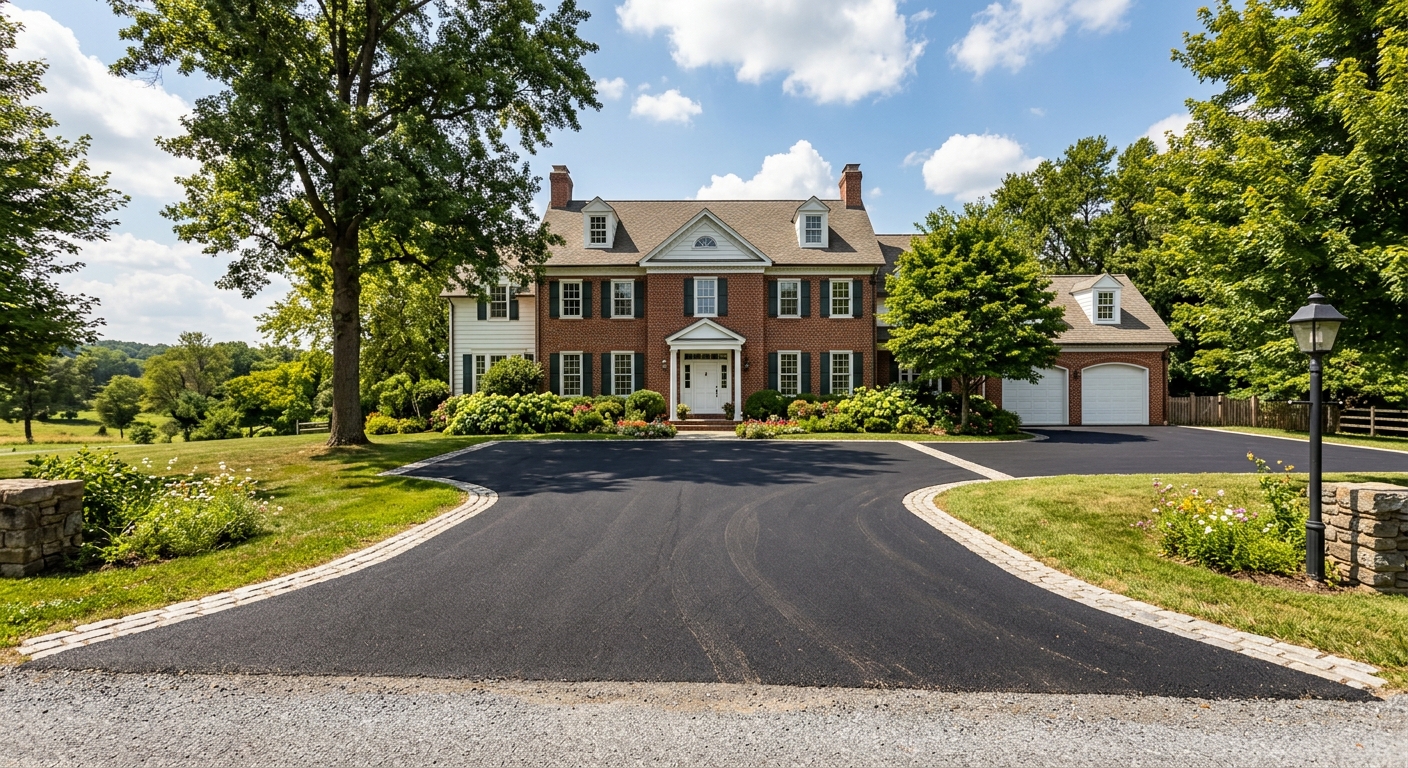
Driveway paving costs in Yeadon — 2026
In Yeadon, driveway paving is mainly a concern for those who own single-family homes, which make up only 13.8% of the housing here (U.S. Census Bureau, ACS 2024). With a homeownership rate under half, plenty of driveways are actually shared or absent. If you do have your own, expect prices to track closely to the condition of what lies underneath—not just what you see.
The regional climate is punishing, with repeated freeze-thaw cycles that test any pavement, and the older homes here (most built before 1980) tend to sit on a patchwork of glacial till or fill. These soils demand extra attention: cheap paving jobs often skip base prep, but that's where the real cost differences are hiding. You might see a wide range in quotes, but thick, compacted base and good drainage account for most of the premium—not brand or equipment. Your future repairs will trace back to how this step was handled, not the cosmetic finish.
If you’re budgeting, here’s what to expect for common options:
| Service |
Best for |
Lifespan |
Price range |
| Asphalt — full replacement with new base |
failed base, structural cracking |
20–30 yrs |
$3,400–$8,700 |
| Asphalt overlay / resurfacing |
sound base, surface cracking only |
8–15 yrs |
$1,450–$4,300 |
| Sealcoating — single application |
preventive maintenance on sound asphalt |
2–4 yrs |
$200–$700 |
| Concrete — new installation |
long service life, low maintenance |
30–50 yrs |
$4,800–$11,500 |
| Crack filling and patching |
isolated cracks under a quarter inch |
1–3 yrs |
$200–$800 |
| Gravel driveway |
rural, budget, long runs |
5–10 yrs with upkeep |
$900–$3,500 |
Estimates for a typical Yeadon driveway. Square footage and base condition drive these figures more than material choice.
Why Yeadon driveways fail from the bottom up
Under every Yeadon driveway is a layered system that matters far more than the paving itself. Start with the subgrade, which here is often glacial till or a mix of compacted urban fill—both typical in Delaware County as older streets and lots were redeveloped. On top of that goes a compacted aggregate base (crushed stone), and finally the asphalt or concrete surface.
Each layer takes the load and spreads it out. If anyone skimps—laying thin stone, skipping proper compaction, or paving directly on old, shifting material—the system fails from the bottom up. The single biggest threat here is frost heave: water in the subgrade freezes, expands, and forcibly lifts the base and surface, creating cracks and uneven areas. Our moderate freeze-thaw climate makes this a recurring event, not just a one-off, so it isn’t enough to add a thicker top layer. The foundation must be right.
Cheap quotes cut costs here, not at the top. Watch for skipped excavation, minimal new stone, single-pass compaction, or straight resurfacing over a visibly failed drive. All are shortcuts that show almost no warning on day one, but reveal themselves within a few winters—cracking, rutting, and edge breakup.
For any replacement or major resurfacing, demand written specs: at least 6 inches of compacted, clean 2A modified aggregate (crushed stone), compacted in “lifts”—that means spreading and compacting stone in 2-to-3-inch layers, never all at once. Compaction testing during install isn’t overkill; it’s insurance. If a crew won’t put these specs in writing, expect the drive to fail early. That’s how most “good deals” become expensive regrets around year three in Yeadon.
Permits and approvals for paving in Yeadon
If you're repaving an existing residential driveway in Yeadon—no changes to its size or footprint—you generally do not need to pull a building permit. This saves a headache and some fees, but make sure there’s no confusion about expanding or moving anything, as that can change the requirements on you.
The line to the road is different: if you need to touch the “approach”—the area where your driveway meets the street—permits are usually handled by your local township for local streets, or by PennDOT District 6 if your property fronts a state route. Many homeowners expect the borough or county to handle all approvals, but for this piece it's a separate process with a different authority.
Stormwater is the next consideration. Expanding a drive, adding impervious area, or changing your drainage plan can trigger requirements for runoff controls. And even if you skip permits, the law still says you can’t send water onto your neighbor’s property. Drainage that keeps water on your lot is your liability, not theirs.
Before hiring anyone, verify they’re properly registered. Pennsylvania requires Home Improvement Contractor (HIC) registration for jobs over $500—make sure your contractor’s status is current at hic.attorneygeneral.gov. If they have employees, verify their workers’ compensation insurance through the WCAIS system at wcais.pa.gov. In Yeadon and all of Delaware County, these protections are non-negotiable, and quick to check.
Comparing materials in southeastern Pennsylvania
Yeadon’s climate is hard on driveway surfaces, and material choice is never just about price. Asphalt is by far the most common in Delaware County: it’s flexible, rides out repeated freeze and thaw cycles, and if the base is done right, it won’t crack easily. That flexibility is its main asset—especially where the underlying soil moves each year.
Concrete, on the other hand, offers the longest lifespan if it survives early winters. It costs more—upfront and for removal if you ever want to change it. But in a climate like Yeadon’s, concrete is vulnerable to scaling and spalling from de-icing salt. If you (or your kids, your tenants, your guests) use regular salt, expect surface damage within a few winters. If you avoid chloride de-icers and don’t mind cleaning snow the traditional way, you will get much longer life.
Concrete mainly makes sense for those committed to maintenance discipline, or those who want the lowest recurring hassle. Asphalt suits most Yeadon households, who need something that tolerates mild neglect and regular salt.
Paver driveways are rare here, but can work on steep lots or for those wanting individual-unit repair. Gravel still serves long, shared, or rear-alley drives, especially where cost matters more than appearance.
| Option |
Installed cost |
Maintenance |
Freeze-thaw performance |
Lifespan |
| Asphalt — new install |
$3,400–$8,700 |
sealcoat every 3–4 yrs |
excellent, flexes |
20–30 yrs |
| Asphalt — overlay |
$1,450–$4,300 |
same |
good if base is sound |
+8–15 yrs |
| Concrete |
$4,800–$11,500 |
low, avoid de-icing salt |
fair, spalls with salt |
30–50 yrs |
| Pavers |
$7,700–$11,500 |
individual units replaceable |
good, settles gradually |
25–50 yrs |
| Gravel |
$900–$3,500 |
top-dress every 2–3 yrs |
excellent drainage |
indefinite with upkeep |
Overlay, patch or full replacement?
Most Yeadon driveways can be diagnosed by a few visual clues. Start with the cracking: if you see interconnected “alligator” cracks over large areas, that’s a sign the base has failed and any surface repair is a temporary patch at best. But if it’s just a handful of thin, straight cracks, you might only need sealing and small patch work.
Depressions or “birdbaths” that hold water point to the subgrade shifting, often caused by freeze-thaw cycles or poor drainage. Crumbling along the edges usually means the original builder skipped proper edge support—very common in older drives built when material standards were more relaxed. Potholes appear where water has penetrated the base, and unless the area is saw-cut and fully rebuilt, it’ll just reappear.
Don’t spend money on overlays (a thin layer over the existing surface) where there’s clear evidence of base failure. A good contractor will probe test the base before recommending anything. If they don’t, they’re guessing, and you’ll be paying again soon.
| What you see |
Likely cause |
Right fix |
Cost |
| Isolated cracks under 1/4 inch |
surface aging |
crack fill and seal |
$200–$700 |
| Alligator cracking over a wide area |
base failure |
full replacement |
$3,400–$8,700 |
| Depressions holding water |
subgrade movement |
excavate and rebuild that area |
$3,400–$5,300 |
| Crumbling edges |
no edge support |
edge repair, consider curbing |
$400–$1,500 |
| Potholes |
water into the base |
full-depth patch, then assess |
$250–$900 |
| Faded but sound surface |
oxidation only |
sealcoat |
$200–$700 |
The driveway scams that work in Yeadon
Even in a crowded market like Delaware County, Yeadon still draws pavement scammers every spring and fall. The scams are formulaic and prey on two things: homeowners’ urge for quick fixes and the simple fact that most paving defects show up years after a job is done.
Most common are the “leftover material” scam (claiming there’s extra asphalt from a job “down the road”), one-day-only pricing, crews in unmarked trucks from out of state, requests for large upfront cash, and verbal-only quotes. Some swindle by spraying a thin oil coat and calling it sealcoating. With so many contractors competing within a few miles (minimal surcharges mean everyone works this area), enforcement is better than rural PA, but so is the volume of crews passing through.
Pennsylvania’s Home Improvement Consumer Protection Act is there specifically to stop this: you’re entitled to a written contract for any job over $500, a three-business-day right to cancel signed contracts, and it’s illegal for a contractor to tell you to waive your insurance deductible. If a contractor pushes you to close immediately, ask for the paperwork and check their registration before you sign.
Five minutes’ work: confirm HIC registration and workers’ comp (sites above), demand a full written scope and estimate, never pay more than a modest deposit up front, and walk away from anyone who pressures you to “act now.” These habits defeat 99% of scams in Yeadon.
Why you can't pave in February
Asphalt paving in Yeadon comes to a hard stop as soon as cold weather sets in. This isn’t just a matter of convenience: hot-mix asphalt must be installed and compacted while it’s still hot, or it won’t bond or seal right. Once outside air drops toward the mid-40s, and certainly below freezing, the mix cools too fast and you’re left with a weak, porous job guaranteed to fail early.
Local asphalt plants—mainly in Eddystone and South Philadelphia for this area—shut down for the winter, so the material just isn’t available after November until spring. Concrete is a little more forgiving but still demands above-freezing air and ground. Pouring either material in weather that’s too cold or too wet is a waste; both the Pennsylvania Uniform Construction Code and common sense demand you avoid it.
The shoulder seasons (April–June, September–early November) are best: there’s capacity, weather is stable, and prices aren’t inflated by mid-summer competition. July and August book up fast—if you want a choice of crews, don’t wait for school to let out. If anyone offers to pave for you in December–February, they’re either new to the region or just don’t care what kind of job you get. Don’t bite.
Frequently asked questions — driveway paving in Yeadon
What does an asphalt overlay cost in Yeadon?
For most Yeadon driveways, an asphalt overlay (sometimes called resurfacing) costs between $1,450–$4,300, with the typical price around $2,900. The exact figure depends on your driveway’s size and, more importantly, its existing base condition. In many Yeadon neighborhoods, driveways are either shared or narrow, which can keep costs toward the lower half of that range. However, overlays only work if the base beneath is still solid—otherwise, it’s quite literally money paved over a problem. If a contractor doesn’t inspect or test the base before quoting, ask pointed questions or look elsewhere. Always insist that price includes saw-cut transitions at the street and garage, as well as repair of any significant base failure spots first.
How often should I sealcoat my driveway in Yeadon?
In Yeadon, most asphalt driveways benefit from sealcoating every 3–4 years. This is because our region’s freeze-thaw weather, combined with summer sun and occasional coastal storms, ages the surface faster than in many other parts of Pennsylvania. Sealcoating isn’t a cure for cracks or potholes, but it does preserve the finished surface and delay oxidation. Expect to pay $200–$700 for a single application, depending on surface area. If your drive is heavily shaded or beneath dripping trees, you may be able to stretch the cycle toward 4 years—but if the surface starts to show grey fading or hairline cracks, don’t delay. Remember, it’s only worth the money if your asphalt isn’t already failing underneath.
Why does my driveway have depressions that hold water?
In Yeadon, depressions or “birdbaths” form in driveways when the subgrade below has shifted or settled over time—often due to freeze-thaw cycles, poor drainage, or thin original construction. Our compacted fill and glacial till soils add to the challenge; water that can’t drain away can expand and contract each winter, leaving sunken spots each spring. If the depressions are deep or new, the remedy is not a simple overlay—those will reflect the problem in a year or two. Typically, the right fix is to saw-cut or excavate those specific areas, rebuild the base, and patch the asphalt, which falls closer to $3,400–$5,300 if a significant portion of the drive is affected. Superficial patches or sealcoating won’t address the underlying cause.
Should I repair or replace my Yeadon driveway?
In Yeadon, whether you repair or replace depends on what you see and what you can’t. Isolated cracks under 1/4 inch wide can often be filled and sealed for $200–$700, buying you a couple more years. But widespread “alligator” cracking, potholes, or sunken areas almost always mean the base has failed—and in Delaware County’s climate and soils, that means full replacement is needed, at $3,400–$8,700. If you’re on the fence, ask for a written base assessment from a contractor (and make sure they actually test—don’t rely on a glance). Spot repairs are only a good bet if 90% of the surface is sound. Otherwise, replacing now is much cheaper than multiple rounds of failed patchwork.
What does compaction in lifts mean?
“Compaction in lifts” is essential for durable driveway construction in Yeadon. It means that, instead of dumping all the new aggregate base down at once and compacting the top, the crew spreads the stone in thin, manageable layers—usually 2 to 3 inches deep at a time. Each lift is mechanically compacted before the next one is added. This step bonds each layer to the one underneath and removes hidden air pockets. In older neighborhoods with glacial till and fill soils, this is especially crucial: water can migrate and freeze in loose base, making failure almost inevitable. A properly compacted base will resist water intrusion and future heaving. Always insist on this in your contract for any paving that costs more than $3,400—you’ll see the benefit for years in a smooth, stable drive.
How much does it cost to widen a driveway?
Widening a driveway in Yeadon typically costs about as much per square foot as a total driveway replacement, mainly because you need to excavate, dispose of old material, prepare the base, and match the new work seamlessly into the old. For most local jobs, this means adding a parking pad or going from a single to a double width usually runs from $3,400–$8,700 total, depending on area. Keep in mind: expanding the drive triggers permit requirements in townships like Upper Darby, and can also require stormwater plans if you increase impervious surface. Budget for both construction and paperwork—and double check setbacks and local requirements before you commit.
Can I cancel a paving contract I signed at my door?
Yes, you can. Under the Pennsylvania Home Improvement Consumer Protection Act, homeowners in Yeadon and anywhere in the state have a 3-business-day right of cancellation on any contract for work over $500—especially important when a paver shows up unsolicited. You must notify the contractor in writing within that window. The law also requires that your written contract (not just a verbal agreement) includes notice of this right. Look for that clause before signing; if it isn’t there, the contract isn’t enforceable and should raise a red flag. If you already made a down payment, the contractor is legally obligated to return your funds after cancellation. This is a critical safeguard, especially with asphalt jobs that can be rushed by transient crews using high-pressure tactics.
How far ahead should I book a paver in Yeadon?
In Yeadon, it’s best to start contacting contractors at least 4–6 weeks in advance of when you hope to have work done, especially in the late spring or early summer. Local demand surges as soon as school ends and weather stabilizes—Delaware County’s big contractor market means competition, but peak dates book fast. If you call in March or April, most reputable crews will be able to visit, estimate, and fit you in before mid-summer. Calling in July or August means you may need to wait until early fall. Also keep in mind that prices occasionally rise by a few hundred dollars per job at the height of the season, with driveways ranging from $3,400–$8,700 for a full replacement. Booking ahead gives you more choice and negotiating leverage.
What kind of soil is under Yeadon driveways?
The soil beneath most Yeadon driveways is a mix of glacial till and compacted urban fill, just like much of inner Delaware County. Glacial till is a blend of silt, sand, gravel, and clay left behind by ancient glaciers; urban fill is a wild card, sometimes containing brick, cinder, or construction debris, especially in neighborhoods built before 1980. These mixed soils can be unpredictable: they may shift or settle over time and are prone to water retention, which is why frost heave is such a persistent problem for driveways here. The right answer for this subgrade is a well-compacted base of at least 6 inches of 2A modified aggregate, which supports the driveway and limits movement. Skimping on base prep to save money—say, with an overlay at $1,450–$4,300—is rarely worth it on these soils.