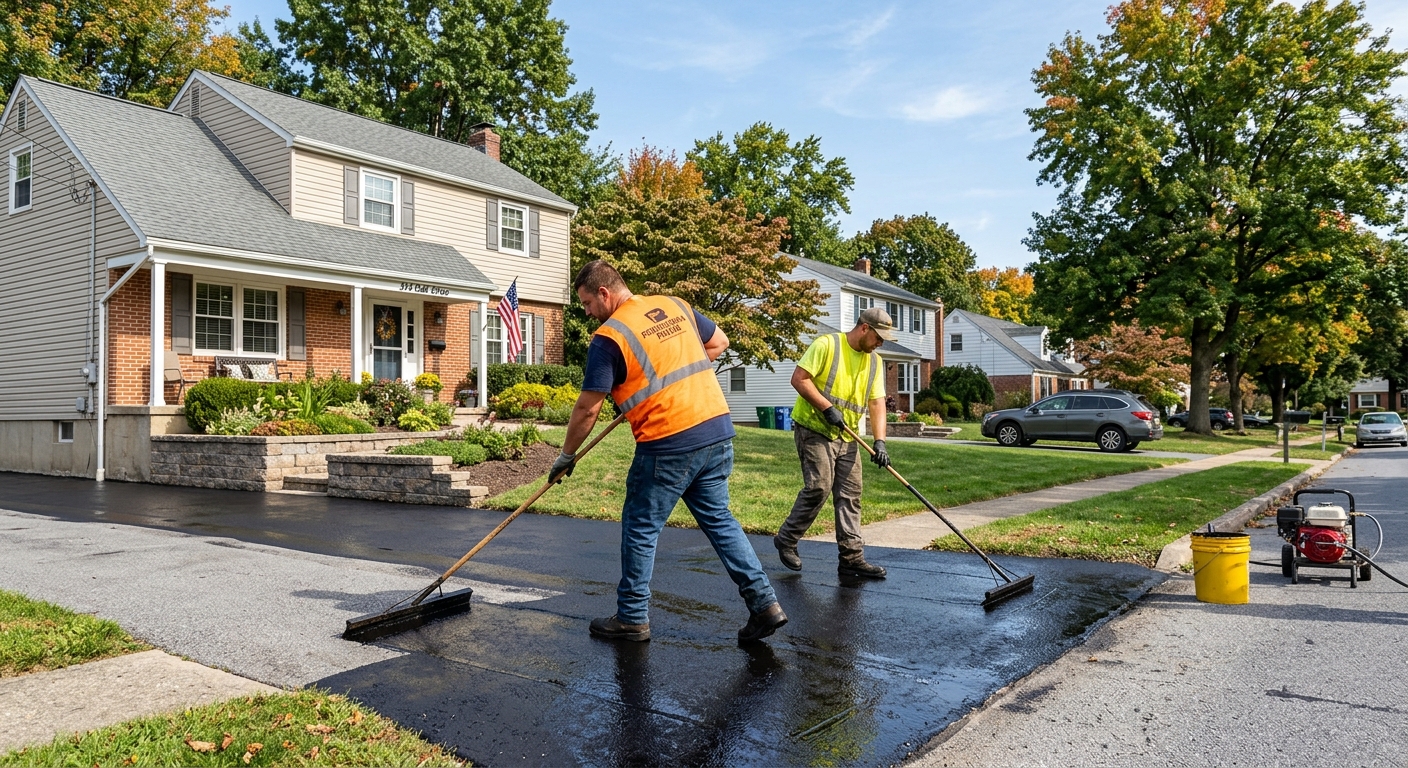
Hampton paving prices by scope — 2026
In Hampton, where nearly 80% of homes are single-family and owner-occupied (U.S. Census Bureau, ACS 2024), driveway paving is a practical necessity. This part of Allegheny County sits on clay and shale subgrade and gets heavy freeze-thaw cycles each winter. Both facts drive up the importance of getting the base right under your driveway — because most of the cost difference between two quotes is what you can't see. Skimp on stone or compaction, and the surface might look fine the first year but will heave, settle, or crack long before it should. All pricing shown here is for 2026 and reflects local conditions, including short hauls from area asphalt plants and a competitive contractor market.
| Service |
Best for |
Lifespan |
Price range |
| Asphalt — full replacement with new base |
failed base, structural cracking |
20–30 yrs |
$3,900–$9,900 |
| Asphalt overlay / resurfacing |
sound base, surface cracking only |
8–15 yrs |
$1,650–$5,000 |
| Sealcoating — single application |
preventive maintenance on sound asphalt |
2–4 yrs |
$225–$750 |
| Concrete — new installation |
long service life, low maintenance |
30–50 yrs |
$5,500–$13,000 |
| Crack filling and patching |
isolated cracks under a quarter inch |
1–3 yrs |
$200–$800 |
| Gravel driveway |
rural, budget, long runs |
5–10 yrs with upkeep |
$900–$3,500 |
Estimates for a typical Hampton driveway. Square footage and base condition drive these figures more than material choice.
Getting thirty years out of a driveway
If you want your Hampton driveway to last decades, start by stopping water before it ever gets beneath the surface. Prompt crack filling is the single cheapest and most effective action you can take. Even a hairline crack is a doorway for water, and in our freeze-thaw climate, that water expands, breaks down the base, and turns small problems into structural failures.
Second, keep the edges supported. Most driveways fail first at the borders, where unsupported asphalt or concrete crumbles under car tires or slips away thanks to ground movement (common with our local clay and shale soils). If your driveway edges border lawn, gravel shoulders or edging stones prevent wheel break-off.
Third, drainage: driveways on Allegheny County hillsides can act as slideways for runoff. Make sure water flows off and away — not down the middle or into a neighbor’s yard — and clear leaves from any drains before winter.
Avoid placing heavy items like dumpsters or jack stands on the same spot. Point loads crush base stone. For new asphalt, wait at least a full week before parking, and don’t turn wheels in place until it has hardened up — a common mistake that scars many driveways here.
As for de-icing: salt damages concrete faster than any freeze can. On asphalt, the main hazard is that salt accelerates freeze-thaw cycling — melting snow in the day and letting it refreeze in cracks overnight. Safer (though more expensive) options: calcium magnesium acetate, or sand for traction without melt.
The honest case for and against sealcoating
Most ads for sealcoating in Hampton claim it will “extend your driveway’s life.” Here’s what a two-decade paver in Allegheny County will tell you: sealcoating does a good job protecting asphalt from UV exposure, engine fluids, and improving its appearance, which can be worth it if you care how your driveway looks. A fresh seal restores that dark black finish and makes tidier neighborhoods look sharper.
What sealcoating does not do: it will not add strength or fix a failing base. If the asphalt is already cracking, the cracks will open right up again under the seal. Too-frequent sealcoating — every year, for example — actually accelerates peeling. Applied too soon (on new asphalt that hasn’t fully cured and released its oils), it can trap volatiles and wreck the surface.
The right timing is every two to four years, starting after the first season has weathered the surface. Less is more. If a contractor tells you to sealcoat annually, ask how they deal with layer buildup and peeling — because excessive layers flake off in our freeze-thaw cycles.
Crack filling does more to prevent real damage than sealcoating alone. And a proper seal (squeegee or heavy spray at the right thickness) will last. Too thin and it just looks black for a season, but provides no protection. At $225–$750 for an application, a suspiciously low price usually signals a quick spray —not enough material, not enough prep.
How to tell if the base is gone
In Hampton, here’s how you can usually tell if your driveway’s real problem runs below the surface: widespread “alligator” cracking (a scaly network over wide areas) is a near-certain sign of base failure. If you resurface over this, the cracks will come right back. Isolated straight-line cracks are mostly just surface aging and can be filled. Depressed spots or birdbaths that hold water indicate subgrade movement below — common on our hilly, clay-heavy soils. Crumbling edges mean there’s no proper border support. Potholes mean water has already punched through the surface and washed out the base, letting wheel traffic finish the job.
Every one of these issues can be diagnosed by any homeowner with a careful walk after a rain. If a contractor gives you an overlay quote without probing or coring the base (digging down or at least prying at an edge), that’s a red flag. It is always cheaper, long-term, to rebuild a failed base than to pave over it; overlays on a rotten base don’t last. Here’s a guide to what you’ll see, what it means, and what the real solutions cost in 2026:
| What you see |
Likely cause |
Right fix |
Cost |
| Isolated cracks under 1/4 inch |
surface aging |
crack fill and seal |
$225–$750 |
| Alligator cracking over a wide area |
base failure |
full replacement |
$3,900–$9,900 |
| Depressions holding water |
subgrade movement |
excavate and rebuild that area |
$3,900–$6,100 |
| Crumbling edges |
no edge support |
edge repair, consider curbing |
$400–$1,500 |
| Potholes |
water into the base |
full-depth patch, then assess |
$250–$900 |
| Faded but sound surface |
oxidation only |
sealcoat |
$225–$750 |
Why you can't pave in February
Paving in Hampton stops for a reason. Hot-mix asphalt — the kind you want for any proper driveway — has a very tight temperature window to work in. The region’s winter design temperature is 8°F, and we’re deep enough into the hills of Allegheny County that ground can freeze over three feet deep. Once air temperatures drop below about 45°F, hot-mix loses workability in minutes. If a crew tries to lay it cold, your driveway will never compact right and will ravel or break up within a year or two. That’s not a preference: it’s physics and regional climate.
Every local asphalt plant closes from late November until April; there’s simply no supply. Concrete also needs above-freezing conditions, or it will not cure properly and can spall or crack. This is why you can’t buy a proper paving job in the dead of winter, no matter what anyone offers. Most contractors fill their calendars in early spring for summer work. Shoulder seasons — April–May and September–October — offer the best chance at flexible scheduling and sometimes better pricing. If someone offers to pave your driveway on a January warm snap, they’re not getting material from a real regional plant, and their standards are suspect.
Local soil, drainage and driveway lifespan
Driveway performance in Hampton is all about what’s beneath: clay and shale. Clay subgrade — common across Allegheny County hillsides — holds water, freezes and expands, then shrinks and destabilizes the base when it dries. This means a deeper aggregate base (sometimes six inches or more, well compacted) is necessary compared to what works in sandier regions. Shale pockets drain poorly and can fracture, undermining support through our severe freeze-thaw cycles and pushing new asphalt or concrete up in “frost heave.”
The frost depth here is 36 inches, and each winter brings enough temperature swings to stress even a properly built driveway. Many driveways in Hampton’s post-1945 subdivisions were put in before base standards were widely enforced. It’s not uncommon to pull back a 1970s asphalt layer and find little more than compacted clay underneath — which means the surface will never last its rated decades unless the base is entirely rebuilt.
In short: our local subgrade demands more attention, not less. No amount of topcoating can fix water trapped under poorly compacted base. Drainage corrections and edge support are not extras — they’re the standard for Allegheny County driveways with any hope of lasting thirty winters.
What you need before paving in Hampton
For most driveway resurfacing projects (asphalt or concrete) on your own property in Hampton, no right-of-way or building permit is typically required if the footprint stays unchanged and does not touch sidewalks, curbs, or the approach at the public road. But as soon as you’re altering the approach — the connection from your driveway to a public road or state route — a separate permit comes into play, and it’s not handled by just the local municipality. In Allegheny County, any approach onto a state route requires a Highway Occupancy Permit from PennDOT District 11-0, not the local code office.
If you plan to widen or reroute your driveway, or add impervious surface, be aware this may trigger local stormwater management rules. Even without a permit requirement, directing your runoff onto a neighbor’s land creates liability and should be avoided; always aim to keep rainwater heading to the street or approved drains, especially on our hilly lots.
By law, any contract for paving over $500 requires the contractor be registered as a Pennsylvania Home Improvement Contractor (verify at hic.attorneygeneral.gov). All employees on site must be covered by workers’ compensation — check their coverage via WCAIS (wcais.pa.gov) before work begins. A written contract and a three-day right of cancellation are also required for your protection under state law.
Frequently asked questions — driveway paving in Hampton
Does Hampton have local asphalt plants?
The Hampton area benefits from a high contractor density and multiple local asphalt plants located around the Pittsburgh metro. This shortens haul distances, which keeps mix temperature optimal on arrival and helps pricing stay competitive compared to more remote Pennsylvania towns. For homeowners in Hampton, this means you’re unlikely to pay extra for long transport, and emergency repairs or small jobs can often be scheduled more quickly. With plants nearby, paying a premium above the usual $3,900–$9,900 band for a new driveway is unnecessary unless you have exceptional site needs.
What does sealcoating cost in Hampton?
Sealcoating a typical Hampton driveway with a single application falls in the $225–$750 range as of 2026, depending on square footage and prep required. Most single-family homes here are on the larger side compared to older urban neighborhoods, so expect to be in the upper half of that band unless you have a short drive. Be wary of much lower estimates — they generally cut corners on surface prep or use too little sealer, which reduces the protective benefit. Good prep (cleaning, crack filling first) lets the coating actually perform its job on our freeze-prone surfaces.
When can I seal a brand new asphalt driveway?
In Hampton and throughout southwestern PA, wait at least a full curing season — 90 days minimum, but ideally until the following spring or fall — before sealcoating new asphalt. The region’s climate and our heavy clay soils slow down the cure, because the surface retains oils longer. Sealing too soon traps volatiles and can peel or crack far earlier than you’d expect. A first seal application, properly done, should leave you on the lower side of the $225–$750 range and won’t need repeating annually. For best results, plan for the first seal during cool, dry weather after the mix has seen both sun and rain.
Why are paving quotes in Hampton so different from each other?
Most of the difference between competing paving bids in Hampton reflects what’s being done under the surface, not just the thickness of the new top layer. With our region’s mix of clay and shale subgrades and freeze-thaw cycles, some contractors may skimp on base prep or compaction — costs you can’t see when work is done. Others may include proper excavation, thicker stone, and edge support, which is what gets you toward the 20–30 year lifespan for $3,900–$9,900. Always ask for details on base thickness and compaction, and choose the bid that addresses your site’s needs, not just the lowest sticker.
What is the difference between binder and surface course?
On asphalt driveways in Hampton, the binder course is the thicker, coarser base layer — it provides strength and absorbs loads, especially critical on our hilly, shifting soils. The surface (or wearing) course is the fine-topped layer you see and drive on. Quality jobs use both, since the surface course alone would not hold up to freeze-thaw or heavy traffic. Expect a standard two-course build to fall within $3,900–$9,900. In resurfacing or overlay jobs, just the surface gets replaced; if the base is unsound, adding binder is necessary for real longevity.
Can I pave over my existing driveway?
If your existing asphalt driveway in Hampton is mostly sound — with just surface cracking or fading — a resurfacing overlay can be a smart move. This costs less, in the $1,650–$5,000 band, and takes less time than full excavation. However, if you have widespread alligator cracking, deep depressions, or multiple potholes (especially on our clay-heavy soils), paving over it is just burying the problem. Any overlay on a failed base in Allegheny County conditions will show new cracks within a couple of winters. Always have a professional assess the base first; a core sample is worth the cost.
How far ahead should I book a paver in Hampton?
In Hampton, the paving window runs from mid-April through October, right after local asphalt plants reopen. The best contractors book up quickly, often 1–3 months out by late spring — especially for full replacement jobs in the $3,900–$9,900 range. Emergency patch or crack filling is easier to schedule than full replacements. Avoid crews who claim they can pave in the dead of winter, since plants are closed and results will suffer. Booking in shoulder months like April or September can also yield better scheduling flexibility and, occasionally, off-peak pricing.
How long should an asphalt driveway last in Hampton?
A well-built asphalt driveway in Hampton, with attention to deeper aggregate base and drainage for our clay and shale soils, should hold up for 20–30 years. If done cheaply — with just a thin layer over old, unsound base — expect 5–8 years. With proper crack maintenance and professional sealcoating ($225–$750 per application every few years), you’ll extend service life substantially. Climate is the enemy here, with freeze-thaw every winter, so placing priority on base prep is money well-spent in the long run.
How do I verify a paving contractor in Pennsylvania?
In Pennsylvania, every paving contractor working on jobs above $500 must be registered as a Pennsylvania Home Improvement Contractor — check their number at hic.attorneygeneral.gov before signing anything for driveway work in Hampton. They are also required to carry workers’ compensation insurance, which you can look up via the WCAIS system (wcais.pa.gov). Require a written contract, with all terms and the three-day right to cancel, as required by state law. All the above applies whether you’re getting a full replacement ($3,900–$9,900) or just patch work. Reputable contractors expect these questions — ask before you sign.