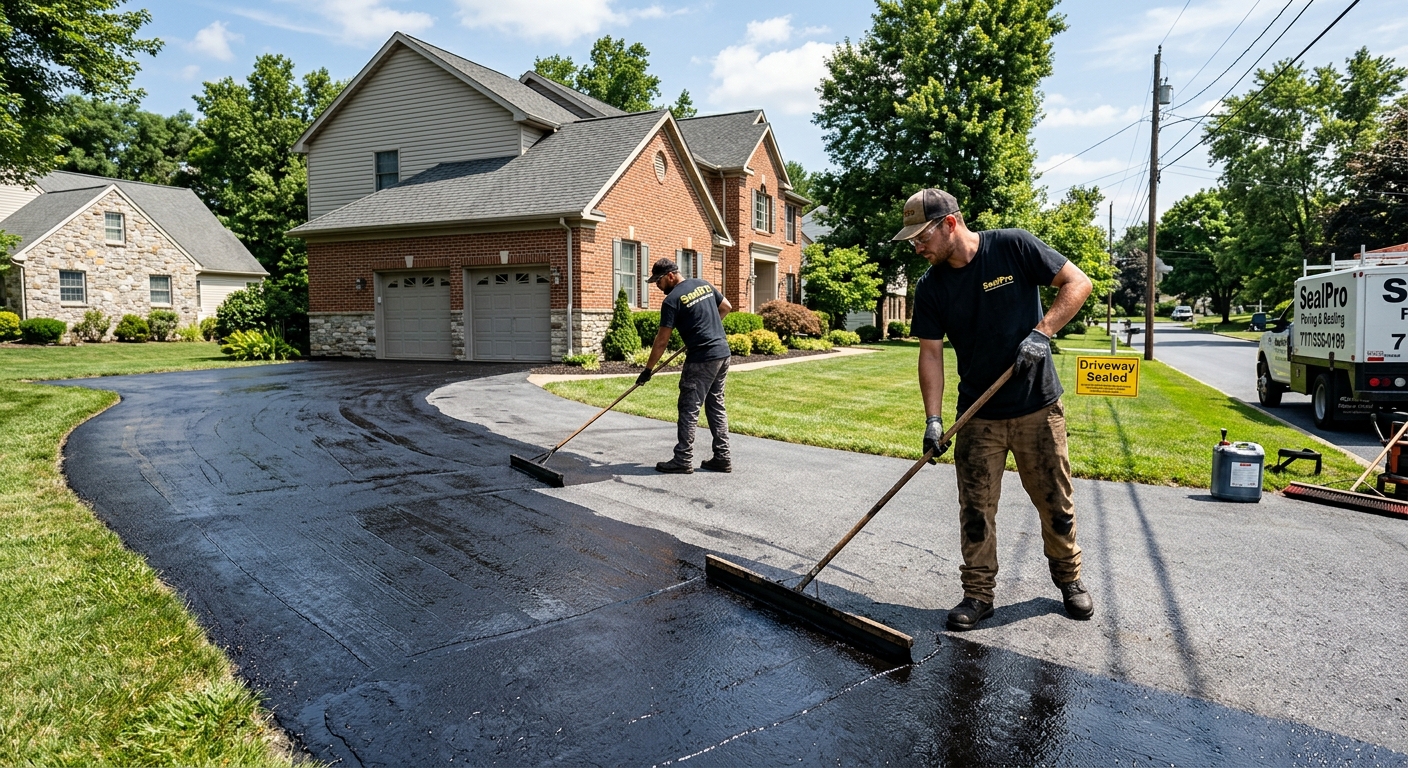
Upper St. Clair paving prices by scope — 2026
Upper St. Clair’s neighborhoods are overwhelmingly single-family, owner-occupied homes (86.7% and 88.3% respectively, U.S. Census Bureau, ACS 2024), so driveway paving is something most residents face sooner or later. Southwest Pennsylvania’s heavy freeze-thaw cycles and native clay-and-shale soils shape both cost and longevity of paving projects in this area. These local ground conditions mean the most important (and expensive) work happens under the surface—out of sight. This is why two quotes for the “same” job can differ by thousands: one might budget for a proper new base, the other for just a skin of asphalt over existing problems.
Because the climate here is tough on pavements, and improper drainage or a weak base will doom even expensive work, it’s worth knowing what you’re really being quoted for. Asphalt replacement, overlays, sealcoating, or concrete all have markedly different costs, benefits, and lifespans. The table below details the typical 2026 price landscape for Upper St. Clair homes:
| Service |
Best for |
Lifespan |
Price range |
| Asphalt — full replacement with new base |
failed base, structural cracking |
20–30 yrs |
$3,900–$9,900 |
| Asphalt overlay / resurfacing |
sound base, surface cracking only |
8–15 yrs |
$1,650–$5,000 |
| Sealcoating — single application |
preventive maintenance on sound asphalt |
2–4 yrs |
$225–$750 |
| Concrete — new installation |
long service life, low maintenance |
30–50 yrs |
$5,500–$13,000 |
| Crack filling and patching |
isolated cracks under a quarter inch |
1–3 yrs |
$200–$800 |
| Gravel driveway |
rural, budget, long runs |
5–10 yrs with upkeep |
$900–$3,500 |
Estimates for a typical Upper St. Clair driveway. Square footage and base condition drive these figures more than material choice.
Widening, extending or adding a parking pad
If you plan to widen your Upper St. Clair driveway for a second vehicle, extend it toward a detached garage, add a turnaround, or install a new parking pad, you’re looking at a project that goes beyond simple resurfacing. Any new footprint—meaning paving where there was previously soil or yard—requires new base stone laid over undisturbed, unprepared clay or shale subgrade. Because these soils are common on our hillsides, proper base depth and compaction are non-negotiable for lasting results.
The new seam between old and new pavement will always be a potential weak spot; it’s either a property line for cracks, or a visual mismatch between aged and fresh material. Impervious surface limits, which restrict how much of your lot you can cover with pavement or concrete, may come into play. Setback rules will also limit how close you can pave to your property line, especially for parking pads or extensions near side yards.
If your extension or pad affects where the driveway meets a public road—especially a state road—the approach often needs a Highway Occupancy Permit from PennDOT District 11-0. Projects that increase paved area can also trigger stormwater management requirements, both local and at the township level, to ensure runoff isn’t directed onto the street or a neighbor’s lot. Before starting, it’s smart to check with local code enforcement to avoid costly corrections.
Reading a driveway proposal
Before hiring a contractor to pave or replace your driveway in Upper St. Clair, insist on a detailed written proposal. The key line items should spell out: measured square footage (not just “typical size”), excavation depth, disposal of any removed material, the aggregate type and depth for the stone base, and methods for base and asphalt compaction, which must be done in stages or “lifts.” Asphalt work should name both the courses (base and surface, with compacted thickness for each) and edge treatment, especially since our hillside soils can promote edge breakup without proper support.
Grading and drainage provisions should specifically say how water will shed—either by cross-slope, crowning, or drains—because improper pitch is a leading cause of pavement failure here. Small details, like how disturbed soil along the edge will be restored, protect the rest of your yard. A legitimate contract should require just a modest deposit, with balance due at completion. Most paving “warranties” exclude cracking (no matter how strongly worded), so make sure what’s covered is clear in writing. Avoid any one-line proposal with just a price—this is how underbuilt work gets passed off as a bargain, but you pay later.
| Line item |
What to look for |
Red flag if… |
| Area |
measured square footage stated |
eyeballed or absent |
| Excavation |
depth and disposal included |
'we'll pave over it' |
| Base |
aggregate type and depth in inches |
'proper base' |
| Compaction |
method, and done in lifts |
not mentioned |
| Asphalt |
courses and compacted depth |
'3 inches' unqualified |
| Drainage |
slope and water direction stated |
silent |
| Warranty |
what is covered and what is excluded |
verbal only |
| Payment |
modest deposit, balance on completion |
full cash up front |
Overlay, patch or full replacement?
In Upper St. Clair, most driveways are decades old and seeing their first or second round of major repair. Here’s how to size up your own: Step one is always the base condition, because no surface fix will survive long if the foundation is undermined.
Alligator (network) cracking across wide areas indicates base failure—an overlay on top won’t hold, and it’s time for a true replacement. Isolated, linear cracks are just a sign of aging asphalt surface; these can be sealed and covered with a sealcoat. Depressions or birdbaths that hold water mean your underlying subgrade has moved, almost always from water infiltration and freeze-thaw cycles in our clay-dominated soils. Edge crumbling means there was never adequate support, common on steep or poorly built driveway borders. Potholes mean water has already reached and weakened the base.
If you get quotes for a simple overlay but you see serious cracking or soft spots, be skeptical—unless the contractor tests the base (probing or digging small test holes), that’s money wasted. Here’s a quick guide:
| What you see |
Likely cause |
Right fix |
Cost |
| Isolated cracks under 1/4 inch |
surface aging |
crack fill and seal |
$225–$750 |
| Alligator cracking over a wide area |
base failure |
full replacement |
$3,900–$9,900 |
| Depressions holding water |
subgrade movement |
excavate and rebuild that area |
$3,900–$6,100 |
| Crumbling edges |
no edge support |
edge repair, consider curbing |
$400–$1,500 |
| Potholes |
water into the base |
full-depth patch, then assess |
$250–$900 |
| Faded but sound surface |
oxidation only |
sealcoat |
$225–$750 |
Where the water goes
Water is the silent killer of Upper St. Clair driveways. If a driveway doesn’t shed water properly, the result is premature cracking, potholing, and even wholesale heaving after one or two harsh winters. The minimum finished slope for runoff is 2%, either crowned or with a cross-slope away from structures. Driveways that run toward a garage or house are at high risk for water intrusion; if regrading isn’t possible, trench or channel drains at the threshold can manage stormwater, but only if the runoff has somewhere to go.
Heavy clay—a common hillside subgrade here—drains poorly and holds water against your driveway’s base. This makes finished grading and underdrain design more critical than just paving “to grade.” When moisture sits below the surface, every freeze-thaw cycle (with 8 °F winter design lows) expands the water, pushing the driveway up and then dropping it unevenly as it thaws—wrecking the pavement structure from underneath. This is why local standards specify both deeper base and proper lateral drainage.
Runoff must discharge to a “daylight” (open) point or filtered into a dry well, never onto a neighbor’s lot. Besides being a liability, redirected runoff can spark disputes no permit will shield you from. A good paving job in Upper St. Clair always starts with water in mind.
Permits and approvals for paving in Upper St. Clair
Most residential driveway replacement or resurfacing projects within the existing footprint in Upper St. Clair don’t require a full building permit, so you can often skip a trip to the township office for those. However, if your driveway ties into a public road, especially a state-owned route, the approach where the driveway meets the street usually requires a Highway Occupancy Permit from PennDOT District 11-0—not your local township. This surprises many, but using the correct authority prevents headaches or fines later.
Projects that widen, extend, or otherwise add to the impervious surface may require additional stormwater review to ensure runoff is controlled and won’t impact neighboring properties or the public right-of-way. Even with permits in hand, channeling water onto adjacent lots creates a liability regardless of code.
By law, any contract over $500 for driveway work must be in writing under Pennsylvania’s Home Improvement Consumer Protection Act. Make sure your contractor’s Home Improvement Contractor (HIC) registration is active (check at hic.attorneygeneral.gov), and verify they have current workers’ compensation insurance through the WCAIS system. Taking the time up front avoids expensive corrections or disputes down the line.
Why driveways behave differently in Upper St. Clair
Driveways in Upper St. Clair endure both the region’s heavy freeze-thaw cycles and the challenges of local hillside soils—mainly clay and shale. Clay, in particular, holds water like a sponge and is slow to drain, making it especially prone to frost heave during the area’s cold snaps, with a frost depth of 36 inches. Shale offers less flex but can create its own issues if crushed under repeated loads.
The practical outcome for homeowners is this: Your driveway needs a thicker aggregate base and thoughtful drainage design than a similar one just a county or two east or south. Most driveways here, built during the postwar subdivision era (1945–1975), might not have been constructed with modern standards for base or compaction. Asphalt driveways in Penn Hills, McCandless, and surrounding townships are reaching the end of their original service life, which means homeowners often face the decision between a proper structural overlay and simple sealcoating. Shortcuts on these hills end up costing more, as water finds and multiplies every mistake under the pavement.
Frequently asked questions — driveway paving in Upper St. Clair
What does an asphalt overlay cost in Upper St. Clair?
An asphalt overlay in Upper St. Clair, where the existing driveway base is still sound but the surface is showing wear, typically runs $1,650–$5,000 depending on driveway size and the amount of edge or patch prep needed. Most homeowners fall around the average of $3,300 for the usual two-car driveway. Because our soils are generally clay and the area is hilly, overlays can only work if the sub-base is firm, shows no depressions or alligator cracking, and sheds water well. If a contractor skips assessing the base, it’s not worth paying even the low end—you’d just be covering up a structural problem that will resurface within a few years. Always ask your paving contractor to explain how they determined the underlying base is suitable for resurfacing in Upper St. Clair’s local conditions.
How often should I sealcoat my driveway in Upper St. Clair?
For Upper St. Clair, sealcoating is recommended every two to four years—closer to two if your driveway sees a lot of sun, heavy traffic, or is older with more minor cracks. The price for a single sealcoat application is typically $225–$750 for a standard residential drive. Our region’s freeze-thaw cycles, road salt, and clay soils stress asphalt, so skipping maintenance allows water to penetrate and shorten pavement life. However, you shouldn’t sealcoat every year—this can build up too much material and lead to peeling. Stick to a schedule based on real wear and weather, not just the calendar, and remember: a sound surface is required for a sealcoat to be effective. If there are major cracks or surface depressions, those should be fixed first, not hidden.
Asphalt or concrete for a Upper St. Clair driveway?
In Upper St. Clair, asphalt is the conventional and more affordable choice for residential driveways, with a full replacement costing $3,900–$9,900 versus concrete’s $5,500–$13,000. Asphalt is flexible, performs better over clay and shale subgrades, and repairs easily—good for freeze-thaw cycles that can crack rigid pavements. Concrete, on the other hand, offers a longer service life (30–50 years), stays lighter in summer, and requires less frequent maintenance. The upfront cost is higher, and local clay soils still require substantial base prep to avoid frost movement. The decision really comes down to budget, desired service life, and willingness to keep up with asphalt maintenance. Always compare proposals that specify base prep and thickness, especially in Upper St. Clair where soils demand it.
Do I need an approach permit where my driveway meets the road?
Yes, in Upper St. Clair and throughout Allegheny County, a permit is required for any new or altered driveway approach where it meets a state, county, or local road. For approaches connecting to state routes, this comes from PennDOT District 11-0, not the township. Failing to secure a permit can delay your project or even result in having to redo the work. For resurfacing an existing driveway that doesn’t change the apron or curb cut, the permit isn’t typically needed. Always check with your local authority and, especially for extensions or new driveways, confirm who owns the roadway before any work begins.
How long should an asphalt driveway last in Upper St. Clair?
With proper installation—including adequate base, compaction, and drainage—an asphalt driveway in Upper St. Clair should last 20–30 years. However, the typical lifespan often falls to 15–20 years because of our hilly terrain, freeze-thaw action, and poor-draining clay soils. Surface overlays without addressing underlying base issues usually last only 8–15 years. Routine maintenance, like filling small cracks and sealing, can stretch your investment, but once you see alligator cracking or depressions, it’s time to plan for full replacement. Skimping on base depth or drainage shortens service life, especially on the slopes and soils common to our neighborhoods.
How long before I can drive on a new asphalt driveway?
In Upper St. Clair, it’s best to wait three full days—sometimes more in cool, cloudy weather—before driving on a new asphalt driveway. Asphalt needs sufficient time to cool and harden, particularly because the region’s humidity and temperatures can slow curing. For heavy vehicles or delivery trucks, hold off at least a week. Even after that, avoid sharp turns and parking in the same spot for extended periods for the first month. A new asphalt installation costing $3,900–$9,900 can be ruined by rushing this step, as indentations and scuff marks from tires are much easier to make in the first couple weeks. Patience up front prevents costly repairs later.
Why are paving quotes in Upper St. Clair so different from each other?
Quotes for the same driveway in Upper St. Clair can easily differ by several thousand dollars. Most of this gap comes from what’s happening below the surface—specifically, the amount and quality of new stone base, the depth and type of asphalt, and proper drainage. One company might promise a “full replacement” for $3,900–$9,900, but if the proposal doesn’t specify the excavation or base preparation, you could end up with a thin overlay that won’t survive more than a few winters. The highest bid isn’t always better, but the lowest often cuts corners on the steps that really matter in our freeze-thaw, clay-heavy environment. Always ask for a line-item proposal so you know what you’re paying for, down to the compaction method and slope.
What kind of soil is under Upper St. Clair driveways?
Under most Upper St. Clair driveways, the subgrade is clay mixed with shale. This combination poses real challenges for paving: clay holds water and expands when frozen, causing heaving and cracks, while shale can fragment or fail to support the edges of a driveway. These soils demand thicker aggregate bases and more aggressive drainage than a sandy or gravelly site. Homeowners frequently see edge cracking and birdbaths where drainage wasn’t properly managed. If you’re planning a replacement in the $3,900–$9,900 range, insist your contractor discusses how they’ll address clay and shale soils—otherwise you’ll pay for the same work sooner than you expect.
What is the difference between binder and surface course?
For asphalt paving in Upper St. Clair, the binder course is the first, thicker layer laid over the base—in effect, the strong backbone of your driveway. It uses larger stone aggregate and acts as the structural support. The surface course, sometimes called “top,” is a thinner, finer mix that gives the finished driveway a smooth, attractive look and protects the binder from water and sunlight. Both are required for a new asphalt replacement, which typically runs $3,900–$9,900. A cheap overlay might use just one thin course, which won’t last on our hillsides and clay soils. Make sure your proposal calls out both courses and their compacted thickness—at least 2.5" of binder and 1–1.5" of surface is standard for our conditions.