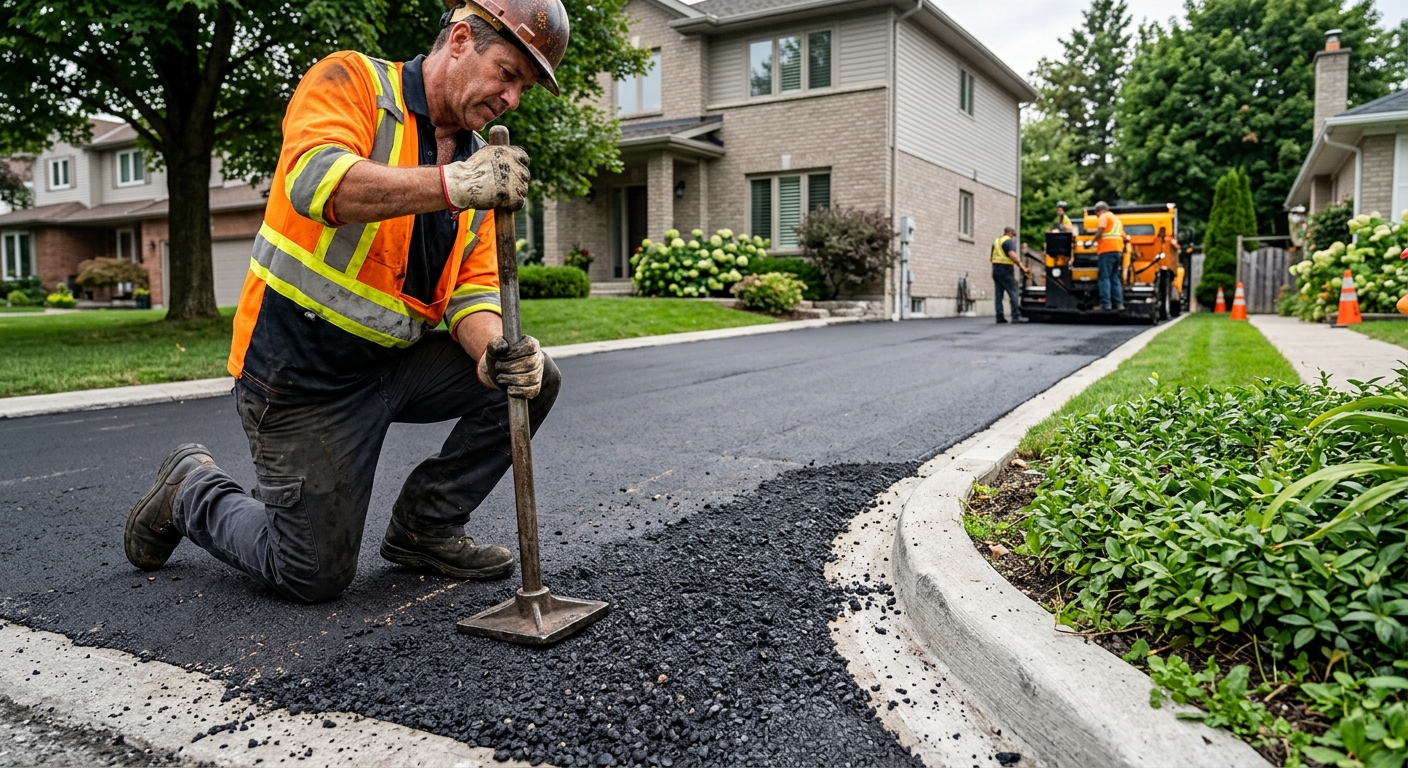
Hatfield paving prices by scope — 2026
In Hatfield, where 48% of homes are single-family and the majority of residents own their homes (65.4%), driveway expenses are a common reality. Southeast Pennsylvania's freeze-thaw cycles and silty clay subgrade mean local driveways face unique stresses, especially under the surface where you can't see. Most price differences between paving quotes here are less about the visible paving layer and more about how the contractor deals with the stone base and soil beneath it. If your home was built before 1980 — as more than half in Hatfield are — chances are the original driveway base has aged or settled, making a competent rebuild crucial.
The big thing to grasp: a cut-rate bid often reflects corners cut underground, not just thrift above it. The local market is dense with contractors, but the real economies — or disasters — are made by base prep. Below, you'll see typical prices and service life for each paving option in Montgomery County:
| Service |
Best for |
Lifespan |
Price range |
| Asphalt — full replacement with new base |
failed base, structural cracking |
20–30 yrs |
$3,700–$9,600 |
| Asphalt overlay / resurfacing |
sound base, surface cracking only |
8–15 yrs |
$1,600–$4,800 |
| Sealcoating — single application |
preventive maintenance on sound asphalt |
2–4 yrs |
$225–$750 |
| Concrete — new installation |
long service life, low maintenance |
30–50 yrs |
$5,300–$13,000 |
| Crack filling and patching |
isolated cracks under a quarter inch |
1–3 yrs |
$200–$800 |
| Gravel driveway |
rural, budget, long runs |
5–10 yrs with upkeep |
$900–$3,500 |
Estimates for a typical Hatfield driveway. Square footage and base condition drive these figures more than material choice.
Caring for a new Hatfield driveway
The single best way to extend your driveway's life in Hatfield is to keep cracks filled before water gets into the base stone. Once moisture gets below the surface — especially in southeast Pennsylvania's freeze-thaw climate — the countdown to major repairs begins. Next in priority: keep the driveway edges supported with soil, stone, or curbing, since unsupported edges break down fast here. Always maintain grading to carry water off; never let it sit. Big point loads — dumpsters, jack stands, campers parked six months — will rut even a new drive on our clay soils.
With new asphalt, let it cure for 3–7 days before parking a car, and avoid turning your wheels while stationary for the first few months. Concrete needs even longer — at least a week without traffic, and up to a month for full strength. Don’t let anyone rush the process; early loading shortens life.
On de-icing: Salt is rough on concrete — it causes scaling and spalling, especially on slabs installed in our region. If you want to use de-icer, opt for calcium magnesium acetate or sand. These are more expensive than rock salt, but you'll get the full service life from your driveway. On asphalt, salt isn’t the direct issue; repeated melt-and-refreeze cycles accelerate surface damage, so use it only when essential and sweep excess off after storms.
How to tell if the base is gone
The condition of your driveway's base — the stone below the asphalt or concrete — is what decides whether repair money is well spent or wasted. In Hatfield, you can do a quick self-check before calling anyone. If you see alligator cracking (thick, web-like patterns), that's a near-certain sign the base is shot. No overlay will outlast a few seasons over that. If the cracks are straight or branching but few and isolated, that's usually aging on the surface. If you notice low spots that hold water ("birdbaths") or general depressions, the stone base or native subgrade has shifted, often thanks to our area's freeze-thaw cycles and silty clay soils. Edges that crumble tend to mean there is no base support at the edge, which is common in this market. Potholes mean that water has reached the base and eroded support — patching won’t hold if the area isn’t rebuilt from the stone up.
If you’re quoted an overlay without the contractor probing through the surface or coring, take it as a red flag. No amount of "top coat" will fix a root issue below. Here’s how the common symptoms line up with fixes and costs in Montgomery County:
| What you see |
Likely cause |
Right fix |
Cost |
| Isolated cracks under 1/4 inch |
surface aging |
crack fill and seal |
$225–$750 |
| Alligator cracking over a wide area |
base failure |
full replacement |
$3,700–$9,600 |
| Depressions holding water |
subgrade movement |
excavate and rebuild that area |
$3,700–$5,900 |
| Crumbling edges |
no edge support |
edge repair, consider curbing |
$400–$1,500 |
| Potholes |
water into the base |
full-depth patch, then assess |
$250–$900 |
| Faded but sound surface |
oxidation only |
sealcoat |
$225–$750 |
Permits and approvals for paving in Hatfield
If you are repaving your driveway in its existing location and dimensions in Hatfield, a building permit is usually not required. However, if you plan to widen it or alter the street apron — where your driveway meets the public road — you’ll likely need a permit. In Montgomery Township, for example, road occupancy permits for driveway approaches are issued by the Montgomery Township Public Works Department, not your local building office or township.
If you plan to expand your driveway or change where runoff flows, be aware that stormwater regulations may kick in. Adding impervious surface can trigger requirements for runoff control: dry wells, trenches, or other measures to prevent flooding neighboring properties. Regardless of what the permit office says, you are responsible if your driveway channels water onto a neighbor’s land.
Every paving contractor who works on jobs over $500 in Pennsylvania must be registered as a Home Improvement Contractor with the Pennsylvania Office of Attorney General — check at hic.attorneygeneral.gov for current registration. If workers are on site, workers’ compensation coverage is required by law; you can confirm active coverage at WCAIS (wcais.pa.gov).
Grading and water management on a Hatfield driveway
Good grading is what separates a twenty-year driveway from a money pit in Hatfield. At minimum, your driveway needs a consistent slope — 2% (about a quarter inch per foot) — to drain water off and away. In this region, driveways are either crowned (center higher than edges, draining both ways) or set with a cross slope to one side. If yours slopes toward your garage, water will try to find a way in, especially during heavy rains brought by coastal storm remnants. When grade can’t be corrected with paving alone, a trench or channel drain at the garage entry is a sound solution. Collected water should be daylighted (run to an open area), not dumped at your home’s foundation or onto your neighbor’s yard.
The southeast Pennsylvania clay in most Hatfield yards holds water against the base. Freeze-thaw cycles turn trapped moisture into frost heaving, which destroys both asphalt and concrete in short order. This is why a thicker graded-stone base is worth every penny. Always err on the side of over-building drainage: once water is under the pavement, repairs are far more costly.
Finally, even if the township grants approval, you remain liable for runoff that damages adjacent property. Don’t settle for “it passed inspection” if the water isn’t managed correctly — you’ll bear the consequences.
Numbers, not adjectives
In Hatfield, price means less than the specs behind it. Insist every quote for paving work spells out the numbers: the depth of excavation (not just the new paving), size and type of stone in the aggregate base, depth after compaction — not just "as laid" — and whether compaction is done in lifts (layers). Asphalt paving compresses about 20–25% from loose to finished depth: “three inches” loose is “two and a half” compacted. Our region’s climate with moderate freeze-thaw, heavy clay soils, and heavy vehicles means minimum depths here are higher than in warmer, drier climates. The mix designation (e.g., ID-2 binder or FC-1 surface), and the specification for edges — curb, extra stone, or nothing — should be written in. Any ambiguity here is to a contractor’s advantage, not yours.
- Total excavation depth (inches, before new base; deeper if old material is soft)
- Aggregate base thickness (compacted; aim for 6–8 inches on Hatfield’s clay soils)
- Base material type/source (2A modified stone is standard locally)
- Compaction method (mechanical plate or roller) and number of lifts (layers)
- Asphalt binder course thickness (compacted, not loose)
- Asphalt surface course thickness (compacted)
- Mix designation for each layer (ID-2, FC-1, etc.)
- Edge detail specification (supported/wrapped, curb, or reinforced edge stone)
- Drainage provision (minimum slope, trench drains, daylighting)
- Paving dates (to avoid cold-weather pours or late-season closures)
Asphalt or concrete for a Hatfield driveway?
Hatfield’s climate, with regular freeze-thaw cycles and humid summers, pushes both asphalt and concrete to their limits. Flexible asphalt survives this region’s subsurface movement by flexing — it may crack, but rarely catastrophically if installed over a good base. Concrete, while it can last 30–50 years, is less forgiving: here it tends to spall and scale under salt use, common in our snowy winters. Salt is a problem with concrete not because of chemicals alone, but because it pulls moisture in; freezing then causes chips and cracks. If you’re the type who won’t use salt, concrete can be a solid investment, but realistically, most owners eventually do.
Asphalt costs less up front and is straightforward to patch and seal when needed. Expect to reseal every few years; it’s the price of flexibility and our winter climate. Pavers are a premium option: they shift with ground movement and can be replaced individually, but cost nearly as much as concrete and depend on a well-built base. Gravel, while the cheapest, brings its own maintenance — dust, ruts, and top-dressing — but works well on long rural drives.
| Option |
Installed cost |
Maintenance |
Freeze-thaw performance |
Lifespan |
| Asphalt — new install |
$3,700–$9,600 |
sealcoat every 3–4 yrs |
excellent, flexes |
20–30 yrs |
| Asphalt — overlay |
$1,600–$4,800 |
same |
good if base is sound |
+8–15 yrs |
| Concrete |
$5,300–$13,000 |
low, avoid de-icing salt |
fair, spalls with salt |
30–50 yrs |
| Pavers |
$8,500–$13,000 |
individual units replaceable |
good, settles gradually |
25–50 yrs |
| Gravel |
$900–$3,500 |
top-dress every 2–3 yrs |
excellent drainage |
indefinite with upkeep |
Frequently asked questions — driveway paving in Hatfield
How long before I can drive on a new asphalt driveway?
Asphalt in Hatfield typically needs 3–7 days to cure before you park or drive vehicles on it. Our southeast Pennsylvania climate with summer humidity might slow that somewhat — on hot, muggy days, give it a full week if you can manage. For heavy vehicles or trailers, longer is better. Turning your wheels when stationary may scuff the new surface for the first month or two, but this is cosmetic and fades over time. If you need to get back on the drive quickly, ask about advance scheduling, but don’t rush; early use can shorten the driveway’s life and lead to cracks or depressions. Compared to the cost of a full replacement — $3,700–$9,600 — waiting a few extra days is a small ask.
Are pavers worth the cost in southeastern Pennsylvania?
Pavers are a legitimate option in Hatfield, especially if you want a distinctive look and easy repair of individual units. Their upfront cost is high — $8,500–$13,000 for most driveways — but they handle our freeze-thaw cycles well. Each paver can shift slightly with ground movement, so rather than cracking as a slab would, any settling is local and patchable. They don’t spall or flake like concrete can after a salty winter. Ongoing maintenance means re-leveling and replacing sand in the joints every few years, but the trade-off is a long service life if the base is properly built. In this area, with its heavy clay and snowy winters, pavers strike a balance between durability and appearance but demand both a bigger investment and solid installation.
Are door-to-door pavers a problem in Hatfield?
Yes, especially in early spring and late fall, it isn’t unusual for crews to canvas Hatfield neighborhoods offering “leftover” asphalt from other jobs. While not illegal, this practice is a red flag. Proper paving takes site prep, grading, and base work — none of which can be rushed just because a truck happened to have surplus material. Hatfield’s code and consumer protection require a written contract for work over $500; legitimate outfits will provide it, along with proof of current contractor registration. If a deal feels pushy or conditional on immediate agreement, politely decline. The risks — thin paving and no recourse if things go wrong — are not worth saving a small amount on the spot, especially when proper asphalt jobs run $3,700–$9,600.
Can I cancel a paving contract I signed at my door?
Yes. Under Pennsylvania’s Home Improvement Consumer Protection Act, any contract signed in your home — like those offered by door-to-door pavers in Hatfield — gives you the right to cancel within three business days, no penalties. The contractor must provide you this right in writing for contracts over $500. If you are not comfortable after signing, send a written notice by mail or email as soon as possible. Protect yourself further by verifying the contractor’s registration and workers’ compensation; if those are missing, cancel right away. The law also prohibits any contractor from offering to waive your insurance deductible — that’s another warning sign.
What does an asphalt overlay cost in Hatfield?
An asphalt overlay or resurfacing — where fresh asphalt is laid over a sound existing base — costs $1,600–$4,800 for the typical residential driveway in Hatfield. Your actual price depends mainly on square footage and whether any minor repairs or leveling are required first. This option gives you 8–15 more years if your base is solid, but if the base is failing, any money spent here is quickly lost. Always have the sub-base examined before committing to an overlay, as full replacement costs, though higher at $3,700–$9,600, are often the only long-term solution when there’s widespread cracking or sinking.
Does sealcoating fix cracks?
Sealcoating will not repair cracks — it only masks them. In Hatfield’s climate, keeping water out of the base is essential, so cracks should be cleaned and filled with a hot or cold crack sealer before any sealcoat application. Sealcoating itself is a surface protectant, extending life and keeping the pavement dark, but if applied over open cracks, water will find its way through. For a typical single application, expect to pay $225–$750. Always ask for the cracks to be filled and detailed separately on your invoice. Neglect this, and Hatfield’s freeze-thaw cycles will shorten your driveway’s lifespan significantly.
Why does my driveway have depressions that hold water?
Depressions or "birdbaths" on your Hatfield driveway happen when the stone base or subgrade shifts or settles. Southeastern Pennsylvania’s glacial till and clay soils hold water, and repeated freeze-thaw cycles expand and contract the ground each winter. If the original driveway base was thin or badly compacted, these weak spots show up earlier. Fixes range from targeted excavation and rebuilding — often costing $3,700–$5,900 for larger areas — to minor leveling if the sinking is shallow and isolated. Always address drainage first, since patching over sunken spots without fixing the root cause only buys time, not a real solution.
What does compaction in lifts mean?
Compaction in lifts means that instead of dumping all the stone or asphalt at once, it’s installed in layers — usually two or more — and each layer is compacted separately. In Hatfield, this is crucial. Our clay soils and the need to handle freeze-thaw mean thick material won’t compact evenly in one go. Without lifts, you get soft spots and later, cracks or dips. This is especially important for the base: for example, a 6–8" base should be placed in two or three layers, compacted with a mechanical roller each time for density. Specifying lifts in your contract, whether the job is $1,600–$9,600, ensures you’re not left with a pancake-thin foundation under your new surface.
How much does driveway paving cost in Hatfield?
For a typical Hatfield home, a full asphalt driveway replacement with new base runs $3,700–$9,600, depending on driveway size and access. An overlay on a solid base costs $1,600–$4,800. Basic sealcoating is $225–$750 per application. Concrete is more, at $5,300–$13,000. Most of the price difference comes from the depth of base reconstruction and not the thickness of the blacktop or concrete you see when it’s done. High homeownership rates in Hatfield mean quality work pays off at resale, but beware: the cheapest quote is usually betting you won’t notice what’s left out beneath the surface.