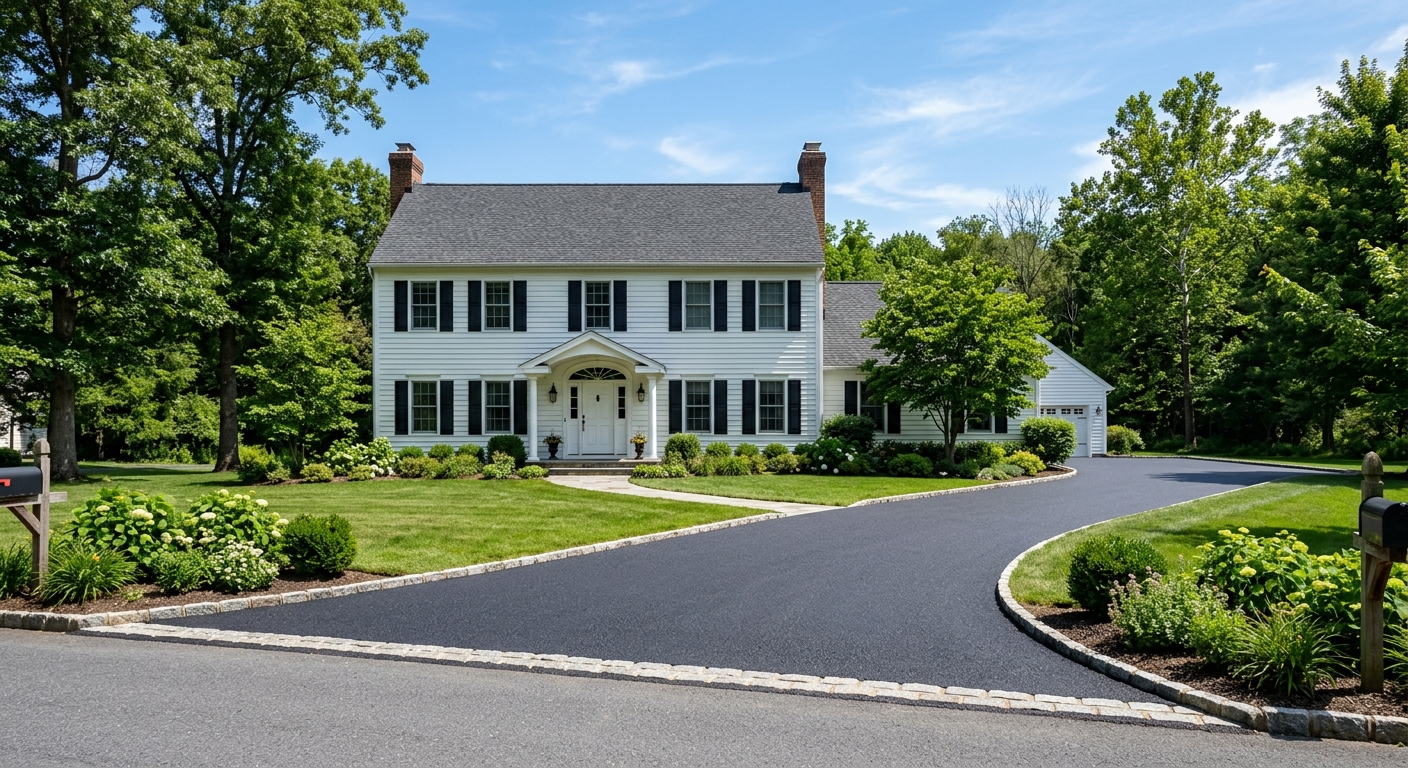
Driveway paving costs in Titusville — 2026
In Titusville, driveway paving costs depend less on the surface you see and more on what’s underneath it. With 59.8% of homes in Titusville classified as single-family and a homeownership rate of 57.1% (U.S. Census Bureau, ACS 2024), driveway replacement or resurfacing is a common, homeowner-driven project. Most driveways here were built before modern base standards, especially in Titusville’s older neighborhoods, which means base problems are the rule, not the exception.
Northwestern Pennsylvania’s freeze-thaw cycles and soils shaped by glacial till make the choice of paving method critical. The surface cost itself is visible, but the most expensive part of the job — excavation, aggregate, and drainage — will be out of sight. That’s why two quotes with identical surface specs can differ by thousands of dollars: one might cut corners on base preparation, shortchanging you on longevity.
Here’s what homeowners in Titusville can expect for their driveway investments in 2026:
| Service |
Best for |
Lifespan |
Price range |
| Asphalt — full replacement with new base |
failed base, structural cracking |
20–30 yrs |
$3,000–$7,800 |
| Asphalt overlay / resurfacing |
sound base, surface cracking only |
8–15 yrs |
$1,300–$3,900 |
| Sealcoating — single application |
preventive maintenance on sound asphalt |
2–4 yrs |
$175–$600 |
| Concrete — new installation |
long service life, low maintenance |
30–50 yrs |
$4,300–$10,500 |
| Crack filling and patching |
isolated cracks under a quarter inch |
1–3 yrs |
$200–$800 |
| Gravel driveway |
rural, budget, long runs |
5–10 yrs with upkeep |
$900–$3,500 |
Estimates for a typical Titusville driveway. Square footage and base condition drive these figures more than material choice.
Diagnosing a failing Titusville driveway
For homeowners in Titusville, being able to spot the signs of a failing driveway puts you on even ground with any contractor. The underlying base condition is what determines whether you need a full replacement or if an overlay or repair will buy you meaningful time. Here’s what to look for:
- Alligator cracking (a spiderweb pattern over a wide area) means the base has failed; any overlay here will just mirror the problem and waste your money.
- Isolated linear cracks or a few straight lines usually indicate surface aging rather than a base problem.
- Depressions or “birdbaths” holding water point to subgrade movement — the foundation beneath the stone base has shifted, usually from freeze-thaw cycles or poor drainage.
- Crumbling edges mean your driveway wasn’t given edge support during installation, which is common on older driveways in Titusville.
- Potholes mean water already reached the stone base, breaking it up underneath the surface layer.
Overlaying a structurally failed base is a guaranteed short lifespan — you’ll pay twice. A reputable contractor will probe and sometimes core sample the driveway to check base hardness and depth. If you get an overlay quote without this, they have not diagnosed the real cause of failure.
| What you see |
Likely cause |
Right fix |
Cost |
| Isolated cracks under 1/4 inch |
surface aging |
crack fill and seal |
$175–$600 |
| Alligator cracking over a wide area |
base failure |
full replacement |
$3,000–$7,800 |
| Depressions holding water |
subgrade movement |
excavate and rebuild that area |
$3,000–$4,800 |
| Crumbling edges |
no edge support |
edge repair, consider curbing |
$400–$1,500 |
| Potholes |
water into the base |
full-depth patch, then assess |
$250–$900 |
| Faded but sound surface |
oxidation only |
sealcoat |
$175–$600 |
Local soil, drainage and driveway lifespan
In Titusville and greater Crawford County, most driveways are built over glacial till — a stony, irregular mix left behind by retreating glaciers. This subgrade is not as well-draining as sand and is prone to holding pockets of water, especially in flatter front yards. Older homes, built between 1900 and 1940, often have steeper, shorter driveways originally laid with minimal grading and thin aggregate. Standards in this era didn’t account for modern vehicle loads or sustained freeze-thaw stress.
What this means for you: if your driveway is original or has only seen patching over several decades, there’s a good chance water is being trapped in the base during winter, heaving sections upward and breaking the asphalt or concrete above. Glacial till is sensitive to improper drainage, making a thicker stone base—often 8–12 inches instead of the standard 6—the rule, not the exception, in Titusville. Even high-riding rural driveways can sink or wash out at the edge when the base is skimped.
In short: this county’s geology drives up base costs, and it’s not contractor upselling — it’s reality for driveways that last in Titusville’s wet, freezing climate.
Permits and approvals for paving in Titusville
In most of Titusville and rural Crawford County, repaving or resurfacing your driveway does not require a building permit if you’re keeping the driveway the same size and in the existing footprint. If you plan to widen the apron where your driveway meets a public road, the approval comes from PennDOT District 1-0 for State Route 19 or 27, not from your township or city. Residents in Meadville will need to pull a driveway permit if replacing, expanding, or tying an apron into a city street, but township rules vary.
If you increase the overall paved area, this may trigger stormwater management requirements, even in unincorporated areas — especially if runoff might cross a neighboring property line. It’s also up to you, not the permit office, to make sure surface water doesn’t flow onto your neighbor’s land. This is a liability risk, not just a code issue.
Pennsylvania law requires that any contractor working on home improvement jobs over $500, including driveway paving, be registered with the Pennsylvania Office of Attorney General’s Home Improvement Contractor (HIC) program. You can (and should) verify this at hic.attorneygeneral.gov. Employers must also have active workers’ compensation insurance; check their status via WCAIS at wcais.pa.gov.
Where the water goes
Water is the underlying cause of nearly every driveway failure in Titusville, especially with the region’s heavy snowfall and frequent freeze-thaw cycles. To avoid cracks, heaving, and potholes, every driveway needs a deliberate drainage plan — not just a surface slope.
A driveway should slope at least 2% (roughly a quarter-inch per foot) toward the street or a ditch. Crowning, where the center is slightly higher than the edges, works well for wide driveways. On steeper approaches, a cross-slope toward a lawn or swale can be more effective. In Titusville’s older in-town lots, a driveway sloping toward your garage or home is all too common; in these cases, trench or channel drains at the garage threshold collect water before it can pool or enter the foundation.
With glacial till soils, which drain poorly and trap water, properly daylighting your pipe drain — letting it exit to a lower area — is crucial. Dry wells can work on bigger lots, but if soil is heavy with clay or till, these fill quickly.
Remember, if your grading change sends runoff onto a neighbor’s property, you could be legally responsible for any damage, even if your project is permitted by the local office.
Why Titusville driveways fail from the bottom up
Most Titusville driveways do not fail at the surface — they fail at the bottom. Every driveway is an assembly: a prepared subgrade (original soil, sometimes amended), a compacted aggregate base (usually crushed limestone or gravel, 6–12 inches thick in this region), and then the asphalt or concrete slab. Each layer has a job: the subgrade must be stable; the aggregate base spreads the load and drains water; the top layer protects and carries traffic. Skimping anywhere shortens the entire structure’s life.
Glacial till soils found in Titusville hold water unevenly. When winter comes and the base is saturated, that water freezes, expands, and pushes the driveway upward — “frost heave.” This lifts and cracks the surface from below. The only effective defense is a deep, compacted base with excellent drainage. That means excavating soft spots, using inch-minus crushed stone (not sand or recycled asphalt grindings), and compacting in lifts of no more than 4 inches at a time.
This is where a low bid almost always gets cheap: skipping base excavation, reusing soft or wet material, laying stone too thin, or skipping compaction between lifts. These shortcuts can’t be seen from your front stoop — or even on paving day — but show up in year 3 as cracks, waves, and ruts.
A proper spec for Titusville: at least 8 inches of compacted crushed stone base (more for clay or till), 3–4 inches of asphalt, each compacted separately. Get these numbers in writing and walk the site before paving. Ask specifically what type of aggregate will be used and require compaction is done in lifts with a plate or roller.
Which surface survives Titusville winters
For Titusville homeowners, freeze-thaw performance is the key difference between asphalt and concrete driveways. Our winters see frequent temperature swings, heavy Lake Erie-fed snow, and lots of de-icing salt. Asphalt’s flexibility allows it to flex slightly as the subgrade moves — it doesn’t crack as easily, making it a better fit for local conditions, particularly when glacial till soil holds moisture under the drive.
Concrete, by contrast, is harder and, in theory, lasts 30–50 years. But in Crawford County, salt applied during winter eats away at surface paste, causing scaling and spalling. Unless you avoid all salt-based de-icers (which few do in Titusville’s climate), concrete’s lifespan is often shortened. Concrete needs a thicker base if the underlying soil is glacial till or clay, which adds to cost.
Pavers can perform well, especially if one or two units need to be reset, and gravel remains a legitimate option for long rural drives as it never truly “fails” — it just needs maintenance.
| Option |
Installed cost |
Maintenance |
Freeze-thaw performance |
Lifespan |
| Asphalt — new install |
$3,000–$7,800 |
sealcoat every 3–4 yrs |
excellent, flexes |
20–30 yrs |
| Asphalt — overlay |
$1,300–$3,900 |
same |
good if base is sound |
+8–15 yrs |
| Concrete |
$4,300–$10,500 |
low, avoid de-icing salt |
fair, spalls with salt |
30–50 yrs |
| Pavers |
$6,900–$10,500 |
individual units replaceable |
good, settles gradually |
25–50 yrs |
| Gravel |
$900–$3,500 |
top-dress every 2–3 yrs |
excellent drainage |
indefinite with upkeep |
Frequently asked questions — driveway paving in Titusville
What slope does a driveway need for drainage?
In Titusville, driveways should be built with at least a 2% slope (a quarter-inch drop per foot) away from the house and toward the street or yard. This minimum is necessary to shed water efficiently, especially given the heavy snowfall and persistent freeze-thaw cycles that we get here each winter. If you have an older home, particularly one from the 1900–1940 era, your drive may be closer to level and prone to pooling. This puts the base at risk for frost heave and early failure. Where grade cannot be corrected, trench or channel drains are installed at typical costs ranging from $400–$1,500 to intercept water. Good drainage design is more important than upgrading the surface.
Why are my driveway edges crumbling?
Crumbling edges on Titusville driveways happen when asphalt or concrete is poured thin at the sides without any kind of edge restraint, which was common in driveways from the 1900–1940 period. Water can seep under the edges, deepening the problem over each freeze-thaw cycle. Heavy vehicles driving close to the edge or mowing close to the drive accelerates this issue. Edge repairs can range from $400–$1,500 if done early. If the edges are severely broken, rebuilding the border with curbing or an edge restraint is a lasting fix, and is a smart investment for longevity — especially given our glacial till soils that don’t provide firm edge support.
How often should I sealcoat my driveway in Titusville?
In Titusville, with its snowy winters and UV exposure, sealcoating is recommended every 3–4 years for asphalt driveways, not every year as some companies suggest. Over-sealing can actually lead to cracking by preventing evaporation. For a typical driveway, a single sealcoat application will cost $175–$600. Sealcoating extends life by preventing oxidation and moisture infiltration, but it’s only worthwhile if the base and surface are in good shape. If you see widespread cracks or shifting, sealing won’t help and your money is better spent diagnosing underlying base issues.
Are there stormwater rules on paving in Titusville?
Yes, expanding your paved surface in Titusville or anywhere in Crawford County may trigger stormwater management requirements, especially if you’re adding significant impervious area or altering runoff patterns. Even where the permit authorities don’t specifically require a drainage plan, you are liable if your runoff damages a neighbor’s property. Adding a new section or widening a driveway often requires that water be directed to a swale, ditch, or storm system rather than onto public streets or neighboring yards. Grading and drains can add several hundred to $1,500 to your job, but ignoring drainage can mean paying much more in repairs and liability later.
How much does driveway paving cost in Titusville?
For 2026 in Titusville, a typical full replacement asphalt driveway including a new base runs $3,000–$7,800. Concrete driveways start around $4,300 and can go up to $10,500 for larger installations. Overlaying an existing asphalt drive costs less, at $1,300–$3,900, but is only recommended if the base is in good shape. Factors like area, amount of excavation and base thickness are the real price drivers—not just surface area or material. Gravel, still common for rural homes, stays much more affordable at $900–$3,500.
How many freeze-thaw cycles does Titusville get?
Titusville sits within the Lake Erie snow belt and typically sees dozens of freeze-thaw cycles each winter, with average winter design temperatures around 5 °F and a frost depth of 36 inches. These cycles wreak havoc on any driveway base that holds moisture, especially if it’s laid over glacial till or clay. That’s why a thicker aggregate base and good drainage are not optional here, even if it costs more up front — neglect means spending $3,000–$7,800 all over again in just a few years.
What does an asphalt overlay cost in Titusville?
An asphalt overlay for a typical Titusville driveway costs between $1,300–$3,900 in 2026, with most averaging around $2,600. This price covers a new layer (1.5–2 inches) placed over a sound base with minor surface cracking. If your base is soft, wave-like, or shows alligator cracking, an overlay will not last. Be wary of overlay offers without any mention of base probing or repairs—overlaying a bad base is paying for a band-aid, not a fix.
Is an overlay worth it or should I start over?
An asphalt overlay in Titusville is only worth the expense if your driveway’s base is sound—meaning no widespread alligator cracking, deep depressions, or base soft spots. Overlays typically add 8–15 years of life and are less expensive, running $1,300–$3,900. But if you overlay over a failed base, you’ll likely find yourself facing the cost of full replacement $3,000–$7,800 much sooner. Always have your contractor core sample or probe the base before choosing an overlay solution.
Can asphalt be laid in cold weather?
Asphalt can technically be installed in cool weather, but for Titusville’s climate, the practical paving window is late April through October. The minimum recommended air temperature for laying hot mix is 50 °F and rising; anything colder risks poor compaction and early failures. If you get an off-season quote, expect the mix to cool before it’s compacted, especially since pavement gets shipped from Erie or Franklin, not made locally. Poorly installed cold-weather asphalt often needs patching within a year, turning that $1,300–$3,900 overlay or $3,000–$7,800 replacement into a do-over much sooner than planned.