What a new driveway costs in Leacock
Leacock’s driveways are the responsibility of homeowners—and with 64.2% of homes being single-family and a 65.9% homeownership rate (U.S. Census Bureau, ACS 2024), nearly everyone in Leacock considering new paving or repairs is facing a substantial out-of-pocket decision. Our south-central Pennsylvania climate—with repeated freeze-thaw cycles and moderate snowfall—shortens driveway lifespans compared to milder regions. The most important fact: for both cost and longevity, what matters most is what’s under the surface. Two bids that look similar on paper may hide big differences in how much old base is removed, how thick the new stone is, and how much asphalt is compacted in place. Those details determine whether your driveway holds up for decades or starts cracking after a few winters.
If you drive past two new driveways in Leacock, you can’t see how deep the contractor dug or how well they compacted the base. That’s why price alone rarely tells you who did the better job. Below are typical price ranges for driveway options in our area, but square footage and subgrade condition impact the total far more than the material you pick.
| Service |
Best for |
Lifespan |
Price range |
| Asphalt — full replacement with new base |
failed base, structural cracking |
20–30 yrs |
$3,500–$9,100 |
| Asphalt overlay / resurfacing |
sound base, surface cracking only |
8–15 yrs |
$1,500–$4,500 |
| Sealcoating — single application |
preventive maintenance on sound asphalt |
2–4 yrs |
$200–$700 |
| Concrete — new installation |
long service life, low maintenance |
30–50 yrs |
$5,000–$12,000 |
| Crack filling and patching |
isolated cracks under a quarter inch |
1–3 yrs |
$200–$800 |
| Gravel driveway |
rural, budget, long runs |
5–10 yrs with upkeep |
$900–$3,500 |
Estimates for a typical Leacock driveway. Square footage and base condition drive these figures more than material choice.
Asphalt or concrete for a Leacock driveway?
Lancaster County’s harsh freeze-thaw cycle takes a toll on all driveways, but it affects materials differently. Asphalt is flexible—when Leacock’s ground moves as it freezes and thaws, asphalt tends to flex and resist cracking. Concrete is much more rigid. It can last twice as long when built right, but in our region, it’s more likely to spall or scale from the use of de-icing salts in winter rather than from normal cracking. Many driveways in Leacock are replaced early because salt exposure flakes the surface, not because they structurally fail.
Concrete costs more up front and delivers a long service life—but only if you avoid using most common salt de-icers, which most people ignore once winter hits. It’s an honest tradeoff: longer lifespan and less maintenance for a higher cost and a stricter maintenance rule that is easy to forget. Asphalt driveways demand regular sealcoating every few years but remain easier and cheaper to repair after snowplow damage or salt tracking.
Pavers can be a good option for accent entrances or short drives, remain stable through gradual settling (especially on Leacock’s changing soils), but cost on par with premium options. Gravel is perfect for long rural drives and regrades easily, though dust and stone movement are ongoing annoyances.
| Option |
Installed cost |
Maintenance |
Freeze-thaw performance |
Lifespan |
| Asphalt — new install |
$3,500–$9,100 |
sealcoat every 3–4 yrs |
excellent, flexes |
20–30 yrs |
| Asphalt — overlay |
$1,500–$4,500 |
same |
good if base is sound |
+8–15 yrs |
| Concrete |
$5,000–$12,000 |
low, avoid de-icing salt |
fair, spalls with salt |
30–50 yrs |
| Pavers |
$8,000–$12,000 |
individual units replaceable |
good, settles gradually |
25–50 yrs |
| Gravel |
$900–$3,500 |
top-dress every 2–3 yrs |
excellent drainage |
indefinite with upkeep |
What to put in a Leacock paving contract
Shopping on price alone will not protect your investment in Leacock. The hidden work—the depth of base, the quality of stone, and the method of compaction—matters far more than the name-brand asphalt or the color of the topcoat. Pennsylvania’s pronounced freeze-thaw cycles and our 30-inch frost depth demand deeper, better-built driveways than you’ll see on TV or in warmer states.
Always get contract details in writing, because “we’ll put down three inches” is unclear: is it three inches before or after compaction? Two inches of fully compacted asphalt yields a much stronger driveway than three inches fluffed up but unrolled. Insist on specifics. In older Leacock homes, driveways may have been built before modern standards—so if you want it to last, you need numbers, not promises.
- Excavation depth (in inches)
- Type and depth of aggregate base (e.g., four inches crushed limestone)
- Compaction method (machine-rolled, in two or more lifts)
- Asphalt binder course thickness (compacted measurement)
- Asphalt surface (wear) course thickness (compacted)
- PA or local mix designation used (e.g., 9.5mm wearing course)
- Edge treatment—tamped, sloped, or with finished borders
- Drainage plan (driveway slope/direction)
- Who supplies the stone and asphalt plant name
- Warranty period for materials and workmanship
How often should a Leacock driveway be sealed?
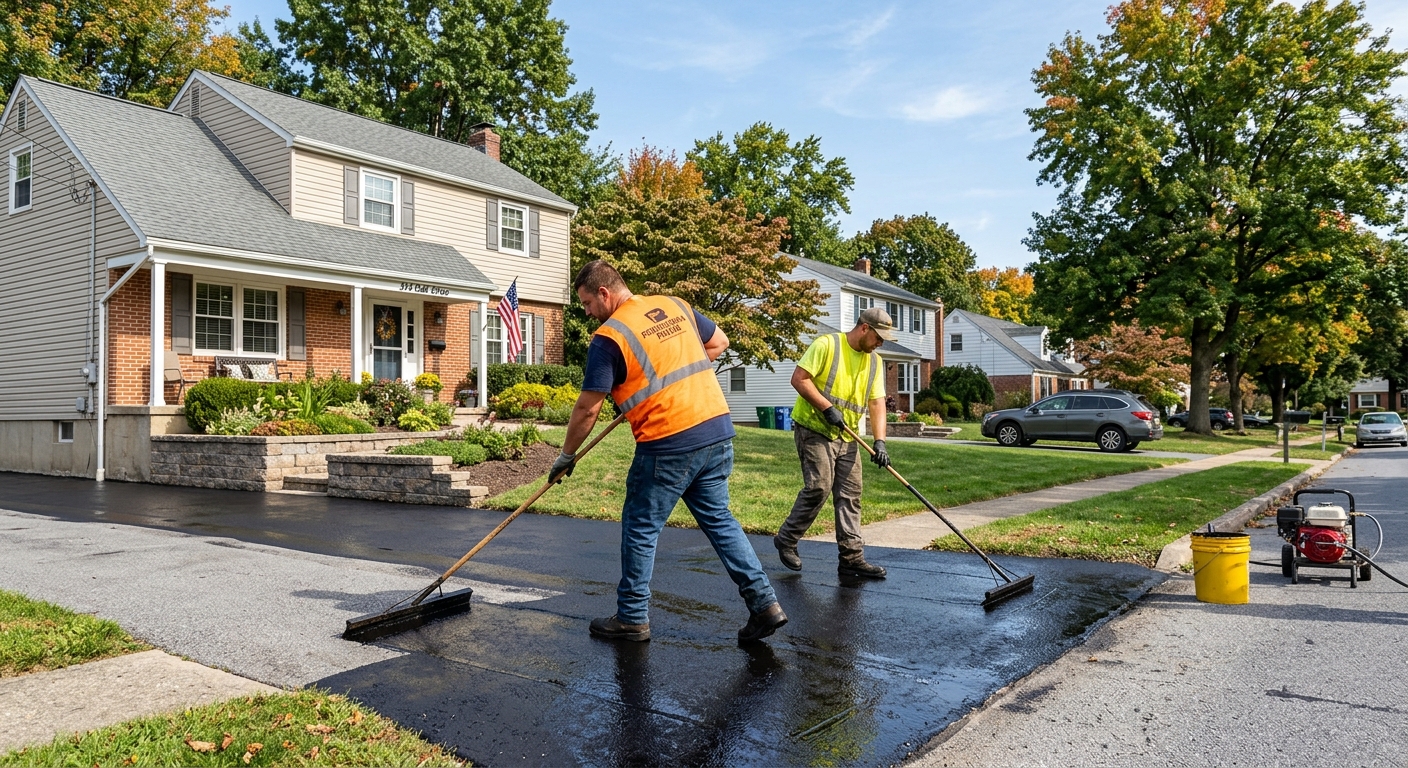
Sealcoating a driveway in Leacock keeps the asphalt looking sharp and shields it from oxidation and spilled oil or gas. It does not, however, make bad asphalt good or add true structural life—if your base is failing, sealcoat just hides the cracks for a while. More importantly, sealing too often is a real problem. Too many coats, too close together, create a brittle buildup that cracks, flakes, and peels as Leacock’s winters work on the surface. Sealcoating a new driveway too early—before it cures—can seal in volatile oils, slowing the hardening and risking soft or sticky spots.
The best advice is to wait one to two years after new asphalt is installed, or until water darkens the surface evenly and the rich black fades a bit. After that, sealcoat every 3–4 years, not every season. This interval works well for our freeze-thaw cycles and typical traffic. A proper job uses a squeegee or brush—not just a spray truck—applied at the right thickness. Sprayed sealcoats typically cost less (sometimes under $200–$400) but lack the durability of a hand-applied coat. Don’t be lured by a low number that buys you a layer of black water instead of a protective barrier.
While sealcoating is good maintenance, real longevity comes from filling cracks as soon as they appear. Proper crack fill keeps water out of the base—a much bigger deal for Leacock’s freeze-prone ground.
How to vet a paving contractor in Leacock
Leacock homeowners have to be diligent, because paving is awash with fast-talking salesmen who have never seen an asphalt plant. Only hire verified companies. First, check that the contractor holds Pennsylvania’s Home Improvement Contractor (HIC) registration—required for any project over $500—at the state’s registry. Any employer must have workers’ compensation insurance; you can confirm this through WCAIS. Ask for a physical business address (not just a cell number), proof of owned equipment (not all rented), and references from driveways done at least three years ago. Fresh references don’t prove durability. A legit local will know their source—Leacock’s stone comes from quarries near Lancaster and, if you’re on the rural edge, sometimes farther out, so the contractor should be able to name their supplier without hesitation.
- Verify HIC registration at hic.attorneygeneral.gov
- Check for workers’ compensation at wcais.pa.gov
- Demand a physical office or shop address in the region
- Request proof of owned paving equipment
- Get references from driveways completed 3+ years ago
- Ask which stone and asphalt plant they use
- Request a detailed, written contract (not just a price slip)
- Insist on compacted thicknesses in writing
- Ask about drainage plans: where does water go?
- Confirm clear cleanup policy for site debris
- Get a warranty in writing—material and labor
- Never sign or pay on the day of a sales pitch
Red flags: Only a phone number, evasive answers about insurance, refusal to give aging references, no knowledge of local plants, and any request for large cash up front. In Leacock, real professionals are easy to spot if you ask the right questions.
Leacock's ground and what it means for paving
In Leacock and much of Lancaster County, limestone karst is a fact of life in certain townships, notably East Hempfield. Where a driveway goes over this kind of subgrade, you need a thicker, carefully compacted aggregate base and a drainage plan that sends water away from stone pockets or voids below ground. Otherwise, you risk settlement and uneven heave as water moves or freezes underneath.
Our regional frost depth of 30 inches and southern Pennsylvania’s strong freeze-thaw cycling directly dictate base design. Shallow or under-compacted driveways heave, crack, and fail early—no matter what surface material is used. The local building era matters, too: Lancaster city’s pre-1940 homes often have narrow, aging drives and shared aprons that were poured or paved before modern standards. These almost always need a full removal and replacement of both base and surface to perform for another generation.
In Leacock, the wise approach is to match your paving design to your lot’s actual soil and drainage—not to the last job a contractor did somewhere else. Get it in writing, especially on older houses that may hide surprises under a worn-out blacktop.
Driveway permits, approaches and stormwater rules
If you’re paving or resurfacing your Leacock driveway and not increasing the width, you usually do not need a permit. Most township governments in Lancaster County do not require right-of-way or street opening permits just to resurface an existing private drive—so you save time and paperwork if you’re simply replacing what you already have.
However, any work on the driveway approach—the section that meets the public road—does trigger a permit in Lancaster city, handled by the City of Lancaster Bureau of Engineering. If you’re on a state road, PennDOT District 8-0 handles the approach. Outside city limits and in most Leacock addresses, these rules ease up but it pays to check if you’re altering the curb cut or entry.
Stormwater is a real concern: adding area or changing slope can lead to runoff issues, and Pennsylvania law holds you liable if your changes direct water onto a neighbor’s property, permit or not. It’s on you—and on your contractor’s contract—to plan drainage so runoff stays on site.
Only hire contractors registered with Pennsylvania’s Office of Attorney General (verify at hic.attorneygeneral.gov), and check that any crew on-site is covered by workers’ compensation insurance, which you can confirm with WCAIS (wcais.pa.gov).
Frequently asked questions — driveway paving in Leacock
Does Leacock have local asphalt plants?
Leacock itself doesn’t have asphalt plants within its small borders, but Lancaster County does benefit from several local quarries and plants close to Lancaster city. That proximity matters—you pay less for trucking stone or hot asphalt, especially for jobs around Manheim Township, East Hempfield, or East Lampeter. Outer sections, like Warwick and Manor, sometimes have slightly higher haul costs. If a contractor cannot name the plant they use, consider it a warning sign. Typical asphalt delivery adds around $250–$450 per load, which is built into the project, but the real flexibility of the market means you get fresher, hotter mix—which makes for a stronger, more reliable driveway in Leacock.
When is the best time of year to pave in Leacock?
In Leacock, late spring through early fall—May to mid-October—is the ideal window for paving asphalt. Our region’s cold winters shorten the working season, since asphalt needs ambient temperatures above 50°F for proper curing and compaction. Paving too early or late risks poor binding and early cracking, especially with freeze-thaw cycles setting in. Concrete can be installed as late as November with care, but needs protection from freezing in its first week. Schedules fill fast: in good weather, reputable crews book out several weeks. If you’re planning a $3,500–$9,100 full replacement, don’t wait until the first frost is in the forecast.
Is gravel a cheaper option in Leacock?
For longer, rural drives or budget-focused solutions, gravel makes a lot of sense in Leacock. Lancaster County soil drains well if the base is planned right, so gravel stays stable—though it will track more in spring’s muddy season. Maintenance is just top-dressing and simple grading. Gravel drives typically cost $900–$3,500—far less than asphalt or concrete, especially if you need an extra-long approach. Just keep in mind the dust and routine maintenance: you’ll need to touch it up every couple years to keep potholes at bay.
Should I repair or replace my Leacock driveway?
In Leacock, the line between repair and replacement comes down to the base. If you see just a few cracks—under a quarter inch wide—and the surface is mostly solid, patching and crack filling (for $200–$800) can buy you another couple years. If you see widespread alligator cracking, heaving, or swales after winter, the base has likely failed and repair money is often wasted. Lancaster’s older driveways, especially those in pre-1980 homes, often weren’t built on modern stone bases, making replacement your only real option. A reputable contractor will core or dig to check before you commit to a full expense.
How often should I sealcoat my driveway in Leacock?
Every 3–4 years is best for a Leacock asphalt driveway. That interval balances protection from sun and chemical spills with avoiding the buildup that causes flaking and peeling. The first coat needs to wait until new asphalt has fully cured, typically one to two years. Fast, cheap jobs—often lower than $200—usually mean too-thin or watered-down product. Paying for a quality coat, applied by hand every few years, will keep up the appearance and offer modest protection, but your focus should be on crack filling for real longevity.
What causes concrete to spall or flake in Leacock?
Spalling—where the surface peels or chips—happens most often from using de-icing salt over the winter. In Leacock, our frequent freeze-thaw cycles make concrete more vulnerable, and salt accelerates water absorption and internal cracking. Concrete rated for freeze-thaw should still be protected: avoid salt-based de-icers (use sand or non-corrosive alternatives), and keep the first winter especially salt-free. Once spalling starts, repairs are difficult and often temporary. For a $5,000–$12,000 investment, consider sticking to asphalt if regular salt use is unavoidable on your driveway.
What slope does a driveway need for drainage?
The minimum grade is 2%, or about a quarter inch per foot, away from your garage or house and toward the street or a swale. In Leacock, with frequent freeze-thaw and sometimes porous limestone subgrades, controlling drainage prevents water from reaching—and breaking up—the base. Poor slope means standing water, ice in winter, and premature cracks. For a replacement costing $3,500–$9,100, drainage should be planned in detail and spelled out in your contract, not left to chance.
Can I cancel a paving contract I signed at my door?
Yes. Pennsylvania’s Home Improvement Consumer Protection Act gives all homeowners, including those in Leacock, a three-business-day right of cancellation on any home improvement contract over $500 signed at home or off-site. This is your “cooling-off” period, regardless of what a contractor tells you. Never waive this right—waiving or offering to pay your deductible is illegal. For sealcoating or paving projects (typically in the $200–$9,100 range), insist on a written contract with the cancellation terms spelled out before any money changes hands.
What does an asphalt overlay cost in Leacock?
An asphalt overlay—a layer placed over a sound existing base—typically costs $1,500–$4,500 for a standard Leacock driveway. Overlays are only an option if your base is solid and cracks are shallow—if deeper issues exist, replacing the entire structure is more cost-effective in the long run. The final price depends most on square footage and whether transitions at the garage and street need grinding or adjustment for height. Always have a contractor core or cut a sample to verify the condition before agreeing to an overlay.