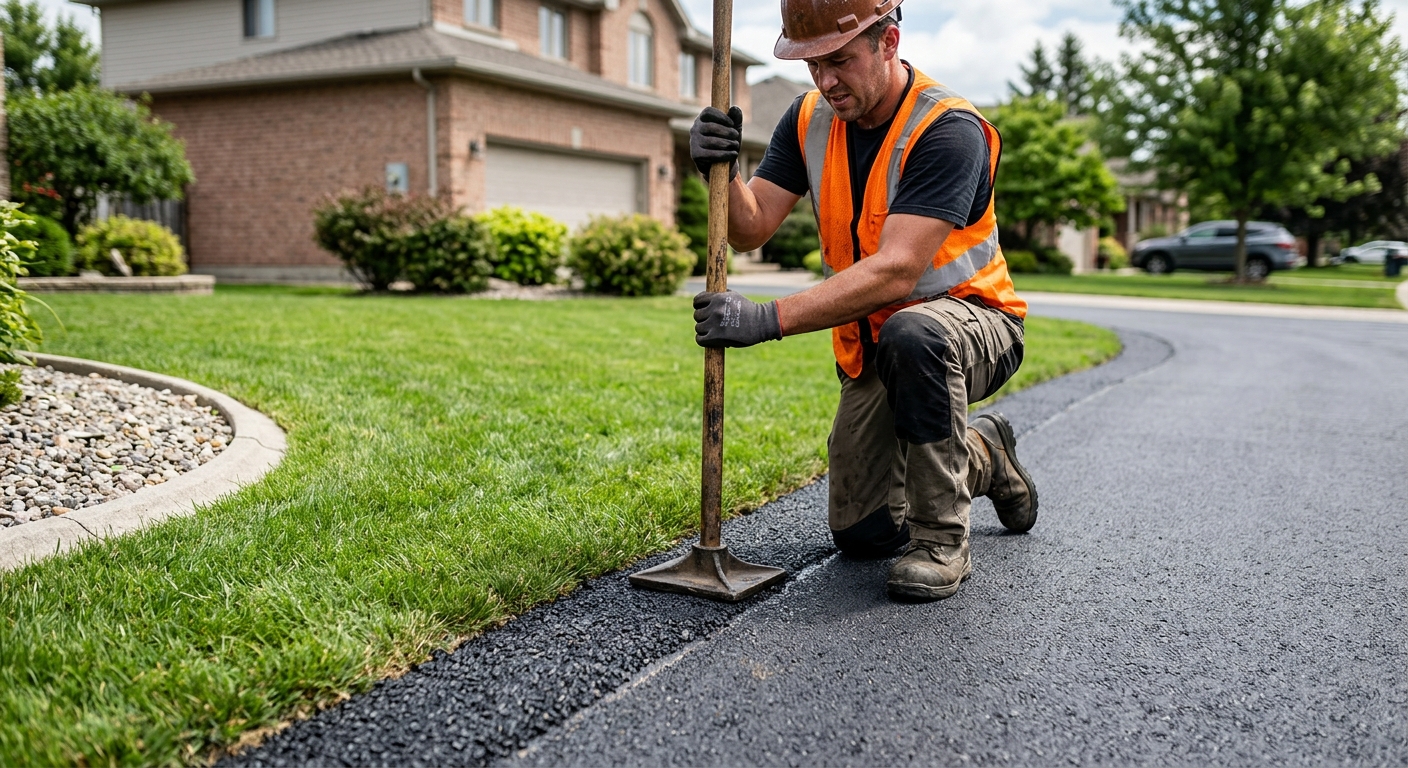
What a new driveway costs in Pittston
Pittston stands out in Luzerne County for its tightly packed lots and an aging housing stock, with 85.2% of homes built before 1980 and just under half (48.9%) owner-occupied (U.S. Census Bureau, ACS 2024). Because driveways here are almost always a single-family homeowner’s expense—and only 47.2% of homes are detached—the question of value matters. In northeastern Pennsylvania, the cycle of freeze/thaw and the glacial till subgrade mean that the most expensive part of a quote isn’t the part you’ll see. Materials are easy to compare, but under the asphalt or concrete, it’s the thickness and compaction of stone that governs longevity.
Nearly every price difference between contractors comes down to what’s buried beneath the surface: how deep they excavate, how much stone they install, how well it’s compacted, and whether they address drainage correctly. Saving on base prep here guarantees trouble after a couple of tough winters. Whether you’re looking at a full replacement, a resurfacing, or basic maintenance, remember that surface repairs do little good if water or frost is breaking up what’s underneath.
| Service |
Best for |
Lifespan |
Price range |
| Asphalt — full replacement with new base |
failed base, structural cracking |
20–30 yrs |
$3,100–$7,800 |
| Asphalt overlay / resurfacing |
sound base, surface cracking only |
8–15 yrs |
$1,300–$3,900 |
| Sealcoating — single application |
preventive maintenance on sound asphalt |
2–4 yrs |
$175–$600 |
| Concrete — new installation |
long service life, low maintenance |
30–50 yrs |
$4,400–$10,500 |
| Crack filling and patching |
isolated cracks under a quarter inch |
1–3 yrs |
$200–$800 |
| Gravel driveway |
rural, budget, long runs |
5–10 yrs with upkeep |
$900–$3,500 |
Estimates for a typical Pittston driveway. Square footage and base condition drive these figures more than material choice.
What you need before paving in Pittston
In Pittston, replacing or resurfacing an existing residential driveway almost never requires a building permit if you’re staying within the current footprint. That’s one less hassle for most homeowners. However, if you want to change the layout, increase the width, or adjust the portion by the street, permitting rules change. The section where your driveway meets a state road—the approach—falls under PennDOT District 4, not the city or borough, and needs a Highway Occupancy Permit. This catches many off guard because you can’t just call municipal code for answers.
Stormwater is another concern: paving more area or changing drainage can lead to runoff regulations. Even if code doesn't require a permit for simple re-paving, sending more water onto a neighbor’s lot creates legal and financial headaches. Keep all runoff on your land with proper grading or swales, especially given northeast Pennsylvania’s heavy snows and quick melts.
When hiring, the Home Improvement Contractor (HIC) registration is required for any job over $500. Always check a Pennsylvania contractor’s registration at hic.attorneygeneral.gov. For crew safety, workers' compensation is mandatory for employers—don’t take their word, verify coverage through WCAIS (wcais.pa.gov). Skipping these steps runs risks no local can afford, given how common door-to-door paving offers pop up in busy seasons.
Where the water goes
Ponded water is the main enemy of driveways in Pittston, thanks to our freeze-thaw cycles and the glacial till shale base throughout Luzerne County. At minimum, a driveway must slope away from the house or garage at least 2%—about a quarter inch per foot—to reliably shed surface water. Some drives use a gentle crown (peak in the center, sloping to both sides); others cross-slope the entire width if grade allows. Where the slope brings water toward the garage or home—and a lot of older Pittston lots are laid out that way—a trench or channel drain at the base is the only real fix short of regrading the entire approach. In some lots, you’ll need to daylight that drain (run it out to the curb or a garden), or, if that’s not possible, route to a dry well below grade. But heavy local soils mean dry wells can quickly become wet spots themselves.
In Luzerne County, holding water on the base is especially damaging—freeze-thaw lifts the base unevenly, then cracks and displaces your pavement from below. This is why stone thickness and good drainage matter even more here than in milder regions. And remember: sending water onto a neighbor’s property, even by accident, makes you responsible for any resulting damage, permit or no permit. Always plan water’s path before you write any check for paving.
Changing the footprint of a Pittston driveway
If you are thinking about widening your Pittston driveway for two cars, adding a pad for parking, or extending the run to a garage, there’s more to it than just pouring more asphalt. Any new pavement over grass or soil requires full excavation and a new stone base—no exceptions. The transition between old and new is a weak point that will always show first in the form of settlement or cracking, especially after a few freeze-thaw cycles hit our local shale subgrade. For those replacing gravel with asphalt, the existing stone may help, but it still needs to be tested and likely supplemented for strength and drainage.
With any footprint change, you’ll run into setback rules: zoning can restrict how close you pave to your property line. If you add area, expect questions about runoff—expanding your driveway can trigger stormwater requirements, and you must keep water on your own land. Finally, if your new section ties into a state road, a Highway Occupancy Permit from PennDOT District 4 is mandatory for the approach. Expansion is possible in Pittston, but hidden rules and weak seams mean you want a contractor who will walk you through every step and not just put down blacktop.
Numbers, not adjectives
If you’re hiring for a Pittston drive, don’t stop at “How much will it cost?”—ask how thick and how well. Most quotes describe the work in adjectives and round numbers. For our region, with its high frost depth (36 inches) and freeze-thaw cycles, the difference between a driveway that lasts 25 years and one that crumbles in five is all in these details. “We’ll put down three inches” doesn’t mean much unless you know: Is that three inches after compaction, or before the roller comes out? Was the base excavated to proper depth, or did they just skin coat what’s there?
Your quote should give you the numbers in writing. Excavation should reach undisturbed glacial till or shale, and base thickness needs to be greater than you’ll see in states with light winters. Look for two layers of asphalt (binder and top), both listed as compacted thickness, and for the proper mix designed for heavy snow loads. Without numbers, you’re just guessing at quality—and so is the contractor.
- Excavation depth (to undisturbed soil)
- Aggregate base thickness in inches (usually 6–8” here)
- Type and gradation of stone (2A modified common locally)
- Compaction method (“in lifts,” with mechanical roller)
- Asphalt binder course thickness (as compacted, e.g. 2.5” min)
- Asphalt surface course thickness (as compacted, e.g. 1.5–2”)
- Mix designation (state-approved, “Superpave” recommended)
- Edge treatment (taper, curbed, or buttressed by stone)
- Driveway slope/crown for drainage
- Expansion joints (for concrete jobs)
Overlay, patch or full replacement?
Most Pittston homeowners want to save their driveway if it’s at all possible, but the condition of the base—not the surface—should decide your path. Here’s what you can check yourself before calling a contractor:
Alligator cracking—those tight, scale-like cracks over a wide area—almost always means the stone base underneath has failed. No overlay, no matter how thick, can fix that. Isolated, linear cracks forming only where the pavement flexes typically signal aging asphalt, which may be a good candidate for overlay or crack filling. Depressions (birdbaths) that fill with water mean the soil or base under that spot has sunk or shifted—often from frost heave. Crumbling at the edges means poor edge support or inadequate stone out to the sides. Potholes are a red flag: water’s already breached the base, and a patch is only a stopgap.
Never accept an overlay price from a contractor who hasn’t tested or probed the base. An overlay on top of a failing base is money burned. If your drive is faded but sound, a good sealcoat buys time. For the rest, don’t patch over trouble—replace what needs replacing, and protect your investment properly.
| What you see |
Likely cause |
Right fix |
Cost |
| Isolated cracks under 1/4 inch |
surface aging |
crack fill and seal |
$175–$600 |
| Alligator cracking over a wide area |
base failure |
full replacement |
$3,100–$7,800 |
| Depressions holding water |
subgrade movement |
excavate and rebuild that area |
$3,100–$4,800 |
| Crumbling edges |
no edge support |
edge repair, consider curbing |
$400–$1,500 |
| Potholes |
water into the base |
full-depth patch, then assess |
$250–$900 |
| Faded but sound surface |
oxidation only |
sealcoat |
$175–$600 |
Base preparation: the part you pay for and never see
The biggest decision for any Pittston driveway is one you’ll never set eyes on: how deep and well the base is built. It starts with subgrade (usually glacial till and shale in Luzerne County), which must be compacted before the first stone is laid. Over that comes crushed aggregate—generally 6 to 8 inches minimum for our climate, compacted in lifts, not just dumped in one go. Then comes the asphalt or concrete. Every layer spreads the weight to protect what’s below, and in a climate like ours—with frost reaching 36 inches down and a cycle of freeze/thaw every spring—a thin or loose base spells disaster.
Here, frost heave is the silent killer: when water in the subgrade freezes, it expands, lifting the pavement, then drops it back down out of level as it thaws. Skimp on base depth and drainage, and you’ll get the “roller coaster” cracks that start appearing about the third or fourth year. Cheaper quotes usually save you money by shortcutting somewhere you can’t see: not excavating enough, laying thin or untested stone, flubbing compaction, or paving over a base that should have been dug out. None of that shows until several wet, cold seasons have passed—and then repairs cost more than was saved.
Insist on written specifics: base depth (in inches), aggregate type (2A modified crushed stone is common and reliable), and that the base is compacted in layers under heavy roller, not just foot tamped. Any “deal” that skips these steps is just a wager you’ll be paying for again, sooner rather than later.
Frequently asked questions — driveway paving in Pittston
What causes driveway cracks in Pittston?
Pittston driveways see more cracking than some nearby Pennsylvania towns because of the combination of glacial till and shale subgrade beneath, plus harsh freeze-thaw cycles. The primary culprit is water infiltrating through the surface, settling in the stone base, and then expanding as it freezes. Every winter, this expanding water can lift and crack the asphalt or concrete from below. Add in the wear from snowplows and de-icing, and even the best surface will develop defects over time. Sometimes, cracks are just from surface oxidation or the pavement shrinking as it ages, but when you spot alligator or "map" cracks, it means trouble deeper down. For smaller cracks (under a quarter inch), crack filling and sealcoating can make sense and typically cost $175–$600 per application in Pittston.
What kind of soil is under Pittston driveways?
Most Pittston driveways sit atop glacial till and shale—as is common in Luzerne County. This subgrade is dense, rocky, and not particularly well-draining, which means that driveways require a thicker, well-compacted stone base to handle the region's frequent frost heave. Glacial till can be unpredictable in strength and water retention, so it becomes critical for any new driveway to use at least 6–8 inches of 2A modified stone, compacted in lifts for maximum strength. Thin bases or poor compaction here will show up after just a winter or two. If you’re quoted less, you’re looking at repairs sooner rather than paying for a fresh asphalt overlay at $1,300–$3,900 a shot.
Is sealcoating a scam?
Not in Pittston, as long as you know what it does and what it does not. Sealcoating is simply a surface treatment—it won’t fix structural cracks, bumps, or a failing base. What it does very well is slow surface wear, block UV, and keep minor water intrusion at bay for 2–4 years per application. Because most of our driveways face repeated freeze-thaw cycles, keeping the surface sealed pays off more here than in most regions. But no reputable contractor in Pittston should claim sealcoating "restores" driveways; it preserves, not repairs. A proper single application should cost in the $175–$600 range depending on driveway size. If you’re being offered aggressive “miracle” claims at your door, walk away.
Is an overlay worth it or should I start over?
If your Pittston driveway’s base is still solid—no widespread sunken spots, no alligator cracking, no movement—then an asphalt overlay is a fair option, especially for surface-level cracks and fading. It costs much less than a total replacement, with overlays running $1,300–$3,900. But if there’s any evidence that the stone base is failing (sunken areas, large cracks, potholes reappearing), an overlay is money poorly spent because those problems will rise back through fast. In Luzerne County, with its harsh winters and problematic subgrade, it’s usually smarter to replace rather than overlay once your base has failed. Don’t let a contractor push an overlay if the real trouble is deeper than the surface.
How far ahead should I book a paver in Pittston?
Paving is a highly seasonal trade in Pittston. Most reputable asphalt or concrete companies are booked several weeks out, especially from May through October when weather is workable. If you're aiming for a major project—like a full replacement at $3,100–$7,800—you want to start checking schedules as early as March or April. Emergency patching can get done quickly, but for overlays and complete rebuilds, four to six weeks lead time is entirely normal once the busy season hits. Book sooner if you want preferred dates or the best crews. And avoid late-fall installations here; the freeze-thaw cycle starts early and fresh pavement needs warm, dry conditions to set up well.
Can I cancel a paving contract I signed at my door?
Yes, in Pennsylvania—including Pittston—the Home Improvement Consumer Protection Act (HICPA) guarantees you a three business-day right to cancel any home paving contract signed at your residence, as long as the price is over $500. The contract should plainly state this right. It doesn’t matter even if work is "ready to start" the next day—don’t let anyone rush you. If you decide to cancel, do it in writing and keep a copy. Be wary of anyone trying to get you to sign on the spot for a single application of sealcoating (typically $175–$600), since this is a notorious pressure tactic in Luzerne County. Always check for the cancellation clause and walk away if it isn’t there.
What does sealcoating cost in Pittston?
For most single-family Pittston driveways, the average sealcoating costs run $175–$600 per application. The exact number depends mainly on the size of your drive and whether there are cracks to prep or weeds to clean out. Sealcoating prices here are rarely driven by materials or hauling since local asphalt plants and suppliers keep transportation costs down. If a company offers a price way out of that range, be suspicious—it’s either a special deal (too good to be true) or padded with unnecessary work. Remember, a sealcoat is only worthwhile on a sound surface; it won’t rescue a failing driveway or solve deep cracks.
How deep should the aggregate base be here?
In Pittston and throughout Luzerne County, you want a compacted aggregate base of at least 6–8 inches under any asphalt driveway. That’s more than you’d see recommended in warmer parts of the country, but our freeze-thaw cycles and glacial till and shale subgrade demand it to prevent frost heave and rutting. Using less only leads to expensive headaches a few winters down the line. For concrete, the requirement is similarly strict—a thin base can mean undermined slabs and eventual cracks. This proper thickness also protects your investment, whether it’s an overlay at $1,300–$3,900 or a full replacement at $3,100–$7,800. Always demand these specs on paper from your contractor.
What does an asphalt overlay cost in Pittston?
An asphalt overlay—adding a new layer directly on top of an existing, structurally stable base—typically runs $1,300–$3,900 in Pittston. It's a cost-effective way to refresh a faded or slightly cracked driveway, but only if the base and grading are still solid. The final number depends mostly on driveway size and how much surface crack repair or clean-up is needed ahead of the overlay. Overlay is not a good option if your drive has sunken patches or widespread "alligator" cracking, as those problems will reappear within a couple years. Local supply keeps hauling costs competitive, but don’t pay for an overlay if the real trouble is beneath the surface—if so, a full replacement at $3,100–$7,800 is the only answer that lasts here.