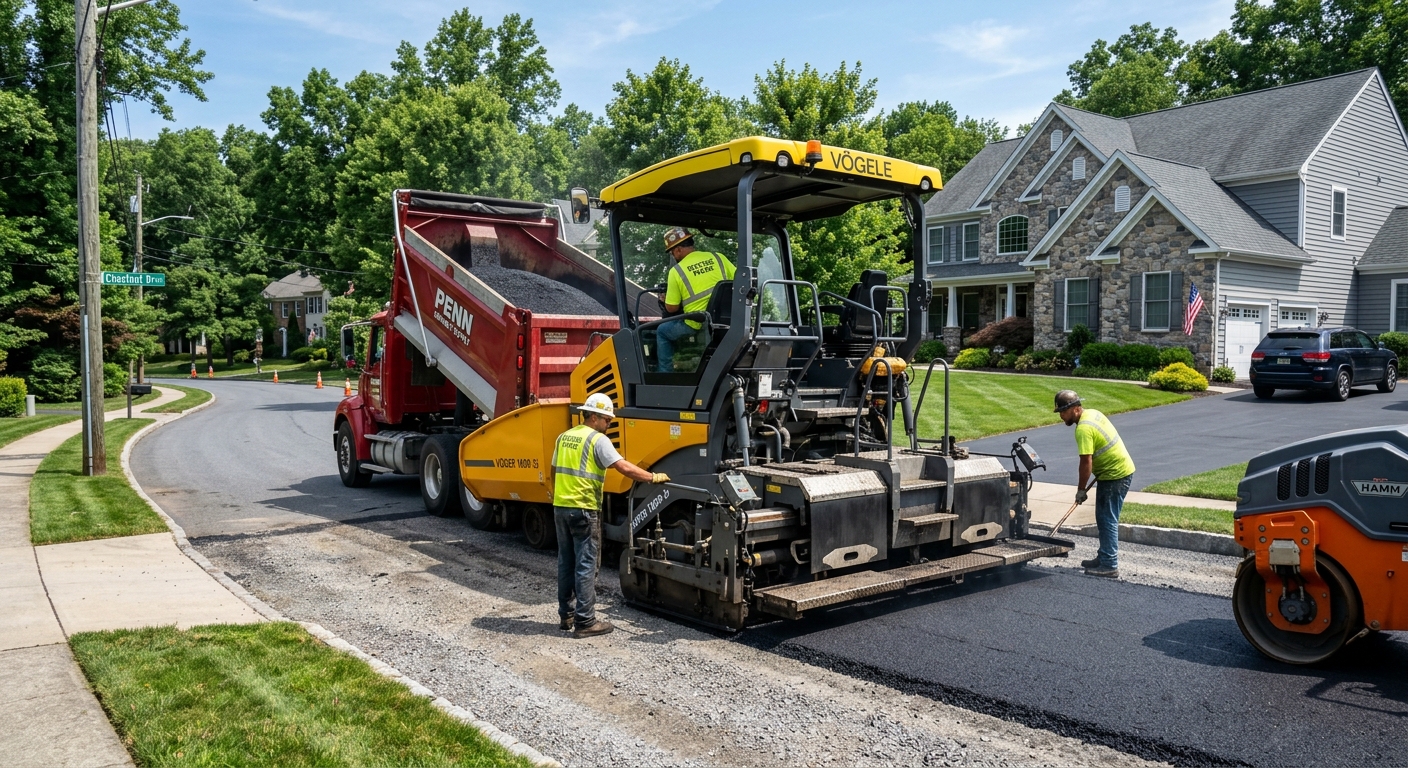
Lower Swatara paving prices by scope — 2026
In Lower Swatara, paving costs sit at the intersection of aging postwar homes, high single-family ownership (64.9%) and the reality that 85.1% of residents are homeowners, not renters (U.S. Census Bureau, ACS 2024). Most driveways here are now 40–70 years old and reaching the end of their service life. Unlike many home fixes, nearly all of the real cost difference between two driveway quotes comes from work the homeowner cannot see: what goes under the asphalt or concrete.
Our region’s limestone karst and shale subgrades around Harrisburg require deeper and more careful base construction than most places. Coupled with the harsh freeze-thaw climate of south-central Pennsylvania, cutting corners out of sight leads to premature failure. Even a $2,000 gap in bids is almost never about the cost of asphalt or concrete itself. It’s about aggregate depth, drainage correction, and good compaction—the foundational work you won’t see unless it fails.
Below are realistic 2026 cost bands for driveways in Lower Swatara. These will be towards the higher end if increased base thickness or drainage upgrades are needed:
| Service |
Best for |
Lifespan |
Price range |
| Asphalt — full replacement with new base |
failed base, structural cracking |
20–30 yrs |
$3,500–$9,000 |
| Asphalt overlay / resurfacing |
sound base, surface cracking only |
8–15 yrs |
$1,500–$4,500 |
| Sealcoating — single application |
preventive maintenance on sound asphalt |
2–4 yrs |
$200–$700 |
| Concrete — new installation |
long service life, low maintenance |
30–50 yrs |
$5,000–$12,000 |
| Crack filling and patching |
isolated cracks under a quarter inch |
1–3 yrs |
$200–$800 |
| Gravel driveway |
rural, budget, long runs |
5–10 yrs with upkeep |
$900–$3,500 |
Estimates for a typical Lower Swatara driveway. Square footage and base condition drive these figures more than material choice.
Door-knocking crews and leftover material
Driveway paving is a magnet for transient, unqualified, or outright fraudulent contractors in places like Lower Swatara, where moderate suburban demand means legitimate jobs are always visible. These crews bank on being paid and gone before defects appear—which, with asphalt, can be months or years down the line.
Classic paving scams here start with a door knock and one of these: “We have leftover asphalt from a job down the road,” “This price is only good today,” or “We can do it cheap for cash.” They’ll show up with an unmarked truck, often with out-of-area plates. Sometimes it’s a rushed verbal quote, a demand for cash up front, or an oil-based spray “sealcoat” that’s only colored water with oil. These operators don’t show you written scopes or contracts, and rarely offer business cards, references, or invoices. The sparsely populated edges of Dauphin County are particularly soft targets, since neighbors are spaced and ask fewer questions.
Pennsylvania’s Home Improvement Consumer Protection Act (HICPA) exists for this reason. Any project over $500 (almost all driveway work) requires a written contract and gives you a three-business-day right to cancel—no questions asked. Never hand over cash or commit on the spot. Demand a contract that spells out everything, and take the time you’re entitled to. No legitimate paving contractor rushes you or objects to this process.
Defeat nearly all scams in under five minutes: verify HIC registration at hic.attorneygeneral.gov, check workers’ comp on WCAIS, and politely decline any offer that ducks those steps.
Which surface survives Lower Swatara winters
Lower Swatara’s driveways live through dozens of freeze-thaw cycles every winter, with frost penetrating as deep as 30 inches. Asphalt and concrete handle this environment very differently. Asphalt’s advantage is flexibility—it bends slightly with ground movement, so it resists cracking even when water in the subgrade expands and contracts in winter. It also absorbs de-icing chemicals better, making it forgiving for owners who salt their driveways.
Concrete, though longer-lasting on paper (up to 50 years), is rigid and can spall or scale under salt—something hard to avoid in a county with the plowing and sanding routines we see here. Most concrete driveways fail locally not from cracking, but from surface flaking due to salt use and our pronounced freeze-thaw pattern. Concrete costs more, and while it can outlast asphalt, this only holds true if you avoid salt-based de-icers and keep up with sealing, which most owners do not in practice.
If you want minimal maintenance, pavers are worth considering—especially for smaller driveways or where look and drainability matter. For long rural lanes, gravel remains the lowest cost option, trading aesthetics for price and drainage.
| Option |
Installed cost |
Maintenance |
Freeze-thaw performance |
Lifespan |
| Asphalt — new install |
$3,500–$9,000 |
sealcoat every 3–4 yrs |
excellent, flexes |
20–30 yrs |
| Asphalt — overlay |
$1,500–$4,500 |
same |
good if base is sound |
+8–15 yrs |
| Concrete |
$5,000–$12,000 |
low, avoid de-icing salt |
fair, spalls with salt |
30–50 yrs |
| Pavers |
$8,000–$12,000 |
individual units replaceable |
good, settles gradually |
25–50 yrs |
| Gravel |
$900–$3,500 |
top-dress every 2–3 yrs |
excellent drainage |
indefinite with upkeep |
How to vet a paving contractor in Lower Swatara
For a homeowner in Lower Swatara, the strongest filter against shoddy paving is verification. Any contractor bidding on a driveway should have more than a mobile number—they should supply a local business address and real references from driveways completed three to five years prior. New references are not enough; you need to know how work holds up. Ask what plant supplies their asphalt; in our area, reputable outfits will name a Harrisburg or Middletown source easily, thanks to local quarries and plants. A contractor who can’t name their supplier is likely a broker, not an installer.
In this county, where aggregate supply is never an issue, anyone pitching “special haul prices” is giving you a story. Look for owned equipment, not all rentals, and ask what happens if you want extra edge work—do they have their own crew, or do they farm it out?
- Verify Home Improvement Contractor (HIC) registration at hic.attorneygeneral.gov.
- Check workers’ compensation coverage at WCAIS (wcais.pa.gov).
- Ask for a local business address.
- Require written contracts for any job over $500.
- Request references for jobs three or more years old in Dauphin County.
- Ask the contractor to name their asphalt plant supplier.
- Look for owned equipment—trucks, rollers—not just rentals.
- See job photos from previous seasons, not just last week’s work.
- Request insurance certificates, not just policy numbers.
- Be clear on warranty terms in writing.
- Get a fixed scope and see what’s included for excavation, disposal, and edgework.
- Assess communication: does the contractor return calls and answer questions directly?
Red flags: demands for cash up front, no written scope, “leftover material” stories, or contractors who can’t name their supplier or prior customers in Lower Swatara.
Driveway permits, approaches and stormwater rules
In most of Dauphin County, including Lower Swatara, you usually do not need a building permit just to resurface an existing driveway in its current footprint. This saves you a phone call for standard repaving jobs. But if you’re changing your driveway apron—the area where the driveway meets the public street—a separate permit is generally required. When the driveway approach is on a state road, that permit comes from the PennDOT Engineering District 8‑0 Highway Occupancy Permits office, not the township. For local roads, Lower Swatara’s code office handles this.
Expanding the impervious surface (by widening or extending your driveway) can trigger stormwater management requirements, since runoff must be managed on-site and can’t be directed onto a neighbor’s property. Responsibilities here are triggered by size and grading, not just by the paving material.
Work only with contractors holding valid Home Improvement Contractor registration, which you can check at hic.attorneygeneral.gov. Workers’ compensation coverage is mandatory for all employers, and you can confirm this in the WCAIS system (wcais.pa.gov) before anyone sets foot on your property.
Maintenance that actually works
The maintenance steps that genuinely extend a driveway’s life are simple and inexpensive. Crack filling before water reaches the base is the single most cost-effective step—do this every spring or fall when cracks open. Keep the driveway edges back-filled and supported to prevent crumbling. Always direct water away: clean gutters and keep the slope so runoff doesn’t sit on or under the slab. Avoid point loads from jack stands, trailers, or dumpsters, which punch through even well-built surfaces.
After a new asphalt install, wait at least 3–7 days before parking—a week or more when temperatures are high—and a month before turning your wheels while stationary. Concrete should not be salted in winter; salt will attack the surface, leading to spalling and early failure. On asphalt, salt isn’t as destructive, but the problem is the freeze-thaw cycle as the meltwater refreezes and works into the base.
Sand or calcium magnesium acetate are better but cost more and are often skipped. Nothing beats basic discipline: fill cracks early, keep water moving away, and avoid pushing a surface past its design weight.
Comparing paving estimates in Lower Swatara
To get value for your money, compare bids line by line. A solid estimate should state square footage, excavation and disposal details, the specific aggregate type and its depth, and how compaction will be performed (always in lifts, never all at once). Look for details about the asphalt or concrete’s course thickness, the treatment of driveway edges, proper grading for drainage, and how cleanup is handled. The payment schedule should call for a modest deposit, with the balance upon completion—never full cash up front.
Most important: see what’s excluded as well as what’s included. Most warranties don’t cover cracking, even though that’s the failure that ruins driveways here. If you get a one-line quote with just a price and “new driveway,” you have nothing to compare. That is the single most common way homeowners overpay for driveways that fail too soon.
| Line item |
What to look for |
Red flag if… |
| Area |
measured square footage stated |
eyeballed or absent |
| Excavation |
depth and disposal included |
'we'll pave over it' |
| Base |
aggregate type and depth in inches |
'proper base' |
| Compaction |
method, and done in lifts |
not mentioned |
| Asphalt |
courses and compacted depth |
'3 inches' unqualified |
| Drainage |
slope and water direction stated |
silent |
| Warranty |
what is covered and what is excluded |
verbal only |
| Payment |
modest deposit, balance on completion |
full cash up front |
Frequently asked questions — driveway paving in Lower Swatara
Are there stormwater rules on paving in Lower Swatara?
In Lower Swatara, the rules around driveway paving are stricter than many realize. While you often do not need a building permit just to resurface your existing driveway, expanding your pavement—either by widening or extending—can bring stormwater management requirements into play. You cannot direct new runoff onto your neighbor’s property, and larger new or expanded driveways may trigger additional drainage work (like swales or infiltration trenches) as part of your project. Stormwater rules matter because Dauphin County’s clay-rich soils drain poorly in freeze-thaw cycles and the zoning office takes neighbor-to-neighbor water complaints seriously. If you’re planning major changes, it’s wise to ask your contractor about extra site work and expect it to show up as a price increase on jobs above $3,500–$9,000 for full replacement.
When can I seal a brand new asphalt driveway?
In Lower Swatara, the best practice is to wait at least 90 days after asphalt placement before applying any sealcoat. Our region's climate—with summer days in the 80s and frequent storms—means that new asphalt needs time to cure fully and release oils. Sealing too early can trap those oils, causing a soft, scuffed surface that won't last. If you pave in late fall, you're better off waiting until the following spring for your first sealcoat. Plan on a single sealcoating application every 3 to 4 years thereafter (costing $200–$700 per coat), which will keep your driveway flexible and help resist cracking. The rule: always let a new asphalt driveway harden up and gray over before the first seal.
What is the difference between binder and surface course?
On a typical Lower Swatara asphalt driveway, the binder course and surface (or wearing) course serve different roles. The binder course is the thicker, structural first layer—usually a coarser, stronger asphalt mix—meant to bridge and support subgrade movement. Over that goes a finer surface course, designed for smoothness, appearance, and shedding water. If water or heavy vehicles ever get past the surface, your driveway’s structure depends on the binder holding up. For full replacement projects (costing $3,500–$9,000), make sure your estimate specifies both courses and their compacted thicknesses. Some low-ball bids skip the binder or put down a thin layer: that’s asking for cracks and depressions within a few winters.
What does an asphalt overlay cost in Lower Swatara?
Asphalt overlay (sometimes called resurfacing) in Lower Swatara costs $1,500–$4,500 for a typical single-family home driveway. This is cheaper than a full replacement because the contractor leaves your existing base, patching spots and then adding a new surface layer. This option is only suitable if your base is in stable, uncracked shape—if there’s major settling or alligator cracking, it won’t last and should be skipped. Overlays buy 8–15 more years, but if your current driveway is pushing 40 years, it's often wiser to put the money towards a full rebuild.
When is the best time of year to pave in Lower Swatara?
The ideal paving window in Lower Swatara is from late April through early October, when nighttime temperatures stay above 50°F and humid days allow proper curing. Asphalt plants in Harrisburg and Middletown operate reliably during this period, and you’ll get the best compaction and long-term durability. Early spring installations risk frost pockets under the surface, leading to cracks, while late fall jobs may not cure fully before winter. Contractors are busiest mid-summer, so you’ll sometimes find shorter lead times—and slightly better prices—early or late in the season. For example, even peak season overlay costs hold at $1,500–$4,500.
How many freeze-thaw cycles does Lower Swatara get?
Lower Swatara typically sees dozens of freeze-thaw cycles each winter, with average winter lows easily hitting 12°F and the frost line reaching 30 inches deep. These cycles—when the ground, and any trapped water, repeatedly freeze and thaw—are the main cause of heaving, cracking, and potholes in driveways. Asphalt handle it better than concrete due to its flexibility, which is one reason full asphalt replacement (for $3,500–$9,000) is more common than total concrete jobs. The more cycles per winter, the more vital it becomes to fill cracks and keep water out from under the surface.
How much does a concrete driveway cost in Lower Swatara?
In Lower Swatara, you should budget $5,000–$12,000 for a new concrete driveway, depending on length, width, and the amount of subgrade work required. Concrete costs more up front than asphalt but, if you stick to proper maintenance (especially avoiding salt-based de-icers), it can last 30–50 years. The underlying shale and limestone in Dauphin County may mean a deeper stone base is needed for settlement, especially for older homes built before 1980. If the contractor only bids at the lower end of this range, check thickness and reinforcement closely.
Why are my driveway edges crumbling?
Edge crumbling is common on older driveways in Lower Swatara, especially if they’ve seen repeated plow passes, erosion, or if the soil was not backfilled after install. The limestone and shale subgrade in this region don’t support edges as well as some soils, so when the asphalt is left unsupported, it can break off in small chunks. Another culprit: surface water running alongside the drive and undercutting the edge. For most properties here, filling and tamping gravel along the sides every couple years, and keeping heavy vehicle tires away from the very edge, will help. Severe edge failure is a sign you may be ready for a full replacement in the $3,500–$9,000 range.
Are pavers worth the cost in south-central Pennsylvania?
Pavers have a high installed cost—usually $8,000–$12,000 locally—but can pay off for certain Lower Swatara homes. Their big advantage is durability in a heavy freeze-thaw climate: each paver moves independently, so settling or heaving won’t crack the whole surface. Repairs are easier than with poured concrete or asphalt, because you can replace individual units if needed. They also drain very well, making them suited to spots with poor runoff. However, the upfront investment is significant, and snow removal can be trickier on textured paver surfaces. If look, drainage and the ability to swap damaged pieces matter to you, pavers are worth considering for a forever home.