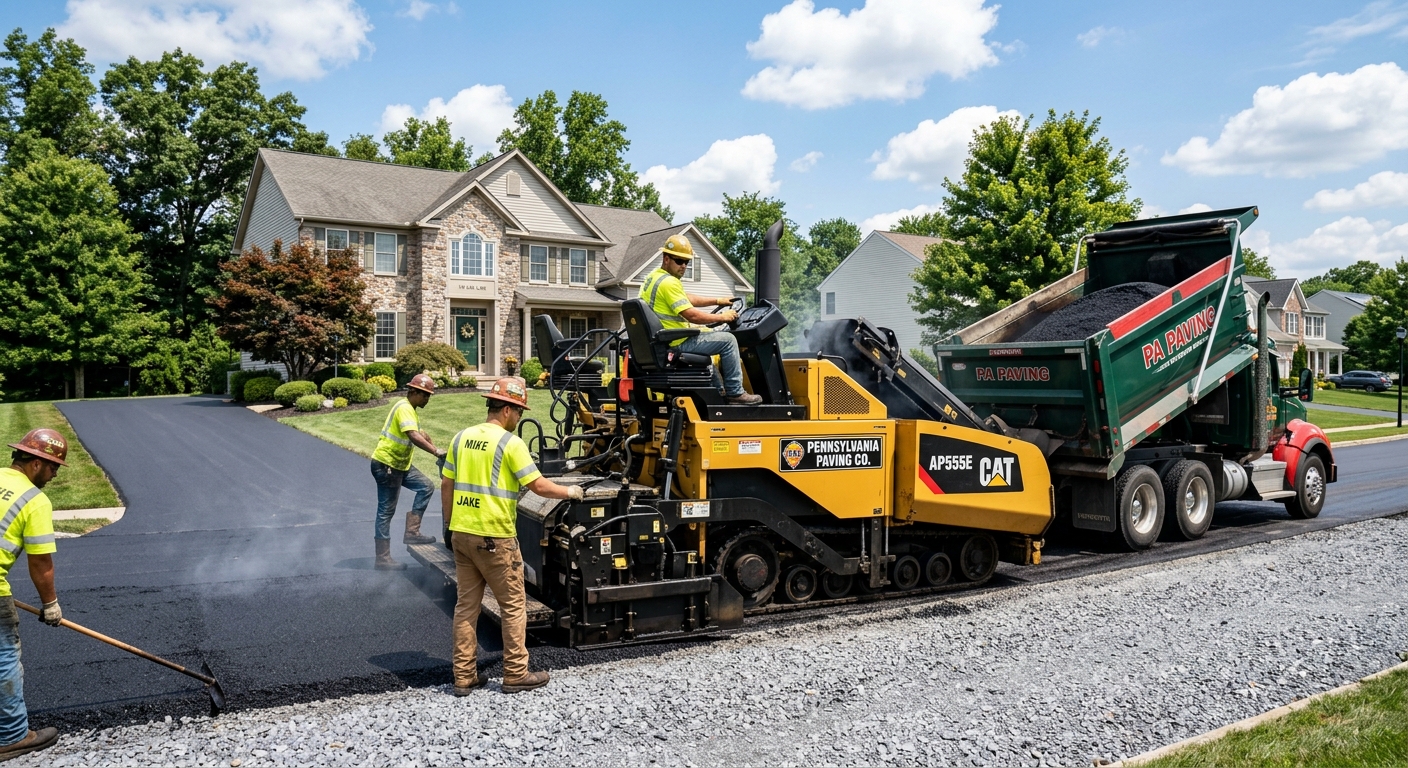
What a new driveway costs in Marshall
In Marshall, where 77.4% of homes are single-family and the homeownership rate is a high 86.6% (U.S. Census Bureau, ACS 2024), driveway paving is an expense most homeowners are likely to encounter. Here, the cost of a new or renewed driveway reflects not just material choices, but the serious challenge of dealing with local freeze-thaw cycles and the region's clay and shale subsoils. Those unseen conditions beneath the surface create most of the cost difference between what look like similar contractor quotes.
A proper base in Allegheny County is critical because the local soils hold water and are prone to movement and heaving as winter sets in. That means driveways built to bare-minimum specs might look acceptable at first, but fail quickly. This is why two bids for what reads as the “same” job can be thousands apart—the real difference is often in excavation and base preparation, which you won’t see when the job is done.
| Service |
Best for |
Lifespan |
Price range |
| Asphalt — full replacement with new base |
failed base, structural cracking |
20–30 yrs |
$3,900–$9,900 |
| Asphalt overlay / resurfacing |
sound base, surface cracking only |
8–15 yrs |
$1,650–$5,000 |
| Sealcoating — single application |
preventive maintenance on sound asphalt |
2–4 yrs |
$225–$750 |
| Concrete — new installation |
long service life, low maintenance |
30–50 yrs |
$5,500–$13,000 |
| Crack filling and patching |
isolated cracks under a quarter inch |
1–3 yrs |
$200–$800 |
| Gravel driveway |
rural, budget, long runs |
5–10 yrs with upkeep |
$900–$3,500 |
Estimates for a typical Marshall driveway. Square footage and base condition drive these figures more than material choice.
Overlay, patch or full replacement?
In Marshall, the decision to overlay, patch, or completely replace a driveway comes down to what’s happening under the surface. No matter what pitch you hear, it’s your base condition—not just the age of asphalt—that sets the repair or replacement plan. Here are some simple diagnostics you can do yourself before you call a contractor:
If you see widespread “alligator” cracking (those interconnected chunks), that’s a failed base—an overlay will follow it to the grave in short order. Small, linear cracks are usually just aging at the surface and can often be sealed. Depressions or shallow “birdbaths” mean the base or subgrade below has given way, usually because of inadequate compaction or poor drainage, both common on our local clay and shale hillsides. Edge crumble almost always points to missing edge support, and potholes mean water found its way through to the base.
Put simply: an overlay on a bad base is money burned. If a contractor recommends one without digging a test hole or probing your base, they haven’t looked (or don’t care).
| What you see |
Likely cause |
Right fix |
Cost |
| Isolated cracks under 1/4 inch |
surface aging |
crack fill and seal |
$225–$750 |
| Alligator cracking over a wide area |
base failure |
full replacement |
$3,900–$9,900 |
| Depressions holding water |
subgrade movement |
excavate and rebuild that area |
$3,900–$6,100 |
| Crumbling edges |
no edge support |
edge repair, consider curbing |
$400–$1,500 |
| Potholes |
water into the base |
full-depth patch, then assess |
$250–$900 |
| Faded but sound surface |
oxidation only |
sealcoat |
$225–$750 |
Finding a legitimate paver in Allegheny County
It’s no secret the Pittsburgh metro market, including Marshall, is thick with paving contractors, so vetting is essential. In Pennsylvania, any project over $500 requires a Home Improvement Contractor (HIC) registration, which you can independently verify at hic.attorneygeneral.gov. True professionals in this field should have a tangible local business address, not just a cell phone, own the equipment they use instead of renting day-to-day, and can give you references from jobs that are three or more years old—because failures from a light base or poor compaction take time to show.
Here, local asphalt plants keep haul distances short. Reliable contractors know which plant supplies their material, and if they can’t name it, you’re likely dealing with a broker, not a builder.
- Check HIC registration at hic.attorneygeneral.gov
- Confirm a real business address (not just a P.O. box or cell number)
- Ask for proof of workers’ compensation (verify via WCAIS: wcais.pa.gov)
- Request references from jobs at least 3 years old
- Require evidence of owned paving equipment
- Ask what asphalt plant or quarry they use
- Look for full written contracts, as required by Pennsylvania law over $500
- Check liability insurance certificate
- Ask who will be on site—employees, not just day laborers
- Get a start and finish date in writing
- Avoid cash-only offers
- Insist on warranty terms clearly stated
If someone dodges these checks, offers a "leftover asphalt" deal, or can't name their material supplier, there’s a reason. In Allegheny County, there's no reason to settle for less.
Why you can't pave in February
In southwestern Pennsylvania, including Marshall, paving season is a brick wall, not a gray area. Our winter design temperature here drops to 8 °F, and freeze-thaw cycles come hard and fast. Hot-mix asphalt can’t be laid or compacted properly below a certain temperature; if it's too cold, the mix stiffens before it can bond, leaving you with a porous, brittle surface that won’t survive two winters. That’s assuming you could even get the material: local asphalt plants shut down in winter because demand vanishes and there's no point in firing up the operation for a handful of tons.
Concrete has its own barrier: it cannot cure right if temperatures dip below freezing soon after it’s placed. The chemical process that hardens concrete is wrecked by sub-freezing nights, so even a brief warm spell in January isn’t reliable.
What does this mean practically? April through mid-November is the real paving window in Marshall. Early spring and late fall (shoulder seasons) are when crews have capacity and prices can be competitive. By June, reputable outfits are scheduling weeks out. If a contractor offers to pave your driveway in late November or February in this climate, you’re not getting professional standards—you’re likely burning money for a surface that will fall apart by next spring.
Driveway permits, approaches and stormwater rules
In much of Allegheny County, including Marshall, resurfacing or repaving a private driveway within its existing footprint does not ordinarily require a building permit—so if you’re simply renewing your surface, you usually save yourself a call to the township. However, if you’re working on your driveway’s approach—where it meets the public road—a permit typically comes from a different authority than you might expect. If your driveway connects to a state route in Allegheny County, you’ll need a Highway Occupancy Permit from PennDOT District 11-0.
Don’t ignore stormwater: any expansion or significant regrading that increases impervious area (more pavement or concrete) can trigger runoff controls. Marshall’s hilly, clay-heavy terrain makes it especially risky to direct driveway water onto a neighbor’s property. Even without permit requirements, this creates a liability and is best avoided with good grading and, if needed, drainage corrections.
Any contract over $500 requires a written agreement under the Pennsylvania Home Improvement Consumer Protection Act. Always verify your contractor’s Home Improvement Contractor (HIC) registration at hic.attorneygeneral.gov. Workers’ compensation coverage should also be confirmed for any crew—not just the owner—using the WCAIS system at wcais.pa.gov.
Comparing materials in southwestern Pennsylvania
Choosing between asphalt and concrete in Marshall isn’t a one-size-fits-all decision—it’s about how each material handles the repeated freeze-thaw cycles, snow load, and regular salting that define southwestern Pennsylvania. Asphalt’s flexibility means it can accommodate the ground movement and slight heaving that comes from our region’s deep winter frost and clay subgrade; it flexes and heals minor movement without cracking. This is why most local driveways are asphalt—and why overlays can add life if the base remains solid.
Concrete is appealing for its low maintenance and longevity, but its rigidity is a weakness here. Allegheny County’s winter, combined with salt-based de-icers, causes concrete to spall and scale, which means the surface flakes and crumbles away long before reaching anything close to its maximum lifespan. To keep concrete intact here, homeowners must avoid salt entirely in winter—a behavioral ask that many don’t keep.
Pavers are a premium option, performing well in freeze-thaw settings because each unit can move slightly—if you’re prepared for the price. Gravel is still a fit for rural or budget drives, with great drainage and indefinite life if maintained, but needs regular attention especially after heavy weather or plowing.
| Option |
Installed cost |
Maintenance |
Freeze-thaw performance |
Lifespan |
| Asphalt — new install |
$3,900–$9,900 |
sealcoat every 3–4 yrs |
excellent, flexes |
20–30 yrs |
| Asphalt — overlay |
$1,650–$5,000 |
same |
good if base is sound |
+8–15 yrs |
| Concrete |
$5,500–$13,000 |
low, avoid de-icing salt |
fair, spalls with salt |
30–50 yrs |
| Pavers |
$8,800–$13,000 |
individual units replaceable |
good, settles gradually |
25–50 yrs |
| Gravel |
$900–$3,500 |
top-dress every 2–3 yrs |
excellent drainage |
indefinite with upkeep |
The specifications to demand in writing
If you only compare prices, sooner or later you’ll be calling someone like me to fix what’s hidden under the surface. In Marshall, with freeze-thaw heaving, clay and shale soils, and deep frost (36 inches down), your defense is to demand numbers—in writing—for every layer and process. Don’t settle for “we’ll put down three inches.” Is that before or after compaction? Is it a single lift or two? What’s beneath the asphalt, how thick, and how tight? Local conditions here mean a skimped base cracks and shifts in just a few seasons.
Here’s what needs to be spelled out in your quote:
- Excavation depth: how deep the old material and soft soils are removed
- Aggregate base depth: typically 6–8 inches compacted for Marshall soils
- Base material: specify type and gradation (e.g., 2A modified stone)
- Base compaction: must specify mechanical compaction, in lifts if >4 inches
- Binder course: thickness after compaction, not loose-laid
- Surface course: same, thickness “compacted”
- Mix designation: PA-approved asphalt mix (e.g., ID-2 Wearing)
- Edge treatment: what supports the sides (tamped, curbed, or reinforced)
- Pitch and drainage: percent slope to keep water moving off the surface
- Joint treatment: how seams are sealed and edges finished
Without these details, you’re signing for someone else’s profit margin—not for a long-lasting Marshall driveway.
Frequently asked questions — driveway paving in Marshall
Can asphalt be laid in cold weather?
Asphalt paving in Marshall—and anywhere in southwestern Pennsylvania—depends entirely on temperature. Hot-mix asphalt must remain workable and compactable, which won’t happen below about 45 °F on the ground. Local asphalt plants shut down for the winter, so it isn’t just risky; materials aren’t available. Trying to pave in February or even late November here means the mix cools too fast and won’t bond, leading to a surface that cracks and crumbles before its time. When someone promises a bargain off-season, you can guarantee you’ll pay for it in repairs. If you value your investment, insist that paving only be done in proper season—April through early November. Otherwise, you're likely to be paying $3,900–$9,900 again in just a few years.
What does an asphalt overlay cost in Marshall?
If your existing driveway base is solid—no heaving, alligator cracking, or deep potholes—an asphalt overlay (sometimes called resurfacing) is a cost-effective way to add 8–15 years of life. In Marshall, a typical overlay costs $1,650–$5,000 depending mostly on size, not just material. Patching major holes or cracks first is a must; if a contractor offers an overlay without fixing the underlying damage, that savings won’t last. Overlays work best where cracking is light, the base is stable, and drainage is sound. Anything less, you’re wasting money on a short-term fix.
Why are my driveway edges crumbling?
In Marshall, crumbling or broken driveway edges are usually the result of no structured edge support in the original build. Without proper base width and compaction right to the side, or without curb reinforcement, the outside of the driveway is left “hanging” over soft soil. Traffic over those edges, even slow tire loads, breaks them down. Our region's clay soils only make this worse. The best fix is edge repair and possibly adding low curbing, which can cost $400–$1,500 depending on the severity. If the rest of your driveway is still sound, keeping water from running over the edges and having them supported is the surest way to stop the damage from spreading.
How many freeze-thaw cycles does Marshall get?
Marshall typically sees dozens of freeze-thaw cycles each winter due to our climate, as cold snaps and warm spells take turns throughout the season. These cycles force the ground to expand and contract, attacking the base and surface of your pavement. Shale and clay subsoils here retain water, boosting the risk of heaving and cracking. That’s why driveways built to shallow base specs or quick-patched with cold patch often fail in just a few years. Investing in a thicker, properly compacted base—factored into the $3,900–$9,900 range for a full replacement—pays off in long-term durability.
Does sealcoating fix cracks?
Sealcoating in Marshall is preventive maintenance, not a structural fix. It renews the surface, protects against sun and water, and helps keep fine cracks from turning into big ones. But it will not fill or repair cracks wider than hairline. Significant cracks—more than 1/4 inch wide or that move when you step on them—require crack filling or patching first. If your driveway is faded but otherwise solid, a single sealcoat costing $225–$750 can keep it healthier, but applying it over neglected cracks only hides the problem for a year or two.
How much does driveway paving cost in Marshall?
For a typical single-family home in Marshall, full asphalt driveway replacement ranges from $3,900–$9,900, with the average job at about $6,100. Resurfacing a sound base runs $1,650–$5,000. Concrete driveways cost more, at $5,500–$13,000, but can last far longer if you avoid de-icing salts. What really drives cost isn’t just square footage—it’s the base preparation underneath, which is critical in Marshall due to our local soils and deep frost line. Don’t be fooled by a low bid that skips proper excavation and compaction; you’ll pay for it when the surface fails early.
What does compaction in lifts mean?
“Compaction in lifts” is a practice critical for lasting driveways in Marshall’s clay-heavy subsoils. When aggregate base or asphalt is applied in thick layers, it’s almost impossible to properly densify the bottom—all the rolling only compresses the top inch or two. Instead, crews should lay base and asphalt in thinner layers (lifts), and compact each lift before adding the next. This makes the structure stronger and more resistant to winter heaving. If your job involves a thick new base, make sure “compacted lifts, 3–4 inches each” appears in writing. Doing it right the first time keeps you from spending another $3,900–$9,900 on a premature redo.
Can I cancel a paving contract I signed at my door?
In Pennsylvania—including Marshall—state law offers a three-business-day right of cancellation on any home improvement contract over $500, thanks to the Home Improvement Consumer Protection Act. If you signed a driveway paving agreement under pressure from a door-to-door salesperson, you can legally rescind it within that window with no penalty. Contractors must inform you of this right in writing as part of the contract. Don’t let anyone pressure you otherwise; you are not bound if you act within three days. For a typical driveway contract—often running $3,900–$9,900—this protection is worth remembering.
Asphalt or concrete for a Marshall driveway?
For most Marshall homeowners, asphalt is the practical choice: it’s less expensive ($3,900–$9,900) and fares better through our region’s freeze-thaw cycles thanks to its flexibility and ability to heal small movement. Concrete, while long-lasting, faces real problems with Albgheny County's use of road salt—surface scaling and spalling is the most common failure here, not cracking. Concrete costs more up front ($5,500–$13,000), but only pays off if you avoid de-icing salt entirely. For those who like clean, white pavement and can keep to sand or magnesium products, concrete is viable. Otherwise, asphalt is the lower-risk, higher-value option for this climate.