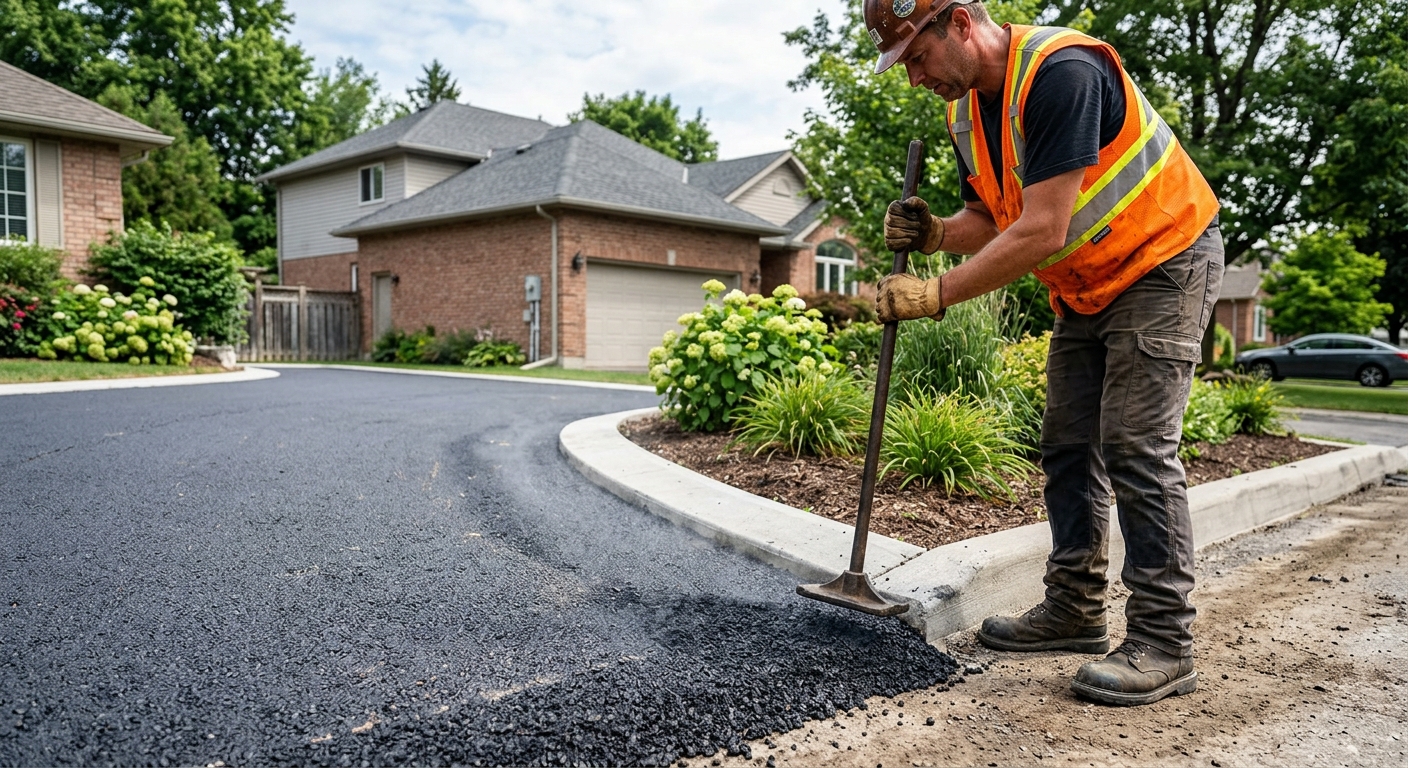
Media paving prices by scope — 2026
In Media, where only 17.8% of housing is single-family and the homeownership rate stands at 39.8% (U.S. Census Bureau, ACS 2024), driveway paving is an investment specific to a subset of households. For those owners, driveway replacement or resurfacing is rarely just a surface decision—it is dictated by conditions beneath the blacktop or concrete that you cannot see. The glacial till and compacted urban fill common under Delaware County driveways affect how much excavation is needed before paving can start. Media's moderate freeze-thaw cycles and 30-inch frost depth also demand a thicker, well-draining base to prevent heaving and premature cracking.
When comparing quotes, the biggest cost differences almost always hide below ground: a low price may mean the contractor is skipping base replacement or using less stone, even though proper base accounts for most of the longevity. Different driveway projects have very different price bands:
| Service |
Best for |
Lifespan |
Price range |
| Asphalt — full replacement with new base |
failed base, structural cracking |
20–30 yrs |
$3,600–$9,200 |
| Asphalt overlay / resurfacing |
sound base, surface cracking only |
8–15 yrs |
$1,550–$4,600 |
| Sealcoating — single application |
preventive maintenance on sound asphalt |
2–4 yrs |
$200–$700 |
| Concrete — new installation |
long service life, low maintenance |
30–50 yrs |
$5,100–$12,000 |
| Crack filling and patching |
isolated cracks under a quarter inch |
1–3 yrs |
$200–$800 |
| Gravel driveway |
rural, budget, long runs |
5–10 yrs with upkeep |
$900–$3,500 |
Estimates for a typical Media driveway. Square footage and base condition drive these figures more than material choice.
The honest case for and against sealcoating
Sealcoating an asphalt driveway in Media is heavily marketed, and for good reason: it offers visible results. Properly applied, sealcoating protects the asphalt binder from sunlight oxidation and chemical spills—fuel and oil damage are slowed. It also gives a fresh, uniform black finish, making older pavement look newer. But sealcoating will not add any structural strength, close wide cracks, or magically extend the lifespan of a driveway if the base below is already failing. If you have deep or alligator cracks, sealcoating is just a cosmetic cover.
There is a downside the industry rarely admits: sealcoating too often leads to the layers cracking, peeling, or even tracking into your house. Applying it to new asphalt too early—before the oils have cured—can trap volatiles, softening the pavement underneath. For most driveways, once every 3–4 years is enough. The first coat should wait a full season after new paving.
Crack filling actually matters more than sealing: clean, thoroughly filled cracks stop water from reaching and undermining the base. It is labor-intensive, and a real job involves routing or blowing clean, hot-pour filler, not cold pour from a bottle or a thin spray. Cheap, drive-by sealcoat offers for less than $200–$400 usually buy watered-down material sprayed so thin it wears off by spring—if the price is suspiciously low, the work is too.
For a sound driveway, professional sealcoating for $200–$700 is value protection, not a fix for deep problems.
Why driveways behave differently in Media
Media driveways sit atop a mix of glacial till and compacted urban fill, not sandy loam or limestone like you find one county over. Glacial till is especially tricky: it is often dense, poorly drained, and sporadically mixed with clay pockets and cobbles. These soils trap water and can hold frost deep into spring, working with Delaware County’s 30-inch frost depth and repeated winter freeze-thaw to push, heave and crack any pavement lacking a thick, free-draining base. If you inherited a driveway in an area built from 1920 to 1960—like Upper Darby or Haverford—it is likely the original builder put down a thin sub-base or just poured asphalt over compacted ground. Standards then were minimal, so even a surface that looks flat may hide a patchwork history of repairs. For these reasons, new paving in Media must use more aggregate base than you see quoted in less challenging areas, and only proper drainage beneath and beside the driveway will keep frost and water from destroying your investment. The visible surface is only as stable as the cold, wet, shifting Delaware County soils below.
Driveway permits, approaches and stormwater rules
For most Media homeowners, repaving an existing driveway in the same footprint—no widening, no new apron—does not require a building permit, especially under the rules applied by most Delaware County municipalities. This saves you paperwork and a trip to the code office. However, where your driveway meets the public road, a separate permit is often needed—particularly if it’s a state road (handled by PennDOT District 6) or a local street (handled by your township or borough). Many miss this, delaying projects or risking unnecessary run-ins with inspectors. Expanding your driveway, widening, or adding to the impervious area does trigger a permit and usually more: runoff and stormwater management rules get involved, especially in towns like Upper Darby where impervious surfaces are closely watched. Even without permits, Pennsylvania law does not allow you to direct drainage onto a neighbor’s property—you are responsible for where water goes.
If you hire a contractor, Pennsylvania requires Home Improvement Contractor (HIC) registration for work over $500; you can verify this at hic.attorneygeneral.gov. Always ask for workers’ compensation proof, which you can check through WCAIS. A written contract is mandatory for work above $500, and you get three business days to cancel under state law.
How to tell if the base is gone
If you want to know whether your Media driveway really needs replacement or just minor repairs, look at the patterns. Wide “alligator” cracking—interlocking, scale-like fractures—almost always means the base has failed. Covering it with a new layer will not last: the new surface will break up too. Linear cracks along the surface generally indicate aging or minor shrinkage, and these can be routed, filled, and sealed if the rest of the driveway is stable. Birdbaths or noticeable depressions are a sign of subgrade movement: water trapped below the base has shifted the ground, and this area needs excavation and rebuilding. Crumbling edges show a lack of support—usually the original builder skimped on stone or didn’t contain the sides. Potholes are a red alert: water has made it through, frozen, and broken up the pavement and base. Never overlay a driveway with base failure—it is money burned. If a contractor quotes you an overlay but hasn’t probed or cored the base, they’re quoting blind at your cost.
| What you see |
Likely cause |
Right fix |
Cost |
| Isolated cracks under 1/4 inch |
surface aging |
crack fill and seal |
$200–$700 |
| Alligator cracking over a wide area |
base failure |
full replacement |
$3,600–$9,200 |
| Depressions holding water |
subgrade movement |
excavate and rebuild that area |
$3,600–$5,600 |
| Crumbling edges |
no edge support |
edge repair, consider curbing |
$400–$1,500 |
| Potholes |
water into the base |
full-depth patch, then assess |
$250–$900 |
| Faded but sound surface |
oxidation only |
sealcoat |
$200–$700 |
Beyond replacement: layout changes
Some of the most common projects in Media are not just replacing an old driveway but widening it for more vehicles, extending it to reach a detached garage, adding a turnaround, or converting a gravel strip to asphalt. Whenever you change the footprint—not just the surface—you’re working with undisturbed subgrade that may never have seen preparation, and so you need a deep, well-compacted base to prevent frost and water damage.
The seam between old and new pavement will always be a vulnerability: it may settle or crack before the rest, no matter how careful the install. Townships in Delaware County often limit how much impervious surface you’re allowed on your lot, and setbacks may stop you from pushing pavement right to the property line. Remember that any new or enlarged portions require a building permit in some municipalities and may trigger stormwater review. Don’t forget: adding or changing the approach (where your driveway meets the street) usually requires a separate permit, from your township for side streets or PennDOT for driveways entering state routes.
Asphalt or concrete for a Media driveway?
Choosing between asphalt and concrete comes down to how each responds to Delaware County’s climate and your own preferences. Our freeze-thaw cycles—combined with 30-inch frost depth and regular winter salt—are tough on rigid pavements. Asphalt is flexible: it bends as the ground moves and comes out of winter with small cracks you can patch and seal. Concrete, while far longer-lived if it survives, is rigid; it handles freeze-thaw poorly unless perfectly drained and sealed from salt, which is what actually destroys most local concrete driveways through spalling and scaling. Unless you are meticulous and avoid de-icing salts, your concrete will show surface flaking within a few winters.
The honest trade: concrete costs more up front $5,100–$12,000 versus $3,600–$9,200 for asphalt, and while it can last 30–50 years if never exposed to salt, few driveways see that in practice. Asphalt can be refreshed every few years with sealcoating. Pavers are an option for aesthetics or smaller projects, with individual units replaceable but at a higher price. Gravel remains a legitimate budget choice, especially for longer runs or less formal properties, with excellent drainage but more maintenance.
| Option |
Installed cost |
Maintenance |
Freeze-thaw performance |
Lifespan |
| Asphalt — new install |
$3,600–$9,200 |
sealcoat every 3–4 yrs |
excellent, flexes |
20–30 yrs |
| Asphalt — overlay |
$1,550–$4,600 |
same |
good if base is sound |
+8–15 yrs |
| Concrete |
$5,100–$12,000 |
low, avoid de-icing salt |
fair, spalls with salt |
30–50 yrs |
| Pavers |
$8,200–$12,000 |
individual units replaceable |
good, settles gradually |
25–50 yrs |
| Gravel |
$900–$3,500 |
top-dress every 2–3 yrs |
excellent drainage |
indefinite with upkeep |
Frequently asked questions — driveway paving in Media
How do I verify a paving contractor in Pennsylvania?
In Pennsylvania, any contractor doing more than $500 in residential paving must be registered with the Attorney General’s Office under the Home Improvement Contractor (HIC) system. You can verify a contractor at hic.attorneygeneral.gov, where the record should show their number and status. Also, Pennsylvania requires all employers to carry workers’ compensation insurance—this covers any injury to their crew on your property and protects you from liability. You can check a contractor’s workers’ comp status through the WCAIS system (wcais.pa.gov). For Media homeowners, never hire a contractor if they won’t provide these items in writing. For work over $500, state law mandates a written contract and gives you three business days to cancel if needed.
What slope does a driveway need for drainage?
In Media and throughout southeastern Pennsylvania, driveway drainage isn’t just about comfort—it’s code and practical necessity. Standard is at least a 2% slope (about a 1/4 inch per foot) away from any buildings and towards a suitable outlet to keep stormwater from pooling or backing up against your foundation. With our dense glacial till soils, water doesn’t percolate well, so you must shed it efficiently off the surface. For long driveways, slight cross-slope is added to ensure nothing ponds in the middle. Most installers include slope calculation in their price, which for a repave or replacement is baked into the $3,600–$9,200 range for a full asphalt job in Media.
Is an overlay worth it or should I start over?
The answer depends on your driveway’s base. In Media, if you have only surface cracks and the base was not ruined by frost or poor drainage, an asphalt overlay ($1,550–$4,600) gives another 8–15 years for less than a full replacement. But if you see widespread “alligator” cracks, depressions, or potholes, the base is likely compromised and overlaying is a waste of money—problems will reflect through within a year or two. Always ask contractors how they know the base is stable. A reputable crew will probe or core-test before offering an overlay.
Can asphalt be laid in cold weather?
Asphalt can technically be placed in cooler weather, but in Media’s climate, early spring and late fall present real risks. Temperatures below 50°F mean the mix cools before it compacts, weakening the bond. Humid, cold conditions—common here—amplify the problem. Most reputable paving outfits stop scheduling by November for this reason. Asphalt laid in poor conditions won’t reach its rated 20–30 year lifespan ($3,600–$9,200 installed), and the risk of surface raveling, cracking, or base separation rises dramatically. It’s always better to wait for warmer, dry weather.
How much does a concrete driveway cost in Media?
Prices in Media for a new concrete drive run $5,100–$12,000 for most residential jobs, depending on size, base prep, and access. Even in Media’s dense suburbs, costs tilt toward the high end for longer or wider runs due to permit requirements for expanded impervious surfaces and the need for extra base atop our glacial till soils. Concrete costs more than asphalt but lasts longer if protected from de-icing salt. Just remember, a concrete job done right in Media often means more excavation than newer developments require.
What causes concrete to spall or flake in Media?
Most concrete driveways in Media fail by spalling—chipping or flaking off the top layer—due to our freeze-thaw winters and heavy use of road salt. During the winter, moisture enters the concrete, freezes, and expands. When salt is used for ice, it accelerates freeze-thaw cycles and the chemical attack on the surface. Media’s 30-inch frost depth makes it worse, and concrete poured without air entrainment or a good sealer is especially vulnerable. Even expensive driveways ($5,100–$12,000) spall if you use salt. The only way to avoid this is using sand for traction and never de-icing salts.
Does Media have local asphalt plants?
Media itself doesn’t host an asphalt plant, but Delaware County is served by plants in Eddystone and nearby South Philadelphia, keeping supply close and reducing material transport costs. This short haul is why Media paving prices stay at the lower end of the Philadelphia metro market. Most local contractors source their mix from these plants, supporting reliable, fresh delivery within the typical $3,600–$9,200 pricing zone for new driveways.
Is sealcoating a scam?
Sealcoating is not a scam if done right and at reasonable intervals. For Media driveways, a single application at $200–$700 gives the asphalt a layer of UV and chemical protection, and it looks better too. The scam is overpromising what it can do—it won’t fix structural damage or extend the life of a failing driveway. Watch for offers under $200: that's usually a thin, watered-out spray that won't last one winter. If the salesman can't explain the difference between hot- and cold-pour crack filling, hire someone else.
How much does driveway paving cost in Media?
For a full asphalt replacement in Media, expect $3,600–$9,200. Resurfacing a workable base is cheaper, around $1,550–$4,600. Concrete runs higher—$5,100–$12,000—with longevity if not exposed to salt. Maintenance like sealcoating, crack filling, or small patch repairs typically costs $200–$800 per visit. Cost is driven by the driveway size and, most importantly, by the condition and thickness of the base needed to handle Media's freeze-thaw cycles and our local glacial till soils.