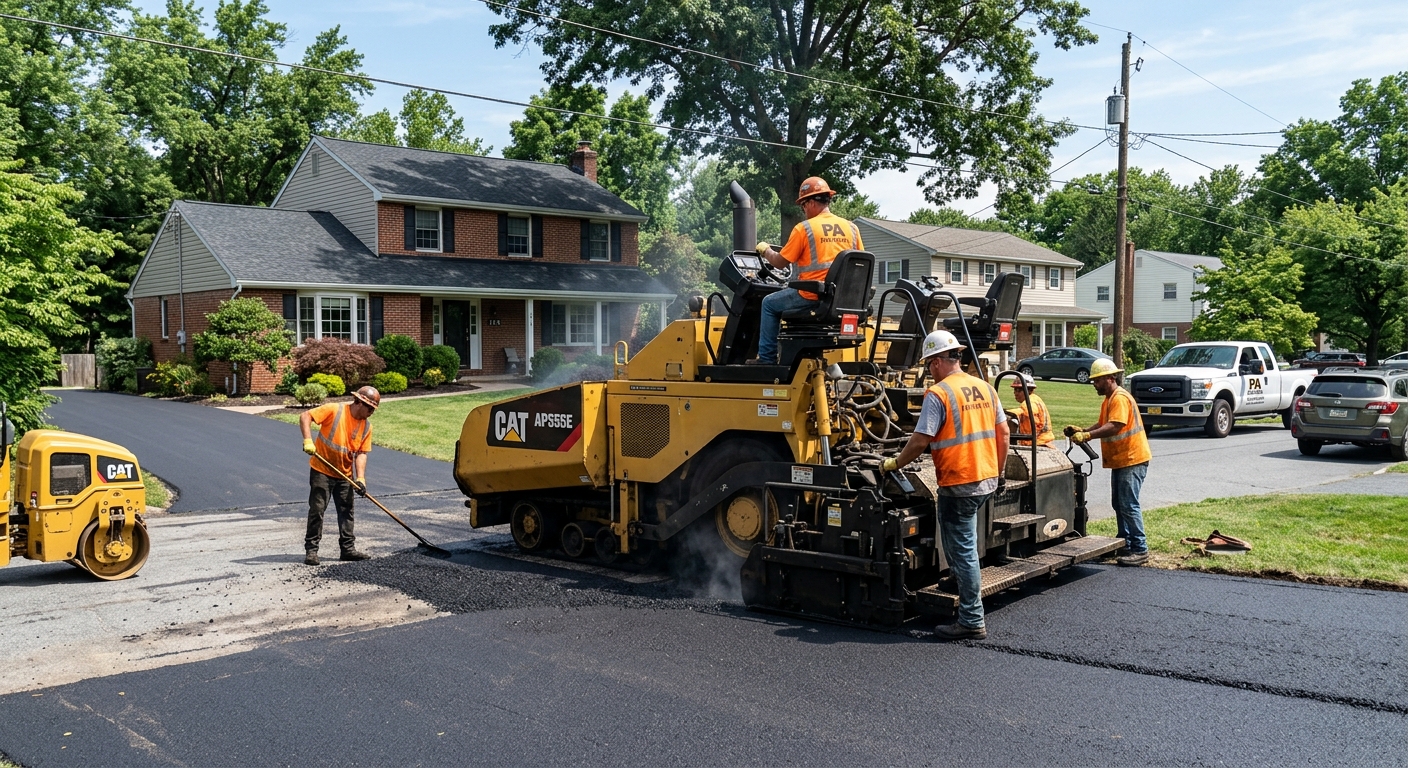
Morrisville paving prices by scope — 2026
Morrisville has a high share of single-family homes—66.5%—and a strong homeownership rate of 68.5% (U.S. Census Bureau, ACS 2024). For most households here, driveway maintenance or replacement is a personal expense, not a landlord’s. Budgeting for it is unavoidable in Bucks County, especially with so many homes built before 1980 when original asphalt grades and drainage were undersized.
The local climate in southeastern Pennsylvania means driveways suffer through regular freeze-thaw cycles, especially on the glacial till and silty clay found near the Delaware River. This combination punishes weak bases and thin paving. The truth: the biggest difference between a rock-bottom quote and a premium one is buried, out of sight, under the asphalt—a proper stone base is labor and stone, not something a homeowner can judge from the surface. Small up-front savings nearly always show up later as cracks, birdbaths, or edge failures.
The table below compares typical 2026 costs in Morrisville for different driveway options and repairs. The right pick depends less on the surface material than on whether the underlying base is sound. Most driveways with widespread cracking or sinking need full replacement; overlays and sealing are effective only when the foundation is intact.
| Service |
Best for |
Lifespan |
Price range |
| Asphalt — full replacement with new base |
failed base, structural cracking |
20–30 yrs |
$3,800–$9,700 |
| Asphalt overlay / resurfacing |
sound base, surface cracking only |
8–15 yrs |
$1,600–$4,900 |
| Sealcoating — single application |
preventive maintenance on sound asphalt |
2–4 yrs |
$225–$750 |
| Concrete — new installation |
long service life, low maintenance |
30–50 yrs |
$5,400–$13,000 |
| Crack filling and patching |
isolated cracks under a quarter inch |
1–3 yrs |
$200–$800 |
| Gravel driveway |
rural, budget, long runs |
5–10 yrs with upkeep |
$900–$3,500 |
Estimates for a typical Morrisville driveway. Square footage and base condition drive these figures more than material choice.
The specifications to demand in writing
As a Morrisville homeowner, the biggest favor you can do yourself is to demand your quote lists every number that matters—not just the price, but exactly what will be buried below the surface. Don’t settle for generalities like “three inches of blacktop” or “plenty of stone.” Here in Bucks County, decades of freeze-thaw plus clay-heavy soils make shortcuts expensive. Typical driveways in the region outlast the others because their contracts call out minimums: base excavation, aggregate type, and layers compacted to spec, not just “spread out.”
What does “three inches” mean? Laid loose, asphalt settles by up to a third after compaction. Quotes should always specify final compacted thickness, not just what’s dumped from the truck. For subgrade here in glacial till, that typically means a thicker crushed stone base than you’d see in the southern states, compacted in lifts—one thick loose layer never locks like three compacted ones.
Before signing, require a quote to state each of the following:
- Excavation depth below finished grade (inches, minimum 10–12 for full replacement here)
- Type and thickness (compacted) of aggregate stone base (e.g., 6–8 inches of PennDOT 2A)
- Number of lifts for both stone and asphalt, and compaction method for each layer
- Binder course (base asphalt) thickness after compaction (minimum 2 inches)
- Surface course (top asphalt) thickness after compaction (minimum 1.5 inches)
- Exact asphalt mix design—who supplies it and the mix type
- Edge support: whether stone is extended beyond asphalt and/or curbing installed
- Joints to old work: method and any tack coat specified
- Drainage plan, minimum finished slope (usually 2%) for water runoff
- Cleanup and restoration: topsoil/seeding to edges, hauling away debris
Diagnosing a failing Morrisville driveway
You don’t need to be a paving pro to get a clear sense of what your driveway needs—you just need to know what to look for. The base beneath your driveway is what makes it last, and most failures start where you can’t see. In Morrisville, freeze-thaw cycles and our local clay-heavy soils make an underbuilt base quick to fail, especially for homes built before 1980.
Start with a walkover inspection. “Alligator” cracking—many thin, interconnected cracks—across a sizeable area is almost always a failed base that needs full replacement, not just an overlay. Isolated, straight cracks under 1/4 inch wide usually mean routine aging and are good candidates for crack filling and a sealcoat. Any part that’s sunken, ponded (birdbaths), or has lost material along the edges points to subgrade movement or poor edge support. If you see potholes, water has already gotten through the top layers to the base, and patching is needed before you discuss any major work.
If a contractor quotes an overlay over a driveway with widespread cracking or depression—without probing to assess the full base depth—walk away. Without addressing the base, any overlay is throwing good money after bad; it will reflect cracks in a year or two.
| What you see |
Likely cause |
Right fix |
Cost |
| Isolated cracks under 1/4 inch |
surface aging |
crack fill and seal |
$225–$750 |
| Alligator cracking over a wide area |
base failure |
full replacement |
$3,800–$9,700 |
| Depressions holding water |
subgrade movement |
excavate and rebuild that area |
$3,800–$5,900 |
| Crumbling edges |
no edge support |
edge repair, consider curbing |
$400–$1,500 |
| Potholes |
water into the base |
full-depth patch, then assess |
$250–$900 |
| Faded but sound surface |
oxidation only |
sealcoat |
$225–$750 |
The honest case for and against sealcoating
Sealcoating gets sold as a cure-all, and there’s money in the push. Here’s what it really delivers for Morrisville driveways: A well-applied sealcoat shields the asphalt binder from UV light and slows down the natural oxidation that makes the surface brittle. It also helps protect against drips of fuel and oil and restores that fresh black look.
But sealcoating does not add structural life—if your base is failing, sealcoat buys you nothing. It does not fill meaningful cracks; those must be treated first with hot rubber or specialty crack fillers. On driveways with extensive cracking, high spots, or softness underfoot, no surface treatment will solve the underlying problem.
And there’s such a thing as too much sealcoating. Applying it every year traps moisture and volatile oils below, leading to peeling or flaking layers—especially if the original asphalt hasn’t cured (ideally, wait a full season before the first sealcoat). A healthy interval here is every two or three years for most Morrisville homes, not annually.
Crack filling is what truly stops water from migrating down to the base, which is where freeze-thaw cycles create the most damage. If a sealcoating price is suspiciously low—under $225—you’re likely getting a thin spray with minimal prep, which may last less than a year. A proper job (in the $225–$750 range) should include full cleaning, oil-spot treatment, crack repair, and two coats applied with a broom or squeegee for best coverage.
Beyond replacement: layout changes
Not every Morrisville paving project is just a straight swap. Many homeowners widen driveways to add second parking spaces, extend to reach a detached garage, or create a new turnaround so backing into busy roads is safer. Others want to replace a worn gravel run with asphalt or concrete for less mess.
Here’s what changes with a new footprint: Anywhere the new driveway goes requires building a new stone base over undisturbed ground. This is usually the most labor-intensive part, especially on Bucks County’s silty clay, which holds moisture and amplifies freeze-thaw heaving. The join between old and new work is always a weak spot—the seam may show movement after a few winters.
Zoning setbacks and “impervious surface” rules often limit how close to the property line you can pave, or how much total paved area you’re allowed. In Bensalem Township, for example, any expansion usually triggers a permit. Also, for driveways that connect to state routes, keep in mind that PennDOT District 6—not just your municipality—handles approach permits. Any increase in runoff may also trigger scrutiny under stormwater management regulations, especially if you redirect water toward a neighbor’s property.
Getting thirty years out of a driveway
If you want your Morrisville driveway to last three decades, focus on what actually works in this climate. The number one factor is keeping water out of the base. That means filling cracks as soon as they appear—don’t let a hairline become a water channel that leads straight to freeze-thaw heaving. Next is edge support: gravel extending past the asphalt edge or concrete curbing keeps vehicles from breaking down the asphalt sides over time.
Proper drainage can’t be overstated here. Southeastern Pennsylvania’s moderate but regular freeze-thaw cycles, and silty subgrade, mean standing water is the enemy. Always keep gutters, downspouts, and landscape grading moving water away from the driveway, not toward it.
On fresh asphalt, be gentle: no vehicles for the first week, and avoid turning steering wheels in place or parking heavy trucks or dumpsters for at least a month, especially in summer heat.
De-icing in winter is necessary, but for concrete, avoid salt and chemical de-icers since they break down the surface over time. Sand is safer, though it requires cleanup. For asphalt, salt is less damaging, but repeated cycles of melting and refreezing are tough on any material.
What you need before paving in Morrisville
If you’re simply repaving your Morrisville driveway in the existing footprint, in most Bucks County municipalities—including Morrisville itself—a building permit is generally not required. If you’re expanding, changing the layout, or adding parking pads, setbacks and impervious area rules may come into play and could require a permit through your local zoning office.
Regardless of the surface area, the connection where your driveway meets the street (“driveway approach”) is handled by a different authority when you’re on a state route. In Bucks County, that is PennDOT District 6, which issues Highway Occupancy Permits for driveway approaches on state-maintained roads, not your town’s public works department.
Stormwater rules apply whenever you expand the impervious surface. Adding pavement may require you to show how you’ll keep water from flowing onto your neighbor’s property. Liability exists even if the township doesn’t require a permit, so plan for positive drainage.
Before hiring any contractor for a job over $500, Pennsylvania requires the contractor to hold a Home Improvement Contractor (HIC) registration from the Office of Attorney General. You can verify this at hic.attorneygeneral.gov. Any company with employees must also carry workers’ compensation insurance, which you can check via WCAIS (wcais.pa.gov). Get these in writing before work starts.
Frequently asked questions — driveway paving in Morrisville
How far ahead should I book a paver in Morrisville?
In Morrisville and the rest of Bucks County, it’s best to contact paving contractors at least six to eight weeks before you want work started, especially from April through October. The paving season here is tied to temperature and weather—nights need to stay consistently above freezing for proper asphalt compaction, so the window can shrink in colder springs or extend longer in warm falls. Demand peaks after a hard winter, when freeze-thaw has cracked older driveways. For popular companies, especially those that do both residential and commercial work, spring and fall schedules can fill months in advance. For reference, a full asphalt replacement here typically runs $3,800–$9,700, so start talking early, get on their calendar, and confirm the specifications in writing.
Do I need a permit to repave a driveway in Morrisville?
In most parts of Bucks County, including Morrisville, you aren’t required to get a building permit to resurface or repave an existing driveway if you are not expanding its size or changing the layout. But if your driveway connects to a state road, you’ll likely need a Highway Occupancy Permit from PennDOT District 6 for any changes to the approach. Expanding the footprint or increasing the impervious surface can also bring zoning and stormwater rules into play. It’s always smart to confirm with your local zoning office before work begins. Overlay work usually costs between $1,600–$4,900, which is a substantial project best done by the rules.
Is gravel a cheaper option in Morrisville?
Gravel remains the lowest-cost driveway surface for Morrisville homeowners, especially for long or rural drives where paving would be costly. Installation for a new gravel driveway runs about $900–$3,500, well below the cost of full asphalt or concrete work. Just know that Bucks County’s local silty clay means more regular maintenance—regrading and topping up stone—to manage ruts and drainage. Gravel works best where you have space, don’t mind dust, and want to keep costs down without investing in a hard surface.
What does sealcoating cost in Morrisville?
A professional sealcoating job for a Morrisville driveway costs between $225–$750 in 2026, depending on the driveway’s size and condition. For the lower end of that range, expect careful cleaning, hand-applied coatings, and crack prep. Cheaper offers often skip surface prep and may be sprayed thin, lasting only a season. Given Bucks County’s freeze-thaw climate, proper crack filling matters more to extending driveway life than just sealing alone. Most driveways here benefit from sealing every 2–3 years, not annually, so budget for quality, not frequency.
What kind of soil is under Morrisville driveways?
Most Morrisville and Lower Bucks driveways are built over glacial till and silty clay soils. The finer particles in these soils hold water, increasing the risk of freeze-thaw damage unless your contractor installs a thicker, well-compacted stone base—at least 6 to 8 inches. Skip this, and you’ll see depressions or cracking in a few years. For repairs, a patch on weak clay will never last as long as one on firm ground, so base prep is the key investment here. Expect that proper excavation and base work puts replacement projects in the $3,800–$9,700 range.
How long should an asphalt driveway last in Morrisville?
With Morrisville’s climate and soil, an asphalt driveway built to regional spec should last 20 to 30 years—with proper care. Most failures I see in Bucks County come from skipped maintenance or skimping on the base during installation. Filling cracks quickly, managing edge support, and controlling drainage easily double the life compared to a neglected drive. Even with heavy snow and salt in winter, the expected lifespan here beats lighter-construction regions. Full asphalt replacements in Morrisville run $3,800–$9,700 and are worth it for the longevity.
Asphalt or concrete for a Morrisville driveway?
For Morrisville driveways, asphalt and concrete each have advantages. Asphalt is more affordable up front—installing new starts at $3,800—and handles freeze-thaw movement better because it flexes. Concrete lasts longer, with low upkeep, but initial costs run higher, typically $5,400–$13,000. Concrete is better where you want decades between resurfacing and minimal fuss but needs to be protected from de-icing salts in winter. In high-clay soils, proper base prep counts more than the choice between the two, so compare based on specifications, not just surface.
When can I seal a brand new asphalt driveway?
After installing new asphalt in Morrisville, wait at least 90 days—and ideally a full summer season—before applying the first sealcoat. The surface needs time to cure and shed volatiles so the sealer can bond properly. Sealing too early traps oils and moisture, causing premature peeling and cracking. For most Bucks County homeowners, I suggest scheduling the first seal in the fall after a spring installation, or the following summer if paved in the fall. The cost for that first proper sealcoat will be in the $225–$750 range, but done too early, it’s money wasted.
What slope does a driveway need for drainage?
In Morrisville, a minimum finished slope of 2% (about a quarter inch per foot) is standard to ensure water drains off the surface and doesn’t pond. With our freeze-thaw cycles and silty soils, standing water accelerates pavement failure, so don’t settle for a flat driveway in Bucks County. Your paving contract should specify the finished grade—often called out for both side-to-side “cross slope” and away from buildings. If drainage isn’t right, expect base failures even after spending $3,800–$9,700 for a new drive. Good grading up front saves thousands in early repairs later.