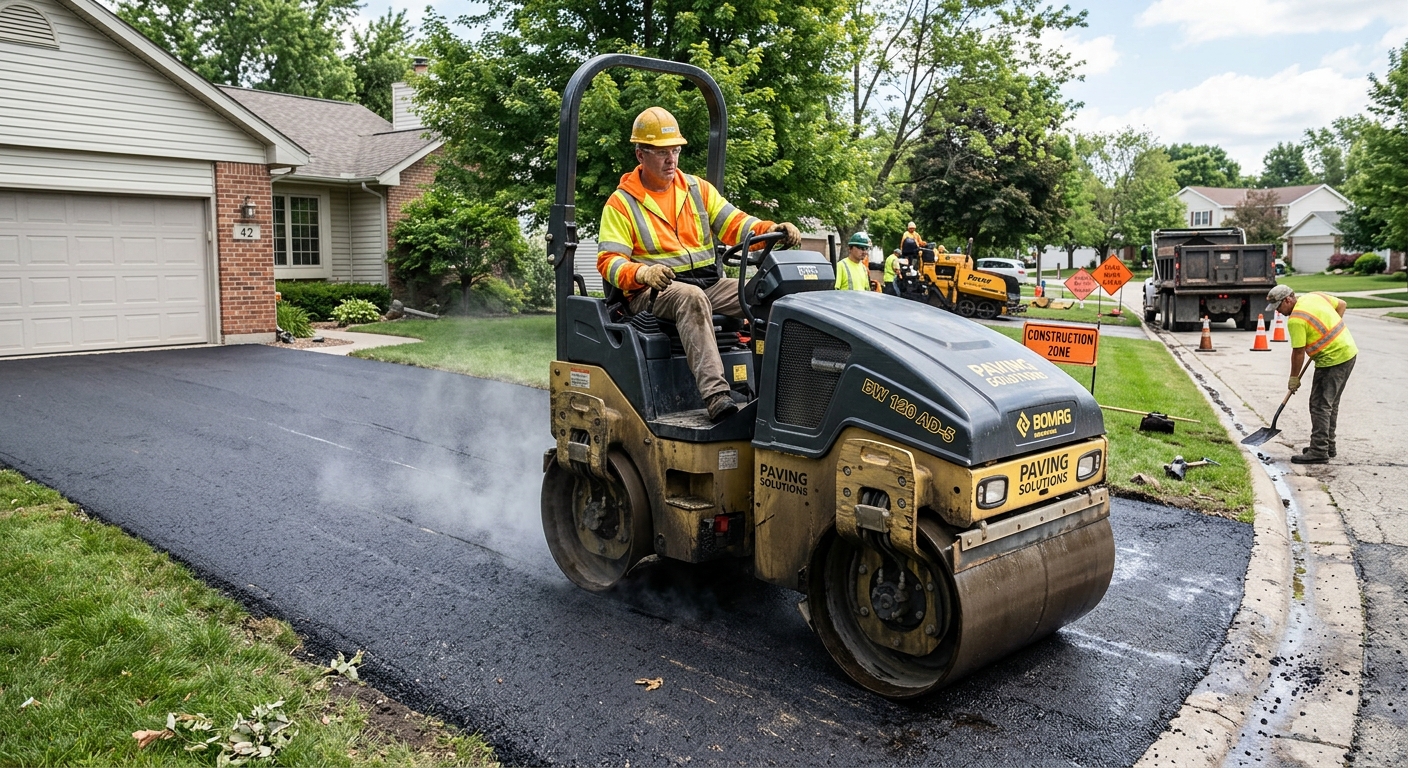
Driveway paving costs in Mount Lebanon — 2026
In Mount Lebanon, where 69.1% of homes are single-family and homeowners account for 75.5% of households (U.S. Census Bureau, ACS 2024), driveways are a major exterior investment. Most Mount Lebanon driveways date back decades—and those postwar installations often sit atop clay and shale subgrades, which have their own challenges unique to the region, especially during our heavy freeze-thaw winters. Paving costs here are less about the surface you see and more about what's hidden beneath: the base. You may get two very different prices for what looks like the same driveway, but the difference is almost always underground—base thickness, drainage prep, and type of aggregate are where contractors cut costs (or do the job right).
| Service |
Best for |
Lifespan |
Price range |
| Asphalt — full replacement with new base |
failed base, structural cracking |
20–30 yrs |
$3,900–$9,900 |
| Asphalt overlay / resurfacing |
sound base, surface cracking only |
8–15 yrs |
$1,650–$5,000 |
| Sealcoating — single application |
preventive maintenance on sound asphalt |
2–4 yrs |
$225–$750 |
| Concrete — new installation |
long service life, low maintenance |
30–50 yrs |
$5,500–$13,000 |
| Crack filling and patching |
isolated cracks under a quarter inch |
1–3 yrs |
$200–$800 |
| Gravel driveway |
rural, budget, long runs |
5–10 yrs with upkeep |
$900–$3,500 |
Estimates for a typical Mount Lebanon driveway. Square footage and base condition drive these figures more than material choice.
How paving fraud actually operates
Paving scams are common in Mount Lebanon because the signs of a bad job—thin asphalt, weak base, poor compaction—may not surface for years, by which time the crew is long gone. Scammers often offer “leftover asphalt from a job down the road,” push a “today only” price, show up with an unmarked truck on out-of-state or distant plates, and insist on cash upfront. You’ll hear a verbal price, never a written contract, and the supposed “sealcoat” may just be a thin oil-based spray that washes away in six months. These operators rely on the visible nature of the work and high turnover to evade accountability.
Allegheny County is part of a saturated paving market, so Mount Lebanon homeowners have plenty of reputable choices. Here, job density means neighbors notice and word gets around. Still, the consumer protection statutes in Pennsylvania are written for these tricks: for any job over $500, you are legally entitled to a written contract under the Home Improvement Consumer Protection Act—don’t proceed on a handshake. You also have the right to cancel within three business days. Never let anyone rush you through the paperwork, and if a contractor offers to “waive your insurance deductible,” walk away—it’s prohibited by law.
Five-minute checks stop almost every scam: ask for their Home Improvement Contractor (HIC) registration and verify it at hic.attorneygeneral.gov, ask for a written contract, confirm they carry workers’ compensation via WCAIS (wcais.pa.gov), never pay cash up front, and don’t agree to anything without three days to think it over.
Local soil, drainage and driveway lifespan
Mount Lebanon driveways sit atop a mix of clay and shale subgrade, not sandy soil or gravel. Clay holds water—when it freezes, it expands, pushing the driveway upward and causing cracks and settlement. Shale, when compacted properly, can support a driveway, but if it’s mixed with clay or left loose, it traps water against the base. This unpredictable subgrade, coupled with a 36-inch frost depth and Allegheny County’s heavy freeze-thaw cycles, means the long-term health of your driveway depends on more than the surface asphalt or concrete.
The postwar housing booms (1945–1975), especially in nearby suburbs, led to a lot of quick asphalt installations. Many existing Mount Lebanon driveways from this era were built with thin or poorly compacted bases—good enough for a few years, but not for decades. As a result, these older driveways often need more than sealcoating; a structural overlay or a full replacement is usually necessary, particularly where the base shows signs of pumping, heaving, or chronic cracking. When you’re quoted for “resurfacing,” make sure it’s not just covering up an old problem with a fresh layer of asphalt.
What's under the asphalt matters more than the asphalt
The durability of a Mount Lebanon driveway depends almost entirely on the layers you can't see. A proper assembly starts with the subgrade (our native clay and shale), then a thick compacted aggregate base (usually crushed limestone or slag), and finally the asphalt surface. Each layer must be carefully built and compacted because it spreads the weight of vehicles and keeps moisture from working up or down.
Here, freeze-thaw is the great enemy. Water trapped in the clay subgrade expands when it freezes (we see plenty of 8°F winter nights), lifting the driveway unevenly and cracking even the best surface from below. The secret to longevity isn’t three extra inches of asphalt—it’s a base at least 6–8 inches deep, properly graded and compacted in 3–4 inch lifts, and never skimped. Most of the ways to cheap out on a paving job happen at this step: skipping base excavation (just topping the old driveway instead), undersized or poorly compacted stone, old concrete rubble as fill, or forgoing compaction testing entirely. None of it is obvious when the crew packs up, but the result is the same: soft spots, sinking edges, puddles, and cracks within 2–4 winters.
If you’re collecting quotes, demand the following in writing: depth of new aggregate base (in inches), type of stone (e.g., 2A Modified Limestone), thickness of asphalt (specify binder and surface course), and that both base and asphalt will be compacted in separate lifts. If a contractor blurs those details or won’t write them down, that’s where the shortcut is hidden.
Driveway permits, approaches and stormwater rules
Repaving your Mount Lebanon driveway—if you’re not changing its footprint—usually does not require a building permit. But where your driveway meets the public street, the rules change. In Allegheny County, if your work alters the curb, apron, or extends into a state-maintained road, a Highway Occupancy Permit from PennDOT District 11-0 is required. Pittsburgh enforces curb and right-of-way permits through its own department; other municipalities administer permits locally. Always check before changing anything at the approach or apron—even regrading—since an unpermitted alteration can cause headaches with city inspectors (and, more importantly, trigger re-do orders at your expense).
Stormwater is another issue: expanding your driveway or altering grade can shift how water leaves your property. Sending runoff directly onto a neighbor’s yard, an alley, or a public sidewalk can create liability regardless of permits. Some neighborhoods may enforce local stormwater codes, particularly if you add new impervious area—plan ahead, and ask a reputable contractor about options for managing runoff, like permeable edges or drains.
Before hiring anyone, verify their Home Improvement Contractor (HIC) registration through hic.attorneygeneral.gov. Any employer must provide workers’ compensation insurance—confirm coverage at WCAIS (wcais.pa.gov) especially for larger crews. Only written contracts are valid for jobs over $500, including specific scope and cancellation terms.
When paving can actually be done in Mount Lebanon
Pavement season in Mount Lebanon is not a matter of convenience—it’s dictated by weather and local plant schedules. Hot-mix asphalt must be laid at temperatures consistently above about 50°F to allow adequate compaction; if it cools before being fully compacted, you end up with a porous, weak surface that fails long before its time. Concrete needs at least several frost-free days (with overnight lows above freezing) to set and cure properly. Once nighttime temps dip and winter sets in—our design low is 8 °F—asphalt plants in the Pittsburgh area simply shut down, and crews switch to other work for the season.
Realistically, the paving window here runs late April through early November. Crews are at their busiest from late May through September; expect longer lead times and higher per-square-foot costs during peak summer. If someone offers to pave in December or March, that’s a red flag—they’re likely working with cold patch or recycling millings, not fresh plant-mix. If you want to get the best value, schedule early in the season or toward the fall; there’s less rush, and many reputable contractors are looking to keep crews busy outside of the summer crunch. The abundant supply of local asphalt and aggregate plants in Allegheny County means that once the season begins, there’s usually no hauling delay for Mount Lebanon jobs.
Where the water goes
Water is what ends most Mount Lebanon driveways before their time. Proper grading is not a finishing detail—it’s the difference between a twenty-year surface and one that unravels after three or four winters. The basic rule: every portion of the driveway should slope at least 2% (about 1/4″ per foot) away from structures to the sides or toward the street, never toward your garage or house. A simple cross-slope (the whole driveway tilting to one side) is common, but wider surfaces may need a crown in the center to shed water in both directions. If the driveway must slope toward the house or garage, a trench or channel drain at the base is essential to intercept water before it reaches the foundation.
Mount Lebanon’s heavy clay holds water against the driveway base. When this moisture freezes, it heaves the slab, breaks bonds, and lets in more water the next time it thaws. That’s why surface runoff must leave the site quickly—no pooling, no slow soak. If runoff can’t be directed to the street or a storm sewer, a daylighted drain out to lower ground is best; if not feasible, a properly sized dry well (with overflow) is the next step. Just never dump water onto a neighbor’s property—this is a headache to resolve legally, regardless of what the permit says or how the last owner did it.
Good drainage is built, not hoped for. If your current driveway ponds water or grows moss in spring, correcting the slope and adding drains where needed will extend pavement life longer than any sealant or patch job.
Frequently asked questions — driveway paving in Mount Lebanon
Are pavers worth the cost in southwestern Pennsylvania?
Paver driveways bring classic curb appeal, but in Mount Lebanon’s freeze-thaw climate, they are not a set-and-forget option. Each unit is susceptible to heaving when our clay-rich subgrade swells in winter, and maintenance involves resetting shifted pavers and re-sanding joints every few years. The upfront cost is typically higher than asphalt or even concrete—easily reaching or exceeding $13,000 for a full standard driveway. The best use of pavers locally is in small accent areas or where drainage runs perfectly. For most homeowners here, concrete or quality asphalt will deliver longer, lower-maintenance performance for less money.
How many freeze-thaw cycles does Mount Lebanon get?
Mount Lebanon gets enough freeze-thaw swings each winter to accelerate pavement wear, sometimes exceeding 30–40 cycles during a tough season. Our 36-inch frost depth means the ground below your driveway can lift and fall repeatedly as moisture freezes, then melts. This is why surface distress and alligator cracking are so common in older asphalt driveways. Investing in a thicker aggregate base with high compaction costs more up front—think the higher end of the $3,900–$9,900 band for a full replacement—but cuts down on long-term repairs and extends driveway life, especially in our regional soil conditions.
How much does it cost to widen a driveway?
Widening drives in Mount Lebanon depends on the material and how much base prep is needed. If the existing base is stable and you’re just adding a few feet of width, it can fall into the lower half of the full asphalt replacement range, roughly $3,900–$9,900—more if you’re moving retaining walls or regrading for drainage. Don’t forget that any curb alteration or new approach onto a public road may trigger a separate permit from PennDOT District 11-0 or your municipality. Sometimes resurfacing the full width—old and new at once—ensures uniformity and fewer future cracks at the seam.
When can I seal a brand new asphalt driveway?
In Mount Lebanon, you should wait a full season—ideally 90–180 days—before applying the first sealcoat to new asphalt. The material needs time to cure and release built-up oils; sealing too soon can lock in volatile compounds and lead to a soft or blotchy surface. Don’t worry if you miss your first fall. As long as your installer did a proper job, a single sealcoating on a new, fully cured surface (at $225–$750) is plenty to weatherproof the top layer. Any reputable local contractor will confirm this timeline based on the mix and the year’s paving schedule.
How long should an asphalt driveway last in Mount Lebanon?
A well-built asphalt driveway in Mount Lebanon—with at least a 6–8 inch compacted base and proper drainage—should last 20 to 30 years. That’s right at the top of what’s possible in western Pennsylvania, if you keep up with crack sealing and periodic sealcoating. If the base prep was skipped or the drainage lets water sit, expect the lifespan to drop sharply—sometimes failing in as little as 8 years (which matches the overlay band of $1,650–$5,000). Homeowners replacing driveways installed during the 1950–1970 subdivision wave should question the condition of the subbase before deciding on just resurfacing.
How far ahead should I book a paver in Mount Lebanon?
Because paving season is limited in Mount Lebanon—roughly mid-April through October—reputable contractors can book up months ahead, especially for work during summer when asphalt plants operate at peak. Calling in March or April for a late spring job is best. Prime weeks fill quickly, and the backlog can push you to late summer or fall. If you’re looking at concrete—where the cost ranges $5,500–$13,000—the scheduling is just as tight, since weather and batch plant hours are about the same. Off-peak projects in early spring or late fall may get faster service and sometimes better pricing.
Can I cancel a paving contract I signed at my door?
Yes. In Pennsylvania (including Mount Lebanon), the Home Improvement Consumer Protection Act gives you three business days to cancel any home improvement contract over $500. This law covers paving—and is there to protect you against high-pressure tactics, such as those used by transient paving crews. If you signed something at your door, or anywhere off the contractor’s normal place of business, you have until midnight of the third business day to cancel without penalty. Don’t let anyone tell you otherwise, or rush you into immediate work. All jobs over $500 must have a written agreement that explains your right to cancel.
What slope does a driveway need for drainage?
The recommended minimum slope for driveways in Mount Lebanon is 2% (a quarter inch per foot) away from buildings and toward the street or an approved drainage point. On wide or dual-pitch driveways, crowning in the center can encourage water to run off both sides. Our local clay subgrade holds water against the base, making positive slope even more critical to prevent freeze-thaw damage. If your drive slopes toward your home or garage, install a channel drain, especially for higher-end surfaces like new concrete ($5,500–$13,000). Good drainage preserves both the pavement and your foundation—even a perfect surface will fail if water can’t leave.
Why are paving quotes in Mount Lebanon so different from each other?
Most of the price variation in Mount Lebanon paving comes down to what happens below ground. One contractor may bid for a full-depth removal, adding 6–8 inches of compacted stone and new asphalt (the top end of $3,900–$9,900), while another prices a quick overlay over a questionable base. The cost you don’t see in the finish—better aggregate, real compaction in lifts, proper drainage setup—is what spares you from redoing the job in five years. Always get the detailed scope in writing, including base depth, materials, and whether drainage corrections are included, so you’re comparing apples to apples rather than surface appearances.