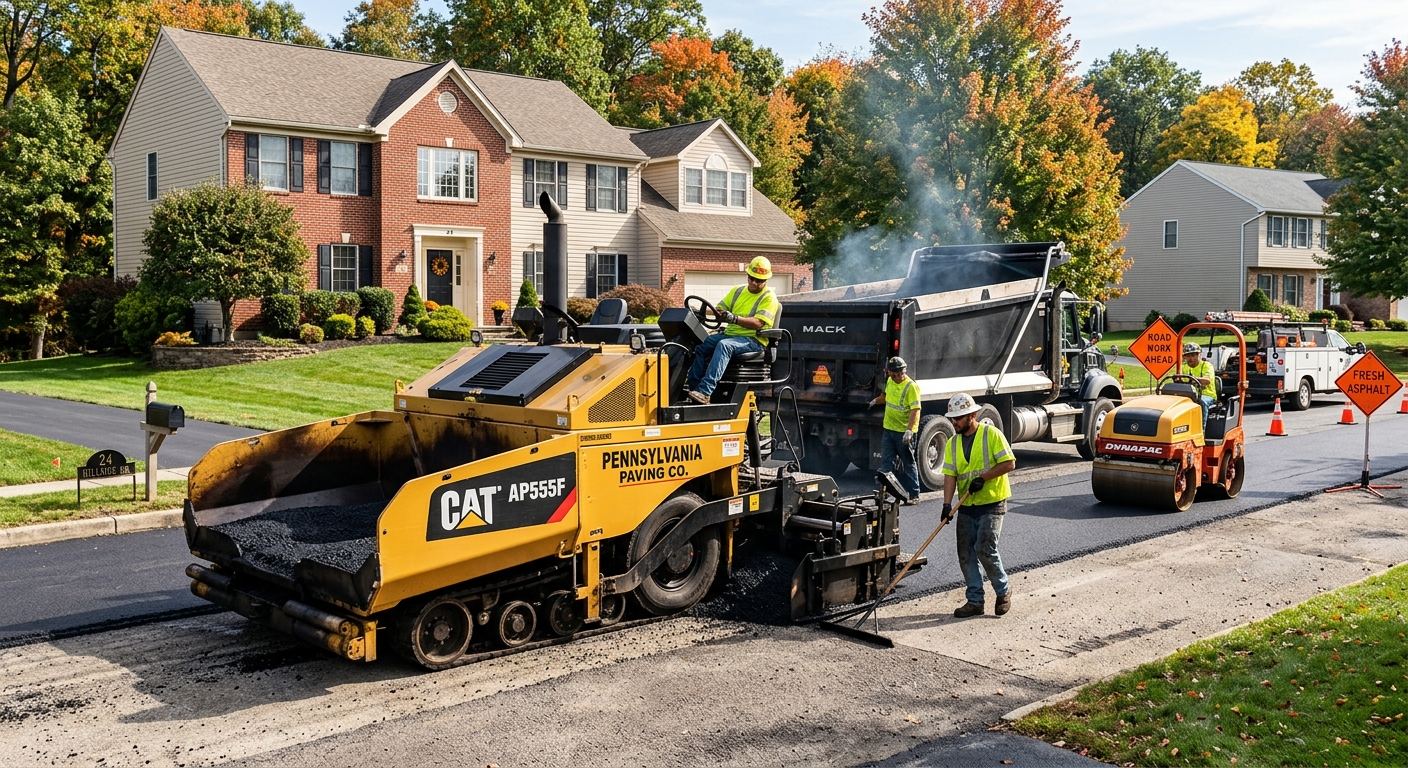
Oil City paving prices by scope — 2026
In Oil City, with nearly three-quarters of homes being single-family (U.S. Census Bureau, ACS 2024), and most homeowners footing the bill for exterior maintenance, driveway paving is a significant expense that falls squarely on the property owner. Even though the finish looks similar from the street, prices for new asphalt or concrete driveways can vary sharply—even on the same block. The main driver isn’t the surface itself, but what goes on under it: rebuilding the stone base, addressing drainage, and handling Oil City’s freeze-thaw cycles caused by our long, snowy winters. Local driveways often rest on glacial till and shale, which means skipping proper base work leads to frost heave, rutting, and early failure. That’s why two quotes for what seems like the “same job” often reflect very different approaches beneath the surface, and why the cheapest bid may end up the costliest in the long run.
This table shows the range of what you can expect for the most common driveway projects in Oil City and Venango County. These prices reflect both urban and nearby rural jobs, where hauling materials in from Meadville or Clarion bumps up costs. Material choice matters, but base preparation is what swings your total price:
| Service |
Best for |
Lifespan |
Price range |
| Asphalt — full replacement with new base |
failed base, structural cracking |
20–30 yrs |
$3,100–$8,000 |
| Asphalt overlay / resurfacing |
sound base, surface cracking only |
8–15 yrs |
$1,350–$4,000 |
| Sealcoating — single application |
preventive maintenance on sound asphalt |
2–4 yrs |
$175–$600 |
| Concrete — new installation |
long service life, low maintenance |
30–50 yrs |
$4,400–$10,500 |
| Crack filling and patching |
isolated cracks under a quarter inch |
1–3 yrs |
$200–$800 |
| Gravel driveway |
rural, budget, long runs |
5–10 yrs with upkeep |
$900–$3,500 |
Estimates for a typical Oil City driveway. Square footage and base condition drive these figures more than material choice.
The honest case for and against sealcoating
Sealcoating is pitched heavily in Oil City, but it’s not the magic fix many believe. What sealcoating actually does is protect the asphalt binder from sunlight, oxygen, and chemical drips like fuel or oil—it helps slow down the slow brittling that comes from our long, cold winters and the occasional hot spell. It also refreshes a faded surface and makes a driveway look sharp. What sealcoating does not do: it does not add any structural strength, it won’t fix underlying base problems, it can’t heal wide cracks, and it absolutely cannot extend the life of a driveway that’s already failing from below.
What never gets said: Sealcoating too often does more harm than good. A new layer every year will build up a brittle glaze that peels and cracks, making repair harder and actually letting in more water. The very first sealcoat should wait until the fresh asphalt cures for a full season. Genuine value comes from waiting until the driveway is hungry—gray and dry—not from a regular calendar schedule. And while sealcoating lasts 2–4 years per application, a cheap job is easy to spot: a thin coat sprayed on for a too-low price glosses up the driveway for a season, then washes away or flakes off after the first freeze-thaw.
Of all the maintenance you can do, crack filling makes the biggest difference. Water entering through cracks, then freezing and expanding below, is how most driveways in Venango County die. A proper hot rubber crack fill—neat, overfilled just a hair, and well-sanded—outlasts any coat of sealer. At $175–$600 per sealcoating, and $200–$800 for a good round of crack filling and patching, pay attention to what’s below, not just the surface shine. If the price seems suspiciously low, expect only a fast, spray-on cosmetic touch-up, not real protection.
Changing the footprint of a Oil City driveway
Adding width for a second vehicle, extending a narrow run toward a garage, or replacing gravel with finished asphalt are all common projects in Oil City’s older neighborhoods. These aren’t just simple overlays—they require building out the stone base onto undisturbed, sometimes soft, subgrade. That means more excavation, more gravel, and full compaction, or you’ll end up with settling and cracks right where the new meets old. No matter how good the match, the seam between an old and new driveway section is always a permanent weak point for water infiltration and frost heave.
Regulations do change when you expand a footprint: Oil City requires a permit if you’re widening or relocating your drive within the street right-of-way—not just at the curb, but anywhere that affects that strip by the road. For the actual apron (the part connecting to a state route), PennDOT’s Highway Occupancy Permit applies through District 1. If you’re working in a rural township outside city limits, resurfacing an existing gravel drive usually doesn’t need a permit, but any new paved access or significant expansion still can. Also, expanding can trigger local impervious-surface or stormwater rules and put you close to property-line setbacks—worth checking before you pour or pave. A skilled contractor will flag these for you before work starts.
How paving fraud actually operates
Paving scams find soft ground in rural counties like Venango, where neighborhoods are farther apart and contractors often travel in from out of town. Fly-by-night crews show up unannounced with the predictable pitch: “We’ve got leftover material from a job down the road—can do your place cheaper if you decide today.” They’ll often push for cash up front, avoid written quotes, and disappear before their substandard work fails. Sometimes it’s unmarked trucks or plates from out of state, sometimes it’s a business with no online record at all.
The tell-tale moves: a verbal-only quote (or a back-of-paper contract), demanding payment before a shovel hits the ground, applying a thin oil-based spray and calling it “sealcoating,” or insisting you must decide before they leave your driveway for a deal. These crews know pavement problems under the surface won’t show for a season or two— long after you’ve paid and they’ve moved on. In Oil City, legitimate jobs require a written contract by Pennsylvania law for anything over $500, and you have a three-business-day right to cancel after signing. Anyone who pressures you to waive your right or pay a suspiciously low price upfront is not running a legal operation.
The law is designed for exactly these problems. Always check that the contractor is Home Improvement Contractor-registered with the PA Office of Attorney General, and has valid workers’ compensation coverage on file in WCAIS. That five-minute check kills every scam above and puts you in control of the process, not the other way around.
Comparing materials in northwestern Pennsylvania
Our region’s climate—over 6,200 heating degree days and some of the state’s roughest seasonal freeze-thaw cycles—shapes how asphalt and concrete hold up in Oil City. Asphalt is flexible by design; when the ground shifts under winter frost, it bends instead of cracking wide open. This makes it a practical choice for driveways in Venango County, where the base sits over glacial till and shale. Concrete, by contrast, is rigid: it outlasts asphalt where it survives, easily hitting 30–50 years’ life, but the northwest’s salt-laden snow and regular plowing chews it up. The most common failure mode for concrete here isn’t even cracking, but surface spalling and scaling from salt.
The honest trade is this: Concrete costs more up front—$4,400–$10,500—and lasts decades if you never use salt-based de-icers. But that’s a hard ask for most. Asphalt is cheaper at install—$3,100–$8,000—shorter in lifespan, but less risky to maintain. Pavers are an option if budget allows; they handle settling well and individual units can be reset, at a premium price. Gravel still works best for long rural drives where drainage matters more and budget is tight.
| Option |
Installed cost |
Maintenance |
Freeze-thaw performance |
Lifespan |
| Asphalt — new install |
$3,100–$8,000 |
sealcoat every 3–4 yrs |
excellent, flexes |
20–30 yrs |
| Asphalt — overlay |
$1,350–$4,000 |
same |
good if base is sound |
+8–15 yrs |
| Concrete |
$4,400–$10,500 |
low, avoid de-icing salt |
fair, spalls with salt |
30–50 yrs |
| Pavers |
$7,100–$10,500 |
individual units replaceable |
good, settles gradually |
25–50 yrs |
| Gravel |
$900–$3,500 |
top-dress every 2–3 yrs |
excellent drainage |
indefinite with upkeep |
Maintenance that actually works
The best money you can spend on a driveway is filling cracks as soon as they form—before water gets to the base and frost can pry the surface apart. In Oil City, where winter means frequent freezes and spring brings fast melt-offs, this is not optional. Next is supporting the edges: most driveways fail at the side because the stone base is too narrow, and vehicles or snowplows break it off. Keep all downspouts draining away from your drive, and make sure the surface stays higher than the yard so water can’t pond or creep under.
Point loads—parking heavy trailers, dumpsters, or using jack stands on the surface—should be avoided, especially with new asphalt that hasn’t fully cured (typically 30–90 days for most jobs). After installation, keep off at least three days and avoid stationary steering for the first two weeks.
When it comes to ice, salt is a necessity on most Oil City asphalt, but on concrete, it’s the leading cause of early spalling and scaling. Alternatives like sand or calcium magnesium acetate exist, but are pricier and harder to source. Honest answer: you’ll do best by using the minimum amount, shoveling promptly, and protecting vulnerable new concrete from salt for at least one winter.
Permits and approvals for paving in Oil City
For most driveways in Oil City, repaving an existing footprint does not usually require a building permit—good news for keeping the project simple. The exception is if you are widening or relocating the drive in the street right-of-way, which does trigger a city-issued construction permit. Homeowners on state roads anywhere in Venango County also need to know: any new or altered driveway approach—where your drive meets a PA state route—requires a PennDOT Highway Occupancy Permit, which is handled out of District 1 and is separate from city or township rules.
When you expand your driveway, you are adding impervious surface, and that can bring stormwater management requirements or runoff restrictions. Even with no permit, water cannot be directed onto your neighbor’s property, or you’ll be liable for damages—permit or no permit, the law still applies.
If the contract is over $500, Pennsylvania’s Home Improvement Consumer Protection Act kicks in: you must get a detailed, written contract, and you have a 3 business-day right of cancellation after signing. Always verify your paving contractor’s Home Improvement Contractor registration at the Attorney General’s registry, and check they have current workers’ compensation coverage through WCAIS before you sign or pay a deposit.
Frequently asked questions — driveway paving in Oil City
What does sealcoating cost in Oil City?
Sealcoating an average single-lane driveway in Oil City runs between $175–$600 for a single application, with most jobs coming in around $350. The range covers everything from small alley-width drives to wider, multi-car approaches. Factors that affect the price include surface preparation, crack filling (which is sometimes extra), and the quality of sealer used. In Oil City, contractors haul in materials from outside Venango County, which does nudge up costs compared to urban Pennsylvania areas. Beware bargains under $200—they usually mean a fast, thin spray that won’t survive the winter. A reputable contractor will tell you honestly if your drive needs it this year at all, especially if the surface is still black and not cracking.
What is the difference between crack filling and sealcoating?
Crack filling and sealcoating are two completely different maintenance steps. Crack filling targets specific cracks—usually anything less than a quarter inch wide—using a hot, rubberized material that keeps water from reaching the stone base. This direct intervention actually extends driveway life by stopping frost from prying the surface further apart in Oil City’s freeze-thaw climate. Sealcoating, on the other hand, is a surface coating that slows oxidation and gives the pavement a fresh black look, but does little to mend structural issues or keep water out of deeper cracks. A full crack-filling pass costs about $200–$800, while sealcoating goes from $175–$600. For longevity, crack filling takes priority—sealcoating is for protection and looks after the cracks are handled.
Do I need an approach permit where my driveway meets the road?
Yes, in most cases. In Oil City and throughout Venango County, any new or reconstructed driveway approach that connects to a PA state route requires a PennDOT Highway Occupancy Permit through District 1. That includes widening, moving, or changing the grade at the entrance—not just new construction. If your approach is on a city street within Oil City, the Code Enforcement Office handles the permit for changes within the right-of-way. For rural townships, resurfacing a private gravel approach usually skips this, but any expansion or new connection to a township or state road means paperwork. Failure to pull the right permit can result in fines or a forced redo, even if you’ve already paid a contractor $3,100–$8,000 for the job.
How much does driveway paving cost in Oil City?
For a standard single-car asphalt drive in Oil City, full replacement including a fresh stone base runs $3,100–$8,000, depending heavily on size and underlying soil condition. An asphalt overlay on a sound base is much less, typically $1,350–$4,000. Concrete installations are more—between $4,400–$10,500—but the lifespan is greater if de-icing salt is avoided. The broad price bands here reflect everything from short city drives to longer rural approaches. Oil City’s market also sees slight travel surcharges, since materials come from outside the county. Surface isn’t the true price driver—prepping and repairing the base is.
Should I repair or replace my Oil City driveway?
If your driveway has alligator cracking, settling, or large potholes, it usually means the base has failed and needs complete replacement—expect $3,100–$8,000 for new asphalt with a rebuilt base. If cracks are narrow (under a quarter inch), and the surface is mostly solid, crack filling and a fresh overlay ($1,350–$4,000) can buy another decade or so. In Oil City, thanks to our glacial till soils and frost-prone winters, base failure is the most common reason driveways fail early. Honest contractors will test the base before deciding, and sometimes the best advice is to spend less and maintain yearly until a full replacement is necessary.
Why are my driveway edges crumbling?
Driveway edges crumble in Oil City mostly because the stone base is too narrow and exposed to heavy seasonal freeze-thaw cycles. Without enough lateral support, asphalt and concrete break off where vehicles drive or plows scrape, letting water reach underneath. On most Venango County homes, early postwar driveways were built just wide enough for tires, not today’s heavier vehicles. Adding a gravel shoulder, keeping water away from the edge, and not parking wheels right at the margin helps. Fixing the edge for real means cutting back and rebuilding the base—a repair running $200–$800 per crack fill and patching session, or more if excavation is needed.
How long does a driveway installation take?
For an average driveway in Oil City, a full asphalt replacement typically takes 2–3 days from the start of excavation to final rolling—weather and base prep allowing. Adding days for demolition and extra drainage may be necessary on older properties where slopes have settled. Overlays or sealcoating go faster, often a single day if no structural repairs are needed. Concrete runs slower—a minimum of 4 days, to allow for pouring and curing, and new surfaces are best left untouched for at least a week. Quick-drying jobs in this region can fail fast because our ground stays cooler, especially early or late in the season, so rushing installation will cost you more than patience. The fastest job—gravel resurfacing—can often be done in a day.
Does Oil City have local asphalt plants?
No—Oil City doesn’t have its own asphalt or aggregate plants. Materials are hauled in from plants near Meadville and Clarion, which means most paving contractors build extra trucking time and cost into their bids. That’s partly why you’ll see the price of asphalt driveway installations here—$3,100–$8,000—run a little higher than in bigger towns closer to hot mix plants. Plan ahead: in peak season, plant supply and travel distance can affect scheduling and price.
What does compaction in lifts mean?
Compaction in lifts means that asphalt (or gravel) is placed in layers, usually 2–3 inches at a time, and each layer is compacted thoroughly before the next is added. In Oil City, where subgrades can include glacial till and shale, this ensures that the finished surface won’t settle or develop ruts during the wet spring or freeze-thaw cycles. Skipping this step creates invisible weak spots that lead to early cracking and potholes, even when the surface looks great on day one. If a crew claims they can lay all your asphalt at once for less—$3,100–$8,000 is the band for a proper multi-lift job—they are cutting costs at your long-term expense. This step is not visible to you after the fact, but it’s what most price differences truly come down to.