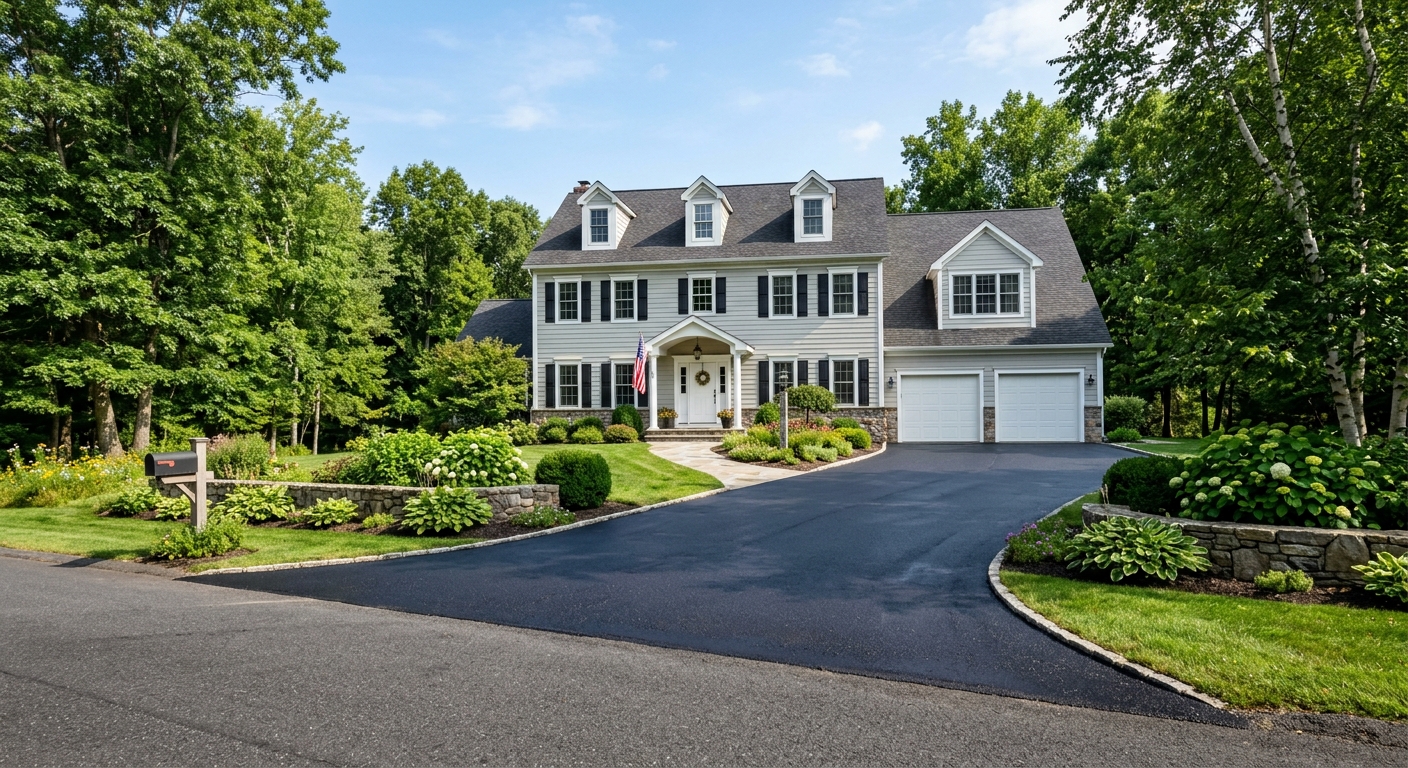
Upper Hanover paving prices by scope — 2026
In Upper Hanover, where 76.9% of homes are single-family and the homeownership rate is a sky-high 93.0% (U.S. Census Bureau, ACS 2024), most residents face driveway replacement as a direct homeowner expense. The climate here is tough on paving materials: winters bring moderate freeze-thaw cycles and humid summers, and underlying soils—especially silty clay and glacial till in Montgomery County—demand attention to the base under any pavement.
For homeowners, the drive price comes down less to the type of surface you see and more to what's hidden underneath. A low bid might save money up front by skimping on the stone base or not excavating deep enough, but that shortcut will show itself as potholes, rutting, or alligator cracking in just a few years. Two quotes that look the same on paper can hide big differences in how long your driveway will last—and how much trouble you’ll be in come spring after a hard winter.
| Service |
Best for |
Lifespan |
Price range |
| Asphalt — full replacement with new base |
failed base, structural cracking |
20–30 yrs |
$3,800–$9,800 |
| Asphalt overlay / resurfacing |
sound base, surface cracking only |
8–15 yrs |
$1,650–$4,900 |
| Sealcoating — single application |
preventive maintenance on sound asphalt |
2–4 yrs |
$225–$750 |
| Concrete — new installation |
long service life, low maintenance |
30–50 yrs |
$5,400–$13,000 |
| Crack filling and patching |
isolated cracks under a quarter inch |
1–3 yrs |
$200–$800 |
| Gravel driveway |
rural, budget, long runs |
5–10 yrs with upkeep |
$900–$3,500 |
Estimates for a typical Upper Hanover driveway. Square footage and base condition drive these figures more than material choice.
Caring for a new Upper Hanover driveway
Extending the life of your driveway in Upper Hanover starts with simple maintenance: tackle crack filling early, before water has a chance to reach the base layer. This is the single cheapest action you can take, and it makes the biggest difference, given southeastern Pennsylvania’s freeze-thaw cycles. Support the edges: the more you let wheels or mower decks break down the sides, the sooner you’ll see cracks and crumbling. Keep drainage paths open—puddled water is the beginning of the end for both asphalt and concrete around here, as water finds every weakness when it freezes and thaws. Avoid parking dumpsters, jack stands, or sharp objects that create point loads, since both materials will dent or crack under stress, especially during the spring thaw.
New asphalt needs time to fully cure. Ideally, wait at least 5–7 days during a warm stretch before parking, and avoid turning your wheels in place for the first month. Concrete is even more sensitive in its first week; avoid any de-icing salts for at least the first winter. Speaking of de-icers, salts like calcium chloride accelerate surface deterioration on concrete and get into the cracks of asphalt, hastening freeze-thaw damage. For both surfaces, sand or non-chloride de-icers are safer, though they cost more and don’t melt as effectively. With our humidity and occasional coastal storm remnants, maintenance here is not optional—water and temperature swings are relentless.
Permits and approvals for paving in Upper Hanover
Most homeowners in Upper Hanover won't need a building permit just to repave an existing driveway in its current footprint. This saves you a call to the local code office if you’re not changing the layout. However, if you plan to widen your driveway or alter where it meets the road—the approach—expect a permit requirement. In nearby Montgomery Township, for example, the Public Works Department issues road occupancy permits for driveway approaches on township roads. Many homeowners are surprised by this; unlike typical building permits, this is administered by road or public works—not the building code office.
Stormwater management is the next hurdle. If your project increases the area of pavement, you may trigger additional requirements to manage runoff, even if no building permit is needed. No permit ever gives you the right to direct runoff onto your neighbor’s property—liability sticks, regardless of the paperwork.
For contractor verification, Pennsylvania requires Home Improvement Contractor (HIC) registration for any contract over $500. You can check this at hic.attorneygeneral.gov. Also, workers' compensation is mandatory for all employers, and proof can be verified through the state’s WCAIS system (wcais.pa.gov). Don’t skip these checks—paperwork is your only defense if something goes sideways.
The specifications to demand in writing
If you want your Upper Hanover driveway to last, the only way is to insist on details in writing—before a dollar changes hands. Every legit quote should specify the excavation depth (in inches), type and thickness of the aggregate base, how the base and asphalt are compacted (roller, plate, or both), and the actual thickness of each asphalt layer after compaction (not just as dumped from the truck). Compacted thickness is always less than what comes out of the paver; for instance, three inches laid becomes about 2.5 inches compacted. Watch out for “we’ll put down three inches”—ask “Is that laid or compacted?” The answer matters.
Montgomery County's seasonal freeze-thaw cycles and silty clay or glacial till soils justify a thicker stone base and true compaction. Shallow or loose bases are a recipe for rutting and flexing within a couple years. Here, what lies beneath the surface will decide whether your investment lasts a generation or flakes away before your car does.
- Measured and staked square footage, not “eyeballed”
- Excavation depth and how removed material is disposed
- Aggregate base material type (e.g., 2A modified stone), depth (at least 6–8 inches in heavy clay areas)
- Base compaction method (roller/plate); compaction performed in lifts
- Asphalt mix specification (e.g., ID-2 or equivalent)
- Binder course compacted thickness (usually 2–3 inches)
- Surface course compacted thickness (1.5–2 inches typical here)
- Edge treatment—extra stone or hand-compacted edge if bordering soil
- Specific slope or grading plan for drainage
- Guarantee terms, including what is explicitly not covered
Local soil, drainage and driveway lifespan
Driveway longevity in Upper Hanover is dictated by the silty clay and glacial till subgrade common across eastern Montgomery County. Clay soils, which dominate in Cheltenham and Abington, absorb and hold water, making them prone to frost heave and rutting if not managed with a thicker aggregate base—at least 6–8 inches, sometimes more. Glacial till provides slightly better drainage than clay but is still far from “free-draining” gravel, so any shortcut on base prep here is an invitation to repeated repair.
With a frost depth of 30 inches and moderate freeze-thaw cycles, water that sits against or below the base will inevitably freeze and expand, pushing up and breaking the surface. These conditions are more aggressive than areas with rocky or sandy soil just a county or two away.
Older driveways, especially in post-1945 subdivisions around Abington and Upper Dublin, were often laid with a minimal or inconsistent base. If your driveway is original and showing significant alligator cracking or settled spots, that’s not just old age—it’s inadequate stone or poor drainage at work. In these cases, overlaying rarely lasts; full excavation and base rebuild is usually justified in both cost and performance.
What a real paving quote contains
Comparing quotes for a new driveway in Upper Hanover is only useful if the details are spelled out. A real quote starts with the measured square footage—no “it looks about right” allowed. Excavation depth and whether debris removal is included. The type and thickness of the aggregate base—are you getting 8 inches of 2A modified stone, or a token layer? Compaction matters: done in lifts with the right equipment or simply rolled once? Asphalt should be divided into binder and surface courses, with compacted thicknesses listed for each. Edge treatment—will the sides be hand-tamped or left to break down? Grading and drainage, especially the intended slope to channel water where it belongs. Cleanup counts, too—will your lawn edge look finished, or will you be left with ruts and cleanup on your own dime? Payment terms should mean a small deposit, balance on completion. Warranties are often limited—most don’t cover cracking, which surprises a lot of buyers.
A one-line quote with just a total price and no specifications is not a bargain—it’s how people overpay for underbuilt driveways every year. You can’t compare what you can’t see, and in paving, what you can’t see is what you’re paying for.
| Line item |
What to look for |
Red flag if… |
| Area |
measured square footage stated |
eyeballed or absent |
| Excavation |
depth and disposal included |
'we'll pave over it' |
| Base |
aggregate type and depth in inches |
'proper base' |
| Compaction |
method, and done in lifts |
not mentioned |
| Asphalt |
courses and compacted depth |
'3 inches' unqualified |
| Drainage |
slope and water direction stated |
silent |
| Warranty |
what is covered and what is excluded |
verbal only |
| Payment |
modest deposit, balance on completion |
full cash up front |
Drainage: the failure nobody plans for
Water is the force behind almost every driveway failure in Upper Hanover. Grade isn’t just about looking good—it’s the shield that protects your investment. You want a minimum slope of 2% (about a quarter-inch per foot) for surface runoff. Depending on your layout, this means either a crown in the center (shedding water to both sides) or a steady cross-slope. If the driveway slopes toward your garage or house, ponding and basement leaks aren’t far behind—no amount of crack filling will fix a driveway designed to pool water.
When grade can’t be adjusted, trench or channel drains across the driveway are the fix, coupled with daylighting the outflow to a lawn or swale, or, when that’s impossible, to a properly designed dry well. In Upper Hanover’s silty clay subsoils, poor drainage is compounded—clay holds water against the base, so it’s not enough for water to leave the surface; it has to get away from the base, too, or every thaw and freeze (and with 14 °F winter design temp it’s a regular occurrence) works to break down the structure from below.
Redirecting runoff onto your neighbor’s land is not solved by a permit and often leads to disputes (and damages) later. This is a real liability under Pennsylvania law—grade wisely from the start, or you’ll pay for it twice.
Frequently asked questions — driveway paving in Upper Hanover
Does Upper Hanover have local asphalt plants?
Asphalt and aggregate for Upper Hanover jobs are supplied from regional plants along the I‑276 and US 202 corridors, as is typical across Montgomery County. While you won't find an asphalt plant directly inside Upper Hanover's borders, local haul distances are short, and this keeps costs in check on material delivery and ensures fresh, workable asphalt for installation. If a contractor quotes you much higher or lower than the local range—about $3,800–$9,800 for a full replacement—it’s worth asking about material sourcing, since longer haul times lead to cold mix and subpar results. Most contractors here source from these same nearby plants; if someone claims “special” distant mix, be cautious.
How often should I sealcoat my driveway in Upper Hanover?
In Upper Hanover’s freeze-thaw climate, most driveways benefit from sealcoating every two to four years. The humid summers and cold winters here put particular strain on unsealed asphalt, so skipping this can lead to faster drying out and early cracks. If your driveway is newer and shaded, you can lean toward the longer end—four years between applications—but if it’s older or exposed to a lot of sun, every two years is safer. Professional sealcoating costs from $225–$750 per application, depending on size. Don’t seal every year; that can cause buildup and peeling. Watch for cracks between coats and have them filled first to keep water out of the base.
Can I pave over my existing driveway?
Sometimes you can. If your current asphalt driveway in Upper Hanover shows only minor surface cracks and the base is solid—no deep settling or flex when you drive—an asphalt overlay can buy you another 8–15 years for $1,650–$4,900. However, if you see large cracks, depressions, or signs of serious base failure (especially in older driveways that were never built on thick stone), overlaying will only hide problems for a short while. In our climate, water trapped under an overlay accelerates freeze-thaw damage. It’s often better, and cheaper in the long run, to remove the failed surface and rebuild the base.
Why does my driveway have depressions that hold water?
Depressions—birdbaths—that hold water on Upper Hanover driveways usually come from one of two causes: inadequate compaction (especially on the stone base layer during installation) or underlying soil settling, which is a real risk given our silty clay and glacial till subgrade. If these low spots freeze in winter, you’ll see even worse cracking and potholing as the thaw sets in. Minor surface dips can sometimes be patched, but if they’re spreading or deepening, the base may be failing and a full replacement (typically $3,800–$9,800) is likely needed.
What is the difference between binder and surface course?
The binder course is the structural layer in an asphalt driveway, laid first over the compacted stone base. It’s coarser and stronger than the surface course and handles most of the load. The surface course is finer, smoother, and goes on top—it seals the drive and provides that finished look. In Upper Hanover, you’ll want both: the binder absorbs the flex from our freeze-thaw cycles, and the surface stands up to weather and wear. Don’t let a contractor sell you a one-layer “all-in-one” pavement, even if the price is in the low range ($1,650–$4,900 for overlay). Insist on separate layers with stated compacted thicknesses for each.
Can asphalt be laid in cold weather?
Asphalt paving is temperature-sensitive. In Upper Hanover, work should be done between late April and mid-October for best results. Asphalt cools quickly; laying it below 50 °F, especially in the fall or early spring shoulder season, means it won’t compact properly and risks early failure. Contractors willing to rush jobs late in the year may offer a lower initial price—but if you end up needing a redo in two years ($3,800–$9,800 for a full replacement), it was no bargain. If the contractor says weather doesn’t matter, look elsewhere.
How do I verify a paving contractor in Pennsylvania?
Pennsylvania law requires all contractors doing jobs over $500 to have a Home Improvement Contractor (HIC) registration, issued by the Office of Attorney General. You can verify any registration number online at hic.attorneygeneral.gov. For employers, workers’ compensation coverage is also mandatory, and you can check their insurance status at wcais.pa.gov. Don’t take registration or insurance on faith—these are your legal protections, not just red tape. Always demand a clear, written contract for any work over $500; in Pennsylvania, you also get a 3-business-day right to cancel under the Home Improvement Consumer Protection Act.
Is gravel a cheaper option in Upper Hanover?
For homeowners in rural or larger-lot parts of Upper Hanover, gravel is the lowest-cost drive option—usually $900–$3,500 depending on length and base prep. Gravel is easier and cheaper to repair, but needs regular maintenance: topping off stone, grading, and weed control. It works especially well for long driveways, where paving costs add up fast. Keep in mind, though, that Montgomery County’s silty clay subsoils hold water, so a good thick gravel base (not just a thin layer) is key; otherwise you’ll end up with mud tracks and ruts in wet springs.
What does sealcoating cost in Upper Hanover?
Sealcoating in Upper Hanover typically runs $225–$750 for a standard single-family driveway, with most jobs landing near $425. The price depends on square footage and how much edge and crack prep is needed. Sealcoating is a simple but effective way to stretch the life of your asphalt by a few years—especially important in our region’s wet and cold seasons, which accelerate surface aging. Don’t expect miracles from sealcoating; it won’t fill potholes or deep cracks, but it does help block water penetration and slows down UV damage.