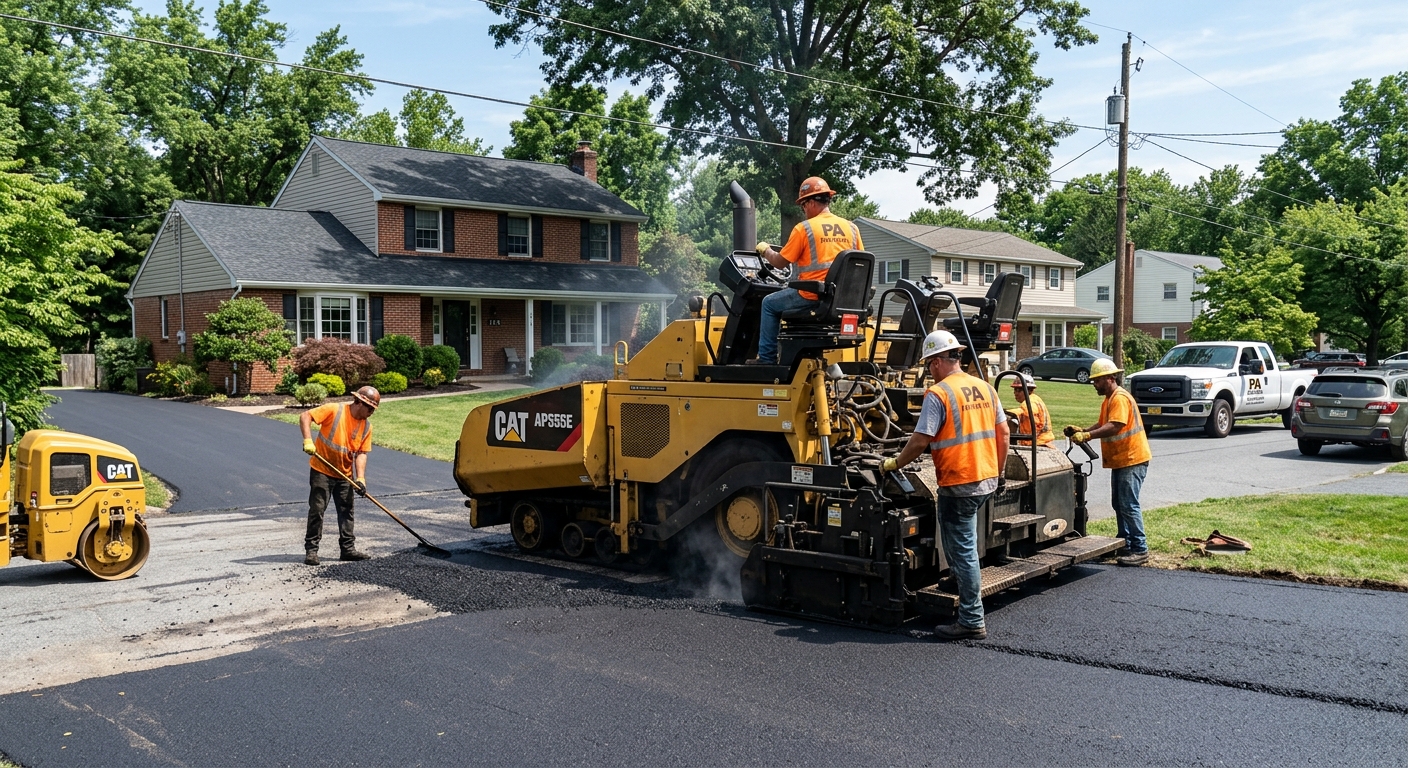
What a new driveway costs in Redstone
Redstone’s driveways are real investments for the 72.5% of local homes that are single-family and the 67.6% homeownership rate (U.S. Census Bureau, ACS 2024) underscores the importance of picking solutions that will last. In Fayette County, with its hilly terrain and hard winters, the question isn’t just which paving material to use — it’s what lies beneath your pavement that matters most. Most of the cost difference between two estimates isn’t the asphalt or concrete you can see, it’s what was done to the base. On Redstone’s clay and shale soils, a skimped base is the root of most premature failures, especially after years of freeze-thaw cycles. If a bid seems "too good to be true," the shortcut is likely hidden below grade, where patching later means paying twice.
Here is what you can expect for common driveway projects in Redstone:
| Service |
Best for |
Lifespan |
Price range |
| Asphalt — full replacement with new base |
failed base, structural cracking |
20–30 yrs |
$3,100–$8,000 |
| Asphalt overlay / resurfacing |
sound base, surface cracking only |
8–15 yrs |
$1,350–$4,000 |
| Sealcoating — single application |
preventive maintenance on sound asphalt |
2–4 yrs |
$175–$600 |
| Concrete — new installation |
long service life, low maintenance |
30–50 yrs |
$4,500–$10,500 |
| Crack filling and patching |
isolated cracks under a quarter inch |
1–3 yrs |
$200–$800 |
| Gravel driveway |
rural, budget, long runs |
5–10 yrs with upkeep |
$900–$3,500 |
Estimates for a typical Redstone driveway. Square footage and base condition drive these figures more than material choice.
Numbers, not adjectives
If you want a Redstone driveway to last, the only question that matters is: what are the specs? Quotes filled with words like “thick” or “sturdy” mean nothing without numbers. Every inch matters here — with our heavy freeze-thaw cycles and 36-inch frost depth, the specs needed in southwestern Pennsylvania are stricter than what you’d see in milder parts of the state. Local clay and shale won’t forgive thin or improperly compacted base. And don’t let “we’ll put down three inches” sound reassuring. Do they mean three inches after compaction (the real measure) or before? Because fresh asphalt loses a quarter to a third of its thickness when compacted. If these details aren’t in writing, you’re rolling the dice on premature failure — and no amount of topcoat will make up for it after the first winter.
Insist that your written quote spells out these items clearly:
- Total excavation depth (inches below finished grade)
- Aggregate base thickness (after compaction)
- Type of base aggregate (e.g., 2A limestone, recycled concrete)
- Number of lifts used for both base and asphalt
- Compaction method (plate, roller, vibratory, pounds force)
- Asphalt binder course thickness (as compacted)
- Asphalt surface course thickness (as compacted)
- Exact mix designation (e.g., PennDOT 19mm base, 9.5mm wearing)
- Edge treatment (including any concrete or reinforced border)
- Driveway slope for drainage (minimum 2% away from structures)
Driveway permits, approaches and stormwater rules
For most driveway repairs or repaving in the same footprint in Redstone, a building permit is generally not required — this is a relief in Fayette County, where many homes just need an existing driveway replaced or resurfaced. However, if you’re modifying your driveway where it meets a public road (the approach), different rules kick in. In Fayette County, all new or altered driveway approaches onto state routes require a permit from PennDOT Engineering District 12‑0, not just the local township. Don’t overlook this — skipping the approach permit can cause real headaches down the road, especially if you later try to sell the property.
Stormwater management can’t be ignored. Enlarging your driveway may trigger stormwater control requirements, particularly if you expand the impervious surface. But even if no permit is technically required, directing runoff onto a neighbor’s property creates liability and can spark disputes. Plan your drainage carefully and avoid shortcuts.
On hiring contractors: Pennsylvania requires Home Improvement Contractor (HIC) registration for all jobs over $500. Always verify registration at hic.attorneygeneral.gov and confirm that workers' compensation coverage is valid via WCAIS (wcais.pa.gov). If someone balks at showing proof, walk away.
Why driveways behave differently in Redstone
The hillsides of Fayette County, including Redstone, are built on clay and shale subgrade. Clay’s biggest problem? It holds water right against the base, and when winter hits and the freeze-thaw cycle gets going in earnest, that water expands, heaves, and breaks up your driveway from beneath. Shale, on the other hand, can sometimes offer better drainage, but when mixed with clay as is typical here, you end up with pockets where water gets trapped. That’s why in Redstone, we build thicker aggregate bases than the minimums you might see elsewhere — skimping is gambling with your wallet.
On top of that, most local driveways were cut to narrow standards for post‑WWII ranch houses, and many were never built with enough base to begin with. If your original drive is crumbling at the edges or rutting after a heavy spring, it’s likely the base was nominal at best — a common story in these older subdivisions. There’s a reason why full-depth replacement is so often necessary in this part of Fayette County: not just to swap the pavement, but to build up a base that can stand up to decades of brutal freeze-thaw and our clay-heavy ground.
Sealcoating: what it does and what it doesn't
Sealcoating your Redstone driveway does exactly three things: it protects asphalt binder from UV and oxygen so it won’t dry out and crack as fast, it guards against oil and gasoline spills (which eat away at asphalt), and it improves surface appearance for a couple of years. What it absolutely doesn’t do: it will not fix cracks, add structural strength, or rescue asphalt if the stone base beneath has started to fail. If the base is bad, you’re just sealing in the problem.
There’s another side industry won’t mention: if you sealcoat too often, the layers build up, become brittle, and start to peel. Even flipping the calendar every year is overkill — you’re just paying for product that never had time to bond. New asphalt? Wait at least one full season before your first sealcoat; sealing too soon traps oils and causes early peeling. For sound driveways, sealing every 3–4 years is reasonable here — not annually.
What REALLY matters isn’t just sealing, but crack filling. Most of the water that ruins driveways in Fayette County gets in through unfilled cracks, then freezes in the clay below. A proper crack-filling job uses hot rubberized material and gets down deep, not just a quick brush over. Cheap sealcoats — the $99 spray specials — are a thin application that makes the surface black for six months and does nothing for long-term protection. A typical quality sealcoating in Redstone runs $175–$600. A suspiciously low price usually means water dilution or cut-rate prep. You aren’t buying real protection.
Overlay, patch or full replacement?
Knowing whether you need a patch job, an overlay, or a full tear out is where most Redstone homeowners get led astray. Fortunately, a quick walk down your driveway gives a lot away. Wide “alligator cracking” — a network of cracks over a large area — means the base has failed. No overlay in the world will fix that, because the new layer will flex and crack the same way in just a year or two. Linear cracks, especially those under 1/4-inch wide, usually signal surface aging — these can be cleaned, filled, and sealed. Depressions and “birdbaths” that collect water mean the subgrade has shifted, often from water sitting in Redstone’s clay. Edge crumbling points to a lack of edge support (either from poor installation or normal wear on those old, narrow drives), and potholes shout that water has already reached your base aggregate.
If a contractor suggests an overlay without probing the base and looking for movement, be wary. It’s easy to spend money on a resurfacing that will only delay, not solve, the real issue. The table below matches what you see to the right solution and cost.
| What you see |
Likely cause |
Right fix |
Cost |
| Isolated cracks under 1/4 inch |
surface aging |
crack fill and seal |
$175–$600 |
| Alligator cracking over a wide area |
base failure |
full replacement |
$3,100–$8,000 |
| Depressions holding water |
subgrade movement |
excavate and rebuild that area |
$3,100–$4,900 |
| Crumbling edges |
no edge support |
edge repair, consider curbing |
$400–$1,500 |
| Potholes |
water into the base |
full-depth patch, then assess |
$250–$900 |
| Faded but sound surface |
oxidation only |
sealcoat |
$175–$600 |
Grading and water management on a Redstone driveway
Water is the real culprit behind nearly every failed driveway in Redstone. Proper grading isn’t a detail; it’s the foundation for long life here. The minimum slope for driveway surface runoff should be at least 2% — that’s a quarter inch per foot — directing water away from buildings and off the pavement quickly so nothing can soak into the base. Crowning (a high spot in the middle) sheds water to both sides, while a consistent cross-slope handles runoff for driveways built alongside a slope. If your drive leads right down to a garage or house, and the slope can’t be re-graded, trench drains and channel drains are necessary where the drive meets the structure.
Our region’s deep frost and persistent freeze-thaw makes standing water a double threat: after it ponds, it soaks into Redstone’s heavy clay and sits against your base. When it freezes, the expansion heaves the driveway, causing cracks and depressions. Don’t forget the neighbor issue—Pennsylvania law makes you liable if you change runoff patterns and water ends up across the property line, regardless of what the permit says. Whenever possible, surface drainage should “daylight” out onto your own lawn or a designated swale, not a neighbor’s property or a blind dry well that will back up during heavy rain.
Frequently asked questions — driveway paving in Redstone
What is the difference between binder and surface course?
Binder and surface course are two layers of asphalt with different jobs. The binder course is the strong, thick middle layer that handles the weight and absorbs movement over Redstone’s clay and shale subgrade. It uses larger, coarser stone and builds most of a driveway’s strength. The surface (or wearing) course is the top layer — smoother, made with smaller stone, designed to handle traffic, resist water, and look good. In southwestern Pennsylvania, codes and best practices say a typical driveway should have at least two inches (compacted) of binder and one to one-and-a-half inches of surface course compounded on top. If a contractor skips the binder or uses thin lifts, you get a pretty surface that fails after a few freeze-thaw cycles, forcing a full replacement at $3,100–$8,000 years sooner than necessary.
Can I cancel a paving contract I signed at my door?
Yes — in Pennsylvania, the Home Improvement Consumer Protection Act (HICPA) gives every homeowner the right to cancel a written paving contract within three business days, especially if it was signed as a result of an unannounced visit or solicitation at your home in Redstone. This applies to all paving jobs over $500, which is almost every meaningful driveway project. You don’t need to give a reason, and the contractor must return your deposit. If a contractor says otherwise, they’re violating the law. Written contracts are required, and any reputable local operator will honor this. Remember, deposits for typical Redstone paving jobs — even the lower end at $1,350–$4,000 for an overlay — are substantial, so you have real protection.
Is an overlay worth it or should I start over?
Overlays — or resurfacing — are only worth it on driveways where the base is still solid. In Redstone, this is less common than you might think, given the old clay and shale subgrades under most post‑WWII driveways. If you see alligator cracking, bad depressions, or soft spots when you walk across the surface, the base has failed and a full replacement is needed. An overlay in these cases won’t last, and you’ll waste $1,350–$4,000 on a repair that’s only skin-deep. If your base is firm and undisturbed, an overlay can buy you another 8–15 years. Always demand that a contractor checks (with a core or a probe) before quoting overlays — don’t trust a visual assessment alone in Fayette County.
Can asphalt be laid in cold weather?
Asphalt paving in Redstone (or anywhere in southwestern Pennsylvania) is best done when the ground and air temperatures are consistently above 50°F. While modern mixes can be laid colder, working below that means the asphalt cools before it can be compacted, trapping voids that destroy strength and let in water. Most local plants shut down for the season around first frost, and reputable contractors don’t rush late projects for this reason. Waiting until spring is almost always worth it. If someone bids on a job in December or January, insist on seeing past work — and get a warranty in writing. A typical full replacement isn’t cheap at $3,100–$8,000, so don’t let hurry cost you quality.
How often should I sealcoat my driveway in Redstone?
In Redstone, where our freeze-thaw cycles are rough on pavement, sealcoating every three to four years is usually enough for a residential driveway in good shape. Sealing too often causes more harm than good—old layers build up and start to peel, especially in our cold winters. For new asphalt, always wait at least one full year before the first application. Sealcoating protects against oxidation and minor oil damage, but does nothing for cracks or structural issues. To really make your paved surface last, focus on prompt crack filling (which usually runs $200–$800) in addition to occasional sealing ($175–$600). Steer clear of anyone peddling annual spray-on specials — you’ll just pay extra for little added value.
What does an asphalt overlay cost in Redstone?
An asphalt overlay — resurfacing over a solid, stable base without a full tear-out — typically costs between $1,350–$4,000 for a standard residential driveway in Redstone. The price depends on driveway size, but also the amount of prep needed: patching isolated cracks, edge repair, and cleaning. If your base is in good shape, overlays offer 8–15 years of additional life at roughly half the cost of rebuilding from scratch. Remember that Fayette County’s soil (clay and shale) and heavy winters mean an overlay won’t fix deep structural issues — putting new blacktop over a bad base turns a short-term rescue into a long-term waste of money.
Does road salt damage driveways in Redstone?
Yes, regular application of road salt is rough on driveways in Redstone, especially concrete and asphalt along edges. Salt helps melt snow and ice during our hard winters, but it also accelerates surface wear, encourages pits in concrete, and can dry out and crack asphalt by breaking down the binder. The damage shows most where plows push slush onto your apron, or along the township and PennDOT roads. Sealing helps on asphalt, but isn’t a cure-all. For concrete, look for air-entrained mixes at installation and avoid deicers with ammonium compounds. Repairs for salt-damaged edges start, conservatively, at $400–$1,500 for edge rehab in Redstone. Regular rinsing during thaws helps, but plan for the added wear in this climate.
How much does driveway paving cost in Redstone?
Driveway paving in Redstone runs a broad range, depending on the size and the base condition. A full asphalt replacement (with new base) costs between $3,100–$8,000 for most residential drives. If your existing base is sound, a new asphalt overlay lands in the $1,350–$4,000 band. Sealcoating and patching (maintenance) typically run $175–$800. Concrete is costlier but lower maintenance, running $4,500–$10,500. Most of the price difference is hidden in how well the base is rebuilt — with Redstone’s clay and shale soils, any shortcut here is an expensive mistake down the road.
How long should an asphalt driveway last in Redstone?
With proper installation — meaning enough compacted aggregate over our local clay and shale, and solid drainage — an asphalt driveway in Redstone can last 20–30 years. The biggest enemy is water getting into the base, which is why grading and prompt crack repair matter more here than in drier places. Driveways done with only a thin base or lacking edge support often fail within 8–10 years, especially after a few harsh freeze-thaw cycles. Regular maintenance, like sealcoating every three to four years ($175–$600) and timely crack filling, extends lifespan closer to the upper end. If anyone quotes a life expectancy much more than thirty years for blacktop here, take it with a grain of salt — but if done right, your investment will outlast most home improvement projects.