Slippery Rock paving prices by scope — 2026
In Slippery Rock, nearly 60% of homes are single-family and just under half are owner-occupied (U.S. Census Bureau, ACS 2024), so driveway projects tend to fall on those who own detached homes. One look at a quote might suggest that two driveways will cost about the same, but the truth is most cost differences come from what’s beneath the surface. The southwest Pennsylvania climate, with its heavy freeze-thaw cycles, inflicts damage mostly by water finding its way beneath asphalt or concrete and expanding as it freezes. Here, natural ground is usually clay, shale, or glacial till, and no two streets have exactly the same subgrade. This means site prep is the most expensive and important part of the job. It isn’t just what you can see — the thickness and density of the stone base, drainage solutions, and edge support drive most of the longevity and cost. In these soils, cutting corners underground guarantees a shorter lifespan on top, no matter the surface material.
| Service |
Best for |
Lifespan |
Price range |
| Asphalt — full replacement with new base |
failed base, structural cracking |
20–30 yrs |
$3,400–$8,700 |
| Asphalt overlay / resurfacing |
sound base, surface cracking only |
8–15 yrs |
$1,450–$4,300 |
| Sealcoating — single application |
preventive maintenance on sound asphalt |
2–4 yrs |
$200–$700 |
| Concrete — new installation |
long service life, low maintenance |
30–50 yrs |
$4,800–$11,500 |
| Crack filling and patching |
isolated cracks under a quarter inch |
1–3 yrs |
$200–$800 |
| Gravel driveway |
rural, budget, long runs |
5–10 yrs with upkeep |
$900–$3,500 |
Estimates for a typical Slippery Rock driveway. Square footage and base condition drive these figures more than material choice.
Getting thirty years out of a driveway
The single biggest factor in maximizing a driveway’s life in Slippery Rock is stopping water from getting into the base. That starts with crack filling — any fissure wide enough for water to enter will start the freeze-thaw process that busts apart even a good build, so seal cracks as soon as they appear. Edges are a soft spot; without support, they break away and let water in by the side. Proper grading is crucial too — all water must move off, not pond. Heavy objects with point loads, like dumpsters or jack stands, can cause compression damage, so avoid leaving them for long periods. For new asphalt, allow adequate curing before parking (at least 3–5 days in summer) and avoid sharp turns while stationary to prevent scarring.
When it comes to de-icers, salt shortens the life of concrete driveways. In Slippery Rock’s freeze-heavy winters, once salt gets into even the best concrete, it attacks the matrix and can cause spalling. Urea or non-chloride de-icers are less harmful but cost more per bag and don’t work as well below 15°F. On asphalt, the concern is the freeze-thaw itself, as repeated melting and refreezing drive water down into the sub-base. For both surfaces, sand can be used for traction without chemical side effects, but you’ll need to sweep it up in spring. With our region’s climate, an ounce of prevention is always worth it.
Slippery Rock's ground and what it means for paving
Slippery Rock sits atop soil that’s mainly glacial till and shale, as is true throughout northern Butler County. Glacial till is a mixed bag—parts of it drain well, but any presence of heavy clay creates pockets that trap water and swell when frozen. Shale layers can shed water horizontally, which sounds good until you get seepage under your driveway base where you can’t see it. These conditions, paired with southwest Pennsylvania’s 36-inch frost depth and persistent freeze-thaw cycles, mean that a shallow or poorly constructed base gets destroyed faster than anywhere with drier, sandier soils.
If your neighborhood was part of the 1990s–2000s building boom in Cranberry or Adams Townships, your driveway is now at the age where a full-depth replacement is common. Earlier subdivisions often skimped on base depth—sometimes only 3–4 inches of stone, which isn’t enough for this soil. Any contractor quoting you a new driveway here should talk about base thickness and drainage, not just the surface course. Skimping here is an expensive mistake and likely means paying for replacement years earlier. If you’re on a property with clear evidence of clay or standing water nearby, you want at least 8 inches of compacted base and clear surface drainage, or you’ll be back to square one inside a decade.
Permits and approvals for paving in Slippery Rock
For most homes in Slippery Rock, repaving an existing driveway in the same footprint does not require a building permit, saving homeowners the back-and-forth with municipal offices. However, when a driveway meets a public road, the rules change. Modifying the approach—or any tie-in to a state-maintained road—means you’ll need a Highway Occupancy permit from PennDOT District 10. On local roads, approach permits come from your township, not from the county or state. Failing to pull an approach permit when required can stall your project or force you to redo the entrance to pass inspection.
Adding square footage (widening or new installation) can trigger stormwater management requirements, especially if you create more impervious surface. Even if the township doesn’t require a permit for resurfacing, they can still enforce runoff and erosion controls. Directing water off your property and onto a neighbor’s is a liability under Pennsylvania law, and permits don’t shield you from civil claims.
For contract jobs over $500, Pennsylvania requires your paving contractor to hold Home Improvement Contractor (HIC) registration. Homeowners should verify this through the Office of Attorney General (hic.attorneygeneral.gov), and every employer must carry workers' compensation insurance—check their status at WCAIS (wcais.pa.gov) before any work starts.
How paving fraud actually operates
Driveway scams hit rural and suburban markets like Butler County hard because houses are spaced out, neighbors often don’t compare notes, and crews can disappear before problems emerge. The classics are legendary for a reason: someone knocks, claims to have ‘leftover asphalt from a job down the road,’ offers today-only pricing, and either has an unmarked truck or out-of-area plates. A demand for full payment in cash, a handshake deal with no written contract, or a price that sounds too flat for what your driveway actually needs—these are all signs you’re about to overpay for a paper-thin overlay sprayed with oil, not real asphalt work or sealcoating.
Butler County’s rural gaps make it even harder to verify credentials or get warnings out. It’s no coincidence scammers target these areas and not city blocks where everyone talks. Pennsylvania’s Home Improvement Consumer Protection Act (HICPA) exists for this reason: jobs over $500 require a written contract detailing scope and price, and you have three business days to cancel any agreement signed at your home—no penalty. It is illegal for a contractor to offer to waive your insurance deductible, which is a frequent ploy after storm damage.
The simplest tools: check their registration at hic.attorneygeneral.gov and workers’ comp at wcais.pa.gov, ask for a local reference, insist on a written contract, and never prepay in full for work that hasn’t started. Five minutes now saves years of regret.
Drainage: the failure nobody plans for
Water is the enemy of every driveway in Slippery Rock, and grading is your only shield. To shed water, driveways must be built with a minimum slope of 2% away from the house or garage—think a quarter inch per foot. That doesn’t seem like much, but without it, you’ll see ponding, which in these freeze-thaw winters becomes a cycle of water infiltrating the base, freezing, and erupting the surface. Crowning places the high point down the center to send water to both sides, while a cross-slope moves it one way if side constraints demand. If your land falls the wrong way and water naturally wants to move toward the house, a trench or channel drain may be mandatory. Where grade corrections alone won’t cut it, drains must daylight out to open ground or, if there’s nowhere else, to a dry well sized to handle runoff.
Slippery Rock’s common clay subgrade doesn’t help—heavy clay holds water against the base for days after rain or snowmelt. Without deliberate sub-base drainage and positive top slope, those “minor” puddles will shatter even the thickest asphalt or concrete. The neighbor risk: Pennsylvania law doesn’t let you solve your drainage by pushing water onto the next lot; that just trades your problem for a new one and can land you in small claims court in a hurry.
Why you can't pave in February
Slippery Rock’s paving season is set by physics, not preference. Asphalt can only be laid when both the air and ground are warm enough to keep the mix workable—generally over 50°F. Below that, the hot mix loses temperature faster than it can be compacted, leaving you with a seam-prone, porous driveway that fails early. During the cold months, local asphalt plants shut down entirely, so even if someone wanted to pave in January, there’s literally no fresh material for sale. Concrete has its own enemy in cold: it can’t cure right below freezing, risking surface scaling and ruined finishes.
Southwestern Pennsylvania’s winter design temp bottoms out at 8°F, and freeze-thaw cycles are relentless from November into April. That’s why almost all paving here is booked between late April and October. In spring and fall (‘shoulder seasons’), contractors have the most availability and you can get competitive prices. Summer is peak season—jobs are booked far ahead and prices go up. Anyone proposing to lay asphalt in late November or through the winter is not following the basics and you’ll pay for it with surface distress and early replacement. Timing is not negotiable, so plan ahead and get on the schedule early to avoid the rush or weather lockouts.
Frequently asked questions — driveway paving in Slippery Rock
What does compaction in lifts mean?
Compaction in lifts is a key step in building durable driveways in Slippery Rock. It means placing the new asphalt or stone base in layers ('lifts') about two to four inches thick, then thoroughly compressing each with a heavy roller before adding the next. This method ensures each layer binds tightly and can’t settle later, which is especially important here, where subgrades often include glacial till and clay that can shift with freeze-thaw cycles. If the contractor dumps the material all at once and compacts only the top, the bottom stays loose and weak—leading to sinking spots and cracks within a few years. The quality and thickness of each lift has a big impact on longevity and can be the difference between a $3,400–$8,700 full-depth replacement and a chronic repair job. Don’t be afraid to ask your paving contractor how many lifts they use and how they verify compaction as they build.
Why does my driveway have depressions that hold water?
In Slippery Rock, depressions or "bird baths" usually form due to compaction issues, an inadequate or uneven stone base, or poor drainage planning. Our local clay and shale soils aren’t forgiving—any soft spot under the surface gets worse over time, especially with parked vehicles and snow loads common in Pennsylvania winters. Water collects in these low spots, especially after freeze-thaw cycles, since ice can heave the pavement up and then let it settle lower each time it melts. Minor dips can sometimes be leveled with patching (typically $200–$800), but when they appear everywhere or get worse each year, it signals a failing base and the need for more serious repair. Proper grading and compaction at install time are the only real fix; relief drains can help, but they rarely solve a major underlying problem in this climate.
Should I repair or replace my Slippery Rock driveway?
The right answer depends on how deep the damage runs. In Slippery Rock, many driveways built during the late-1990s subdivision boom are nearing the end of their natural lifespan, especially if base prep was skipped or water has undermined it. If your driveway only has surface cracks and the base feels solid—no soft spots or wide structural cracks—you may get more years from an overlay ($1,450–$4,300). If you see deep cracks, widespread sinking, or patches that never hold, it’s likely time for a full removal and new base ($3,400–$8,700). A reputable contractor can core or dig test holes to check, but don’t throw good money after bad on patches if there’s a structural or drainage issue under the surface.
Are door-to-door pavers a problem in Slippery Rock?
Yes, they’re a known problem in Slippery Rock and greater Butler County. Scammers exploit the area’s rural layout and lower population density to move quickly from house to house, relying on no one comparing notes before they disappear. They’ll often offer a low cash price for ‘leftover’ asphalt or promise a fast job, but what you’ll get is a thin layer or poor-quality material that breaks up before long, wasting your money. Pennsylvania requires HIC registration for these jobs, and by law (Home Improvement Consumer Protection Act), you’re entitled to a written contract and a three-day cancellation period. Insist on both. If a crew shows up unannounced, with no proof of insurance or registration and demands full payment upfront, that’s your cue to send them packing. If it sounds too good to be true here, it’s a red flag, not a real deal.
Is sealcoating a scam?
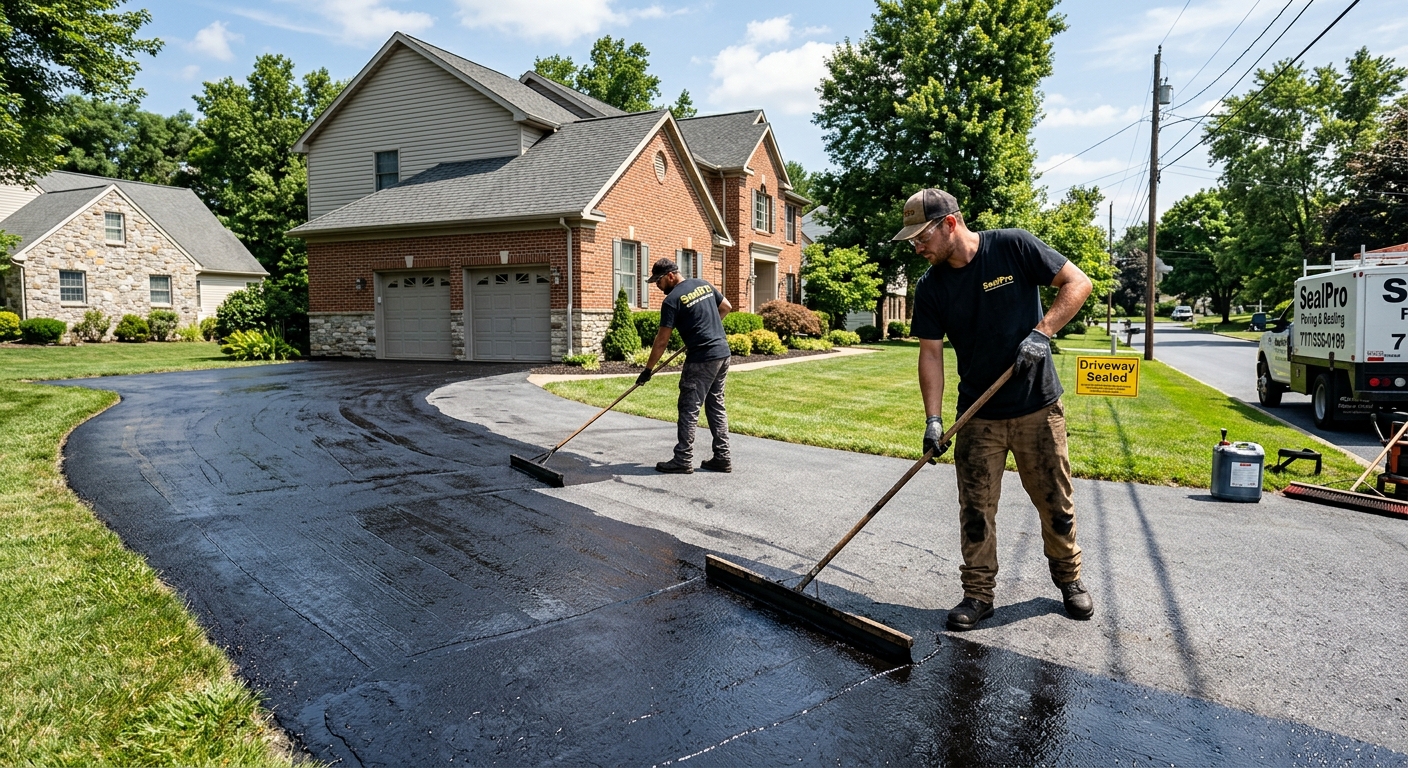
Sealcoating isn’t a scam in itself, but what passes for sealcoating in some drive-by offers absolutely is—especially in Slippery Rock, where thin spray-on oil pretending to be asphalt sealer is common. Real sealcoating is a layer of asphalt-based emulsion brushed or squeegeed on at the right rate, typically every 2–3 years, to help protect against water and UV damage. It won’t fix cracks or structural issues, but for sound asphalt, it gives a little more life and keeps things looking sharp. Expect it to cost $200–$700 depending on your driveway size. If someone offers it for half that and sprays it out of a weed sprayer, it’s not really sealing anything. As always, written contracts, insurance, and references are your best defense.
Can asphalt be laid in cold weather?
It’s rarely possible to lay asphalt properly in Slippery Rock’s cold months. Hot mix must be compacted before it drops below a workable temperature—usually meaning air and ground temps above 50°F at installation. Southwest Pennsylvania’s winters routinely dip well below that, and our local plants shut down entirely in winter. Trying to pave outside the approved season results in poor compaction, rapid cool-down, and premature failure. If a contractor offers to install asphalt in February, that’s not a mark of hustle—it’s a bad sign. For reference, a typical full-depth job here costs $3,400–$8,700, and you want it done right the first time. Book jobs for late April through October, and be wary of anyone promising a quality result outside the real season.
Do I need an approach permit where my driveway meets the road?
Yes, for most Slippery Rock homes, an approach permit is required when doing anything more than simple resurfacing—especially if you change the width, alignment, or use on a state or township road. Driveways that connect to state routes in Butler County require a Highway Occupancy permit from PennDOT District 10. Townships handle their own permits for local roads. Skipping the permit can get your job stopped, fined, or force you into rework. Most contractors handling jobs above $500 should know these rules and guide you through the process, but as the homeowner, it’s your responsibility too. Always verify with your township before work starts, especially for any new curb cut or expanded entrance.
How much does a concrete driveway cost in Slippery Rock?
In Slippery Rock, current pricing for a new concrete driveway ranges from $4,800–$11,500 depending on size, required base, concrete thickness, and finish. Concrete driveways offer a 30–50 year service life with proper care, and in our climate—where freeze-thaw cycles are tough on everything—choosing a reputable local contractor is critical. The higher end of pricing applies to large or decorative surfaces. Keep in mind that a thicker stone base is sometimes needed on clay-rich soils here, especially if you have poor drainage or heavy vehicles, which can push the cost higher than an average asphalt job but will likely last longer with less maintenance down the line.
How much does it cost to widen a driveway?
The cost to widen a driveway in Slippery Rock varies with size, material, and what the underlying soil requires, but you should expect a per-project cost often starting around $1,450–$4,300 for additional asphalt or $4,800–$11,500 for concrete, depending how far you go. Keep in mind widening means new excavation, extra base prep, and matching to the older surface in both grade and finish—sometimes requiring a new approach permit through your township or PennDOT District 10 if you connect to a state road. On our local glacial till and clay, don’t skimp on base depth or drainage. It might look simple, but what’s under the surface is where the real cost (and future headaches) lie.