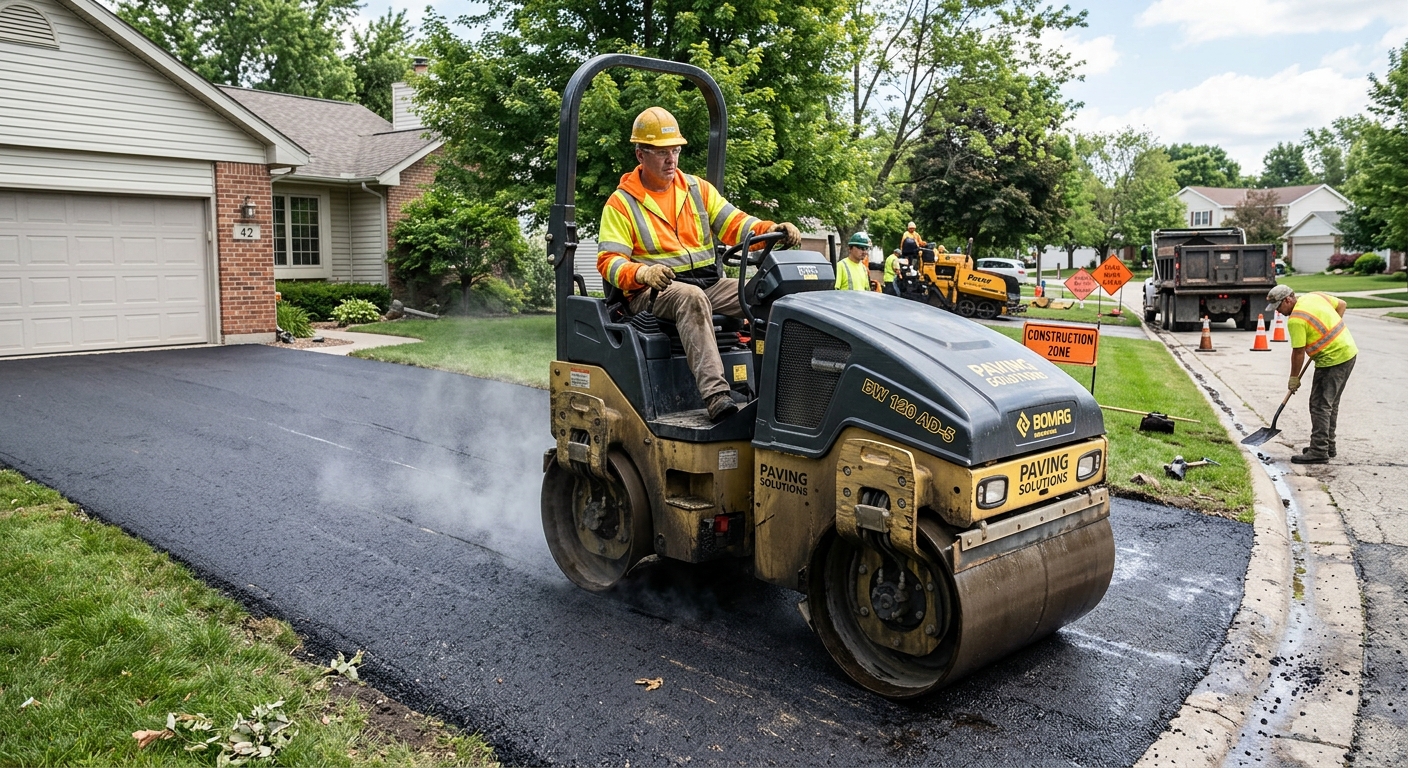
Lackawaxen paving prices by scope — 2026
Lackawaxen’s driveways are almost all for standalone homes, and with a homeownership rate north of 90.9% (U.S. Census Bureau, ACS 2024), the expense of driveway paving or replacement nearly always falls on the homeowner. Every driveway in this part of Pike County is exposed to heavy freeze-thaw cycles—ground freezes to 36 inches, and the severe winter means snow loads are high and ice is a given. Driveway costs here are higher than in more temperate, urban areas, not just because of distance to the asphalt plant, but because the rocky, glacial till subgrade requires significant base prep.
The reality is that for your Lackawaxen driveway, what you pay mostly determines the quality of what’s under the surface. The biggest price differences between contractors are rarely visible at first glance. Cutting corners on excavation depth and base thickness can leave you with an asphalt surface that looks fine in year one, but fails by year five after the first severe freeze-thaw cycle. A quote that’s thousands less usually means less base, thinner asphalt, and minimal drainage correction. Quality paving is built from the ground up—literally.
| Service |
Best for |
Lifespan |
Price range |
| Asphalt — full replacement with new base |
failed base, structural cracking |
20–30 yrs |
$3,500–$8,900 |
| Asphalt overlay / resurfacing |
sound base, surface cracking only |
8–15 yrs |
$1,500–$4,500 |
| Sealcoating — single application |
preventive maintenance on sound asphalt |
2–4 yrs |
$200–$700 |
| Concrete — new installation |
long service life, low maintenance |
30–50 yrs |
$4,900–$12,000 |
| Crack filling and patching |
isolated cracks under a quarter inch |
1–3 yrs |
$200–$800 |
| Gravel driveway |
rural, budget, long runs |
5–10 yrs with upkeep |
$900–$3,500 |
Estimates for a typical Lackawaxen driveway. Square footage and base condition drive these figures more than material choice.
Why you can't pave in February
In Lackawaxen and across Pike County, asphalt work shuts down for the winter and that isn’t just a contractor preference—it’s a hard physical limit. Asphalt needs to be placed and properly compacted while still hot, and with a winter design temperature of 4 °F and over 6,100 heating degree days a year, the mix simply cools too quickly outside the May-to-October paving season. Below about 50 °F ambient, the hot-mix will start to set before rollers can achieve full compaction. When that happens, you end up with a porous, brittle surface that cracks by the next freeze-thaw.
Asphalt and aggregate are trucked in from near Scranton or Lackawanna County, and those plants entirely close down in winter. There’s no sourcing “cold patch” for a proper driveway—what’s available in February is emergency repair only. Concrete pours face the same problem, since it requires above-freezing conditions for days to cure or else it will crack before it ever reaches strength.
Practically, this means paving crews book up quickly from late spring through early fall. Shoulder season (May, September) is when you’re likeliest to get on the schedule without a rush charge. If a crew says they can pave your full driveway in the depths of November or March around here, it means they’re either cutting corners, using old cold mix, or unfamiliar with Pike County conditions. Quality work in Lackawaxen waits for the right window. Off-season delays aren’t a contractor’s excuse—they’re a sign you’ve got a pro who cares whether your driveway lasts.
Which surface survives Lackawaxen winters
Northeastern Pennsylvania’s winters, with regular deep freezes and heavy snow, dictate what driveway materials survive and for how long. Asphalt’s greatest strength in Lackawaxen is flexibility. The same freeze-thaw cycling that pushes up heaving cracks and pops concrete slabs will cause an asphalt drive to flex a little and settle back. Most Pike County homes get over 40 psf ground snow loads each winter—and more importantly, the temperature fluctuation works ground moisture through the base. Asphalt weathers this well if the base is prepped and drainage is right.
Concrete, on the other hand, is all or nothing. When poured over a first-rate base and if never hit with salt, it’ll last as long as you own your home, but spalling and scaling are real risks. De-icing salt (inevitable here, given the ice-dam exposure) chews up concrete’s surface and leads to fast, ugly deterioration even if the slab doesn’t crack from ground movement. Most Pike County driveways don’t see perfect owner maintenance; salt finds its way onto the drive.
Paver driveways are rare, more expensive to install, but individual bricks can be lifted and reset when frost heaves cause unevenness. Gravel remains a viable option for long and steep runs, offering the best drainage and the least up-front investment, but at the cost of ongoing attention and regrading.
| Option |
Installed cost |
Maintenance |
Freeze-thaw performance |
Lifespan |
| Asphalt — new install |
$3,500–$8,900 |
sealcoat every 3–4 yrs |
excellent, flexes |
20–30 yrs |
| Asphalt — overlay |
$1,500–$4,500 |
same |
good if base is sound |
+8–15 yrs |
| Concrete |
$4,900–$12,000 |
low, avoid de-icing salt |
fair, spalls with salt |
30–50 yrs |
| Pavers |
$7,900–$12,000 |
individual units replaceable |
good, settles gradually |
25–50 yrs |
| Gravel |
$900–$3,500 |
top-dress every 2–3 yrs |
excellent drainage |
indefinite with upkeep |
Lackawaxen's ground and what it means for paving
Pike County’s native soil is glacial till mixed with rocks of every size, left behind from the last ice age. In Lackawaxen, you won’t find the uniform sandy or loamy soils that make base prep easy—nearly every job uncovers stones, seams of dense clay, or both. Glacial till drains unpredictably, holding water in pockets and pushing it up toward the surface during winter freezes. Combined with a frost depth that regularly reaches 36 inches, that means driveway bases here must be deeper and better-draining than most places—4 to 6 inches of compacted crushed stone is just a starting point.
One other factor that shows in Lackawaxen: most homes were built as vacation or second homes from the 1970s through the early 2000s, and a lot of sloped, winding driveways were cut with only a thin aggregate base to save money. If your current drive is from that era, odds are it’s sitting on just enough stone to keep the mud off, not enough to handle freeze-thaw heave over decades. This, more than surface wear, explains why so many driveways in the township need complete rebuilding, not just a fresh coat of asphalt.
What to put in a Lackawaxen paving contract
In Lackawaxen, you get what you specify in writing. Since glacial till and deep frost drive up the risk of heaving and early failure, protecting your investment means treating the contract like a blueprint—not just a price. Nearly every driveway failure I see in Pike County tracks back to a vague quote: “We’ll put down three inches,” without saying if that’s loose or compacted, or what’s under it. Material compresses; a three-inch “loose” lift could be just over two inches once rolled. And the deeper the base and stronger the compaction, the longer your drive will survive year after year of winter.
Here’s what your contract should detail, number for number, and why. Without these, you’re leaving the quality (and the life) of your driveway entirely to trust.
- Total excavation depth below existing grade
- Aggregate base depth (in inches) and stone type—crushed, not round river stone
- Base compaction method and number of passes
- Number and thickness (as compacted) of asphalt lifts
- Binder course thickness, distinguished from surface course
- Asphalt mix designation for each lift (e.g., 19mm binder, 9.5mm wearing)
- Edge treatment—tapered, with or without shoulder stone for support
- Driveway pitch and cross-slope for drainage (degrees or percent)
- Joint location and type, especially at interfaces with walks or garage slabs
- Written start and completion date range
Getting thirty years out of a driveway
Longevity for a Lackawaxen driveway isn’t just about which material you choose, but how you care for it. The number one factor—by far—is dealing with cracks as soon as they appear. Once water works its way through and hits the base, freeze-thaw cycles will jack the pavement. Second: support the edges. A driveway’s sides are its weakest point, and without extra stone or soil shoulders, heavy loads can crack the edge right off.
Keeping water draining off and away from your driveway is next. Pike County’s heavy snow—and the spring thaw—means that standing water is your enemy. Clean ditches and maintain swales. Avoid leaving cars parked with jack stands or dumpsters on the drive for weeks; point loads will leave permanent dents or cracks.
After any new asphalt work, wait at least 3–7 days before parking, and don’t turn wheels while stopped for the first month. For winter traction, use sand or non-chloride de-icers. On concrete, salt is your sworn enemy; it will spall the surface in just a few seasons. On asphalt, the risk is melting and refreezing—so shovel early so water doesn’t have a chance to sit.
What you need before paving in Lackawaxen
For most properties in Lackawaxen Township, repaving or patching your driveway in its current footprint does not typically require a building permit. If you’re replacing your driveway completely or installing a new one, expect to need a local building or zoning permit; the township usually wants to review any major surface change. The exception is minor repair or pothole patching, which you can do without permits in much of Pike County according to local practice.
If your driveway connects to a state route, you’ll need a separate Highway Occupancy permit from PennDOT District 4 before touching the approach at the road; this is a common surprise for homeowners. Expansion or new driveways may trigger township stormwater review—adding impervious area means you bear responsibility for runoff, especially if water ends up on a neighbor’s land. Permits don’t protect you from drainage-related liability.
Pike County contractors must be registered as Home Improvement Contractors (HIC) for any job over $500; always verify at hic.attorneygeneral.gov. Workers’ compensation is mandatory for any employer; you can confirm coverage through the state’s WCAIS system (wcais.pa.gov). For pre-1978 homes, the EPA’s lead-safe rules apply—confirm any contractor is certified if paint disturbance is involved.
Frequently asked questions — driveway paving in Lackawaxen
What does compaction in lifts mean?
Compaction in lifts is a method that means each layer (“lift”) of material—be it stone base or asphalt—is installed to a specific thickness, then thoroughly rolled and compacted before adding the next layer. In glacial till soils like those in Lackawaxen, this process is critical. Trying to compact a thick layer in one go leaves weak spots and voids. For example, laying three inches of asphalt “hot” in one lift won’t compact properly; the standard is to lay two lifts (binder and surface), each rolled to its final thickness. If your paving quote just states “three inches of asphalt,” ask whether that’s as-laid or as-compacted, and insist on compaction in lifts. It can be the difference between a drive that lasts twenty-five years or one needing a resurfacing at $1,500–$4,500 after a few winters.
How long should an asphalt driveway last in Lackawaxen?
A properly built asphalt driveway in Lackawaxen should last 20 to 30 years, but that depends on the quality of the base, proper drainage, and some regular maintenance. With the freeze-thaw cycles and heavy snow loads in Pike County, a driveway with a thin base or poor compaction will see major cracks and potholes before 10 years is up. If you’ve just bought a home with a 1980s or 1990s drive, and you see alligator cracking, the original base likely wasn't thick enough for local conditions. At the full replacement price of $3,500–$8,900, it pays to get it done right the first time, since overlays and patch jobs—running $1,500–$4,500—only buy you another 8–15 years if the base is already failing.
Asphalt or concrete for a Lackawaxen driveway?
Asphalt is more forgiving in the face of deep freezes and shifting Pike County ground, flexing rather than cracking. Concrete costs more ($4,900–$12,000), but can last twice as long if it isn’t hit by salt. However, most homeowners end up using de-icers. In Lackawaxen, winter salt is nearly unavoidable, so concrete often spalls and flakes after just a few years. In short, if you want to avoid the hassle and just get longevity with periodic maintenance, asphalt is the reliable, lower-risk option at $3,500–$8,900 for a full install. Only choose concrete if you’re committed to never using salt and willing to stay on top of winter maintenance—few households actually manage this.
How many freeze-thaw cycles does Lackawaxen get?
Lackawaxen driveways typically endure dozens of freeze-thaw cycles each winter. Every time temperatures swing above and below freezing, moisture in the ground or in pavement cracks expands and contracts, prying apart weak spots. This is especially tough on driveways built on glacial till without enough base. The repeated cycles are why specifications in Pike County call for deeper excavation and better-draining stone. Cutting corners on base prep might lower your initial cost to $1,500–$4,500 for an overlay, but you’ll be repeating the work sooner as those cycles stack up.
Why are paving quotes in Lackawaxen so different from each other?
Most of the cost difference you’ll see in driveway quotes for Lackawaxen isn’t about the asphalt or concrete itself—it’s what’s below the surface. Contractors cutting base prep or shorting you on compaction can offer a low price, but you end up paying more when freeze-thaw breaks it apart. Other factors include the haul distance from asphalt plants near Scranton and travel surcharges, which matter in Pike County’s rural market. A price toward the lower end (like $3,500 for asphalt replacement) usually means a thinner base and limited drainage work, while a top-end figure gets you the depth, grading, and detail that lasts. Always compare specs, not just numbers.
How far ahead should I book a paver in Lackawaxen?
Given the short paving season in Pike County—usually May through October—and the thin contractor market, it’s best to contact pavers at least two to three months in advance. For peak summer dates, even earlier is wise, since crews book up quickly and haul time from asphalt plants near Scranton limits how many jobs they can do each week. Trying for last-minute work can lead to travel surcharges or getting pushed into a late-season rush, risking shortcuts just to close out a schedule before cold weather hits. To hit your target window and lock in the going rates—$3,500–$8,900 for an asphalt replacement—it pays to plan well ahead.
How often should I sealcoat my driveway in Lackawaxen?
For Pike County and Lackawaxen, a good rule is to sealcoat every 3–4 years, or if you start to notice graying, fine cracks, or aggregate appearing at the surface. The local climate—with its high snow load and UV exposure on those bright Pocono days—can dry out surface oils faster than owners expect. Sealcoating fills hairline cracks and helps keep water out to reduce freeze-thaw damage, extending the life of even a well-built drive. For a typical single-family driveway, expect to pay $200–$700 per application. Skipping sealcoat may not ruin your drive, but you’re likely to pay that back in early crack repairs or even resurfacing down the line.
Can I cancel a paving contract I signed at my door?
Yes, under Pennsylvania’s Home Improvement Consumer Protection Act (HICPA), you have a three-business-day right to cancel any paving contract signed at your door or in your home, so long as the job is over $500. This right can’t be waived—not by you, nor by the contractor. In Lackawaxen and anywhere else in Pike County, reputable contractors will spell this out in writing, as required by law. If you have second thoughts about a project priced at $3,500–$8,900 or more, send written notice within that period—email, mail, or fax—to protect yourself. Beware anyone who pressures you to waive your cancellation rights or offers to “cover your insurance deductible”—that’s explicitly prohibited.
What does sealcoating cost in Lackawaxen?
Sealcoating a single-family driveway in Lackawaxen costs between $200–$700 as of 2026, depending on square footage and current surface condition. Most homes in this part of Pike County fall toward the middle of that range—around $400 for a standard double-wide, 60–80 foot drive. The price includes cleaning, crack prep, and two coats, not just a quick brush-over. If your driveway hasn’t been sealed in years or requires extra prep due to cracks, expect to pay toward the higher end. Remember, done properly, this buys years of life compared to the cost of an overlay at $1,500–$4,500.