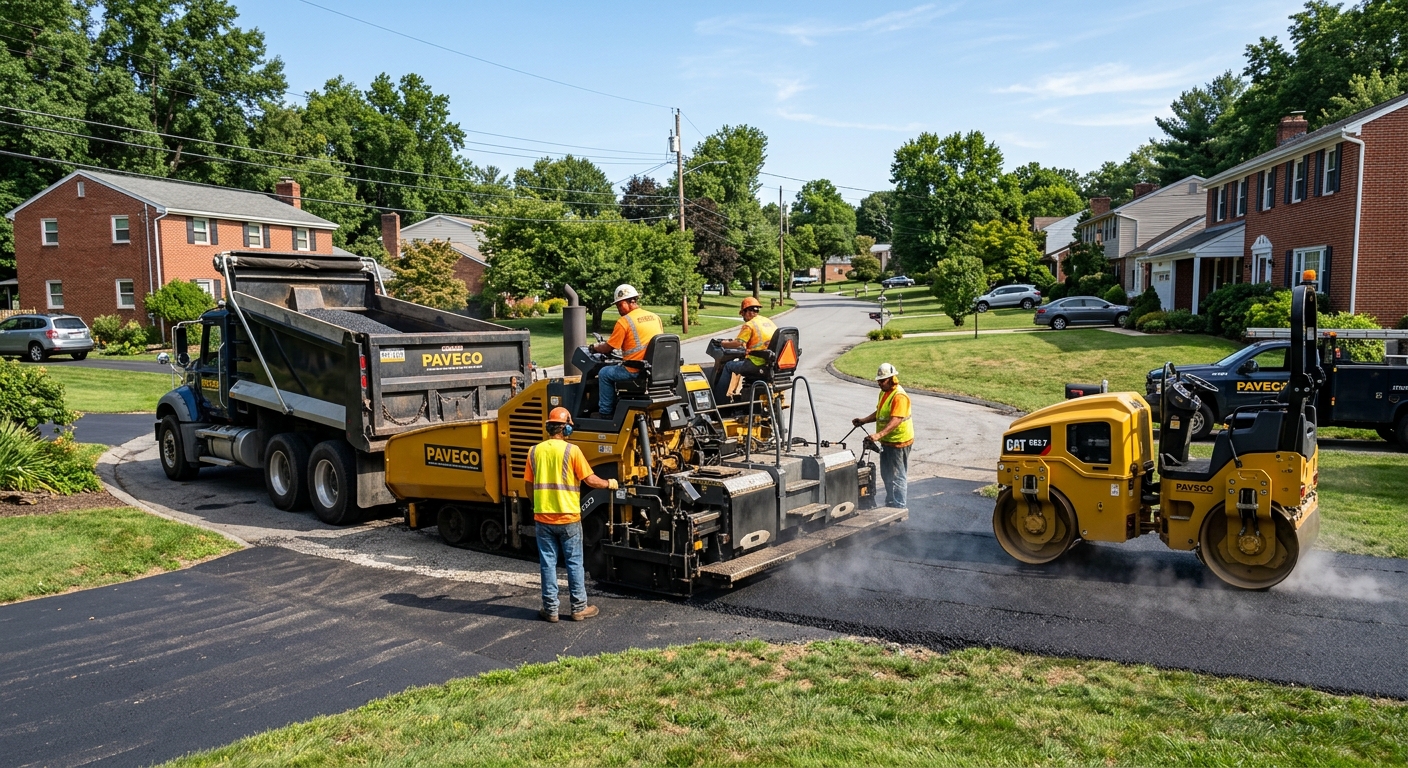
South Hanover paving prices by scope — 2026
South Hanover’s driveways are mostly the responsibility of homeowners, given that 63.5% of local homes are single-family and the homeownership rate is a strong 71.7% (U.S. Census Bureau, ACS 2024). That means most residents bear the full cost of installation and upkeep. Driveway paving here is shaped by aggressive freeze-thaw cycles and the region’s limestone karst and shale subgrade—factors that drive up both labor and material needed for stable results. Most crucial to price, though, is what’s buried: base depth, base material, and how the work is layered and compacted. Surface appearance never tells the full story. Two driveways might look similar on top, yet one could last twice as long if built on a properly deep, compacted aggregate base suited to local soils. As asphalt driveways from Dauphin County’s post‑1950 suburban buildout age out, full replacements are more common, and so are price differences masked by shortcuts you can’t see from the curb.
| Service |
Best for |
Lifespan |
Price range |
| Asphalt — full replacement with new base |
failed base, structural cracking |
20–30 yrs |
$3,800–$9,800 |
| Asphalt overlay / resurfacing |
sound base, surface cracking only |
8–15 yrs |
$1,650–$4,900 |
| Sealcoating — single application |
preventive maintenance on sound asphalt |
2–4 yrs |
$225–$750 |
| Concrete — new installation |
long service life, low maintenance |
30–50 yrs |
$5,400–$13,000 |
| Crack filling and patching |
isolated cracks under a quarter inch |
1–3 yrs |
$200–$800 |
| Gravel driveway |
rural, budget, long runs |
5–10 yrs with upkeep |
$900–$3,500 |
Estimates for a typical South Hanover driveway. Square footage and base condition drive these figures more than material choice.
What to put in a South Hanover paving contract
If you want your South Hanover paving quote to defend you from shortcuts—and overpayment—you need numbers, not just a price. The real structural work takes place under the surface, and shortcuts in excavation or base prep leave you with a project that will break up years before its time. Freeze-thaw cycling here and limestone karst and shale subgrade require thicker, well-compacted bases than you’d get away with in milder climates. If a quote just promises “three inches of asphalt,” that number means little unless it states whether it’s before or after compaction and what lies under it. Without specs, you’re trusting your driveway (and wallet) to a handshake.
Pin down these details on your contract:
- Total square footage measured, not estimated by the eye
- Excavation depth below existing grade, especially if removing failed base
- Type of aggregate base (crushed limestone or equivalent), and compacted thickness—often at least 8–12 inches for this region
- Proof of compaction in lifts, not all at once
- Binder course asphalt compacted thickness, plus mix designation (e.g., ID-2 base)
- Surface course asphalt compacted thickness, plus mix designation (e.g., ID-2 wearing)
- Edge treatment (tapered, concrete, or reinforced)
- Finished grade stated as slope percentage away from structures
- Drainage and any swale or trench drain installation if water management is needed
- Cleanup plus written warranty with exclusions clearly stated
South Hanover's ground and what it means for paving
South Hanover sits over a mix of limestone karst and shale, a combination unique to this part of Dauphin County. Limestone karst introduces the risk of subgrade settlement—cavities can shift, causing the base to sink or crack, especially under repeated freeze-thaw cycles. Shale, meanwhile, drains better than heavy clay but can fracture, leading to uneven settling if not properly compacted. Building a driveway here means not just scraping off the old top and repaving. You need a thicker aggregate base, often 10–12 inches, to distribute weight and absorb movement from the ground below.
Most of the area’s paved drives went in after 1950 as postwar subdivisions filled out. Early subdivisions didn’t always build for longevity—the focus was fast expansion, not deeply layered bases suited to the ground here. That’s why so many now need full-depth replacement rather than just a new surface. If your current drive has alligator cracking or edge breakup, it’s almost always a base issue rooted in our soil makeup and 30-inch regional frost depth. You’re better off ensuring proper excavation and rebuild, rather than covering up deeper problems with an overlay that’s doomed to fail early.
What a real paving quote contains
Comparing paving quotes takes more than lining up bottom-line prices. In South Hanover, a proper quote itemizes every step that dictates lifespan: measured square footage, excavation and disposal (especially if there’s failed base), type and thickness of aggregate, compaction method, asphalt courses with compacted depths, and edge treatment. Drainage, too, can’t be left to chance—good grading and attention to water flow matter just as much as the visible surface.
The payment schedule is a tell—modest deposits and balances on completion protect you. Warranties in this industry usually cover material defects but typically exclude cracking, which, unfortunately, is the type of failure homeowners most expect to be protected against. If a quote gives you only a single line with a total and no breakdown, you cannot compare it to anything meaningful. That’s the number one way folks in South Hanover pay too much for work that won’t last.
| Line item |
What to look for |
Red flag if… |
| Area |
measured square footage stated |
eyeballed or absent |
| Excavation |
depth and disposal included |
'we'll pave over it' |
| Base |
aggregate type and depth in inches |
'proper base' |
| Compaction |
method, and done in lifts |
not mentioned |
| Asphalt |
courses and compacted depth |
'3 inches' unqualified |
| Drainage |
slope and water direction stated |
silent |
| Warranty |
what is covered and what is excluded |
verbal only |
| Payment |
modest deposit, balance on completion |
full cash up front |
What you need before paving in South Hanover
For South Hanover residents planning a driveway project, there’s some good news: in most of Dauphin County, you don’t need a new building permit just to repave or resurface an existing driveway on a local, non-state road, as long as the driveway’s footprint doesn’t change. That means you save both paperwork and time. Where a permit nearly always comes up is the driveway approach—where your drive meets the public street. That part is typically under township or PennDOT authority, not the building office, and in Dauphin County, new or widened approaches on state routes require a Highway Occupancy Permit through PennDOT Engineering District 8‑0, not your local building office. Misunderstanding this is a common source of costly delays.
If your project expands the paved area or directs stormwater differently, it may trigger runoff management rules or invite disputes if you send water onto a neighbor’s property—liability doesn’t wait for the permit process. Always check your property boundaries and confirm whether stormwater review is required before starting work.
Don’t forget to verify your contractor’s Home Improvement Contractor (HIC) registration: look them up at hic.attorneygeneral.gov. Workers’ compensation coverage is also mandatory for all Pennsylvania paving employers, and you can check current coverage at WCAIS (wcais.pa.gov). A legitimate contractor expects these checks and should readily provide proof.
Where the water goes
Water, not traffic, destroys most South Hanover driveways. Proper grading isn’t optional—it’s fundamental. A driveway should have a minimum slope of 2% (about a quarter-inch per foot) to shed surface water. On wide drives, crowning the center can direct runoff to both sides; on narrow or more steeply pitched runs, a simple cross-slope works. The worst mistake is sloping toward your garage or house—it guarantees water at your foundation, which will eventually cause leaks or frost heave. If grade can’t be corrected, trench or channel drains at the garage threshold can capture runoff before it causes problems. All outlets—whether daylighted at the end of the property or tied to a dry well—must clear water away from paved surfaces and foundations.
South Hanover’s limestone karst and shale subgrade actually drains a bit better than heavy clay, but settlement risk remains. Freeze-thaw cycles amplify the hazard: water that infiltrates even a small crack will expand when it freezes, prying the base apart and guaranteeing further deterioration. For this reason, edge drains or sub-base drainage layers should be considered on properties with history of water issues.
Redirecting runoff onto a neighbor’s property is never permitted—liability follows the water regardless of what the township or county says about permits. Always direct water across your own land or to a permitted stormwater outlet.
Widening, extending or adding a parking pad
If your South Hanover project involves more than just replacement—widening to park an extra vehicle, extending the drive to a garage, turning a gravel track into pavement, or adding a turnaround for safer street access—planning ahead is essential. Any new paved area requires excavation down to stable, undisturbed subgrade, plus a fresh aggregate base built to area thickness standards. The seam where new paving meets old is always at higher risk of cracking, so expect some separation over time; no contractor can guarantee a perfect joint between new and decades-old asphalt or concrete.
Increasing the paved footprint may trigger local impervious-surface limits, affecting how much area you can pave and requiring a stormwater review. The approach or curb cut—your connection to the public street—still requires specific permission through your township or PennDOT Engineering District 8‑0 if on a state route. Watch for setback rules: property lines or utility easements may restrict how close you can pave to the edge.
For homeowners considering these changes, plan permitting early. Retroactive approvals are harder than getting it right up front, and stormwater rules can delay even small projects if they come as a surprise mid-job.
Frequently asked questions — driveway paving in South Hanover
What are the signs of a failing driveway base?
A failing driveway base in South Hanover will show certain symptoms that go beyond surface wear. Look for “alligator” cracking—clusters of interconnected cracks that resemble the scales on a reptile—which usually indicate deep movement in the subgrade. Potholes that return year after year, dips at the edge, upheaval after winter, or spots that remain soft long after a rain are further signs. In an area with limestone karst and shale like South Hanover, base failure is often masked for years by the top course, but by the time you see pronounced settlement or crumbling along the edge, resurfacing won’t solve your problem—you’ll need full removal and replacement with a new base. That kind of repair runs $3,800–$9,800 depending on driveway size and base depth.
Are pavers worth the cost in south-central Pennsylvania?
In South Hanover and the wider south-central Pennsylvania region, pavers can offer a high-end look, but their value depends on your budget, soil, and willingness to maintain them. Paver driveways excel at drainage and are easy to repair piece by piece, which is helpful for dealing with South Hanover’s freeze-thaw cycles and potential for subgrade movement. But pavers cost far more than asphalt—often double or triple per square foot, with a typical local asphalt install at $6,000 for comparison. On our local limestone and shale soils, pavers can shift or settle if the base isn’t perfectly prepared. If your priority is longevity and low maintenance at a sensible price, asphalt or concrete usually wins in this township.
When can I seal a brand new asphalt driveway?
After a brand new asphalt driveway goes in, you’ll need to wait before applying a sealcoat—usually six months to a full year in South Hanover’s climate. This delay lets the asphalt cure and off-gas volatiles, which ensures that the sealer actually bonds, rather than peeling or turning gray. Sealcoating too early can trap oils in the mix and weaken the surface, especially after our freeze-thaw season. Once cured, budgeting for sealcoating—$225–$750 per application—every few years can add life and appearance to an already-solid drive, but it's wasted on a new install before the surface has stabilized.
When is the best time of year to pave in South Hanover?
The best months to pave a driveway in South Hanover are late spring through early fall—roughly May through early October—when daily highs are reliably above 50°F. Asphalt needs warmth to compact and set properly, and paving too close to the first freeze or during cold snaps can result in weak bonding or premature cracking. Our local freeze-thaw cycle is brutal on poorly compacted or “cold-laid” drives, so it’s best to plan work for months when crews can work steadily and the mix can reach proper temperature. Scheduling ahead is smart, since the busiest paving months also see the most demand and prices in the typical band of $3,800–$9,800 for a full replacement.
How deep should the aggregate base be here?
In South Hanover, an aggregate base for asphalt or concrete driveways should be thicker than what’s common in counties with milder winters or more uniform soils. Because our local limestone karst and shale soils are prone to settlement and because freeze-thaw cycles can heave thinner bases, a compacted depth of at least 8 to 12 inches of crushed stone is standard. Any less risks premature cracking or settling. Less-than-professional bids sometimes skimp here—a common cause of drives that fail after just a few years. Given the cost of full replacement at $3,800–$9,800, building the right base up front is well worth it.
What does an asphalt overlay cost in South Hanover?
An asphalt overlay, also known as resurfacing, is the most cost-effective fix for South Hanover driveways with a sound base but some surface cracking or fading. Overlays run from $1,650–$4,900 locally, depending on square footage and prep required. This covers milling or leveling, a tack coat, and a new surface layer compacted to spec. Keep in mind: overlays don’t fix cracking or settlement in the base. If you see widespread “alligator” cracking or have persistent low spots, overlay is just a temporary patch. Only drives with solid structure will get the 8–15 years of added life that overlays can deliver in our climate.
Does South Hanover have local asphalt plants?
Yes, South Hanover benefits from having several quarries and asphalt plants nearby in the Harrisburg and Middletown area. This keeps haul distances—the main source of “hidden” cost increases—short, and makes it much easier to schedule paving within optimal temperature windows. Asphalt mix comes in hot from the plant, so less travel time means a stronger, better-compacted surface. It’s one reason the standard price range of $3,800–$9,800 for a full replacement is realistic in our market, unlike in more remote parts of Pennsylvania where trucking adds considerably on top.
Do I need a permit to repave a driveway in South Hanover?
In South Hanover and most of Dauphin County, you usually do not need a new permit just to repave or resurface an existing driveway on a local (non-state) road—if you’re not changing the driveway’s width, length or position. But if you’re working on the approach where your driveway meets a state route, or if you expand the footprint, you’ll need a Highway Occupancy Permit from PennDOT Engineering District 8‑0. These rules keep the process simple for most straightforward replacements, but don’t skip checking with your township for updates, especially if you plan to widen or add a parking pad. Typical resurfacing costs run $1,650–$4,900 locally.
How much does driveway paving cost in South Hanover?
For most single-family homes in South Hanover, a full asphalt driveway replacement—including new aggregate base—runs from $3,800–$9,800, with the typical job landing around the $6,000 mark. A concrete driveway starts higher, from $5,400–$13,000. These prices depend nearly entirely on square footage, the condition of your base, and whether you’re changing the driveway layout. Maintenance options like sealcoating cost much less at $225–$750 per application, but are only effective if the base and surface are sound to begin with. Don’t accept a quote without a detailed breakdown—price alone won’t tell you if the job will last in our local soil and climate.