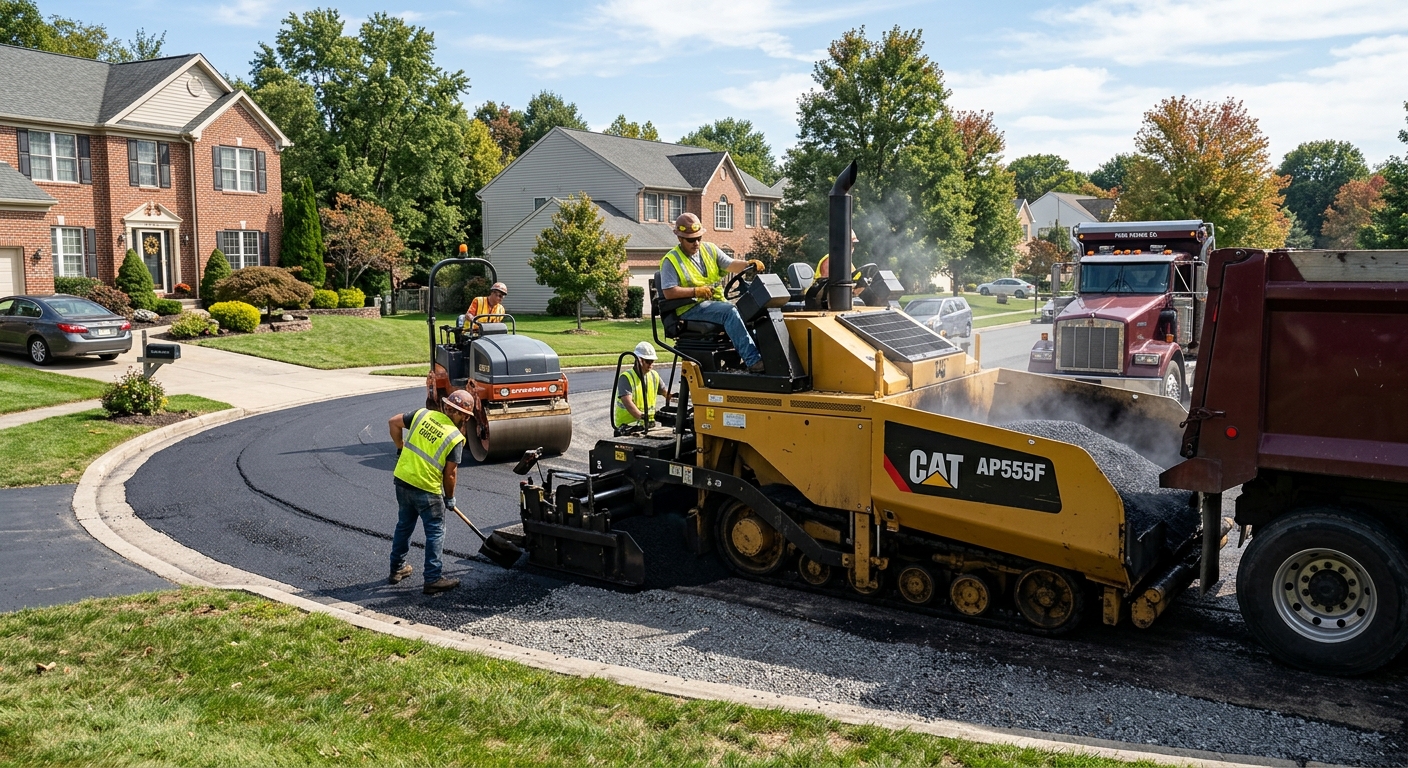
Driveway paving costs in Abington — 2026
Abington is a township of mostly single-family homes, with 69.9% of its housing stock detached and 78.2% owner-occupied (U.S. Census Bureau, ACS 2024). Paving a driveway here is a substantial investment and usually falls to homeowners rather than landlords or associations. Freeze-thaw cycles are common in southeastern Pennsylvania, and local soils—especially the silty clay and glacial till found in Abington—mean subgrade preparation and drainage play a bigger role in long-term performance than the paving method itself.
What most people don’t realize is this: the price difference between two competing quotes in Abington almost always comes down to what happens under the surface. It’s what you don’t see—the thickness and compaction of the stone base, the quality of the edge support, and how drainage is handled—that determines whether your driveway lasts ten years or thirty. Most driveways in Abington’s postwar neighborhoods are coming due for major work, with original surfaces and under-built bases now showing cracks, rutting, and settlement. That’s why asking “what’s the cheapest way” misses the biggest risks. Spend your time comparing specifications—especially what each contractor does under the asphalt or concrete—not just the surface pitch.
| Service |
Best for |
Lifespan |
Price range |
| Asphalt — full replacement with new base |
failed base, structural cracking |
20–30 yrs |
$3,800–$9,800 |
| Asphalt overlay / resurfacing |
sound base, surface cracking only |
8–15 yrs |
$1,650–$4,900 |
| Sealcoating — single application |
preventive maintenance on sound asphalt |
2–4 yrs |
$225–$750 |
| Concrete — new installation |
long service life, low maintenance |
30–50 yrs |
$5,400–$13,000 |
| Crack filling and patching |
isolated cracks under a quarter inch |
1–3 yrs |
$200–$800 |
| Gravel driveway |
rural, budget, long runs |
5–10 yrs with upkeep |
$900–$3,500 |
Estimates for a typical Abington driveway. Square footage and base condition drive these figures more than material choice.
Abington's ground and what it means for paving
Driveway performance in Abington comes down to what’s underneath. Much of eastern Montgomery County, including Abington, sits on glacial till and silty clay subgrade. Unlike the gravelly or well-draining soils you’ll find just one county over, this clay-rich ground holds water, swells and shrinks through the seasons, and is slow to drain after rain or snowmelt. For driveway construction, that means a thicker and well-compacted stone base is mandatory—not optional—to resist rutting and frost heave.
The frost depth in this region is 30 inches, with moderate freeze-thaw cycles that can easily push a poorly built driveway out of level after just a few winters. That’s why applying surface fixes—like a thin overlay—over a base never designed for modern traffic is rarely money well spent here. Most original driveways in Abington’s post‑1945 subdivisions went down when standards were looser and many builders ran stone bases barely thick enough for a light sedan. With today’s heavier vehicles and trash trucks running over the apron, under-building is a recipe for cracked surfaces and settlement along the wheel paths.
If you’re resurfacing a driveway more than 40 years old—and that’s most of Abington—ask questions about the condition and depth of the base. Bite the bullet now by adding additional stone and proper compaction, or be prepared to repeat the work a lot sooner than you’d like.
Where the water goes
Water rarely gets the attention it deserves in driveway work, but it’s the culprit for most failures in Abington. A new driveway needs at least a 2% slope—about a quarter inch per foot—to move surface water away quickly. Crowning the center, so water runs off both edges, or sloping the entire drive across its width are both options. But if the driveway slopes toward your garage or house, standing water backed up against the foundation becomes a real threat, raising the risk of seepage and frost heave as the seasons change.
Where you can’t get enough slope because your house sits lower than the street or your lot’s layout is tight, trench drains or channel drains come into play. These collect water and route it away—ideally daylighting at a low point in your yard, if the grade allows, or into a dry well installed by code. Heavy clay soils here—typical of Abington—drain so poorly that it’s easy to keep water on the surface or trapped in the base, especially after a rainstorm. In winter, the effect compounds: water trapped under the driveway freezes, expands, and lifts the pavement, only to settle unevenly once it thaws.
Lastly, remember that you are responsible for your runoff. It’s not just a code requirement; channeling water off your property and onto your neighbor’s can put you on the hook for damage, regardless of whether a permit was issued or required. Invest up front in grading and drainage—it costs much less than fixing a ruined driveway or neighbor dispute down the road.
Driveway permits, approaches and stormwater rules
Most paving projects in Abington—if you’re just resurfacing or replacing an existing driveway in place—do not require a building permit. It’s only when you alter the footprint, widen the curb cut, or work near sidewalks and aprons that municipalities require permits. For example, in Norristown, replacing a driveway that changes the curb or apron usually triggers a building or street opening permit. Driveway approaches, where your drive meets the township road, are handled by the Montgomery Township Public Works Department in Montgomery Township—not always the authority homeowners expect.
Stormwater rules apply throughout Montgomery County. If you’re adding new impervious surface, like widening the driveway or converting gravel to asphalt, the extra runoff can trigger requirements for on-lot stormwater handling—usually means a swale, dry well, or approved connection to an existing system. No permit or design lets you direct water onto your neighbor’s land, and you’ll be liable if it causes issues.
In Pennsylvania, any paving contract over $500 requires the contractor to hold Home Improvement Contractor (HIC) registration, which you can verify at hic.attorneygeneral.gov. Contractors with employees must have workers’ compensation insurance—check status through WCAIS (wcais.pa.gov). These are basic protections and not optional, regardless of quote.
The specifications to demand in writing
If you want a driveway that lasts in Abington, skip “how much per square foot” and grill your bidders on specs. Decades of freeze-thaw, glacial till and silty clay demand a more substantial build than you’d get in milder places. A sloppy job might last five years; a properly built driveway over thick, compacted stone will last decades. Every quote you get should state in writing—down to the inch and pound—what gets built. If a contractor just says “three inches of asphalt,” you haven’t learned anything: is that three inches before or after compaction? Over what thickness of stone? One lift or two? What’s the base specification for Montgomery County’s clay or till?
Expect to see subgrade excavation of soft or organic material, then a well-compacted stone base—8 inches minimum on silty clay is common here—built up in layers. Asphalt should be laid in at least two lifts, with thickness specified as compacted, not just spread loose. Edge support (preferably with compacted stone and clean cutoff), match to the street apron, drainage slope, and proper mix design (say, PennDOT 19mm binder with a 9.5mm wearing course) all belong in black and white. Hold out for these details—in Abington’s soils and weather, shortcuts never pay.
- Excavation depth below finished grade
- Stone base thickness and material type
- Compaction method and proof-roll requirement
- Number of lifts for both base and asphalt
- Binder and surface asphalt course depths (compacted)
- Asphalt mix designation (e.g., 9.5mm wearing, 19mm binder)
- Edge support details (stone shoulders or concrete strip if specified)
- Specified slope or drainage plan
- Tie-in method at street and garage slab
- Crack filling and surface preparation if resurfacing
When paving can actually be done in Abington
In Abington, paving isn't a year-round business. The climate sets hard boundaries. Hot-mix asphalt needs to be placed and properly compacted while the air and ground are warm—ideally above 50°F for both. Below that, the mix cools off so fast you won’t get it tight, and the result is a weak, porous surface that won't last ten years. Around here, the winter design temperature drops to 14°F, and asphalt plants serving Montgomery County—clustered along the I-276 and US 202 corridors—shut down from roughly November through early April. If a crew tells you they can pave in December, they’re not using plant-fresh hot-mix, and you’ll see the difference next spring.
Concrete has its own restriction: it must cure above freezing. Cold-weather pours risk weak, flaky surfaces even if you don’t see problems right away. The busiest time for paving is late spring through early fall, when both material supply and weather line up. Schedules fill fast in the May–August peak, and last-minute deals are rare unless rain delays create wiggle room.
The best value often comes in the shoulder seasons—late April or early October—before the big rush or just as things wind down. Crews have space, you can still get good material, but you’re not paying the high-season premium. Don’t waste time with anyone eager to lay your drive when it’s cold and damp. This isn’t southern California—it pays to plan ahead.
Maintenance that actually works
Keeping an Abington driveway in good shape is mostly about keeping water away from the base. Crack filling is the single best investment you can make: treat every new crack before it’s wide enough for water. Clean out debris and fill with a quality asphalt crack sealer—done early, this simple step can add years to your surface. Keeping the edges supported (for asphalt, that’s compacted stone shoulders, not just topsoil) prevents lateral breakup and edge cracking, which are common here due to heavy clay and moderate freeze-thaw cycles.
Never let water pond on the driveway or run toward the garage, especially in winter. The cycle of daytime melting and overnight refreeze causes most of the early failures in this climate. After a new asphalt driveway, wait at least 48–72 hours before parking, and two weeks before turning wheels in place—until then, the surface is still curing and easy to scuff.
For ice, de-icers with calcium chloride are safer than rock salt for both materials, though salt will eventually attack concrete if used heavily. Asphalt is mostly at risk from the increased freeze-thaw cycling caused by repeated melting and refreezing rather than from the salt itself. Sand or non-chloride “ice melt” products offer a safer alternative, though they cost more. In this part of Pennsylvania, keeping up with cracks and water movement is what really matters for lifespan.
Frequently asked questions — driveway paving in Abington
How deep should the aggregate base be here?
For Abington and most of eastern Montgomery County, the answer comes down to soil: glacial till and silty clay require a deeper base than areas with gravelly or sandy soils. We generally recommend at least 8 inches of well-compacted crushed stone—sometimes more over the wetter, heavier clay found through much of Abington. Anything less invites rutting, frost heave, and early cracking, especially with the moderate freeze-thaw cycles we see in southeastern Pennsylvania. It's common in older Abington neighborhoods to find driveways built decades ago with only 3–4 inches of stone, which simply isn’t enough for today’s vehicles and weather swings. Upgrading to a proper full-depth replacement typically runs $3,800–$9,800, but pays you back in longevity and reliability.
How much does it cost to widen a driveway?
Widening a driveway in Abington can mean different things—a few extra feet at the apron, or a whole additional parking bay. The main cost drivers are excavation, extending the stone base, and matching the tie-ins at the curb and garage. For a typical two-car asphalt driveway, adding width usually falls at the lower end of a full replacement range, often between $1,650–$9,800 depending on the amount of work. You'll also want to budget for stormwater compliance if you’re adding significant impervious area, as local rules apply. Remember: the process is not just "add asphalt"—you need new base, proper compaction, and grading so water still drains safely.
What kind of soil is under Abington driveways?
Under most driveways in Abington, you'll find silty clay and glacial till. This is noted in eastern Montgomery County's soil assessments and has a big impact on driveway design. Silty clay retains water and swells, then shrinks when it dries, leading to surface movement and cracking if not managed. Glacial till varies in stone content but is also prone to poor drainage if left untreated. That means any new driveway, asphalt or concrete, should have a thicker stone base and a focus on surface drainage—otherwise freeze-thaw cycles can cause costly damage. These conditions explain why a simple overlay, even at $1,650–$4,900, may not last unless the subgrade is properly prepared.
Asphalt or concrete for an Abington driveway?
In Abington, both asphalt and concrete are common, but there are trade-offs. Asphalt is more forgiving in our freeze-thaw climate; it flexes and is easier to repair. It’s also less expensive up front, typically $3,800–$9,800 for a full replacement. Concrete offers a longer service life (30–50 years), lower maintenance, and doesn’t soften in summer, but it costs more—usually $5,400–$13,000. On silty clay soils, either material needs a thick, well-drained base. If budget allows and you want minimal upkeep, concrete is worth considering; if you prefer easier repairs and a lower initial outlay, asphalt is a solid choice for Abington's climate.
Can asphalt be laid in cold weather?
In southeastern Pennsylvania, including Abington, local asphalt plants shut down through the winter—typically from late November until April—because hot-mix asphalt can't be placed or compacted properly in the cold. The region's winter design temperature of 14°F is well below what's needed to get a lasting result. Even if material were available, it would cool too quickly to bond, resulting in a weak, porous, and short-lived surface. That means any reputable company won’t schedule full paving during the off-season. If you're being quoted cold-weather work, be extremely cautious—it’s rarely worth the risk, even at the low end of the pricing band ($1,650–$4,900).
What is the difference between crack filling and sealcoating?
Crack filling targets active cracks—usually under a quarter inch wide—by injecting a rubberized filler to block out water, saving the underlying base from freeze-thaw damage. This is vital in Abington due to clay-rich soils and a moderate freeze-thaw cycle. Sealcoating, on the other hand, is a thin surface treatment applied over the whole asphalt driveway to slow oxidation and minor weathering. It doesn't repair damage beneath; it’s more cosmetic and preventive. Crack filling is the first priority (runs $200–$800 for typical jobs); sealcoating adds short-term surface protection for $225–$750 but won't stop water if cracks aren't filled first.
Can I cancel a paving contract I signed at my door?
Yes. Under Pennsylvania’s Home Improvement Consumer Protection Act (HICPA), any contract for home improvement work—like paving—signed at your home, and over $500, comes with a three business-day right of cancellation for homeowners in Abington and elsewhere in the state. This applies whether you signed in person or after a solicitation. Be certain to cancel in writing and keep a record. A reputable contractor will include this notice with your contract, as required by law. If you locked into a contract for asphalt replacement at $3,800–$9,800 and change your mind after reading the fine print, use this window—it's there to prevent buyer’s remorse and protect your rights.
What causes concrete to spall or flake in Abington?
Concrete spalling—when the surface flakes or crumbles—is nearly always related to moisture infiltration and freeze-thaw cycling. Abington’s humid summers and moderate winter swings aggravate the problem, especially if the mix was too wet, under-cured, or de-icers were overused the first few winters. Silty clay soils hold moisture right at the slab’s bottom, keeping conditions ripe for freeze-induced damage. Use only de-icers labeled safe for concrete and sweep off puddled salt in spring. Even with correct installation (at $5,400–$13,000), most spalling here traces back to drainage and maintenance, not just the mix itself.
What does an asphalt overlay cost in Abington?
For most Abington homes, an asphalt overlay—resurfacing over an existing, sound base—is between $1,650–$4,900 depending on size and prep required. This lower-cost option extends the life of a driveway that hasn’t suffered major base failure or structural cracks, and is most cost-effective for properties with driveways built in the last thirty years. If the underlying stone is thin, soft, or uneven—as is common on the original driveways laid in postwar subdivisions—overlaying is often short-term. Be sure to verify the base is solid before committing; otherwise, full replacement may prove a better value.