Driveway paving costs in Springfield — 2026
Springfield, situated in Bucks County where over 96.3% of homes are single-family and 84.1% of residents own their houses (U.S. Census Bureau, ACS 2024), sees steady demand for driveway paving and replacement. Here, resurfacing or replacing a driveway is rarely a quick fix or simple upgrade—it's a core maintenance expense tied to your home’s function and longevity. With our local freeze-thaw cycles and silty clay subsoil in areas near the Delaware River, driveways must be built to handle both deep frosts and drainage challenges.
In Springfield and throughout Lower Bucks, the true cost difference between two paving quotes nearly always hides under the surface. What you see on top—fresh black asphalt or neat concrete—tells you nothing about the stone base, compaction, or whether drainage was improved. Most of your investment goes into this unseen work, which governs how long the surface will last before cracks or heaving appear. A low bid often means a thinner base or skipped prep—cut corners that won’t reveal themselves until winter has worked on the seam for a few years.
| Service |
Best for |
Lifespan |
Price range |
| Asphalt — full replacement with new base |
failed base, structural cracking |
20–30 yrs |
$3,900–$10,000 |
| Asphalt overlay / resurfacing |
sound base, surface cracking only |
8–15 yrs |
$1,700–$5,000 |
| Sealcoating — single application |
preventive maintenance on sound asphalt |
2–4 yrs |
$225–$800 |
| Concrete — new installation |
long service life, low maintenance |
30–50 yrs |
$5,600–$13,500 |
| Crack filling and patching |
isolated cracks under a quarter inch |
1–3 yrs |
$200–$800 |
| Gravel driveway |
rural, budget, long runs |
5–10 yrs with upkeep |
$900–$3,500 |
Estimates for a typical Springfield driveway. Square footage and base condition drive these figures more than material choice.
The honest case for and against sealcoating
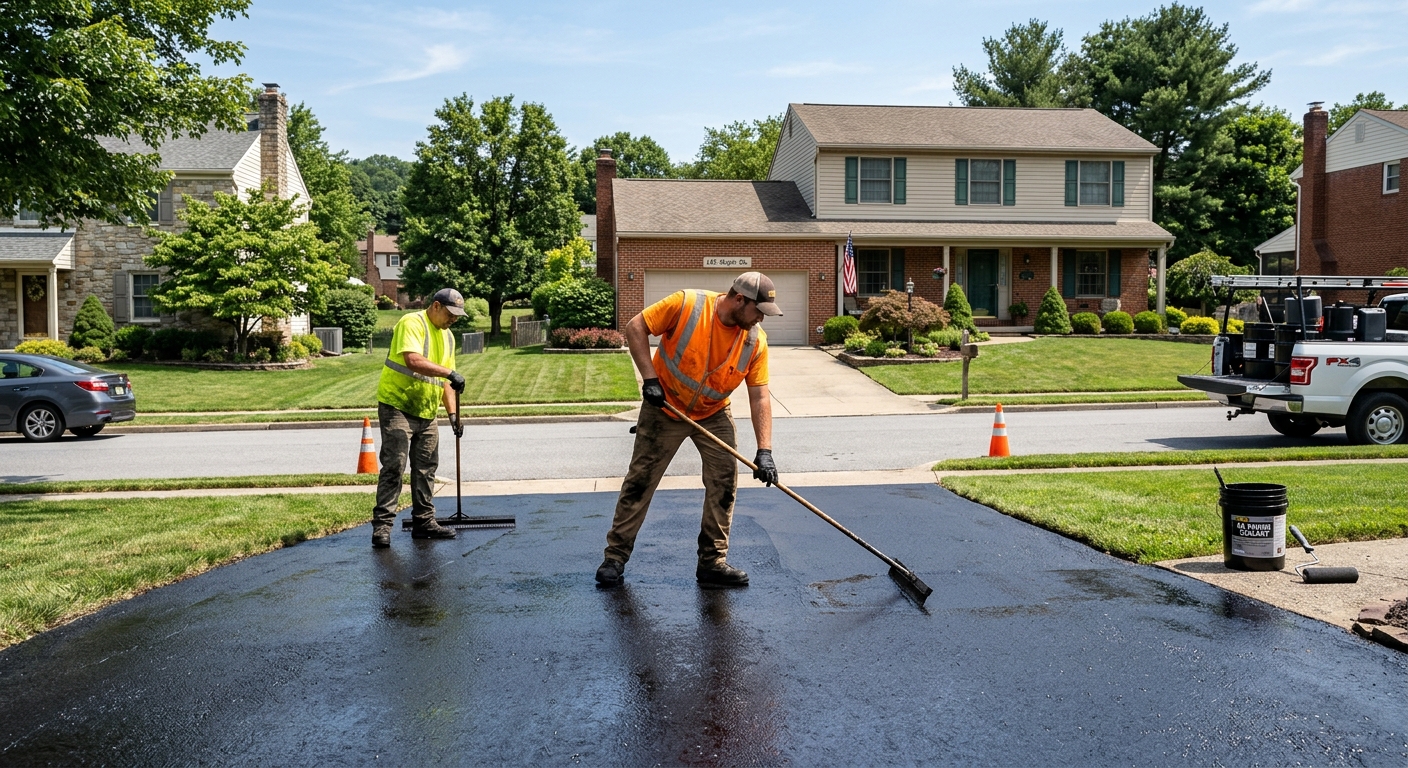
Most Springfield homeowners have heard that sealcoating is a must for any asphalt driveway. The truth is, it’s worthwhile—but not for the reasons most ads claim. Sealcoating lays down a thin layer of coal tar or asphalt emulsion that helps slow binder oxidation from UV, shields against oil and fuel drips, and temporarily freshens the surface look. It won’t fix a failing driveway or stop cracks from growing if the base underneath is settling. And it has no real value when the drive has widespread alligator cracking or frost heave; in those cases, you’re covering a much bigger problem.
Sealing too often actually causes more harm than good. Layering sealant every year will eventually create a brittle, crack-prone glaze that can peel or flake. New asphalt in particular should not be sealed until it has cured for at least six to twelve months, or you risk locking in volatiles and trapping moisture. Every two to three years is a reasonable interval for healthy, sound driveways in Bucks County, not annually.
Crack filling matters more than sealcoating. Filling tight, isolated cracks with hot rubber or a professional-grade fill prevents water infiltration—the main cause of winter damage here in southeastern Pennsylvania. A proper sealcoating job uses squeegees or brushes to work the material into the surface. Spray-only applications, especially for under $225–$800, tend to be too thin and do little. If the price sounds low, expect diluted product, no prep, and no crack filling—just a cosmetic rinse. If your drive is in good shape, sealcoating protects your investment. If it’s failing, save your money for real repairs.
The specifications to demand in writing
For Springfield homeowners, a driveway paving quote is only as good as the details it lists. Our local freeze-thaw cycles and the silty, often poorly-drained glacial till in Lower Bucks mean the right depths and materials matter more here than they might in a milder climate. Don’t settle for a contractor who says, “We’ll put down three inches.” That tells you nothing: Is it three compacted inches or three loose? Is that measuring the base, the binder, or the surface course?
A proper quote covers exactly how deep the excavation will go, what kind and size of aggregate they’ll lay for the base, the compaction method (including whether it’s done in lifts, not all at the end), and the thickness of both binder and top asphalt layers as measured after compaction. It should also state what edge support or treatment is planned, so the drive won't fray or crumble at the borders, which is common here when the base is too thin against the Delaware River clay soils.
- Excavation depth below finished grade (in inches)
- Type and thickness of compacted aggregate base (e.g., 6–8 inches of 2A stone)
- Number and thickness of asphalt courses (binder and surface, each measured after compaction)
- Type/designation of asphalt mix (e.g., PennDOT ID-2 wearing course)
- Compaction method (plate compactor, roller; compaction in lifts, not just at the end)
- Edge treatment (e.g., to prevent fraying or raveling at borders)
- Drainage slope and method (to direct water safely off the drive)
- Crack filling or patching specifics if requested
- Cleanup and protection of existing yard/landscaping
- Any warranty or maintenance interval promised, in writing
Permits and approvals for paving in Springfield
Within Springfield and much of Bucks County, repaving a driveway inside the original footprint typically does not require a building permit, so if you’re simply resurfacing or replacing what’s already there, you can often skip the call to the township office. Expanding the driveway’s width or changing its layout, however, will trigger a building and zoning permit review, particularly in townships that administer their own permits like Bensalem Township.
The more common trip-up is the driveway “approach”—the part where your drive connects to a public road. For driveways on state routes in Bucks County, permits are issued not locally, but by PennDOT District 6. Even if your street is township-maintained, most local authorities require permit checks if you’re changing the width, material, or profile of the approach apron.
Adding new or extra driveway surface may trigger stormwater runoff requirements, and you are liable if changes redirect water to a neighboring lot or public sidewalk—permits don’t shift this responsibility. Always confirm your contractor’s Home Improvement Contractor (HIC) registration with the Pennsylvania Office of Attorney General (hic.attorneygeneral.gov), and verify that workers’ compensation is covered through the WCAIS system (wcais.pa.gov) for your own protection and the crew’s safety.
Finding a legitimate paver in Bucks County
In Bucks County’s dense suburban market, where asphalt and stone come from nearby Delaware Valley plants, finding a quality paver calls for more than just checking price and crew size. Start with the Pennsylvania Office of Attorney General’s HIC registry (hic.attorneygeneral.gov); any contract over $500 must use a registered business, or it’s not worth signing. Workers’ compensation is also mandatory—check through the WCAIS system (wcais.pa.gov) that it’s valid for every employee.
Go further: a legitimate paver should have a published, verifiable local address, not a P.O. Box or just a mobile number. If they can’t name their main local asphalt and aggregate supplier from the Delaware Valley, they likely do not control their material and may just be brokering jobs. References should be for work installed three or more years ago—how a drive looks at age five is much more significant than how it looked at installation.
- Check HIC registration at hic.attorneygeneral.gov
- Verify workers’ compensation at wcais.pa.gov
- Request references from jobs at least three years old in Bucks County
- Confirm business address that’s local, not just a cell number
- Ask: “Which quarry or plant do you buy your stone and asphalt from?”
- See photos of base preparation, not just finished surfaces
- Owner on-site during work, not just an estimator
- Owned, not rented, equipment (look for company decals, receipts)
- Written, signed contract showing all spec details and payment terms
- Scope of work matches township and PennDOT permit requirements
- Clear, written warranty terms (duration and what is covered)
- Details on who handles any permit filing with township or PennDOT
Red flags: cash-only payment, pressure for a same-day decision, vehicles without signage or local plates, or not providing written details. Any of these—walk away.
How paving fraud actually operates
Driveway paving across Springfield and Bucks County is a prime target for transient and out-of-area contractors because it is a big, sidewalk-visible expense with long-term risks that don’t show up for years. Here’s how it typically plays out: you get a knock at the door with a story about “extra material from a job down the road,” a deal if you sign and pay today, or a rock-bottom price for a large, cash-only job. The truck is often unmarked or has plates that don’t line up with local townships. The pitch comes with a handshake or a short receipt—no written contract, no mention of warranty, and sometimes not even a last name.
Thin or diluted oil-based sprays—offered as “sealcoating”—are common in this market and rarely deliver anything but a quick cosmetic glaze. In Bucks County’s dense suburban setting, the spread-out neighborhoods and quick access from the river towns mean these operators can disappear before problems surface. More troubling: the quality you paid for may only last one or two winters before cracks, weeds, or rutting appear.
Here’s what the law in Pennsylvania gives you: for any paving contract over $500, the Home Improvement Consumer Protection Act (HICPA) guarantees your right to a written contract and a three business-day right to cancel the agreement after signing—no reason required. Never waive your rights or sign a blank or incomplete contract. And no contractor can lawfully “cover” your insurance deductible as part of the job price: that’s illegal in Pennsylvania.
To shut down 90% of scam risks in five minutes: verify the HIC number at hic.attorneygeneral.gov, check comp coverage at wcais.pa.gov, demand written specs and payment terms, and walk away from any “special deal” that pressures you to decide today.
Base preparation: the part you pay for and never see
The most important part of driveway paving in Springfield is the work that vanishes under fresh asphalt: the base. Proper driveway construction is a three-layer system. The subgrade is shaped, leveled, and compacted—especially important here, where Springfield’s glacial till and silty clay subsoils hold moisture. On top of this sits the compacted aggregate base, most often 2A modified stone, which must be thick enough (often 6–8 inches compacted) to distribute wheel and weight loads. Only after that comes the actual asphalt paving—usually a binder course topped by a finer surface course, both measured after compaction, not just when dumped from the truck.
If base prep is poor, Bucks County’s freeze-thaw cycles turn small errors into big failures. Water in the subgrade expands when it freezes (what we call frost heave), lifting sections of the driveway unevenly and cracking the surface from underneath. With Springfield’s humid summers and wet fall seasons, drainage is as important as depth—a thick base with nowhere for water to exit just becomes a frost sponge.
This is the lever for driveway life or death: cut-rate quotes get cheap by shaving the critical steps here. They might skip real excavation, dump a thin layer of stone, roll it once without staged compaction, or lay new asphalt directly over a failed old base. On installation day it’s invisible; by year three or four, ruts and cracks reveal the shortcuts.
The numbers to insist on—and see in writing: base excavation of 8–12 inches for poor soils, minimum 6–8 inches of compacted 2A stone, each lift compacted separately, with base edges built up and sloped for drainage away from the house. A full-depth asphalt binder course should be ≥2 inches (after compaction), and the wearing surface at least another 1.5–2 inches.
Frequently asked questions — driveway paving in Springfield
Can asphalt be laid in cold weather?
In Springfield and across Bucks County, asphalt paving has a practical season: late April through October. Local plants supplying Delaware Valley mix typically shut down for much of the winter. Even if “hot mix” is available, paving in cold weather (below 45–50°F) risks improper compaction, weak bonds, and rapid raveling, especially with our area’s wet subsoils. If a contractor in Springfield offers you driveway installation during cold snaps, walk away. Off-season jobs rarely last. Wait until spring or early fall for best performance, even if it delays your project. For full replacement, expect to pay $3,900–$10,000 in 2026—don’t risk these stakes on a winter install.
What does an asphalt overlay cost in Springfield?
An asphalt overlay—sometimes called resurfacing—usually runs $1,700–$5,000 for a typical Springfield drive. Overlays are only appropriate when the base is still stable, and the existing asphalt just shows minor surface cracking or mild wear—think modest settlement, not full-scale alligatoring or frost heave. Trying to save money by overlaying a badly broken base won’t last more than a few winters, thanks to our freeze-thaw cycles and the silty clay under much of Springfield. Always ask that the underlying base and edges are carefully prepped and that thickness is measured after compaction in your quote.
Are there stormwater rules on paving in Springfield?
When you expand an existing driveway or install a new one in Springfield, stormwater considerations come into play because most Bucks County townships restrict how much new impervious surface you can add. Any addition that increases runoff—especially toward sidewalks or neighboring yards—can require permits and even engineered drainage solutions. Even if the township doesn’t require a permit for simple resurfacing, the liability for diverted stormwater is still yours, not the contractor’s. If you add surface area or change slope, you may face new requirements or need to prove your plan won’t send water to the wrong spot. For a standard replacement within the footprint, costs will fall in the $3,900–$10,000 range, but always ask about drainage corrections in your estimate.
Why are paving quotes in Springfield so different from each other?
Price swings in Springfield paving quotes are almost always about what’s buried, not the asphalt you can see. Some contractors skip or thin the stone base, skip compaction in lifts, or patch over failed material instead of removing it—all of which drops their obvious costs but shortens driveway life in southeastern Pennsylvania’s freeze-thaw climate. The right specs here—6–8 inches of compacted aggregate, layered compaction, and written details on slope and drainage—cost more up front but prevent the frost heave and rutting that kill cheap driveways in our glacial till soils. Expect to pay from $3,900–$10,000 for full replacement, and judge quotes by their written specs, not their headline numbers.
What kind of soil is under Springfield driveways?
Springfield—and much of Lower Bucks—sits over glacial till with silty clay pockets, especially approaching the Delaware River plain. This makes drainage and subgrade stability major concerns. These soils trap water more than sand or gravelly soils do, which means frost heave is a greater risk in winter—lifting and cracking asphalt from underneath. For this reason, local pavers are justified in recommending deeper stone bases (6–8 inches, sometimes more) and strict attention to slope and water runoff. For a concrete drive, costs run $5,600–$13,500; but whether you go concrete or asphalt, ask about specific base prep—not just what’s poured on top.
Are pavers worth the cost in southeastern Pennsylvania?
Pavers—meaning individual concrete, brick, or stone units—cost significantly more than poured concrete or asphalt, and prices climb further with proper sub-base prep to prevent settling in our freeze-prone soils. While they can add curb appeal and are easier to patch in small areas, they are rarely cost-effective for the climate and soil conditions in Springfield. Silty clay and freeze-thaw cycles in Bucks County mean pavers require extra excavation and a very thick, well-compacted stone base to avoid movement and weed growth. For context, a high-end concrete drive costs $5,600–$13,500; pavers can run even higher, sometimes doubling these numbers. Ask yourself if the look and resale value are worth the extra maintenance and up-front price for your property.
What slope does a driveway need for drainage?
For Springfield, aim for a minimum slope of 2–3% away from structures and toward the street or a safe drainage swale—roughly 1/4 inch per foot. This is necessary because our glacial till and silty subsoils retain water, and any standing surface water will find its way through cracks over the winter, multiplying freeze-thaw damage. Local code may have additional requirements if you’re connecting to a public road or making changes near a sidewalk; approach permits apply here, and drainage must always be designed not to impact neighbors. If your job quote includes regrading, this may increase costs toward the upper end of the $3,900–$10,000 range for asphalt replacement.
How often should I sealcoat my driveway in Springfield?
In Springfield, with Bucks County’s freeze-thaw climate and typical oxidation rates, sealcoating is best done every two to three years—not annually, despite what some contractors say. Sealing too often will build up a brittle, flaking layer, especially on older asphalt. Always wait at least 6–12 months after a new paving job before the first seal; this lets the asphalt cure and release excess oils. A single proper sealcoating application by brush or squeegee in Springfield should cost $225–$800. Focus first on urgent crack filling, and never seal just to freshen the look if there are deeper issues below.
Why does my driveway have depressions that hold water?
Depressions or “birdbaths” in driveways around Springfield typically stem from improper base compaction—either the aggregate was too thin, not compacted in multiple lifts, or the subgrade wasn’t prepared to account for settling. Sometimes settling occurs after heavy trucks or water infiltration, particularly in areas with silty subsoil that turn soft when saturated. Once water collects in these depressions, it speeds up surface wear and freeze-thaw damage in Bucks County winters. For minor issues, patching and filling can last 1–3 years and may cost $200–$800, but recurrent or spreading dips mean it’s time for a full-depth repair.