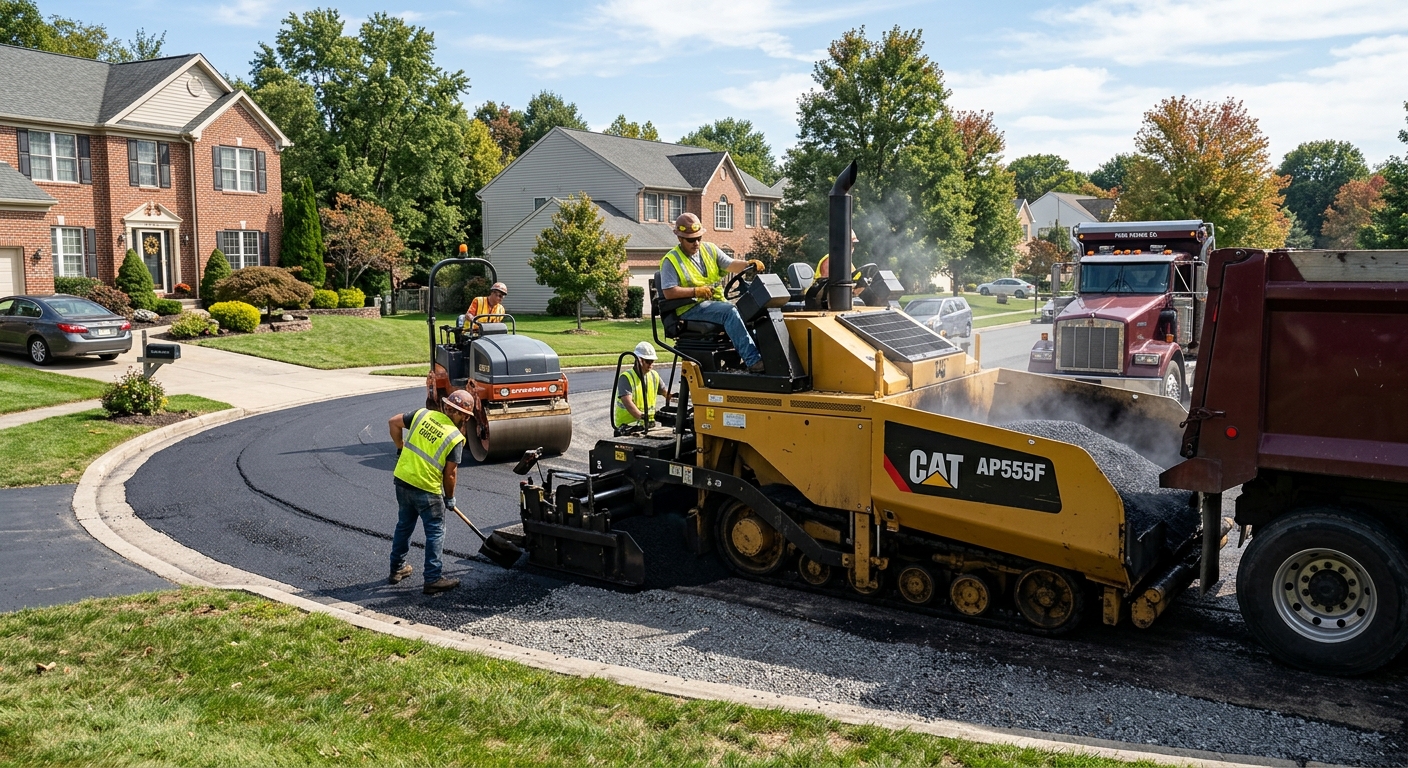
Driveway paving costs in Buckingham — 2026
Buckingham’s driveways are almost all homeowner responsibilities — 95.5% of local households own their homes, and 82.7% are single-family (U.S. Census Bureau, ACS 2024). When you’re evaluating paving quotes here, know that you’re buying what’s below the surface. Local soil is often glacial till and silty clay, which holds water and heaves when the ground freezes and thaws. Most early subdivisions in Bucks County, including near Levittown, were built before modern base standards, leaving many driveways resting on thin stone or compacted fill. That’s why prices vary so much: one contractor might simply overlay old, shifting asphalt; a better bid will excavate and rebuild the foundation where it’s compromised.
Long-term value comes from what goes under the driveway, not just the surface you see. A sound stone base and attention to drainage matter more than finish or brand. Contractors here source aggregate and hot mix from nearby Delaware Valley quarries, so material costs tend to be stable—most of your spend is labor and site prep. Below are the actual figures for what you’ll pay in Buckingham, depending on your driveway’s needs:
| Service |
Best for |
Lifespan |
Price range |
| Asphalt — full replacement with new base |
Failed base, structural cracking |
20–30 yrs |
$4,400–$11,500 |
| Asphalt overlay / resurfacing |
Sound base, surface cracking only |
8–15 yrs |
$1,900–$5,700 |
| Sealcoating — single application |
Preventive maintenance on sound asphalt |
2–4 yrs |
$250–$900 |
| Concrete — new installation |
Long service life, low maintenance |
30–50 yrs |
$6,300–$15,000 |
| Crack filling and patching |
Isolated cracks under a quarter inch |
1–3 yrs |
$200–$800 |
| Gravel driveway |
Rural, budget, long runs |
5–10 yrs with upkeep |
$900–$3,500 |
Estimates for a typical Buckingham driveway. Square footage and base condition drive these figures more than material choice.
How often should a Buckingham driveway be sealed?
Many Buckingham homeowners feel pushed to sealcoat every year, but yearly sealing is usually neither necessary nor good for your driveway. Sealcoating creates a protective layer over the asphalt binder, which helps slow oxidation (the process that makes asphalt brittle) and offers mild resistance to oil and gasoline drips from parked vehicles. Sealcoat also improves dark color and curb appeal, but it does not fix structural cracks, add meaningful strength, or make up for underlying base failures.
Too-frequent sealing, especially on new driveways, leads to peeling and cracking. The layers build up, trap moisture, and can actually speed up surface failure. New asphalt should cure for at least a full summer before the first sealcoat, giving volatiles time to escape. After the initial treatment, every 3–4 years is typical in Buckingham—not annually. More important than surface sheen is how cracks are handled. Ignoring cracks lets water seep to the stone base, which is what actually causes long-term damage during freeze-thaw cycles.
There’s a real difference in service, too. A brushed or squeegeed sealcoat is thicker and actually fills pores; a cheap, fast spray can be little more than watery black dye. If someone offers to sealcoat for far less than $250–$900, expect either corners cut or diluted material. The biggest value in maintenance dollars is found in quality crack filling, not oversold sealing.
Getting thirty years out of a driveway
The single factor that most helps a Buckingham driveway last is stopping water from reaching the base. That means filling cracks before freeze-thaw cycles can wedge them open, and patching as soon as you see a depression or small pothole. Edges matter too—without supporting soil or paving, the sides crumble and let water in. Make sure gutters and downspouts carry water away from the edge, not onto it, and keep drainage running away from the driveway, since Lower Bucks clay holds water and heaves with frost.
Heavy point loads, like dumpsters or stationary trailers, will leave depressions—spread weight out with plywood or avoid parking them there altogether. Don’t let anyone turn their wheels while stopped on new asphalt for at least a month after install; it’s soft and will rut. For de-icing, avoid rock salt on concrete entirely, as it attacks the surface. On asphalt, salt works but accelerates melting, so if you apply it, sweep excess promptly to limit water infiltration during refreezes. Sand or calcium blends are safer but costlier and less immediately effective.
Buckingham’s humid summers are less of a problem, but those sharp winter freezes are why maintenance here is especially worth doing right away.
Buckingham's ground and what it means for paving
Buckingham and much of Lower Bucks County rest on glacial till and silty clay, unlike the rockier soils north of Doylestown. Silty clay is notorious for poor drainage—it holds onto water and moves seasonally as it freezes and thaws. That’s why you see so many driveways here with waves and settled depressions, especially in neighborhoods where the original asphalt was put down in the 1950s and 1960s without a substantial stone base. Older homes in Falls and Bristol Townships are particularly prone to this.
The frost depth in this part of Pennsylvania is 30 inches, with moderate freeze-thaw cycles every winter. If a base is too thin, or the wrong stone is used, water gets trapped and expands as it freezes—lifting or cracking the surface from below. That’s why a reputable contractor in Buckingham will often specify a thicker aggregate base than you’d see elsewhere, sometimes 6 or 8 inches of compacted stone. Good drainage is essential. A paver who doesn’t address the underlying soil is setting you up for early failure, no matter how nice the surface looks.
In Bucks County, extra money spent on base prep pays back by pushing out the costly cycle of replacement.
How paving fraud actually operates
Paving is easy for fraudsters because you can see the flashy new surface instantly, but can’t see the thickness, stone base, or compaction—the things that determine if your driveway lasts. In Bucks County’s mix of dense and more rural markets, scammers prey on neighborhoods where the original driveways are failing and the next house is out of sight or occupied by new residents who may not know the signs.
The pitches are old but effective: a “leftover load” from a job nearby, a bargain if you pay today in cash, verbal quotes with no paperwork, an unmarked pickup with out-of-county plates, or anyone applying a thin black spray and calling it sealing or resurfacing. They pressure you to act fast. A handshake deal or no written contract should always be a red flag.
Pennsylvania law (Home Improvement Consumer Protection Act) requires a written contract for any paving job over $500—and you have three business days to cancel, no explanation needed. Anyone offering to “waive your deductible” is operating illegally. Always ask for proof of workers’ compensation, which is required for all employers, and the contractor’s official Home Improvement Contractor registration (verify at hic.attorneygeneral.gov and wcais.pa.gov).
Take five minutes: check registration through the Attorney General’s HIC lookup, workers’ comp through WCAIS, and always get the contract in writing. These three steps prevent most scams cold.
What to put in a Buckingham paving contract
If you take only one thing from this page, it’s this: demand specifics in writing. In Buckingham’s silty clay and freeze-thaw climate, what’s under your driveway matters more than the top layer. A contract that says, “three inches of asphalt” is not enough—there’s a real difference between three inches before and after compaction, and between one thick pour and two compacted lifts. Without numbers, you’re gambling. For our region, a properly constructed driveway needs a thicker base than you’d see in milder areas, and drainage has to be spelled out as well.
Your quote should list: depth of excavation, type and thickness of aggregate base (at least 6 inches is common here), compaction process (vibratory roller, plate, in two or more lifts), asphalt mix design (specify PennDOT or plant rating), compacted thickness of both binder and surface courses, edge treatment (will it be backfilled, shouldered, or left exposed?), provisions for drainage (where does the water go?), exact areas to be paved, and details on any transitions to garage floors or sidewalks.
- Excavation depth (inches or inches below finished grade)
- Type and compacted thickness of aggregate base (e.g., 2A modified, 6–8 inches)
- Base compaction method and number of passes
- Binder course compacted thickness and mix type
- Surface course compacted thickness and mix type
- Total asphalt thickness specified as compacted, not as laid
- Edge treatment (soil, stone, or concrete restraint)
- Drainage features and final slope
- Transitional tie-ins to structures or walks
- Cleanup and disposal responsibilities
Driveway permits, approaches and stormwater rules
In most of Bucks County, repaving a driveway in its original footprint usually does not require a building permit, but check your township’s specific rules before starting. Expanding or building new, however, does trigger a permit review in many municipalities—Bensalem, for example, has both building and zoning review for new or expanded asphalt driveways, handled by the township’s Building and Planning Department. If your driveway meets a state road, don’t assume it’s only local—PennDOT District 6 controls all permits for driveway approaches (where your driveway meets the highway), and you’ll need a Highway Occupancy Permit before altering or replacing that entrance.
Stormwater is another gotcha. Adding impervious surfaces, or redirecting water, can draw attention from the township—and sending runoff onto your neighbor’s property can create direct liability, even if you have a permit. Proper grading and drainage aren’t just smart—they keep you inside both the letter and spirit of local rules. For verification, Pennsylvania law requires contractors to hold a Home Improvement Contractor registration for jobs over $500 (look up at hic.attorneygeneral.gov). All employers must also carry workers’ compensation, which you can verify instantly at wcais.pa.gov.
Frequently asked questions — driveway paving in Buckingham
How deep should the aggregate base be here?
In Buckingham, the glacial till and silty clay soils mean most driveways perform best with a 6–8 inch compacted stone base, not the 3–4 inches you might see in milder climates. Thin bases let water accumulate, freeze, and heave the pavement, causing early failure. For a full-depth asphalt replacement (typically $4,400–$11,500), make sure your quote specifies the compacted thickness, base material (often 2A stone), and compaction process in writing. Don’t settle for vague promises—this detail is the difference between a twenty-year driveway and one that fails in a few winters.
Is sealcoating a scam?
Sealcoating is not a scam, but it is oversold in Buckingham and elsewhere. Applied at the correct interval (every 3–4 years), sealcoating protects the asphalt binder from oxidation and minor chemical stains, delivering a fresh look for your driveway. It doesn’t fix cracks or structural issues, but it is a legitimate part of a maintenance regimen. What is a scam: companies pushing annual or semi-annual sealing, using cheap spray-on sealers that simply wash off, or saying sealcoating will extend a failed driveway’s life by years. A reputable, proper application costs $250–$900 here. Quality crack filling is more important for most homeowners.
How do I verify a paving contractor in Pennsylvania?
In Pennsylvania, any contractor performing residential driveway work over $500 must have Home Improvement Contractor (HIC) registration, issued by the Office of Attorney General. For Buckingham, check a contractor’s license at hic.attorneygeneral.gov. Ask for proof of workers’ compensation (which is mandatory for all employers—look them up at wcais.pa.gov). Never skip these steps. Written contracts are required by law for jobs over $500, and you have a mandatory three-business day cancellation period thanks to Pennsylvania's consumer protection laws. These checks are your best fraud protection—past price shopping.
Does Buckingham have local asphalt plants?
Yes, Buckingham and the rest of Bucks County are supplied by several Delaware Valley asphalt plants and aggregate quarries located within a modest haul of the township. Material is typically trucked in from eastern Montgomery County as well, so availability is rarely a timing issue for residential driveways. Supply routes are short enough to avoid the extra cost you’d see in remote areas. That’s why most homeowners pay between $4,400–$11,500 for a full-depth asphalt replacement—the material pricing is competitive, and the big variable is usually site prep and base work, not asphalt delivery.
Is an overlay worth it or should I start over?
Overlays (resurfacing) are an option in Buckingham only if the base beneath is stable and there’s no structural cracking or heaving from frost. In those cases, an overlay can extend your surface life another 8–15 years for $1,900–$5,700. If you see large cracks, sunken areas, or significant movement, it’s smarter to invest in a full replacement with a rebuilt base. Skipping a proper rebuild on clay-heavy sites like ours just buys you a few years before the same old problems resurface—literally.
Why does my driveway have depressions that hold water?
Depressions, sometimes called “birdbaths,” usually come from settlement in the stone base, often due to silty clay soils common in Buckingham. If the original installer didn't compact the base properly, or didn’t use enough stone, water collects and softens the subgrade with every freeze-thaw, eventually letting the surface sag. Sometimes, heavy vehicles or dumpsters left in place will crush the structure below. For shallow birdbaths, a patch can buy time (typically $200–$800); for deeper or widespread areas, a full-depth base repair is the only durable solution.
When is the best time of year to pave in Buckingham?
The best paving season in Buckingham is late spring through early fall (May to early October), when daytime temperatures reliably stay above 50°F and there’s less moisture in the ground. Summer paving ensures better compaction and curing, especially important with our region’s humid summers and freeze-thaw winters. Paving late in the season or during wet weather risks improper bonding and cracks. Most local contractors schedule their biggest projects between Memorial Day and Labor Day, so expect prime timing to come at a slight premium—particularly for full replacements costing $4,400–$11,500.
How much does driveway paving cost in Buckingham?
For a typical single-family home in Buckingham, a full asphalt replacement with new base runs $4,400–$11,500, depending mainly on driveway size and site prep—not just the visible surface. If the base is solid, an asphalt overlay is usually between $1,900–$5,700. New concrete driveways are higher, at $6,300–$15,000. Maintenance services such as patching and crack filling cost far less, and thoughtful upkeep often extends the replacement cycle by years. Always get itemized quotes so you see where the money is actually being spent.
What does sealcoating cost in Buckingham?
A single, proper sealcoating application on a standard Buckingham driveway costs $250–$900. The wide range comes down to driveway size, whether cracks are cleaned and filled beforehand, and if the job is done by hand or sprayed thin. Beware unusually cheap prices: they often mean dilute material or rushed prep, which does little to protect your investment. Quality is more important than frequency—one excellent application every three or four years beats multiple cut-rate jobs hands down. Don’t rely on sealcoat to fix base or drainage issues; it’s a protective measure, not a structural one.