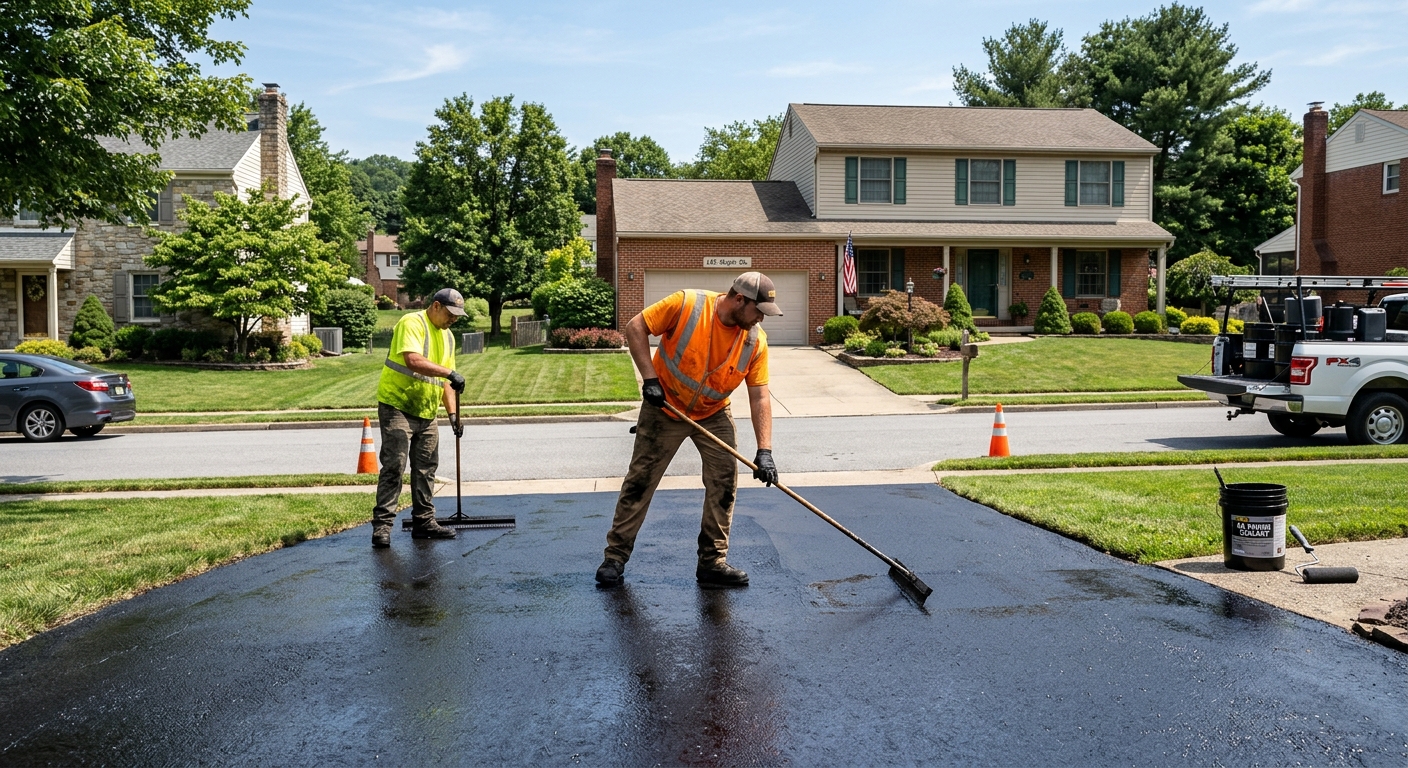
Springfield paving prices by scope — 2026
In Springfield, where 70.2% of homes are single-family and most are owner-occupied (80.7%), a driveway is a real investment and often a top exterior upgrade. Driveway paving costs here reflect two local realities: first, our moderate freeze-thaw winters and persistent humidity put pressure on every inch of pavement. Second, many Springfield driveways sit on glacial till or silty clay, which means thicker, better-prepared stone bases are standard—skimping there leads quickly to rutting and cracks. Most of what you pay for is below the surface and out of sight, even on a straightforward replacement. That’s why quotes can look wildly different: one may seem like a deal, but could hide shortcuts where you’ll pay in repairs three to five years down the road.
Wear and tear in Springfield come as much from the ground up as from the weather above. Freeze-thaw cycles move clay and silt, and a base that isn’t thick, well-compacted and properly drained won’t make it to ten years, regardless of what’s on top. Homeowners replacing original postwar driveways often find there’s no sense overlaying or coating failing pavements—a true fix usually means new stone. Below you’ll find realistic 2026 prices for a typical area driveway, drawing from what reputable Montgomery County contractors quote and using local materials to keep haul costs moderate.
| Service |
Best for |
Lifespan |
Price range |
| Asphalt — full replacement with new base |
failed base, structural cracking |
20–30 yrs |
$4,000–$10,000 |
| Asphalt overlay / resurfacing |
sound base, surface cracking only |
8–15 yrs |
$1,700–$5,100 |
| Sealcoating — single application |
preventive maintenance on sound asphalt |
2–4 yrs |
$225–$800 |
| Concrete — new installation |
long service life, low maintenance |
30–50 yrs |
$5,700–$13,500 |
| Crack filling and patching |
isolated cracks under a quarter inch |
1–3 yrs |
$200–$800 |
| Gravel driveway |
rural, budget, long runs |
5–10 yrs with upkeep |
$900–$3,500 |
Estimates for a typical Springfield driveway. Square footage and base condition drive these figures more than material choice.
Which surface survives Springfield winters
Springfield driveways take a beating from southeastern Pennsylvania’s freeze-thaw cycles and humid summers. When the ground freezes around 14 °F in winter, it moves—subgrade expands, contracts, and pushes against anything resting on top. Asphalt handles that shifting better than any rigid material. It flexes with the ground rather than snapping, so a basic asphalt drive can tolerate ground movement, making it a safe choice for homes on our clay-rich soils. It does, though, need regular sealing to keep water out.
Concrete lasts significantly longer when it’s kept dry and free of de-icer salt, but that’s rarely realistic here. In Montgomery County, road salt is a fact of winter life, and with over 80% of Springfield homes built before 1980, many drives already show salt-induced scaling and surface “spalling.” Concrete fails here mostly from salt—not cracking—unless you avoid using salt entirely. That’s a tough ask for most owners.
Paver driveways are a legitimate upgrade, especially when appearance and patching flexibility matter, though initial costs rival high-end concrete. Gravel is a viable low-cost choice for long rural drives, less so in suburban tracts, but it handles drainage and freeze-thaw with fewer problems than either asphalt or concrete.
| Option |
Installed cost |
Maintenance |
Freeze-thaw performance |
Lifespan |
| Asphalt — new install |
$4,000–$10,000 |
sealcoat every 3–4 yrs |
excellent, flexes |
20–30 yrs |
| Asphalt — overlay |
$1,700–$5,100 |
same |
good if base is sound |
+8–15 yrs |
| Concrete |
$5,700–$13,500 |
low, avoid de-icing salt |
fair, spalls with salt |
30–50 yrs |
| Pavers |
$9,100–$13,500 |
individual units replaceable |
good, settles gradually |
25–50 yrs |
| Gravel |
$900–$3,500 |
top-dress every 2–3 yrs |
excellent drainage |
indefinite with upkeep |
What's under the asphalt matters more than the asphalt
However you finish the surface, the layers beneath determine how long a Springfield driveway lasts. The typical build is: native subgrade (usually glacial till or silty clay in this part of Montgomery County), topped by four to eight inches of compacted crushed stone base, with asphalt or concrete on top. These layers exist for a reason—each one spreads load to the one below and protects it from water and frost.
Springfield’s moderate but persistent freeze-thaw cycles are the main threat. When water in the silty clay subgrade freezes, it expands upward, lifting and cracking pavement from below—a process called frost heave. Drainage is just as critical: if water gets trapped in or under the stone base, freeze-thaw cycles rip it apart even faster. Asphalt thickness alone can’t make up for poor prep below.
Most shortcuts on price come from invisible corners cut underground. Skipping base excavation, laying new pavement over a failed or soggy base, using less stone or cheap recycled material, or not compacting base or asphalt in lifts—these all save money up front, but the consequences show by year three in low spots, edge crumbling, or cracks that never seal. You’ll rarely see this the day the crew leaves—it’s baked into the earth itself.
If you want protection, your contract should specify: minimum four inches of compacted, clean 2A stone base for asphalt (six inches if you want to outlast your neighbors), tight subgrade compaction, and proof that compaction was done in lifts (not just at the end). Ask to have lift thickness and base stone type stated in writing—you’ll pay more, but it shows up every winter you don’t call in for repairs.
Maintenance that actually works
In Springfield, driveway longevity comes down to a few honest steps. First: crack filling before water gets beneath the surface is the best bang for your buck—it only takes one freeze-thaw cycle to turn an ignored hairline into a full-depth split. Keep driveway edges supported with soil or stone rather than letting them overhang and break off. Clear debris so water can flow off and away from the pavement, and keep grass trimmed back from edges to reduce moisture retention.
Avoid loading one spot with heavy weight—parking dumpsters or using jack stands on hot days dents asphalt and can break off corners in both surfaces. For new asphalt, let it cure at least four to six months before sealcoating, and avoid tight turning (like spinning wheels while stopped) during the first few weeks.
De-icing is a double-edged sword: salt eats concrete and ages even the best slab in Springfield’s humid, snowy winters, so alternatives like calcium magnesium acetate or clean sand are smarter choices, though pricier. On asphalt, the main risk is the water from melting and refreezing, not chemical attack. Here, keeping up on crack sealing makes more difference than a switch in ice melt.
What to put in a Springfield paving contract
Springfield homeowners get the best value not by chasing the lowest bid, but by pinning down exactly what they’re paying for. Here, our soils—glacial till and silty clay—expand and contract, and shallow bases don’t last. Ask every contractor for written specs, not just “three inches” or “lots of stone.” The distinction between “as laid” and “as compacted” thickness matters: hot asphalt compresses about 20–25% under rollers, so “three inches as laid” becomes just over two when finished.
Without clear specs on base depth, aggregate type, compaction method, lift thickness, and final asphalt depth as compacted, you’re blind to the cost-cutting that leads to failure. Good contracts here will always note a thicker-than-average base (because our frost depth is 30 inches), proper drainage slope, quality stone, and edge handling to stop cracks at the pavement’s weakest point.
- Excavation depth to reach stable subgrade (often at least 8–10 inches)
- Aggregate base: clean 2A modified stone, minimum 4 inches (6 preferred on clay)
- Base stone compacted in lifts, not just once at the end
- Asphalt binder course: 2–2.5 inches compacted
- Asphalt surface (wear) course: 1–1.5 inches compacted
- All asphalt thicknesses specified as “in-place” (after compaction)
- Mix designations for both binder and surface course (i.e., ID-2 or ID-3)
- Edge treatment (sloped asphalt or stone shoulders to prevent raveling)
- Surface drainage slope of at least 2%, away from structures
- Written warranty specifying coverage (typical one year, longer is rare but worth asking)
Driveway permits, approaches and stormwater rules
In much of Springfield and Montgomery County, routine resurfacing or sealcoating a driveway in its current footprint doesn’t require a building permit — for example, Lower Merion Township allows straightforward sealcoating without going through the permit office. However, when you replace, widen, or regrade a driveway in a way that changes the curb, sidewalk, or road apron, then municipal permission or even a street opening permit is typically required, as in Norristown.
The driveway approach, where your drive meets a township road, is regulated separately. In Montgomery Township, for example, you’ll need a road occupancy permit from the Public Works Department—not the usual building permit office. If you plan changes near the roadway, always check with township public works first to avoid surprise stop-work orders or retroactive fees.
Expanding your driveway (making it wider or longer) creates more impervious surface. This can trigger runoff requirements, especially if you’re redirecting water or increasing flow toward a neighbor. Rules are enforced by municipalities, but keep in mind: even if you squeak by permitting, you’re still liable if your project causes drainage problems next door.
For contractor verification in Pennsylvania, every project over $500 requires a written contract under the Home Improvement Consumer Protection Act. Before signing, check the contractor’s HIC registration at hic.attorneygeneral.gov and confirm valid workers’ compensation coverage through WCAIS (wcais.pa.gov).
When paving can actually be done in Springfield
Paving season in Springfield isn’t just a matter of preference—it’s decided by temperature and material supply. Hot-mix asphalt must be spread and compacted while still hot; below about 50 °F air temperature, it cools too fast and won’t compact correctly. Local asphalt plants along the I‑276 and US 202 corridors close for the winter, so from roughly mid-November through mid-March, you simply can’t get the material, and trying to install late or early risks a short-lived surface.
Concrete, meanwhile, needs air temperatures above freezing to cure safely. Our local winter design temperature is 14 °F, and with a frost depth of 30 inches, jobs that try to squeeze in too late may end up with surface scaling or frost damage before the first year is out—especially during a wet shoulder season.
Spring and fall are your sweet spots for scheduling: crews are less slammed than during the peak of summer, material is available from nearby plants, and the temperature is reliably in the right range for durable results. If a crew offers to pave your driveway in Springfield after Thanksgiving or before St. Patrick’s Day, be skeptical. Their standards—or their workload—may not line up with what you want for your home.
Frequently asked questions — driveway paving in Springfield
What causes driveway cracks in Springfield?
Most driveway cracks in Springfield come from the combined effects of ground movement and moisture—especially with our local silty clay and glacial till soils. During freeze-thaw cycles (when temperatures bounce around freezing), water captured under and within your driveway expands, lifting and stressing the pavement. Asphalt flexes some, but repeated heaving leads to alligator cracking or open seams, especially as water seeps into existing thin cracks and freezes again. For homes built before 1980, original driveway bases may also be too thin for today’s climate expectations, leading to rutting and edge breaks. That’s why it’s so important to address cracks early with crack filling, which here in Springfield typically runs $200–$800 and can add years to your surface.
Do I need an approach permit where my driveway meets the road?
Yes, in most of Montgomery County (including Springfield), the driveway approach—where your driveway meets the public roadway—is regulated separately from the rest of your driveway. For example, in Montgomery Township, the Public Works Department oversees these permits, called road occupancy permits. Even if you don’t need a building permit for repaving or basic repairs in your own yard, any change to the curb, apron, or tie-in with the street usually requires a separate permit. Failing to get it can mean fines or stop-work orders. This extra step usually adds a few hundred dollars to your project ($200–$800 for patching and small tie-ins), but saves headaches later.
Are pavers worth the cost in southeastern Pennsylvania?
Pavers are a premium driveway option in Springfield and the wider region—they look great, handle drainage well, and let you repair sections instead of tearing out the whole drive. Their installed cost rivals or exceeds concrete ($9,100–$13,500), but the value comes if you prize appearance or anticipate shifting soils (like our local glacial till). Pavers settle a bit over time, but unlike poured surfaces, they don’t crack in slabs. Most problems are edging or weeds, both easier to fix than a cracked asphalt or concrete slab. In older Springfield neighborhoods with mature trees, pavers can also handle root pressure without heaving the entire drive.
How far ahead should I book a paver in Springfield?
If you want the best crews in Springfield, aim to book at least two to three months in advance, especially for jobs from late spring through early fall. Paving crews here fill their calendars quickly once the plants open, especially in the peak stretch from May through September. Emergency jobs or simple patching ($200–$800) might be fitted in sooner, but complete installations or concrete work often back up for weeks at a time. Booking early lets you set the timing to fit your other exterior projects. Remember: anyone available next week for a large job in July or August is either canceling on another client or not in demand for a reason.
Does Springfield have local asphalt plants?
Yes, and that’s a real advantage for Springfield homeowners. Asphalt and aggregate are supplied from plants along the I‑276 and US 202 corridors, which keeps both material costs and quality control consistent for the area. Shorter haul distances matter: mix cools quickly, and nearby plants mean your driveway is paved with fresh, workable material—not reheated leftovers. With these plants so close, Springfield gets better value compared to outlying rural areas, and small jobs like overlays ($1,700–$5,100) are easier to schedule during the paving season.
Why are paving quotes in Springfield so different from each other?
The biggest difference in Springfield paving quotes is almost always what you can’t see: the amount and quality of base preparation. Some contractors skip deep excavation, use less or lower-quality stone, ignore compaction, or try to overlay new asphalt on a failing base. These shortcuts slash the upfront price but lead to rutting, frost heave, and cracks within a few winters—a particular risk here with our silty clay soils and freeze-thaw climate. A thorough full replacement should fall between $4,000–$10,000 for most Springfield driveways; if a bid is much lower, ask how deep they’re digging, what stone they’re using, and insist on compaction in lifts. Write these details into your contract so you don’t pay again in repairs.
What does an asphalt overlay cost in Springfield?
For Springfield homes with a structurally sound base, an asphalt overlay or resurfacing is a cost-effective fix—assuming the existing surface only has minor surface cracks or wear. In 2026, you can expect overlay prices between $1,700–$5,100 for a typical single-family driveway, with most landing around $3,400. Overlays save thousands compared to a full replacement but won’t solve issues like deep rutting or frost heave in a weak subgrade, which are common in older neighborhoods. Make sure any contractor inspects and approves the base before going this route.
What slope does a driveway need for drainage?
In Springfield, proper driveway drainage means a minimum slope of 2% (about a quarter inch per foot) away from your garage or house and toward the street or a swale. Our area gets significant summer storms and winter freeze-thaw conditions, so you don’t want water pooling by your house or under your driveway, where it can freeze and heave the surface. In planning or reviewing a new driveway project, check the contract for written drainage slopes, and make sure your paving crew builds in enough pitch. Good drainage dramatically increases the lifespan of both asphalt ($4,000–$10,000 for full replacement) and concrete ($5,700–$13,500) installations.
When can I seal a brand new asphalt driveway?
In Springfield’s climate, you should let new asphalt cure for at least four to six months before applying a sealcoat. Fresh asphalt needs time for excess oils to evaporate and for the surface to harden; sealing too soon locks in those oils, causing premature cracking and a soft, tire-marked finish. Paving early in the season lets you seal before winter, but if you pave after June, it’s usually smarter to wait until the following spring. Sealcoating runs $225–$800 and, timed right, extends the life of your driveway without trapping in moisture or softening the new surface.