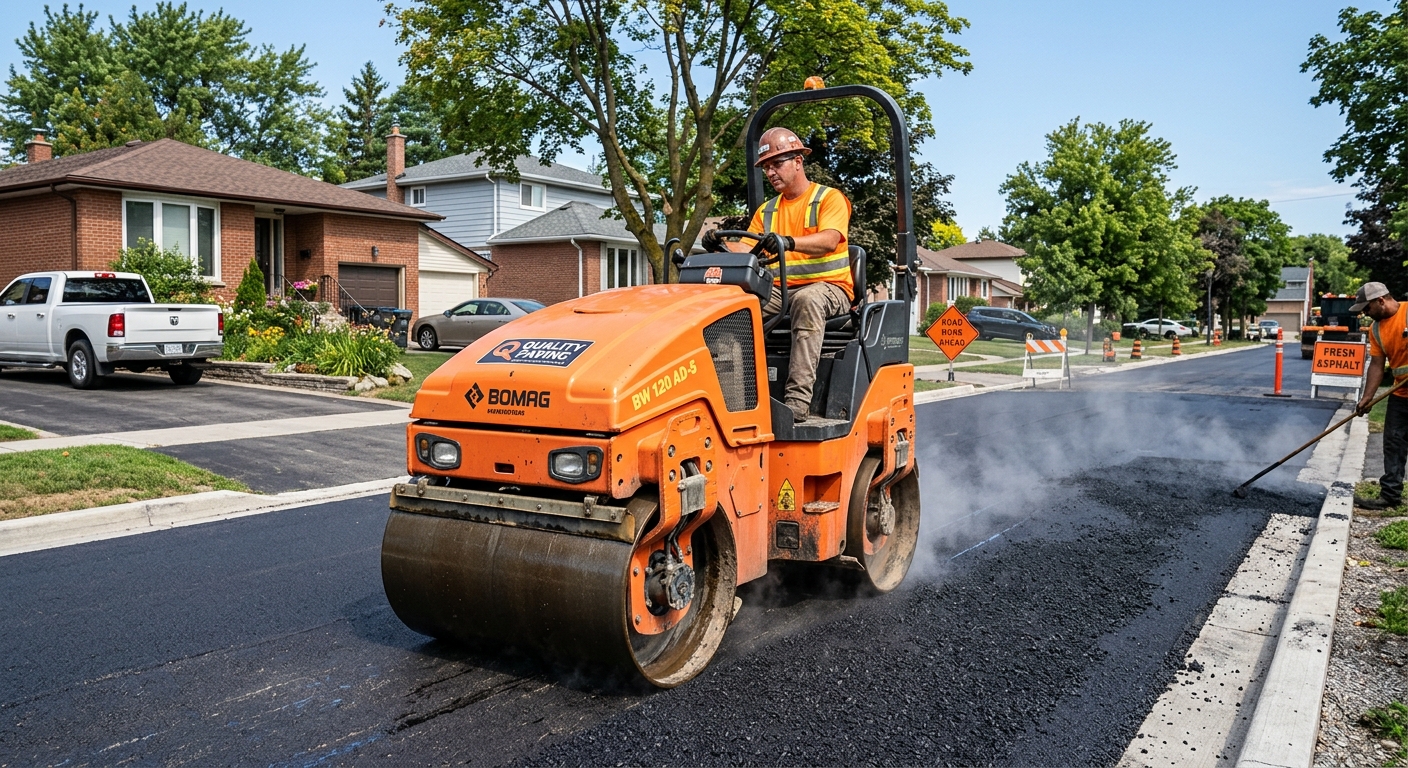
West Bradford paving prices by scope — 2026
In West Bradford, where 86.7% of homes are single-family and the homeownership rate runs an unusually high 96.0% (U.S. Census Bureau, ACS 2024), driveway paving is a common and recurring expense. The price of a new or restored driveway here reflects factors you can’t see from the curb—most notably the work done under the surface.
The humid summer and moderate freeze-thaw cycles in southeastern Pennsylvania, together with the local limestone and dolomite subgrades, are hard on driveway surfaces. Many installations dating from the 1960s–1980s are at the end of their service life, especially where the underlying base has settled or broken down over time. In Chester County, a proper base matters as much as the visible surface. One quote may be higher not because of a pricier material, but because it accounts for deep excavation, thicker aggregates, or more substantial drainage correction—or simply does the work right where others do not.
| Service |
Best for |
Lifespan |
Price range |
| Asphalt — full replacement with new base |
failed base, structural cracking |
20–30 yrs |
$4,400–$11,500 |
| Asphalt overlay / resurfacing |
sound base, surface cracking only |
8–15 yrs |
$1,900–$5,600 |
| Sealcoating — single application |
preventive maintenance on sound asphalt |
2–4 yrs |
$250–$900 |
| Concrete — new installation |
long service life, low maintenance |
30–50 yrs |
$6,300–$15,000 |
| Crack filling and patching |
isolated cracks under a quarter inch |
1–3 yrs |
$200–$800 |
| Gravel driveway |
rural, budget, long runs |
5–10 yrs with upkeep |
$900–$3,500 |
Estimates for a typical West Bradford driveway. Square footage and base condition drive these figures more than material choice.
Asphalt or concrete for a West Bradford driveway?
West Bradford driveways face the region’s moderate freeze-thaw cycles, with winter lows typically down to 14 °F. In this climate, asphalt and concrete perform very differently. Asphalt’s flexibility is a real advantage here. When temperatures drop and the ground shifts, the asphalt can flex ever so slightly, absorbing movement that would crack more rigid materials. Concrete is more rigid and will last much longer—sometimes up to 50 years—but its greatest weakness here in Chester County isn’t cracking, it’s the spalling and scaling caused by road salt. Most driveway failures in this area show up as chipping, flaking, and pitting in the surface, especially after aggressive de-icing.
The honest answer: concrete costs more going in, demands less regular maintenance, and can outlast asphalt—if you avoid de-icing salts entirely. The catch is that most homeowners do use salts, and nearly every Northeast concrete driveway will show damage eventually because of it. That’s not a knock on the material, just the reality of winter here. Asphalt requires intermittent sealcoating, but if it does crack or wear, repairs are simple and not glaring.
Pavers are a premium option—visually appealing, removable for underground work, and tolerant of imperfect subgrades. They do need periodic joint refilling and isolated resets where frost heave occurs. Gravel is still common for long rural drives in Chester County: lowest up-front cost, excellent drainage, but expect dust and ongoing grooming.
| Option |
Installed cost |
Maintenance |
Freeze-thaw performance |
Lifespan |
| Asphalt — new install |
$4,400–$11,500 |
sealcoat every 3–4 yrs |
excellent, flexes |
20–30 yrs |
| Asphalt — overlay |
$1,900–$5,600 |
same |
good if base is sound |
+8–15 yrs |
| Concrete |
$6,300–$15,000 |
low, avoid de-icing salt |
fair, spalls with salt |
30–50 yrs |
| Pavers |
$10,000–$15,000 |
individual units replaceable |
good, settles gradually |
25–50 yrs |
| Gravel |
$900–$3,500 |
top-dress every 2–3 yrs |
excellent drainage |
indefinite with upkeep |
Reading a driveway proposal
Comparing bids for a driveway in West Bradford only makes sense when every important detail is spelled out. Most of the cost is buried in what you never see: subsurface work, base material, and site prep. A real proposal should list square footage, note the depth of excavation and base, specify aggregate type and compaction, show thickness and number of asphalt courses, describe edge restraints and drainage management, and promise clean lawn edge restoration at the finish. Payment should be a modest deposit with the rest due on completion. Warranties should be short, clear, and state exactly what is covered—driveway warranties very often exclude most cracking, which is what homeowners assume is protected.
If a quote contains only a one-line total with no specifics, you cannot compare that to anything—and it’s the easiest way to end up overpaying for a rushed or underbuilt job. Details give you leverage, and a lack of detail is itself a red flag.
| Line item |
What to look for |
Red flag if… |
| Area |
measured square footage stated |
eyeballed or absent |
| Excavation |
depth and disposal included |
'we'll pave over it' |
| Base |
aggregate type and depth in inches |
'proper base' |
| Compaction |
method, and done in lifts |
not mentioned |
| Asphalt |
courses and compacted depth |
'3 inches' unqualified |
| Drainage |
slope and water direction stated |
silent |
| Warranty |
what is covered and what is excluded |
verbal only |
| Payment |
modest deposit, balance on completion |
full cash up front |
What you need before paving in West Bradford
Across much of Chester County, including most of West Bradford, repaving or resurfacing a driveway that stays within its original footprint and does not encroach onto the public road almost never requires a building permit. That saves homeowners a call to municipal offices, but there are exceptions if you’re expanding or paving into the township right-of-way. In North Coventry Township, for example, any work in the public right-of-way—including new driveway approaches or widening at the street—does require a driveway permit.
Where your driveway meets a state road, the permitting authority is PennDOT’s local Engineering District 6-0, not the township office. Neglecting this step can lead to a stop-work order or future headaches if you sell.
Changing your driveway so that more water runs onto a neighbor’s property, or into the street, can create liability—even if no permit is technically required. Expanding a driveway adds impervious surface, sometimes triggering stormwater management requirements in Chester County.
By law, any job over $500 requires a written contract under Pennsylvania’s Home Improvement Consumer Protection Act—waiving this is illegal. Contractors must be registered with the Office of Attorney General. You can verify at hic.attorneygeneral.gov. All employers must carry workers’ comp, verified via WCAIS (wcais.pa.gov).
How to tell if the base is gone
Your driveway’s base is its foundation. Knowing if it’s failed can save you from throwing good money after bad, or from being upsold on unnecessary work. Here are tells you can spot yourself: wide patches of alligator cracking—interconnected chunks, like the skin of a frozen lake—mean the base has completely failed. You can’t fix this with a patch or an overlay; only rebuilding the base solves it. Isolated, straight cracks, especially under a quarter inch wide, are just surface aging. Depression zones that pool water (so-called birdbaths) reflect movement or collapse below the surface. Edges that break away crumbly are lacking support or proper base width. Potholes, especially those returning after patching, confirm water has penetrated right down to the base layer.
A proper overlay is only justified when the existing base remains sound. Anyone quoting an overlay without probing the base—via core, dig, or a tamper test—is not serious about the work. Fixes that skip over deep flaws are always short-term and will cost more to undo.
| What you see |
Likely cause |
Right fix |
Cost |
| Isolated cracks under 1/4 inch |
surface aging |
crack fill and seal |
$250–$900 |
| Alligator cracking over a wide area |
base failure |
full replacement |
$4,400–$11,500 |
| Depressions holding water |
subgrade movement |
excavate and rebuild that area |
$4,400–$6,900 |
| Crumbling edges |
no edge support |
edge repair, consider curbing |
$400–$1,500 |
| Potholes |
water into the base |
full-depth patch, then assess |
$250–$900 |
| Faded but sound surface |
oxidation only |
sealcoat |
$250–$900 |
Why you can't pave in February
Every year in West Bradford, paving work comes to a standstill from late fall into early spring. That’s not just preference—it’s the reality of how hot-mix asphalt and concrete behave in this climate. Asphalt must be placed and compacted while hot; if air or ground temperatures are too low, it chills before crews can compress it fully, leaving a porous, short-lived finished product. Most Chester County asphalt plants close down entirely for the winter.
Concrete is equally sensitive. In cold weather, it cures slowly or not at all. Pouring over frozen ground traps frost, which expands and undermines the slab as soon as it thaws. The region’s winter design temperature of 14 °F and moderate freeze-thaw cycle mean that outdoor paving is limited almost entirely to April–November.
The practical upshot: early spring and late fall are when local schedule openings appear. Summer is peak season—everyone wants work done, and reputable crews get booked out fast. If you’re approached by anyone offering to lay asphalt in freezing conditions, they’re either cutting corners or desperate for work. Wait for proper weather. There is no substitute.
Why West Bradford driveways fail from the bottom up
Every driveway in West Bradford, from Exton to West Goshen and through the limestone-dominated soils of central Chester County, lives or dies by what happens underground. The standard build is: subgrade (the native soil), overlaid by compacted aggregate base (crushed stone, usually 4–8 inches here on limestone), then the asphalt lift or concrete slab. Each layer has a purpose—bearing weight, distributing load, draining water, and insulating the surface from seasonal movement.
Freeze-thaw cycles are the principal enemy. When water sits in the subgrade and freezes, it expands—lifting and cracking the finished driveway. This frost heave is especially common over limestone, where water finds pockets quickly. A thin, poorly compacted, or skipped base won’t protect your driveway. Nor will simply paving over an old, already-failed surface. For Chester County homes built before the 1980s boom, bases often need to be rebuilt, not just overlaid.
Here is where you see cheap quotes go bad: crews rush the site, barely skim the top, or dump thin layers of base rock and asphalt, compacting all at once or not at all. These shortcuts look fine for a season or two, but stripes, cracks, and trenches follow soon after. By year three, the differences in bids start to show.
For this market, ask for: at least 6–8 inches of compacted 2A modified aggregate base over limestone soils, compacted in lifts no thicker than 3–4 inches each. The base type and compacted thickness should be in writing, with the brand and plant location for the asphalt. If a contractor balks at these details or refuses to commit them to your contract, move on.
Frequently asked questions — driveway paving in West Bradford
Are pavers worth the cost in southeastern Pennsylvania?
Pavers have a high up-front cost—usually $10,000–$15,000 for most West Bradford driveways—but for some homeowners they’re worth every penny. Because pavers are individual units, if there’s movement—very possible here with our freeze-thaw cycles and limestone soils—you replace or reset only the affected area, not the whole surface. They drain well and don’t show spalling from salt like concrete. Their look can complement historic homes, which are common in Chester County, and they outperform both asphalt and concrete for repairs after utility work. Maintenance mostly means joint sand replacement and occasional resets. It’s a luxury option in this market, but when installed properly, pavers can last 25–50 years and keep their appearance through decades of Pennsylvania weather.
How much does it cost to widen a driveway?
Widening a driveway in West Bradford depends on how much area is being added, what type of surface you’re matching, and whether you’re expanding into the public right-of-way (which would trigger a separate permit in many Chester County townships). For asphalt, figure around $4,400–$11,500 for a full replacement if you’re redoing the entire surface, but many small widenings (just a few feet of new base and lane) run nearer the lower part of that range or can be added as a linear extension for $1,900–$5,600 if your existing base is solid. Remember: more paved surface may trigger township stormwater review. For concrete, expect costs on the higher end. The final price will depend on square footage and subgrade work required.
What are the signs of a failing driveway base?
Base failure shows itself in several ways even before you look under the surface. In West Bradford, where limestone and dolomite dominate, alligator cracking—interconnected cracks like a web over a wide area—is the classic sign. Depressions that hold water (“birdbaths”), repeated potholes, and crumbling at the edges all point to inadequate or exhausted base materials. If you’re seeing multiple areas go bad at once, and patching doesn’t hold up a full year, your base is likely shot. At that point, it no longer pays to try overlays or repeated patch jobs. You’ll almost always need a full-depth rebuild, which runs $4,400–$11,500 in this market. Surface cracks alone, under a quarter inch, don’t mean the base is failed—crack sealing and sealcoating are usually enough.
How far ahead should I book a paver in West Bradford?
For July or August work in West Bradford, it’s wise to contact quality paving contractors two to four months in advance. Summer is the peak for driveway work in Chester County and the whole region, since weather conditions are reliably warm and dry, asphalt plants are open, and many homeowners are trying to get jobs done before the school year. If you can be flexible into early spring or late fall (when the ground has fully thawed but plants haven’t closed), you may find schedule gaps with the better crews. Don't be lured by anyone promising a February installation—you’re almost always trading quality for speed in our climate. Prices don’t drop much mid-season, so plan with at least a quarter-year’s notice for asphalt replacement (typically $4,400–$11,500).
What is the difference between binder and surface course?
An asphalt driveway in Pennsylvania is usually built in two layers: a binder course and a surface (or wearing) course. The binder course is the structural layer—made with bigger, coarser aggregate for strength and flex. The top surface course uses smaller, finer stone for a smoother finish and weather resistance. In Chester County’s climate, you want at least 2–4 inches of binder and 1.5–2 inches of surface course compacted. Bargain quotes often skimp here, using a single thick layer, but this doesn’t perform as well against freeze-thaw cycles. For the price-conscious, a quality full replacement with both layers starts at $4,400–$11,500. Always ask your contractor to specify both layers (and thickness after compaction) in writing.
What does an asphalt overlay cost in West Bradford?
The cost for an asphalt overlay in West Bradford runs from $1,900–$5,600 as of the 2026 estimate. This assumes your existing base is still firm and unbroken—overlaying a failed base is asking for problems. The overlay is a fresh layer, typically 1.5 to 2 inches thick after compaction, placed over your existing driveway after cleaning and crack repair. Overlays work well when you have surface cracks and some fading but no birdbaths, widespread alligator cracks, or soft spots. If you have more extensive damage, you’ll need a full-depth replacement (up to $11,500), but the overlay option is a cost-effective choice for driveways with only surface wear, prolonging their useful life for another 8–15 years.
Does road salt damage driveways in West Bradford?
Yes, road salt is tough on driveways in West Bradford and the rest of Chester County. For concrete especially, salt accelerates spalling and causes the smooth, top layer to pit and flake—most failures I see in older local concrete are due to years of aggressive salting. Asphalt holds up better, though repeated freeze-thaw cycling with salt-laden runoff can open up cracks and potholes in time, costing $250–$900 per sealcoating or patch cycle. Pavers are best at resisting salt, and gravel doesn’t mind it, but both need edge maintenance after plowing. If you want your driveway to last, minimize salting, switch to calcium chloride, or use only sand/grit for traction where possible. Damage from salt is rarely covered under any paving warranty.
Do I need an approach permit where my driveway meets the road?
In Chester County, including West Bradford, you are required to get a permit when you’re doing any paving that alters the approach where your driveway meets a public road. This isn’t handled by your township—if your driveway connects to a state route, you’ll need a permit from PennDOT’s Engineering District 6-0. This applies even if you’re only resurfacing or expanding the apron. If your driveway only touches a township road and all work is within your lot, a permit is rarely needed. Ignoring approach permitting can lead to trouble with closings or later utility work. Fees are minor, but requirements must be met, especially for sight distances and stormwater runoff. Factor this into your project budgeting alongside paving costs of $1,900–$5,600 for overlays or more for full replacements.
How often should I sealcoat my driveway in West Bradford?
In West Bradford’s climate, you should plan to sealcoat a new or nearly new asphalt driveway every 3–4 years. The region’s moderate freeze-thaw cycles and humid summers gradually oxidize the asphalt, making it more susceptible to cracking and water infiltration. Sealcoating forms a barrier against moisture and salt, helping preserve flexibility and color. Going longer between coats isn’t fatal, but the surface will fade and lose resilience faster. For most Chester County homes, a sealcoating run costs $250–$900 depending on driveway size. If your surface is already showing deep cracks or birdbaths, sealcoating alone won’t solve underlying problems—those situations call for repairs or full resurfacing. Good maintenance can stretch the useful life of an asphalt drive by several years.