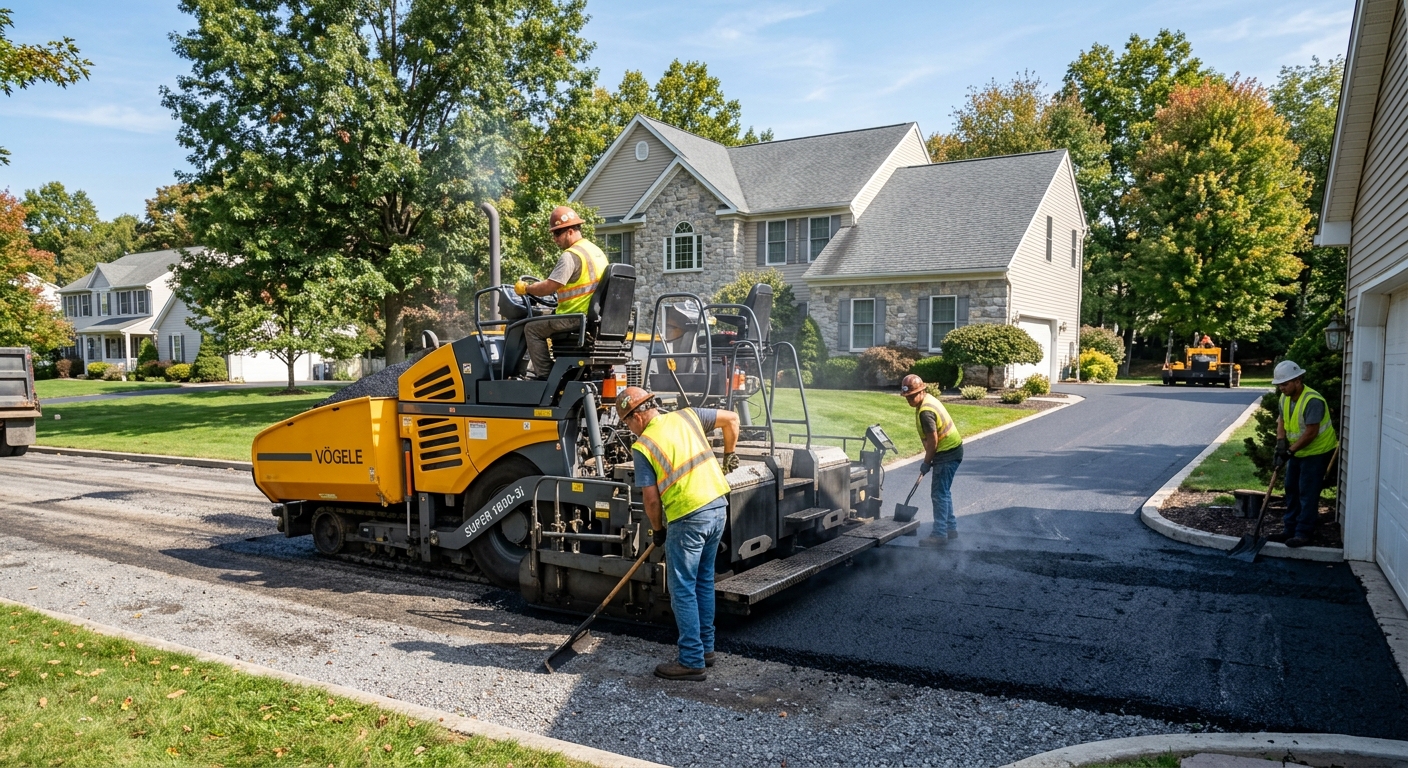
Driveway paving costs in Altoona — 2026
In Altoona, where 73.4% of homes are single-family houses and 65.5% of residents own their homes (U.S. Census Bureau, ACS 2024), driveway paving is one of the bigger property investments most owners face. Pricing here for asphalt and concrete work is shaped by the local climate—our winters push freeze-thaw cycles hard, and hillside lots around Altoona and Hollidaysburg give up plenty of work for the regrading crew. The underlying geology matters too: much of Blair County sits on limestone and shale, which means some driveways need extra attention to underdrains and thicker aggregate bases to avoid future settlement.
The most important thing to keep in mind is this: For any driveway paving job, most of the price difference between contractors is locked in below the surface. You rarely see where the money went until year three or four. Some quotes leave out proper base work, compaction, or drainage, pushing costs down now and pain up later. Here’s what the real range looks like for a typical residential job in Altoona:
| Service |
Best for |
Lifespan |
Price range |
| Asphalt — full replacement with new base |
failed base, structural cracking |
20–30 yrs |
$3,100–$8,100 |
| Asphalt overlay / resurfacing |
sound base, surface cracking only |
8–15 yrs |
$1,350–$4,000 |
| Sealcoating — single application |
preventive maintenance on sound asphalt |
2–4 yrs |
$175–$650 |
| Concrete — new installation |
long service life, low maintenance |
30–50 yrs |
$4,500–$10,500 |
| Crack filling and patching |
isolated cracks under a quarter inch |
1–3 yrs |
$200–$800 |
| Gravel driveway |
rural, budget, long runs |
5–10 yrs with upkeep |
$900–$3,500 |
Estimates for a typical Altoona driveway. Square footage and base condition drive these figures more than material choice.
When paving can actually be done in Altoona
North-central Pennsylvania’s paving season is dictated by cold temperatures and how fast the weather can change. Hot-mix asphalt must be spread and compacted before it loses too much heat. Once ambient or ground temperatures fall below about 45°F, and especially when air dips near our winter design temperature of 2°F, there’s no way to get the mix down tight—it chills too fast, which leaves you with air pockets and a surface that will scale and ravel by its first spring.
Local asphalt plants around Altoona and Duncansville actually shut down in winter, so hot-mix material simply isn’t available from roughly mid-November until March. Even concrete driveways have a cutoff; concrete won’t cure right when it’s freezing, and overnight lows often dip well below freezing here for long stretches. Attempting a pour “before the snow flies” usually translates to cold joints and future cracking.
Best practice in Blair County is to target paving between late April and early October. Shoulder seasons—April/May and September/early October—are where you’ll get better crew availability, and sometimes better pricing. Summer, on the other hand, is the busiest: nearly every reputable crew will be booked out. If someone is offering to pave in late November in this climate, it either means they’re ignoring best practices or they are in desperate need of work. That’s almost never the contractor you want on your property.
Choosing a paving company
In Altoona, hiring a driveway paving contractor takes more than just picking the lowest bid. The best sign is a business with a physical address in Blair County—one you can check—and not just a pickup truck with temporary plates. Paving requires specialized equipment, and anyone in this region who’s been doing the work a while will own their own rollers, skid steers, and compactors. Renting it all means they’re in this part-time.
Ask about jobs completed at least three years ago—new driveways all look fine, but you want to know how their old work is holding up to Blair County’s heavy freeze-thaw and the hillside soils around Altoona and Hollidaysburg. Any reputable contractor should easily tell you which Altoona or Duncansville asphalt plant supplies their mix. If they can’t name it, odds are you’re dealing with a broker, not a builder.
- Check for registration with Pennsylvania’s HIC system (hic.attorneygeneral.gov).
- Verify workers’ compensation coverage through WCAIS (wcais.pa.gov).
- Ask for a local business address, not just a cell phone number.
- Find out which asphalt or aggregate plant they use around Altoona or Duncansville.
- Request three references from jobs at least three years old in Blair County.
- Make sure heavy equipment is owned, not rented for the week.
- See their written contract; required by Pennsylvania law over $500.
- Never pay more than a small deposit upfront (rarely over 33%).
- Look for clear details on base depth, compaction, and drainage work in the proposal.
- Confirm proper insurance; no coverage means no go.
- Ask who will supervise the job—someone accountable should be onsite.
Red flags: refusing written references, high-pressure sales, door-to-door “leftover asphalt” offers, and no business address in Blair County. If the deal sounds too good for this market, assume the job will be, too.
Why Altoona driveways fail from the bottom up
Every driveway in Altoona is only as strong as what’s beneath it. The build is layered: the undisturbed soil (subgrade), a compacted crushed stone base, then a couple of inches of pavement—usually asphalt here. The point of the stone base is to transfer the weight of cars down and out into the soil. But if you skip or shortcut any of that, your asphalt will flex and crack with every freeze-thaw cycle, or settle into ruts you can’t patch away.
Around Hollidaysburg, a lot of driveways sit on limestone or shale subgrade. These soils drain faster than heavy clay, but in the hillier areas where depth isn’t managed and drains aren’t installed, you can get pockets of wet soil that turn soft in spring—or worse, collect water that freezes and “heaves” the driveway. When water in the ground freezes, its volume increases by about 9%, lifting sections of slab and forcing cracks from below. That’s why 36-inch base depth figures—matching our frost line—matter, not just as a number, but as insurance.
A cheap quote here often means corners cut where you can’t see it: shallow excavation, undercutting the aggregate base (using 4 inches or less instead of the 8–12 inches often needed here), loose compaction, or laying new asphalt over a base that’s already failed. In Blair County, that shows in heaving, sinking, and “alligator” cracking once the third winter rolls through.
Insist the contract spells out: at least 8 inches of compacted aggregate base (often 2A modified stone from Altoona or Duncansville plants), that it’s compacted in lifts (not just top-layer tamped), and proof of compaction before paving. For concrete, the recommendations are similar: don’t skip the crush-run stone base or cut corners on rebar.
Driveway permits, approaches and stormwater rules
In Altoona, repaving an existing driveway—so long as you’re not widening it or changing where it meets the street—usually doesn’t require a building permit. That’s a welcome break for most homeowners. But if you do widen, reconstruct, or otherwise change the driveway’s access to a public road, you’ll need to go through the Altoona City Codes Department for a local paving or occupancy permit. Out in Logan Township, minor patching jobs rarely trigger a driveway paving permit at all.
Take note: If your driveway ties into a state road (like U.S. 220 near Hollidaysburg), the approach itself falls under PennDOT District 9, not just your local borough. For regular subdivision streets, permits are typically local. This is where many homeowners get tripped up—the permit is about traffic and runoff at the street, not what you do at your garage.
Whenever adding pavement or expanding impervious surfaces, be mindful that Altoona and outlying Blair County areas may enforce stormwater regulations if you increase runoff toward drains, hillsides, or neighboring properties. Even if you technically have a permit, pushing water onto your neighbor’s land leaves you liable for resulting damages.
Before hiring any paving contractor, verify their Home Improvement Contractor registration at hic.attorneygeneral.gov, and workers’ compensation compliance using WCAIS (wcais.pa.gov). Both are required for your legal protection.
Drainage: the failure nobody plans for
Water is the enemy, and in Altoona’s driveway market, poor drainage is the invisible killer. A driveway should slope away from the house and garage, ideally at a minimum rate of 2% (a quarter inch per foot). Crowning—raising the centerline slightly above the edges—lets water shed both directions, but some hillside lots in Altoona and Hollidaysburg need a controlled cross-slope instead.
If your driveway slopes towards the house, it’s almost guaranteed to deliver water to your garage or foundation. Where you can’t change the grade, trench or channel drains paired with solid piping to daylight or a dry well are the fix. Around Blair County, especially where limestone and shale subgrade is present, water escaping the driveway base is vital—a base that holds water will freeze and heave more dramatically than a well-drained one.
That’s why drainage should be called out explicitly in the contractor’s plan, not just a “detail” left to the end of the job. Once water seeps into small surface cracks, freeze-thaw cycles expand those cracks from below, eventually turning a minor flaw into a structural failure. Letting runoff discharge into the neighbor’s yard—no matter what your own property’s permit says—can land you in civil hot water and court.
Even a basic job deserves a clear, written drainage plan. Done right, you’ll go decades before needing another major repair.
Maintenance that actually works
Pavement lasts in Altoona if you keep water and debris from finding a way beneath it. The first priority is sealing cracks before water can undermine the base, especially with repeated freeze-thaw cycles in Blair County’s long winters. Keep your driveway edges supported—once they erode, the pavement unravels quickly.
Do not let water pool anywhere. Clear drains and gutters, and direct downspout runoff away from the pavement. If you must place dumpsters or jack stands, always use plywood or pads beneath them—point loads deform hot asphalt and can even crack new concrete.
On brand new asphalt, wait at least three full days in summer before parking, longer if it’s cooler out. Never turn wheels while the car is stationary on warm, uncured asphalt; it shears the surface.
When it comes to de-icing, rock salt degrades concrete, causing pitting and flaking in just a few seasons. On asphalt, the problem isn’t chemical, but physical: meltwater penetrates, refreezes at night, and expands those cracks. Sand, calcium magnesium acetate, or even using less aggressive traction instead of melting every snowstorm will prolong life, though these options cost more.
In Altoona’s climate, maintenance isn’t optional if you want your driveway to last anywhere near 20–30 years.
Frequently asked questions — driveway paving in Altoona
What slope does a driveway need for drainage?
In Altoona and the rest of Blair County, the recommended minimum for driveway slope is 2%—that’s about a quarter inch of drop per foot of run. This keeps water from collecting on your pavement, which is critical in our climate where freeze-thaw cycles can quickly turn standing water into cracks and potholes. Some hillier parts of Hollidaysburg or around Logan Township demand even steeper slopes or a combination of crowning and cross-slope so water gets off the drive and away from your foundation. If your crew is resurfacing, insist they check and document grade. Proper slope minimizes standing water and can add years to a driveway’s life—enough to offset the cost of a $1,350–$4,000 overlay.
Why are my driveway edges crumbling?
Edge breakdown is one of the most common driveway problems in Altoona, especially with our freeze-thaw cycles and the hilly topography. The usual cause is lack of lateral support: when aggregate base or soil at the edges isn’t compacted well or erodes away—often from runoff or vehicles parking right at the edge—the asphalt or concrete loses its support and breaks off. In Blair County, where limestone and shale are common, base failures show up first at the edges. Prevent this by never driving or parking on the unpaved sides. Rebuilding edges with proper base and compacting, followed by a patch or overlay (sometimes just $200–$800 for smaller fixes), is often needed to restore integrity.
How much does a concrete driveway cost in Altoona?
A new concrete driveway in Altoona generally runs between $4,500–$10,500 for typical residential sizes, with the average homeowner investing around $7,200. Costs here are shaped partly by the need for thicker aggregate bases on Blair County’s limestone and shale soils, and the higher labor to regrade hillside lots—especially if there are drainage concerns or you’re replacing an older slab. Finishes and decorative work (like colored or stamped patterns) add more. Get bids that spell out stone base thickness (usually 6–8 inches here) and reinforcement. Concrete gives 30–50 years of service with routine joint sealing, making it a solid investment for Altoona’s single-family homes.
Can asphalt be laid in cold weather?
Asphalt paving in Altoona stops for the winter each year. Our local asphalt plants close once daytime temperatures consistently drop below 45°F, usually from mid-November until March. Below this, the mix loses heat too fast and can’t compact correctly, leading to porous, short-lived surfaces—the freeze-thaw cycles then finish the job. Crews promising to pave outside the April–October window are not giving you a long-lasting job. Wait for the right season; otherwise, you’re wasting money on a $3,100–$8,100 replacement long before you should have to.
Are door-to-door pavers a problem in Altoona?
Yes, Altoona and surrounding Blair County are not immune to door-to-door paving scams, especially from crews promising steep discounts for “leftover asphalt.” Local legitimate contractors are busy enough in-season and rarely go door-to-door. The risks: improper base work, low-quality hot-mix, little to no compaction, or no contract at all. If you let one of these outfits work, odds are you’ll need a full redo within a few years—meaning a real $3,100–$8,100 replacement instead of just a simple fix. Always verify HIC registration and business address before agreeing to anything.
What is the difference between crack filling and sealcoating?
Crack filling targets individual cracks—usually those under a quarter inch wide—using flexible sealant that keeps water from infiltrating the base. Sealcoating is a thin surface treatment brushed or sprayed over the whole drive; it protects against UV and surface oxidation but doesn’t fix cracks beneath. In Altoona’s climate, crack filling comes first: unaddressed cracks let water in, and our freeze-thaw cycles turn them into serious structural problems. Sealcoating is useful as preventive maintenance every 2–4 years (about $175–$650 per visit), but never skips crack repair or replaces it.
How do I verify a paving contractor in Pennsylvania?
For Altoona and all of Pennsylvania, start by confirming that the contractor holds a Home Improvement Contractor registration—searchable at hic.attorneygeneral.gov. This registry shows status, business address, and complaint history. For any crew with employees, verify workers’ compensation through WCAIS (wcais.pa.gov). Always ask for references you can visit, ideally jobs more than three years old on Blair County soil. Avoid anyone unable to say which local Altoona or Duncansville plant supplies their asphalt. Solid vetting now can be the difference between years of trouble-free use and a premature $3,100–$8,100 replacement.
What does an asphalt overlay cost in Altoona?
An asphalt overlay in Altoona costs between $1,350–$4,000 for most single-family driveways. The lower end applies to short, easy jobs with a sound base, while larger or more complex layouts (like long, curved, or steep drives) cost more, especially if you need spot base repairs. An overlay is only suitable if the existing base is stable and cracks are less than a quarter inch deep. If your old drive has a soft or repeatedly patched base, you’ll need a full replacement instead. Always get a written proposal that details thickness (typically 1.5–2 inches here) and explains how transitions to the street or garage will be handled.
Are pavers worth the cost in north-central Pennsylvania?
Paver driveways offer unmatched appearance and, when laid correctly, excellent durability. However, in Altoona and the rest of north-central Pennsylvania, they’re rare for a reason. Materials and installation are substantially higher than even premium concrete (often several times the $4,500–$10,500 concrete driveway range), and pavers on a hillside or the limestone/shale soils we see near Hollidaysburg need painstaking base preparation to avoid shifting and frost heave. For most homes here, asphalt or concrete is the practical long-term bet. However, if aesthetics are your priority and you’re willing to invest in a deeply excavated, properly drained base, pavers can last decades. Just be ready for the price tag and the reality of periodic joint maintenance in our climate.