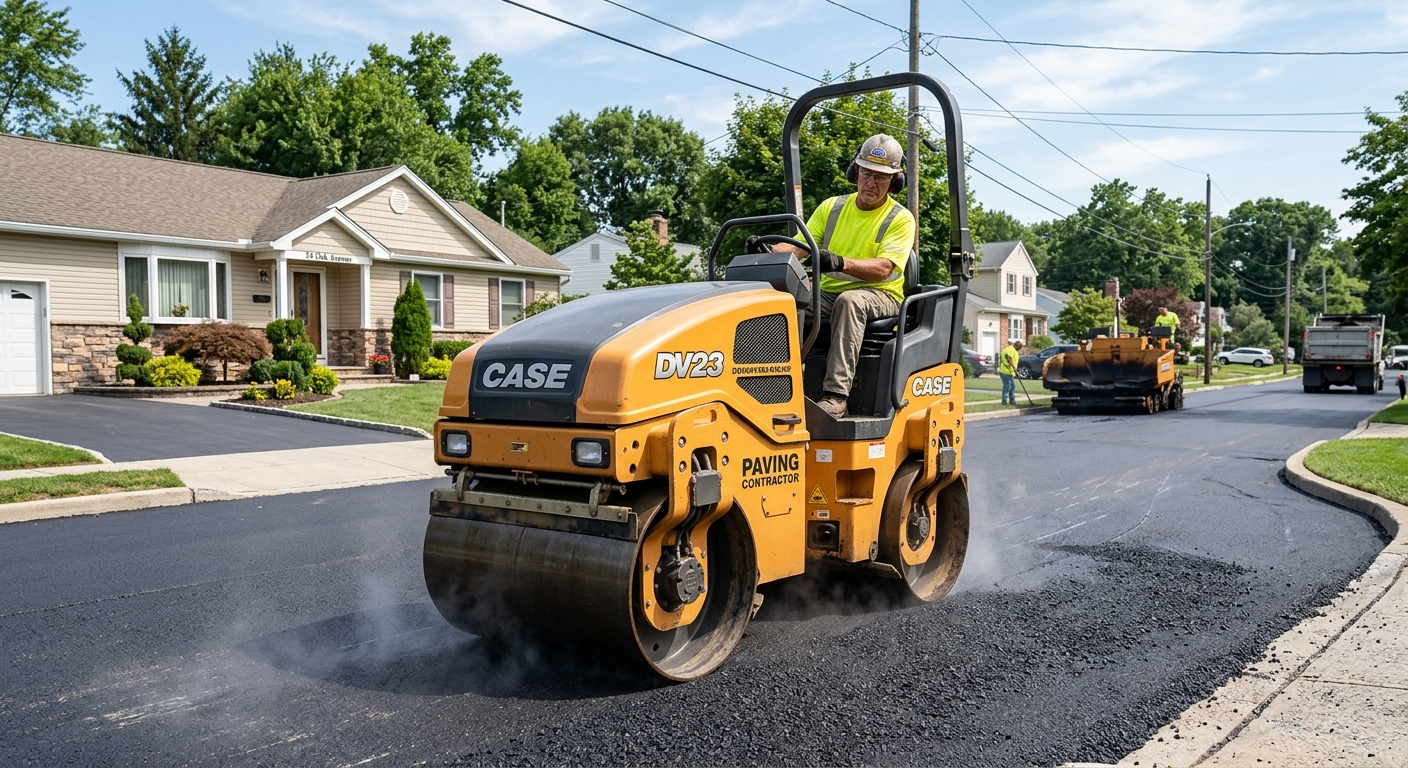
Westtown paving prices by scope — 2026
Westtown’s driveways mostly serve single-family homes—over 70% of all homes here (U.S. Census Bureau, ACS 2024)—with an owner-occupancy rate near 81%. That makes driveways a common homeowner expense, especially as properties built in the 1960s–1980s reach the end of their first driveway’s useful life.
With Chester County’s moderate freeze-thaw cycles each winter, and local soils often set over limestone and dolomite, what you don’t see under the pavement matters as much as the surface itself. Most of the price difference between competing quotes for the same driveway will come from the work below the surface: aggregate depth, base compaction, drainage correction, and prep. A cheap job can look fine for a year and then break up because it skipped base work invisible to the owner. When comparing prices, assume that the lowest bid cut corners on the foundation, not just finish work.
| Service |
Best for |
Lifespan |
Price range |
| Asphalt — full replacement with new base |
failed base, structural cracking |
20–30 yrs |
$4,100–$10,500 |
| Asphalt overlay / resurfacing |
sound base, surface cracking only |
8–15 yrs |
$1,750–$5,300 |
| Sealcoating — single application |
preventive maintenance on sound asphalt |
2–4 yrs |
$225–$800 |
| Concrete — new installation |
long service life, low maintenance |
30–50 yrs |
$5,800–$14,000 |
| Crack filling and patching |
isolated cracks under a quarter inch |
1–3 yrs |
$200–$800 |
| Gravel driveway |
rural, budget, long runs |
5–10 yrs with upkeep |
$900–$3,500 |
Estimates for a typical Westtown driveway. Square footage and base condition drive these figures more than material choice.
Widening, extending or adding a parking pad
Adding width for a second car, extending toward a garage or barn, or putting in a turnaround or parking pad changes more than just the look of your Westtown driveway. Anytime you want to increase the paved footprint, you’re dealing with undisturbed subgrade—meaning a new aggregate base must be installed and properly compacted from scratch. That seam between old and new will always be a long-term weak point; it’s less forgiving than a straightforward overlay or replacement in the original footprint, and preparation is everything if you want it to match in function and appearance.
Townships across Chester County may restrict how close to the property line you can put new pavement, and there are often impervious-surface ratios written into zoning rules to help manage stormwater. If your driveway extension drains toward the street or a neighboring yard, that can create water problems or even legal liability, regardless of permit status.
If your plans touch the public right-of-way—such as adding a new apron or changing where the drive meets the street—a driveway permit is required in some townships. Where the driveway meets a state road, you’ll need a Highway Occupancy driveway approach permit from PennDOT Engineering District 6-0. All told, widening or adding parking means careful planning and sometimes more red tape than a straight replacement.
Local soil, drainage and driveway lifespan
The backbone under most driveways in central Chester County, including Westtown, is limestone and dolomite bedrock. That makes settlement and reflective cracking a legitimate long-term concern—limestone soils settle differently than the clay or glacial tills common further north or west. A proper driveway base here often needs to be thicker than elsewhere, with a well-compacted subbase to prevent voids and shifting as the years pass.
Add to that a frost depth of 30 inches and annual freeze-thaw cycles, and you see why so many driveways built during the big Exton and West Goshen expansions (1960s–1980s) are now ready for full-depth replacement. Many of those old driveways weren’t built with much attention to base prep, especially in large subdivisions—a shallow stone bed or uneven compaction means surface patching and overlays won’t last. Water finds any weakness, and limestone’s natural drainage can be defeated by poor grading or clogged edges, leading to potholes and edge breakup.
Modern replacements in Westtown almost always include a heavier stone base, careful grading for positive drainage, and sometimes even underdrains if seepage is persistent. Doing this right stretches the lifespan of your investment by a decade or more, and protects you from the slow, uneven settlement that plagues driveways laid too close to the natural surface.
Driveway permits, approaches and stormwater rules
In much of Chester County, including Westtown’s surrounding townships, most homeowners do not need a building permit to resurface or replace a driveway that stays entirely within their lot and outside the road right-of-way. This is a real advantage—there’s no paperwork or approval process for an interior resurfacing, saving both time and permitting costs.
However, the situation changes at the driveway approach—the junction with the street. Work in that area, or any driveway connecting to a state road, generally does require a permit. In Chester County, driveway approaches onto state roads must be permitted through PennDOT Engineering District 6-0’s Highway Occupancy program. For local roads, check the township code office; North Coventry Township, for example, requires a permit even for repaving within the public right-of-way. Always verify which authority covers your street before any curb or apron work.
When adding pavement—widening, extending, or adding a pad—impervious surface counts increase, sometimes triggering township stormwater regulations, which may require on-site infiltration or special grading. Regardless of township rules, channeling runoff from your new pavement onto a neighbor’s property can create a civil liability. Drain it with care.
For your protection, Pennsylvania requires any paving contract over $500 to be in writing, and all contractors must have valid HIC registration through the Attorney General’s site (hic.attorneygeneral.gov). Employers must also carry workers’ compensation insurance, verifiable via WCAIS (wcais.pa.gov).
Which surface survives Westtown winters
In Westtown, winter brings moderate freeze-thaw cycles—design temperature is 14 °F, frost depth 30 inches, and humid summers don’t help. Asphalt and concrete both have their place, but they live and fail differently in this climate.
Asphalt is flexible. It handles the seasonal flexing of our limestone-based soils, yielding without cracking as the ground moves. That flexibility means asphalt is likely to last its full 20–30 years if built on a solid base and resealed every 3–4 years. When the base is sound, even an overlay can deliver 8–15 years of life for less upfront cost.
Concrete lasts longer when it holds up—30–50 years isn’t unusual—but it’s stiff and unforgiving. In this region, concrete’s weak spot isn’t cracking from freeze-thaw cycles, but spalling and scaling when exposed to de-icing salts. If you (or people plowing for you) sometimes use salt-based de-icers, know that concrete may look rough within a few winters, compromising long-term value. The honest answer: concrete suits those willing to avoid salt. Most owners don’t manage that every winter.
Pavers can work, but installation cost is high and settling can occur if the base prep is second-rate. Gravel remains a smart, low-cost choice for rural runs, with minimal drainage hassles and indefinite life if you’re willing to re-dress it every few years.
| Option |
Installed cost |
Maintenance |
Freeze-thaw performance |
Lifespan |
| Asphalt — new install |
$4,100–$10,500 |
sealcoat every 3–4 yrs |
excellent, flexes |
20–30 yrs |
| Asphalt — overlay |
$1,750–$5,300 |
same |
good if base is sound |
+8–15 yrs |
| Concrete |
$5,800–$14,000 |
low, avoid de-icing salt |
fair, spalls with salt |
30–50 yrs |
| Pavers |
$9,400–$14,000 |
individual units replaceable |
good, settles gradually |
25–50 yrs |
| Gravel |
$900–$3,500 |
top-dress every 2–3 yrs |
excellent drainage |
indefinite with upkeep |
Finding a legitimate paver in Chester County
In Chester County’s dense market, every contractor must carry a Home Improvement Contractor (HIC) registration from the Pennsylvania Office of Attorney General—verify at hic.attorneygeneral.gov. But that’s just the floor, not the ceiling. A trustworthy paver will have a fixed business address, not just a mobile number, and can name the local quarry or asphalt plant they actually buy from. Thanks to the concentration of plants near Downingtown and Coatesville, any legitimate local will have a real, working relationship with a supplier. If a paver can’t tell you where they’re buying hot mix or stone, they’re a broker or a middleman.
Driveways built to last require owned equipment, not rental hand tools, and the only references that count are from installations that have survived several winters—three years old or more. Make sure references are real, from within Chester County, and the work matches what you’re hiring for.
- Check HIC registration at hic.attorneygeneral.gov
- Verify workers’ compensation at wcais.pa.gov
- Ask about insurance—get a certificate, not a promise
- Require a permanent, local business address
- See photos or visit jobs done 3+ years ago locally
- Ask which Downingtown or Coatesville plant supplies their materials
- Check for owned equipment (not just truck rental)
- Get a written, line-item contract as required by HICPA
- Ask about base prep and how thick the stone layer will be
- Do not hire anyone just knocking on doors after a storm
- Ensure clear schedule, start/finish dates, and payment terms
- Avoid “out-of-state crews” that can’t offer real references nearby
Red flags: unregistered crews, cash-only deals, claiming no insurance needed, refusing to name suppliers, or offering discounts for “today only.” In Westtown, legitimate paving doesn’t require urgency or secrecy.
Why you can't pave in February
Paving in Westtown follows the seasons. It’s not just a preference—local hot-mix asphalt plants close completely through the winter, and the material is literally unavailable from late November into spring. Even if you had a source, asphalt cools too quickly in cold air, and can’t compact or bond to the base properly below about 50 °F. Any “deal” to pave in February or during a freeze is a guaranteed shortcut on quality, and you’ll see that failure within a year.
Concrete is also ruled by the thermometer. For a proper cure, concrete installation demands consistently above-freezing air and ground temperatures. Chester County’s typical winter design temp is 14 °F, so neither asphalt nor concrete will survive installation in our coldest months without special (and rarely successful) measures.
With several quarries and plants near Downingtown and Coatesville, material supply isn’t a problem—except when the plants are shut for the season. The practical paving window for quality asphalt work here runs from April through October, peaking in the dry, warm stretch of summer. Shoulder seasons (late spring/early fall) have slightly more crew availability, and may offer better pricing than the height of summer when paving calendars are loaded.
If a crew offers to pave late in the year, ask them what plant they’re buying from after November—if their answer is vague, move on. Good work waits for the right season and the right materials.
Frequently asked questions — driveway paving in Westtown
What slope does a driveway need for drainage?
You want a minimum slope of 2% (about a quarter inch per foot) for proper drainage away from your garage and foundation—especially with limestone soils in Westtown, which can settle unevenly over time. On too shallow a slope, water will pool and find even the smallest crack, speeding up freeze-thaw damage and shortening lifespan. For a typical single-family driveway here, correcting poor slope often requires not just new asphalt or concrete but regrading the base itself, which can move your cost into the $4,100–$10,500 range for replacement. Always confirm that a contractor is checking existing grades before quoting: a cosmetic overlay over a low-spot is money wasted.
When is the best time of year to pave in Westtown?
The optimal time to pave in Westtown is from April through October, when both the air and ground temperatures stay reliably above 50 °F. Local asphalt plants near Downingtown and Coatesville only operate seasonally, matching when paving can be done to a high standard. Scheduling in the shoulder months—April, May, September, or October—sometimes yields the best prices and availability. Trying to pave outside these windows almost always ends up with a poor bond and faster failures, regardless of whether you’re installing new asphalt (costing $4,100–$10,500) or resurfacing. Good contractors simply won’t take the risk of working in winter conditions here, and you shouldn’t either.
Are pavers worth the cost in southeastern Pennsylvania?
Pavers offer visual appeal and spot-repair flexibility, but in Westtown’s climate and with typical limestone soils, their value is mixed. The up-front cost for pavers is steep—typically $9,400–$14,000. When installed over a high-quality, well-compacted base, they handle freeze-thaw cycles well and can last decades. However, many paver jobs in southeastern Pennsylvania fail prematurely because installers rush the base prep, leading to settling and weed growth. For owners willing to budget for proper installation and some yearly maintenance, pavers can be a long-term solution. But the price isn’t justified unless appearance or drainage specific to your home demands it.
What are the signs of a failing driveway base?
If your driveway in Westtown is showing deep alligator cracking, frequent new potholes, or sunken areas that don’t bounce back after rain, you’re likely dealing with a failing base—not just superficial age. On limestone soils, base failure often appears as long, reflective cracks or sags where settling has occurred. Water sitting in these depressions over winter vastly accelerates surface breakup. Patching or filling cracks may buy you a season or two ($200–$800), but persistent symptoms mean it’s time for a full-depth replacement to avoid throwing more money at fixes with diminishing returns.
Does road salt damage driveways in Westtown?
Yes—road salt significantly impacts both concrete and, to a lesser extent, asphalt driveways in Westtown and the rest of southeastern Pennsylvania. Salt accelerates spalling and surface scaling in concrete, often shortening its lifespan by years. Even asphalt can age faster if salt-laden runoff isn’t quickly drained away, especially over limestone, which won’t buffer freeze-thaw cycling as well as sandier soils. Concrete owners should avoid salt-based de-icers and use sand or magnesium alternatives. Still, if you plan to use de-icers every winter, it may make more sense to invest in high-quality asphalt ($4,100–$10,500 for new installation) with regular sealcoating than concrete, which will show salt damage visibly.
Can I cancel a paving contract I signed at my door?
Absolutely. In Pennsylvania, any home improvement contract over $500—paving included—must be in writing and include a consumer’s right to cancel within three business days. This is the law under the Home Improvement Consumer Protection Act (HICPA), and applies to Westtown as well as the rest of Chester County. If you signed after a door-to-door solicitation, you still have the right to cancel within those three days, regardless of pressure tactics or “one-day only” offers. Do not pay up front; cancellation rights hold regardless of a deposit. If you feel pressured or the contract price (often $1,750–$10,500) seems too high or unclear, use your right to rethink the deal.
Is sealcoating a scam?
Sealcoating is not a scam if done at the right interval, with the right material, and by a reputable Westtown contractor. For driveways in good structural condition, a quality sealcoat application every 2–4 years ($225–$800) helps protect against water infiltration and slows oxidation. The scams come from door-to-door “deal” crews who water down sealer, spray it on too thick, or try sealing driveways that should be replaced. If your surface is cracked, patched, or sagging, sealcoat is wasted money. But if your drive is sound, on a solid base, and the sealer is applied after proper cleaning and prep, it’s a solid maintenance move—not magic, but it does what it claims.
Is gravel a cheaper option in Westtown?
Gravel driveways are the most affordable choice in Westtown, especially for long runs or secondary parking, with costs generally between $900–$3,500. The limestone and dolomite base locally drains well, so washouts are rare except on steep slopes. However, gravel means ongoing upkeep: regrading, weed control, and periodic top-dressing. For owners concerned mainly about budget and function, or for rural lots where mud and ruts matter more than appearance, gravel is a smart option. If you want finished edges and are bothered by scattered stone or dust, it may not meet your expectations long-term.
How much does driveway paving cost in Westtown?
For a standard single-family home in Westtown, a new asphalt driveway with proper base prep will fall between $4,100–$10,500; most land around the median (about $6,400). If your existing base is still solid, a resurfacing or overlay can often be done for $1,750–$5,300. Concrete driveways are pricier up front—expect $5,800–$14,000—but deliver longer service if maintained. Ultimately, square footage and existing subgrade conditions drive total cost, far more than just material type or appearance. If a bid comes in thousands below these bands, ask what’s been left out of the base work or site prep.