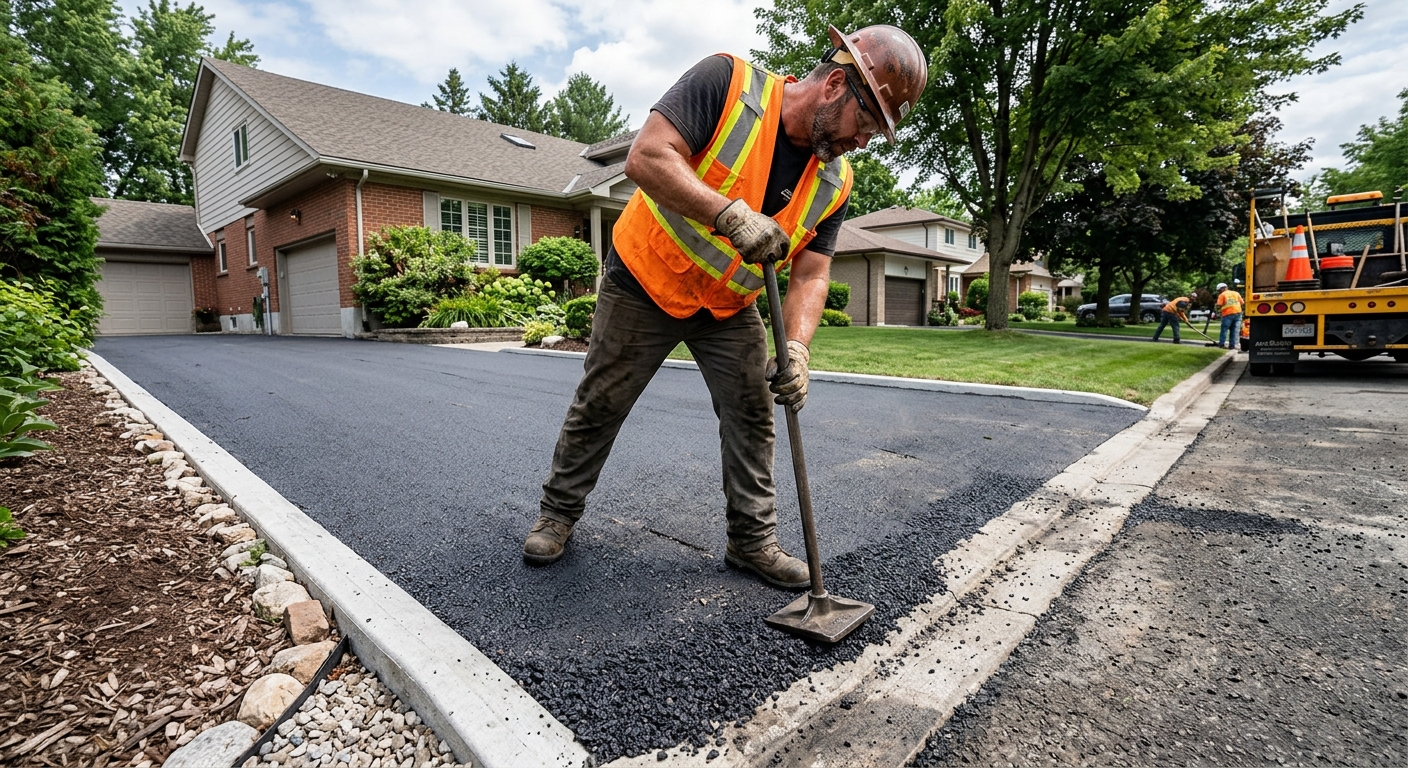
What a new driveway costs in Clairton
Clairton is a city of mostly single-family homes—about 60.2%—and nearly 6 in 10 homes are owner-occupied (59.7%, U.S. Census Bureau, ACS 2024). For these homeowners, replacing or resurfacing a driveway is a practical expense tied to real property value, not just curb appeal. Southwest Pennsylvania’s freeze-thaw cycles, paired with the hilly clay and shale soils underlying most of Allegheny County, mean driveways here take a beating below the surface. That matters because what you see—the smoothness of the top coat or the neat lines along an edge—says little about what really determines long-term cost: the condition, depth, and compaction of the base beneath the pavement.
When comparing estimates, remember: most of the price difference between two driveways is buried where you cannot see it. The cut corners are always under the surface, whether in thin or poorly compacted base, skipping geotextile, or scrimping on compaction time. With so many driveways in Clairton reaching their design life—especially those put in during the postwar expansion—owners need real, local pricing anchored in what lasting work actually costs.
| Service |
Best for |
Lifespan |
Price range |
| Asphalt — full replacement with new base |
failed base, structural cracking |
20–30 yrs |
$3,300–$8,500 |
| Asphalt overlay / resurfacing |
sound base, surface cracking only |
8–15 yrs |
$1,400–$4,200 |
| Sealcoating — single application |
preventive maintenance on sound asphalt |
2–4 yrs |
$200–$650 |
| Concrete — new installation |
long service life, low maintenance |
30–50 yrs |
$4,700–$11,500 |
| Crack filling and patching |
isolated cracks under a quarter inch |
1–3 yrs |
$200–$800 |
| Gravel driveway |
rural, budget, long runs |
5–10 yrs with upkeep |
$900–$3,500 |
Estimates for a typical Clairton driveway. Square footage and base condition drive these figures more than material choice.
What you need before paving in Clairton
In most cases, for a residential driveway on private property in Clairton, you will not need a building permit to repave or resurface your existing driveway if you are staying within the current footprint. This is typical for municipalities in Allegheny County outside Pittsburgh, where minor resurfacing projects rarely trigger permit requirements. However, the driveway approach—where your driveway meets the public road—almost always requires a permit if you plan to change or replace it, and this is handled by the Pennsylvania Department of Transportation (PennDOT) District 11-0 for state routes. Many homeowners are surprised this step isn’t controlled by the city or borough.
If you intend to expand the paved area or reroute drainage toward the street or a neighboring property, local officials may require you to address stormwater runoff. Even if permits don't cover it, you are responsible if water from your improved driveway flows onto a neighbor’s land or worsens street flooding.
When hiring, Pennsylvania requires a written contract for any home improvement work over $500 under the Home Improvement Consumer Protection Act. Every contractor must carry workers’ compensation if they have employees—this is non-negotiable. Always verify Home Improvement Contractor (HIC) registration at hic.attorneygeneral.gov and check their workers’ compensation directly in WCAIS (wcais.pa.gov).
Getting thirty years out of a driveway
Of all the maintenance tasks, crack filling—done before water reaches the base—delivers more service life per dollar than anything else you can do. Once water gets below the surface, freeze-thaw cycles in our region’s harsh winters pry small cracks open and turn them into big problems. Next is keeping the edges well-supported: when the edge is left unsupported on our local hillsides and clay soils, it crumbles and pulls the drive apart. Directing water so it never ponds or drains under the pavement is critical. Never let a gutter discharge toward the drive, and keep low spots filled.
Avoid placing jack stands, dumpsters, or heavy trailers on asphalt for more than a day—point loads will indent even well-built drives. For new asphalt, give it at least three or four hot weeks to fully cure before parking vehicles or pivoting wheels while stopped.
As for de-icing in Clairton: road salt attacks the surface of concrete, causing scaling and spalling over time, especially with our 8 °F winter design temperatures. On asphalt, salt isn’t as damaging directly, but repeated freeze-thaw cycling from refreezing meltwater is. Alternatives like calcium magnesium acetate and sand are gentler but can cost several times more than salt.
Diagnosing a failing Clairton driveway
In Clairton, knowing when you need a full tear-out versus a repair can save thousands. Here’s how you get a sense yourself: if your driveway has “alligator cracking”—a patchwork of cracks over a broad area—that signals the base has failed. Surface repairs or overlays thrown on top won’t last; the problem is underneath. On the other hand, isolated straight-line cracks (especially less than a quarter inch wide) point to surface aging and can often be filled and sealed. If you see depressions that always hold water (birdbaths), it’s most often subgrade movement, made worse by the area’s expansive clays. Edge crumbling points to inadequate base support at the sides, while potholes mean water’s already into the structure and you’ll need at least a full-depth patch.
Never trust a contractor who proposes a simple overlay or “cap” without probing and documenting the base—they haven’t diagnosed your problem. An overlay on a broken base is money burned.
| What you see |
Likely cause |
Right fix |
Cost |
| Isolated cracks under 1/4 inch |
surface aging |
crack fill and seal |
$200–$650 |
| Alligator cracking over a wide area |
base failure |
full replacement |
$3,300–$8,500 |
| Depressions holding water |
subgrade movement |
excavate and rebuild that area |
$3,300–$5,200 |
| Crumbling edges |
no edge support |
edge repair, consider curbing |
$400–$1,500 |
| Potholes |
water into the base |
full-depth patch, then assess |
$250–$900 |
| Faded but sound surface |
oxidation only |
sealcoat |
$200–$650 |
How often should a Clairton driveway be sealed?
Sealcoating does a few things well: it keeps the asphalt binder from oxidizing in the sun, blocks spilled gas and oil from softening the surface, and sharpens up the look of a driveway, which makes sense in a town with as many pre-1980 homes as Clairton. But sealing does not add structural strength, mend failing bases, or fix cracks—the kind of problems common here where freeze-thaw cycles and clay soils put the pressure on below.
The catch: sealing too often, or slapping it on before new asphalt has finished curing, can make matters worse by trapping volatiles and building up brittle layers that crack and peel. For most Clairton driveways, every two to four years is plenty—never annually. The first application after a new install should wait until at least the next season, especially if you want the work to really extend surface life.
For cracks, filling them before they widen is much more important than how dark your surface looks. A thin spray-on sealcoat might run at the low end—$200–$650—but it generally offers little real protection, mainly darkening the surface for a season. A proper job uses squeegees to force sealer into the pores and fills cracks separately.
The paving season in southwestern Pennsylvania
Driveway paving in Clairton follows the calendar, not preference. Local hot-mix asphalt plants simply do not operate through winter, so from roughly mid-November to April, new asphalt just is not available. This hard stop is rooted in physics, not business: hot-mix asphalt must remain above a certain temperature during placement—if it cools too quickly, which happens at our typical winter design low of 8 °F and in the long shadows of local hills, you get a porous, raveling mess that will not last. Concrete has a similar constraint: it requires above-freezing weather to cure without scaling or pop-outs.
The practical upshot for Clairton homeowners is that the window for paving is short and busy. Most crews are booked solid during peak summer, and it’s in the early spring and late fall—the shoulder seasons—when you might find a slot, especially for smaller drives under a half day’s work. If a contractor offers to lay hot-mix asphalt in late November or early March, be skeptical; that’s not how quality work gets done in Allegheny County, despite the convenience of local aggregate and asphalt supply keeping haul times down.
If planning a replacement, call as early as possible to get on the schedule and expect some shuffling based on weather. No reputable crew will guarantee a date too far in advance during our unpredictable mid-spring and late-fall conditions.
Numbers, not adjectives
If you want your investment in a Clairton driveway to last, insist on numbers—not adjectives. What matters most isn’t hearing “good thick base” or “nice heavy asphalt” but seeing written, measurable specs on your quote. Our region’s heavy freeze-thaw cycles and the widespread local clay and shale demand a build-up that would be overkill in a milder place. Trusting a bid that just says “three inches of asphalt” is risky: is that before or after compaction? Is it an inch of base with two inches of top, or something else entirely? The difference can be years of lifespan.
In this part of Allegheny County, anything less than 6–8 inches of compacted aggregate base under asphalt is asking for trouble, especially on a hilly lot. The aggregate should be crushed limestone, not river rock, and the asphalt layers specified in both binder and surface course—with each thickness listed “compacted,” not as laid. Edge support matters too, as driveways here often fail where the base tapers thin or is left unsupported.
- Base aggregate type (e.g., PennDOT 2A stone, not river gravel)
- Base excavation depth and compacted base thickness (minimum 6–8 inches)
- Number of base and surface asphalt lifts, with compacted thickness for each
- Total compacted asphalt depth (2.5 inches base, 1.5–2 inches surface common here)
- Mix designation and temperature at time of placement
- Compaction method—plate, roller, and pattern
- Driveway width and exact square footage specified
- Edge support method—tapered base, concrete, or curb
- Drainage slope and discharge location
- Separation layer or geotextile, if used over clay/shale
Frequently asked questions — driveway paving in Clairton
What slope does a driveway need for drainage?
A driveway in Clairton should have at least a 2% (or roughly a quarter inch per foot) slope away from structures and toward the street or swale to keep water moving. Our heavy freeze-thaw and hilly terrain make managing runoff a bigger deal than in flatter areas. Without enough slope, melting snow and rain will pond or soak in, leading to base failure in our area's clay and shale soils. When priced right, drainage corrections can mean some extra excavation or regrading, which will reflect in quotes—typically between $1,400–$4,200 if drainage rework is paired with resurfacing. Always confirm in writing where the water will go; directing runoff at a neighbor creates real liability here regardless of permits or city lines.
What causes driveway cracks in Clairton?
In Clairton, cracks are usually the result of freeze-thaw cycles paired with our local subgrade—clay and shale under most Allegheny County hillsides is not forgiving. Water works into even hairline cracks, expands and contracts with the weather, and eventually separates the asphalt or concrete. Old, unsealed driveways (especially those laid before 1980, as many here were) are also prone to oxidation and shrinkage cracks. The kind of cracks tells you about the problem: wide “alligator” patterns spell base failure, while straight, small cracks are usually age or surface stress—proper crack filling at $200–$650 can head off much worse if done early.
How much does it cost to widen a driveway?
Widening a driveway in Clairton means real costs, especially because you can’t just pave over grass—you’ll be excavating new base and likely addressing edge drainage. For asphalt, figure on a cost similar to a new install for the added section: $3,300–$8,500 for substantial widening, though smaller add-ons may be far less. Expect to need a permit if the new edge approaches the public right-of-way, and don’t neglect the slope—a poor widen job can shuttle water onto your or your neighbor’s property, creating headaches and potential liability.
Does road salt damage driveways in Clairton?
Yes, but it depends on material. In Clairton, salt eats into concrete, causing scaling and surface flaking after a few winters, especially where puddles collect or plows push salt-laden snow into piles. Asphalt isn’t directly attacked by salt, but repeated freeze-thaw cycles from melting and refreezing increase cracking and shorten the lifespan. Alternatives exist—calcium magnesium acetate, for example—but these can be pricey compared to what the city spreads on the roads. Repairing salt-damaged concrete can run from a surface sealcoat at $200–$650 to a full replacement if the damage runs deep.
How far ahead should I book a paver in Clairton?
In Clairton and wider Allegheny County, booking one to three months ahead is realistic, especially for work anytime between late spring and early fall. Top paving crews fill their summer calendar first, and those offering a “right away” slot in the heart of the season are the exception, not the rule. For smaller jobs like crack filling or sealcoating ($200–$650), you may find more flexible timing. But with our paving season shut down November–April, calling early guarantees you a better shot at both price and quality, as crews are less likely to rush or cut corners at their busiest.
Can I pave over my existing driveway?
You can overlay if the base is sound, no widespread alligator cracking, and the existing drive is not crumbling at the edges—which is hit or miss, especially with so many pre-1980 drives in Clairton. A proper contractor will core or probe to check base integrity first; otherwise, a new layer is likely to fail just as quickly as the last. The cost for a legitimate overlay (not a thin “cap” over a broken base) is $1,400–$4,200; this option only makes sense if you know the underlying structure is solid.
What does an asphalt overlay cost in Clairton?
In Clairton, an asphalt overlay—where a fresh layer is laid over an existing, structurally sound drive—will usually run between $1,400–$4,200, depending on size and prep work. This is far less than a full replacement, but that savings only lasts if the current base is stable and you don’t have edge, drainage, or severe crack issues. Too many overlays on a failing drive in our climate lead to rip-up and full replacement, which jumps the price quickly. A good contractor will include price and specifications for edge tie-ins and transitions, not just the visible surface.
Do I need a permit to repave a driveway in Clairton?
Normally, repaving or resurfacing a private driveway inside your property lines in Clairton does not require a building permit, saving you a bit of red tape. However, if the project changes or replaces the driveway approach—the connection to a public road—you’ll need a Highway Occupancy Permit from PennDOT District 11-0 for state routes. Expanding beyond your original footprint, rerouting drainage, or tying into a city sidewalk can trigger both permit and stormwater reviews. For straight re-sealing ($200–$650), you won’t need to notify anyone unless you’re in a curb zone or altering drainage paths.
Does sealcoating fix cracks?
It does not. Sealcoating will darken and refresh the surface, but it won’t fill or bridge any cracks—especially the wider ones you find after a harsh Clairton winter. Proper crack sealing or filling should always come first, since water intrusion is the main enemy in western Pennsylvania’s climate. Sealcoat simply slows oxidation and improves oil resistance at the top. A “cheap” seal offered at $200–$650 that skips crack treatment is mostly cosmetic; cracks will widen and telegraph through the coating in one or two freeze-thaws. For value, ask what prep is included; real maintenance starts with treating the cracks themselves.