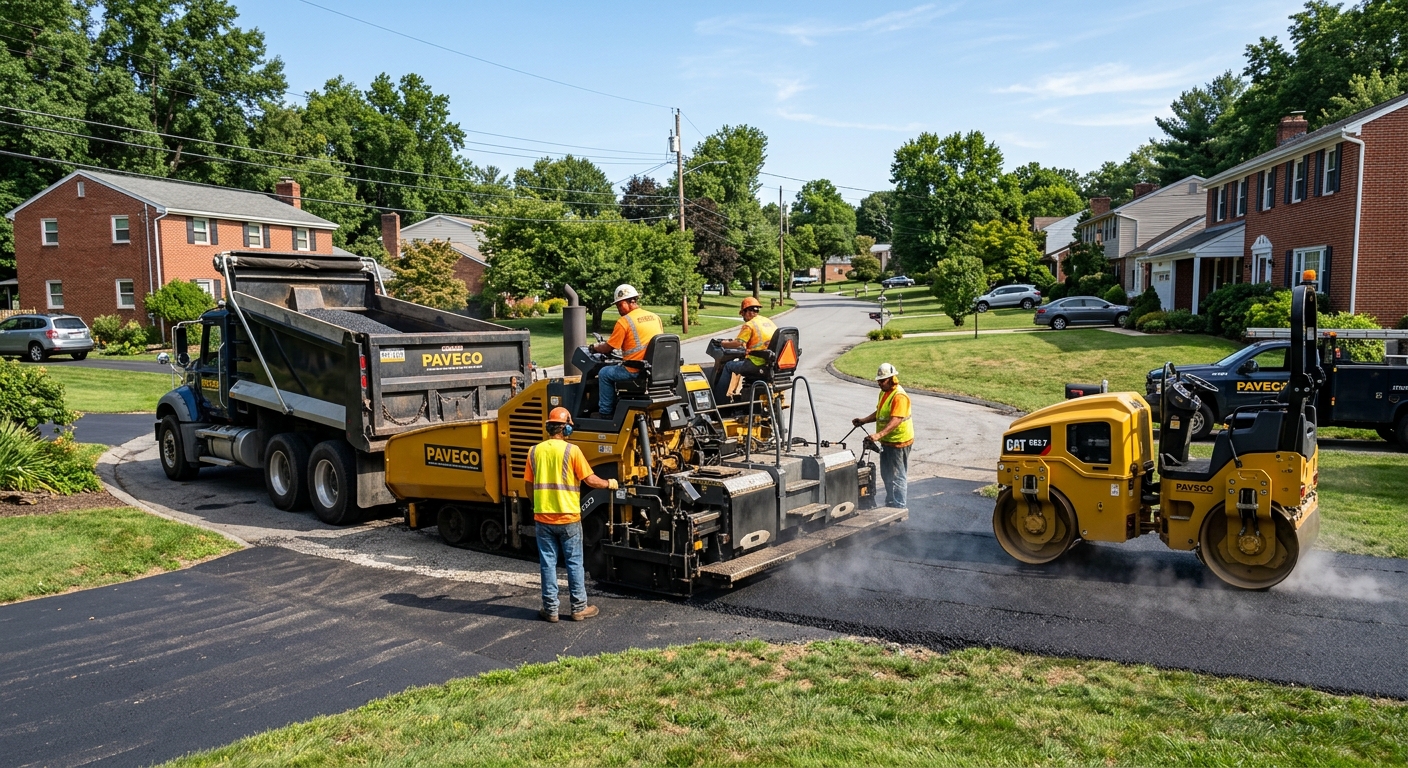
What a new driveway costs in Center
In Center, where over 80% of homes are owner-occupied and nearly three-quarters are single-family houses (U.S. Census Bureau, ACS 2024), paving or replacing a driveway is a decision most homeowners will face sooner or later. In southwestern Pennsylvania, driveways contend with heavy freeze-thaw cycles and subsoils of clay and shale that are unforgiving to shortcuts. These underground factors have a bigger impact on cost than material choice; two contractors quoting dramatically different prices are probably planning very different work beneath the surface. A low bid may mean less excavation, a thinner aggregate base, or skipping base repairs entirely, which rarely ends well in Butler County’s soil. Most full replacements are triggered by base failure beneath aging 1990s–2000s asphalt drives as these homes reach the 20–30 year mark.
If your base is still sound and the existing driveway is properly drained, resurfacing or overlay costs much less than a complete tear-out and rebuild. Concrete costs more up front, but offers a longer lifespan—if you’re prepared to avoid salt-based de-icers. Maintenance services like crack filling and sealcoating protect what you have but do not fix underlying problems. Gravel remains a practical, cost-effective option for longer runs in rural Center, especially where budgets or distance from the main roads make asphalt less appealing.
| Service |
Best for |
Lifespan |
Price range |
| Asphalt — full replacement with new base |
failed base, structural cracking |
20–30 yrs |
$3,600–$9,200 |
| Asphalt overlay / resurfacing |
sound base, surface cracking only |
8–15 yrs |
$1,550–$4,600 |
| Sealcoating — single application |
preventive maintenance on sound asphalt |
2–4 yrs |
$200–$700 |
| Concrete — new installation |
long service life, low maintenance |
30–50 yrs |
$5,100–$12,500 |
| Crack filling and patching |
isolated cracks under a quarter inch |
1–3 yrs |
$200–$800 |
| Gravel driveway |
rural, budget, long runs |
5–10 yrs with upkeep |
$900–$3,500 |
Estimates for a typical Center driveway. Square footage and base condition drive these figures more than material choice.
Numbers, not adjectives
Price alone doesn’t guarantee a long-lasting driveway in Center. What separates a good paving job from a doomed one is the numbers on your contract: how deep the excavation, how thick the base, how the asphalt is built up and compacted. In Butler County, the clay and shale subgrades and severe freeze-thaw cycles make local driveways far more demanding than those in warmer, flatter areas. It’s easy for a contractor to promise “three inches,” but that’s meaningless unless you know if it's measured before or after compaction (you'll lose about 20% to compaction), and whether it even covers the subgrade uniformly.
Don’t settle for adjectives (“thick,” “good base,” “proper compaction”)—insist on numbers, in writing. Vague promises hide shortcuts that only become clear after your driveway buckles in spring. Even honest contractors need to spell out lift thicknesses and base specs, since the required depth here is greater than what you’ll see in a mild climate.
- Excavation depth (inches below finish grade)
- Aggregate base thickness (minimum 6–8 inches for clay/shale; more in bad spots)
- Aggregate type and gradation (e.g., PA 2A modified, compacted with plate compactor/roller)
- Compaction method (roller vs. plate compactor) and whether base was compacted in lifts
- Asphalt binder course depth (after compaction; 2–2.5 inches typical)
- Asphalt surface course depth (after compaction; 1.5–2 inches typical)
- PA asphalt mix designation (e.g., ID-2 wearing, ID-2 binder or state mix number)
- Edge treatment (tapered or vertical, with or without curb/stone support)
- Tack coat used between asphalt layers (yes/no)
- Drainage details—where runoff will go (daylight, swale, drain, etc.)
Permits and approvals for paving in Center
In Center and the greater Butler County area, repaving or resurfacing an existing residential driveway without changing its width or footprint usually does not require a township permit. For example, in Butler Township, this is routine and saves you time and fees. However, if your project involves altering the entrance to a public road—say, widening your approach or connecting a new driveway—then you typically need a driveway or approach permit. This permit is not issued by the county itself, but by your local municipality for township roads, or by PennDOT District 10 if your driveway connects to a state route.
Adding or widening driveway surface increases impervious area, which can bring stormwater management issues into play. Local codes may require you to contain runoff on your property. Even if not, Pennsylvania law holds you responsible if your new driveway causes water to run onto a neighbor’s property and causes damage. Plan for correct grading and consider perimeter drains or swales if the area is at all hilly or prone to runoff.
If you pay over $500, Pennsylvania requires your paving contractor to carry a Home Improvement Contractor (HIC) registration, verifiable at hic.attorneygeneral.gov. Workers’ compensation coverage is mandatory by law for all employers—check compliance via the WCAIS system at wcais.pa.gov before work begins.
Asphalt or concrete for a Center driveway?
In southwestern Pennsylvania’s climate, driveway material choice is about more than just looks or up-front cost. The freeze-thaw cycle is harsh—winter design temps hit 8°F, and freeze-thaw shifts play havoc with rigid paving surfaces. Asphalt remains the workhorse for most homes in Center because it flexes with ground movement, reducing the risk of major cracks. Asphalt can survive decades of these cycles if properly maintained and installed over a compacted, well-drained base.
Concrete offers a longer theoretical lifespan—up to 50 years here—but it’s a rigid slab, so when Butler County’s clay or shale subgrade heaves, the concrete can’t flex and is prone to cracking. Far more often, however, concrete in this region fails by spalling and surface scaling, which is triggered less by cold than by salt-based de-icers—ubiquitous in snowbelt counties like ours. Unless you’ll never use salt, or you plan to sand and shovel exclusively, concrete may not pay off.
Pavers (interlocking blocks) are a valid but more expensive option, often chosen for decorative appeal or those looking for a fully repairable surface. Gravel is a sensible choice for long, rural driveways in Center—lower cost, forgiving over poor base conditions, and simple to repair as needed.
| Option |
Installed cost |
Maintenance |
Freeze-thaw performance |
Lifespan |
| Asphalt — new install |
$3,600–$9,200 |
sealcoat every 3–4 yrs |
excellent, flexes |
20–30 yrs |
| Asphalt — overlay |
$1,550–$4,600 |
same |
good if base is sound |
+8–15 yrs |
| Concrete |
$5,100–$12,500 |
low, avoid de-icing salt |
fair, spalls with salt |
30–50 yrs |
| Pavers |
$8,200–$12,500 |
individual units replaceable |
good, settles gradually |
25–50 yrs |
| Gravel |
$900–$3,500 |
top-dress every 2–3 yrs |
excellent drainage |
indefinite with upkeep |
Why driveways behave differently in Center
Center’s driveways rest atop subgrades of glacial till and shale, with a healthy dose of clay—this is not forgiving ground. Clay holds water and swells when frozen, leading to frost heave and cracks in poorly built drives. Shale, for its part, can layer up and allow for sudden settling if not compacted right. These soil types require a thicker aggregate base—at least 6–8 inches, often more in bad patches—to resist rutting and upheaval when winter freeze sets in.
Regionally, the frost depth reaches 36 inches, so base preparation is not a spot where you want your contractor to save time or material. Cheap jobs are often shallow, skipping proper excavation and base depth, and that shows up in the first hard winter. Many Center driveways—particularly those put in during the Cranberry and Adams Township subdivision boom of the 1990s and 2000s—are now approaching the end of an expected 20–30 year lifespan. In older homes, especially those predating 1980, driveways may never have had a proper base, especially if they’re showing widespread cracking or sinking.
If your contractor isn’t probing below the surface, they’re missing the single largest predictor of how long your new driveway will last in Butler County.
Where the water goes
Grade isn’t a finishing touch on a Center driveway—it’s the foundation of its lifespan. To shed water, a driveway must slope at least 2% (a quarter-inch per foot) away from buildings. In Center’s landscape, where driveways often run up or across slopes, getting the water to move off the surface is a fight against gravity, clay, and freeze-thaw cycles. Crowning (a gentle center peak) works well for wide drives, while a simple cross-slope may do for a single-car run, but both need to move water away from the house and foundation.
When driveways slope toward a garage or low spot, plan on a trench or channel drain at the bottom, tied to a daylight outlet or, if that’s impossible, a dry well. Simply pointing water off your property is not a solution—under Pennsylvania law, if you cause runoff onto your neighbor and create a problem, you’re liable even if you have a permit.
Heavy clay soils in Center hold water under the base, which means minor ponding lasts longer and increases the risk of frost heave. This is why proper grading, edge drainage, and sometimes subsurface drains are essential. It costs more up front, but one freeze-thaw cycle trapped over waterlogged clay can trash an entire driveway in a single winter.
Diagnosing a failing Center driveway
As a homeowner in Center, you don’t need to be a contractor to do a basic driveway diagnosis—just an honest look at what’s on the surface. If you see wide areas of interconnected cracks (the classic “alligator cracking”), the base beneath your driveway has failed, and any overlay will follow it down before long. Isolated, straight cracks might just be shrinkage or surface aging—these can be filled and sealed. If you notice sunken spots that collect water (birdbaths or depressions), the subgrade has likely shifted or settled, and repair means excavating and rebuilding in those areas. Crumbling edges show a lack of base or no edge support. Potholes are signs that water has reached the base, and a patch is only a stopgap until the underlying problem is fixed.
It’s easy for a paving contractor to push an overlay when they shouldn’t. If no one is digging or drilling to check your base, you’re being steered toward a quick sale—not toward a lasting fix.
| What you see |
Likely cause |
Right fix |
Cost |
| Isolated cracks under 1/4 inch |
surface aging |
crack fill and seal |
$200–$700 |
| Alligator cracking over a wide area |
base failure |
full replacement |
$3,600–$9,200 |
| Depressions holding water |
subgrade movement |
excavate and rebuild that area |
$3,600–$5,600 |
| Crumbling edges |
no edge support |
edge repair, consider curbing |
$400–$1,500 |
| Potholes |
water into the base |
full-depth patch, then assess |
$250–$900 |
| Faded but sound surface |
oxidation only |
sealcoat |
$200–$700 |
Frequently asked questions — driveway paving in Center
What are the signs of a failing driveway base?
A failing base in Center usually shows itself as widespread “alligator” cracking, significant sunken spots, or persistent potholes. If you see cracks forming an interconnected pattern rather than just a few straight lines, that means the support beneath the asphalt or concrete is no longer stable—often due to Center’s clay or shale subgrade holding water and swelling with freeze-thaw cycles. Potholes and depressions are a dead giveaway that water has infiltrated below, making patch jobs a short-term fix at best. If these signs are present, a full replacement is generally advised, which for most Center driveways will run $3,600–$9,200 for asphalt, depending on size and base depth.
What slope does a driveway need for drainage?
In Pennsylvania’s climate, and especially in Center with its heavy freeze-thaw, a driveway needs at least a 2% slope—about a quarter inch per foot—to reliably shed water. Without that slope, water will pond on the surface or at the edges, soak into the base, and then freeze, causing heaving and rapid surface failure. If your driveway slopes toward your house or garage—common in some older Center developments—you’ll need a channel drain or to rework the grade. Adding proper drainage at paving time costs extra, but not nearly as much as rebuilding a frost-heaved drive (which can mean $3,600–$9,200 for a full asphalt replacement).
Should I repair or replace my Center driveway?
The choice comes down to what you see on the surface and, ideally, what’s happening underneath. In Center, isolated cracks under a quarter inch wide can be filled, and a good sealcoating can stretch your driveway’s life at a fraction of replacement cost—$200–$700 for a sealcoat. But if you notice large areas of interconnected cracks, sinking spots, or chronic edge breakdown, repairs are likely throwing good money after bad. The clay and shale soils here mean that once the base goes, patches and overlays won’t last. In that case, it’s more cost effective to invest in a full replacement.
Can asphalt be laid in cold weather?
Asphalt can technically be installed in cooler temperatures, but in Butler County—Center included—it’s never a good idea once daytime highs drop lower than about 50°F. Asphalt cools too quickly, making proper compaction impossible, especially with short haul distances from plants along Route 8 and 422. Jobs rushed late in the season fail early due to poor bonding and water infiltration. Best practice is to schedule your project for spring through early fall when temperatures let the material be worked to spec. For work done outside these times, expect to pay the same, $3,600–$9,200 for a full replacement, but get a much shorter lifespan.
Are door-to-door pavers a problem in Center?
In Center and surrounding communities, door-to-door paving offers tend to spike in spring and summer. While not every traveling crew is a scam, most legitimate contractors are booked weeks ahead and do not knock unsolicited. Many out-of-town operators skip proper base work and disappear before warranty issues show. It’s not just a matter of quality—a valid Home Improvement Contractor (HIC) registration is required in Pennsylvania for jobs over $500, which you can and should confirm at hic.attorneygeneral.gov before signing. Do not hand cash to anyone offering a “leftover asphalt” deal; what you save up front is usually lost to repairs or replacement, often as much as $3,100 for a new overlay.
Can I cancel a paving contract I signed at my door?
Yes, Pennsylvania’s Home Improvement Consumer Protection Act gives you a three business-day right to cancel any home improvement contract signed at your residence—including paving—in Center or anywhere else in the state. The contract must include written notice of this right. If you change your mind, deliver your cancellation in writing within three business days to the contractor, and you owe nothing. This protection is one reason not to hand over a deposit to a door-to-door operator before verifying their credentials. For jobs over $500 the contract must be in writing by law.
How often should I sealcoat my driveway in Center?
With Center’s climate and heavy freeze-thaw cycling, a sound asphalt driveway should be sealcoated every three to four years. This keeps the surface flexible, blocks UV damage, and helps prevent water from working into small cracks that can become potholes during winter. Because Butler County’s subgrade is mostly clay and shale, preventing water infiltration is crucial. Skipping sealcoating for too long risks opening the door to much costlier repairs down the road—small cracks can be filled as they appear, but consistent sealcoating is your first line of defense. A typical sealcoat in Center runs $200–$700 depending on size.
What does sealcoating cost in Center?
In Center, a single application of professional sealcoating for a typical two-car driveway runs between $200–$700. The exact amount depends on your square footage and whether any crack filling or patching is needed beforehand. Sealcoating doesn’t fix deep cracks or base damage, but it can add years to the lifespan of an otherwise sound asphalt surface, stretching out the intervals between more expensive resurfacing jobs, which leap to $1,550–$4,600. Most homeowners find regular sealcoating easily pays for itself compared to waiting for surface problems to multiply.
Why are paving quotes in Center so different from each other?
In Center, the biggest factor behind price differences is what’s happening below the surface. Two quotes for an “asphalt driveway replacement” in Butler County can differ by thousands because one includes proper excavation, thick aggregate base, and compaction—which you need in our clay and shale soils with deep frost. The other might be skipping base repair entirely. Haul distances are fairly short here thanks to local quarries and plants, so it’s not about fuel. If you’re seeing a wide spread—from $3,600–$9,200 for asphalt replacement—look for specific details in the contract: base depth, material specs, and how drainage will be handled. Anyone skipping those numbers is probably skipping the work.