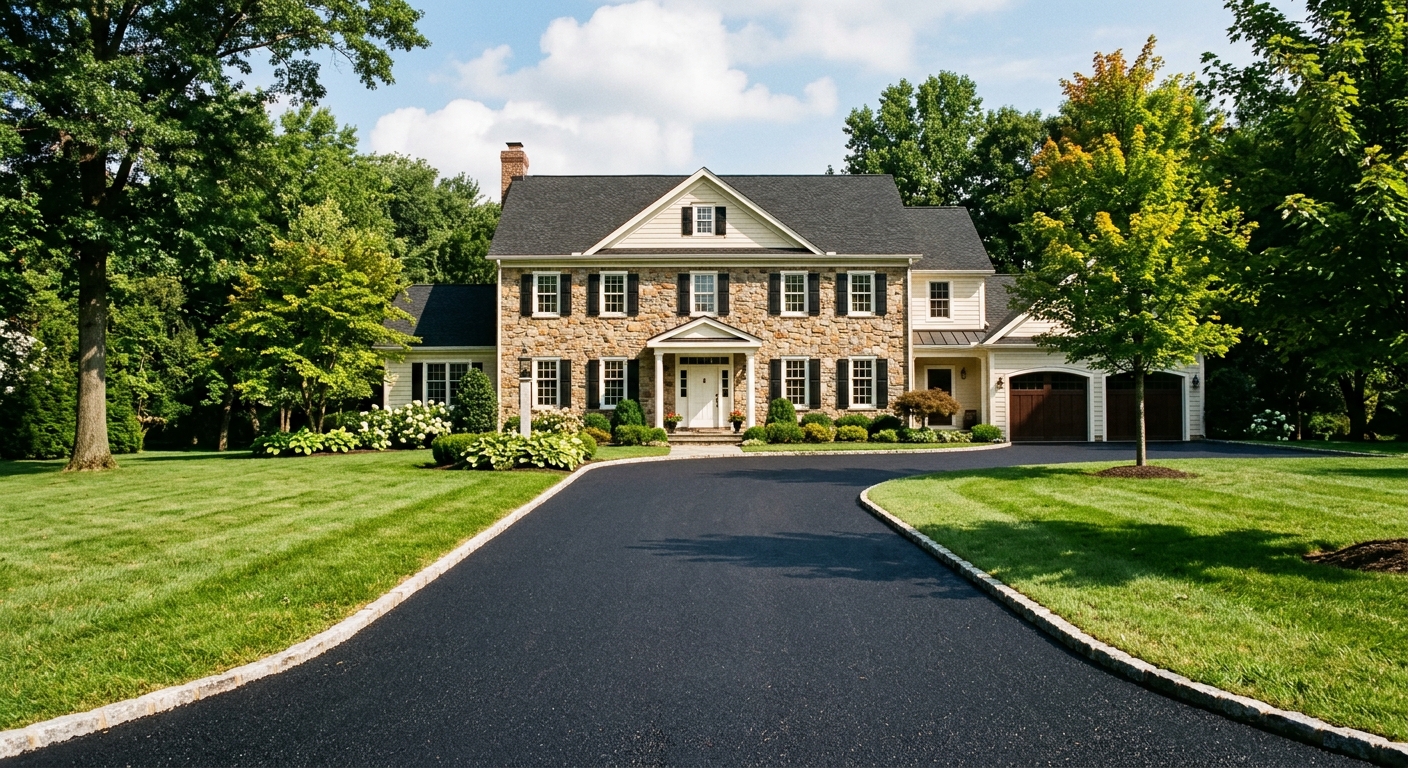
Vandergrift paving prices by scope — 2026
In Vandergrift, where 70.7% of homes are single-family houses and just over half are owner-occupied (U.S. Census Bureau, ACS 2024), paving is one of the larger homeowner expenses you'll face. Southwestern Pennsylvania’s hard winters and constant freeze-thaw cycles mean a driveway is never “set it and forget it”—if you skimp on what’s below the surface, you pay for it twice. Most differences in price between paving quotes are not for the visible topcoat, but for excavation, stone base, and drainage. With local clay and shale soils, how well the base is built will determine how long your drive lasts and how often you'll be fixing ruts or heaves. You can’t see the base thickness after installation, so who you hire matters as much as the material you select.
| Service |
Best for |
Lifespan |
Price range |
| Asphalt — full replacement with new base |
failed base, structural cracking |
20–30 yrs |
$3,100–$8,100 |
| Asphalt overlay / resurfacing |
sound base, surface cracking only |
8–15 yrs |
$1,350–$4,000 |
| Sealcoating — single application |
preventive maintenance on sound asphalt |
2–4 yrs |
$175–$650 |
| Concrete — new installation |
long service life, low maintenance |
30–50 yrs |
$4,500–$11,000 |
| Crack filling and patching |
isolated cracks under a quarter inch |
1–3 yrs |
$200–$800 |
| Gravel driveway |
rural, budget, long runs |
5–10 yrs with upkeep |
$900–$3,500 |
Estimates for a typical Vandergrift driveway. Square footage and base condition drive these figures more than material choice.
Drainage: the failure nobody plans for
In Vandergrift, water is the enemy of any driveway. Every winter freeze-thaw cycle here turns a small drainage mistake into a major headache: ponded water works its way into the base, then freezes and expands, causing heaving and early cracking. Minimum slope matters. To shed water effectively, an asphalt or concrete driveway needs at least a 2% grade—or about a quarter inch drop per foot—away from the house or garage. Crowning (a slight hump in the center) can help water run off both sides, but on short or narrow drives, a cross-slope is more practical.
Heavy local clay is poor at letting water pass through, so it holds moisture right against your stone base. This means extra focus on getting water away from the driveway quickly: a surface that slopes toward your house risks water in the basement, while grading toward the street or a proper swale keeps foundations dry. Some lots can’t be pitched correctly due to shape or elevation; in those cases, trench or channel drains—and careful daylighting (draining to open air away from the house)—are necessary. A dry well is a last resort when no other option will work, but it’s rarely ideal in our clay soils. Whatever the plan, runoff directed onto a neighbor’s property is a legal problem waiting to happen, so design yours to keep water on your side.
Permits and approvals for paving in Vandergrift
For most Vandergrift homeowners, repaving or sealcoating an existing driveway—where you aren’t expanding or altering drainage—does not require a building permit (see Hempfield Township as an example). But if you replace, widen, or move a driveway so that it affects the curb, sidewalk, or any drainage in Greensburg, you’ll generally need a zoning or building permit through the local authority. The critical exception is the driveway approach—the spot where your driveway meets a public road. That’s not covered by your borough, but by PennDOT District 12, through the Westmoreland County maintenance office. Even if your whole driveway is on private property, changing the apron or curb cut needs their permission.
If you plan to increase the impervious area (by widening or adding parking), you may be asked to show how stormwater will be managed, regardless of permit status. Dumping runoff onto the street or a neighbor’s lot is a liability even if a permit is granted.
For contractor paperwork, Pennsylvania requires anyone doing over $500 in paving work to be registered as a Home Improvement Contractor through the Attorney General (verify at hic.attorneygeneral.gov). All contractors must also carry valid workers’ compensation insurance, which can be checked via WCAIS (wcais.pa.gov).
Door-knocking crews and leftover material
Driveway paving in Vandergrift attracts its share of “traveling crews”—some legitimate, many not. Common scams in Westmoreland County include someone stopping unannounced, saying they have “leftover material from a job down the road,” offering a discount if you agree today. Other warnings: an unmarked pickup with out-of-county plates, a demand for cash before any work begins, a hand-written quote with no details and no warranty, or a thin coat of oil sprayed and called “sealcoating.” These outfits count on getting paid and gone before any defects show up, and they thrive where neighbors are spaced out and local contractor density is lower—just like rural parts of this county.
Pennsylvania law is on your side if you know your rights: any home improvement over $500—including driveway work—must be backed by a written contract under the Home Improvement Consumer Protection Act. This contract must detail the work, price, and materials, and you always get three business days to cancel, no questions asked. Anyone offering to waive an insurance deductible is breaking the law and risking your coverage.
Before you get talked into a deal, take five minutes: check the contractor’s registration at hic.attorneygeneral.gov, verify their address isn’t a mailbox, confirm workers’ compensation at wcais.pa.gov, and refuse cash-only deals with no receipt. Nothing else needed.
Vandergrift's ground and what it means for paving
The clay and shale subgrade around Vandergrift is the root cause of many driveway failures here. Clay holds water against your stone base, making it soft when wet and prone to frost heave when temperatures drop. Shale can break down over time, creating voids. Glacial till, found elsewhere, drains differently, so the stone depth and underdrain design that works in Allegheny County does not always work in Westmoreland.
With a 36-inch frost depth and heavy freeze-thaw cycles, base thickness and drainage are not optional here—they’re essential. Many driveways in post-1960 subdivisions, especially in Hempfield and North Huntingdon, were built when code enforcement was minimal for private drives. It’s rare to find more than 4 inches of base stone under a 1980s driveway, and often there’s less. When considering resurfacing or overlay, it’s critical to check for rutting or signs the base has shifted—because adding asphalt over clay or uncorrected heaving just locks in failure.
Driveways built on solid, well-drained stone (often at least 6–8 inches deep in this region) are expensive up front but last decades longer. In Vandergrift’s soil, shortcuts come back to haunt you—especially after a wet winter.
The honest case for and against sealcoating
Sealcoating gets sold hard in Vandergrift, but it’s not a miracle fix and the honest case goes both ways. Sealcoating does protect the asphalt binder from UV sunlight, slows down oxidation, shields against dripped oil or gasoline, and freshens the jet-black look. That’s good for curb appeal and helps resale. It is inexpensive insurance if the asphalt and base are otherwise sound—one application sets you back between $175–$650 on a typical drive.
But too many applications, especially too often, mean trouble: excess buildup cracks, peels, and makes the surface slick or patchy. New asphalt needs a season to cure before being sealed, or you’ll trap oils that need to escape. Some contractors push annual sealing—that just pads their pockets and gives you nothing. Every 2–4 years is plenty for most properties here, and the first seal shouldn't hit the surface until it’s a full year old.
Crack filling is where your real maintenance dollars should go. Filling small cracks prevents water from getting into the base—the step that gives you years, not just months. Watch out for crews who spray a watery, oil-based “sealcoat” from unmarked tanks. A proper sealcoat is brush-applied, thick, and dries to a hard layer. If the price is suspiciously low, say under $175, it’s probably not doing much for your driveway.
Reading a driveway proposal
A real paving quote is more than just a total at the bottom. It should include the measured square footage, depth and type of excavation, base material and how thick it will be placed and compacted, number and thickness of asphalt lifts, edge treatment, how water will drain, and exactly what cleanup will be done after. The payment schedule should spell out a small deposit (not 50% or cash only) and balance upon completion. Warranties should be clear about what is and isn’t covered—most don’t include cracking, despite what people expect, so ask.
A one-line handwritten quote with a price and “asphalt driveway” tells you nothing: you can’t compare it, hold anyone accountable, or even know what you just bought. This is the most common way people in Vandergrift overpay for underbuilt work that won’t last.
| Line item |
What to look for |
Red flag if… |
| Area |
measured square footage stated |
eyeballed or absent |
| Excavation |
depth and disposal included |
'we'll pave over it' |
| Base |
aggregate type and depth in inches |
'proper base' |
| Compaction |
method, and done in lifts |
not mentioned |
| Asphalt |
courses and compacted depth |
'3 inches' unqualified |
| Drainage |
slope and water direction stated |
silent |
| Warranty |
what is covered and what is excluded |
verbal only |
| Payment |
modest deposit, balance on completion |
full cash up front |
Frequently asked questions — driveway paving in Vandergrift
Can asphalt be laid in cold weather?
In Vandergrift and across southwestern Pennsylvania, asphalt paving is best left to the warmer months. While some contractors will claim they can pave year-round, cold temperatures below 45°F make it nearly impossible to get proper compaction. Once the mix cools, it can't be compacted to full density, increasing the risk of premature cracking and potholes—especially with our severe freeze-thaw cycles. For optimal longevity, asphalt should be installed when air and ground temperatures are consistently above 50°F. If a crew tells you it’s fine to pave in late November or early spring, expect a lifespan on the low end of the typical 20–30 years you’d get with a $3,100–$8,100 replacement. Rush jobs done in cold almost always cost more in repairs later.
How much does it cost to widen a driveway?
Widening a driveway in Vandergrift comes down to how much new surface you’re adding, the site grading, and the type of material. For asphalt, the average price to widen by a car’s width along 30 feet is typically in the $1,350–$4,000 range if the base is sound; full-depth excavation drives it higher. For concrete, expect $4,500–$11,000 for new work of comparable length. Keep in mind, if the widening changes drainage or impacts the sidewalk or curb (as in Greensburg), you may need a permit. Proper base prep is the difference between a strip that lasts and one that crumbles. Never just “feather in” new material—undercut and full base work is critical in our clay soils.
What does compaction in lifts mean?
Compaction in lifts is the gold standard for durable driveways in Vandergrift. Rather than laying down all the stone base or asphalt at once and compacting just the top, materials are placed in manageable layers—usually 2–3 inches for asphalt—then compacted fully before the next is added. This prevents air pockets, rutting, and sinking later on, which is especially important with our clay and shale soils. Compaction in lifts also gives better bonding between layers, which is why a properly built driveway can achieve a 20–30 year lifespan, like a $3,100–$8,100 full replacement. If you see “compacted in lifts” on a proposal, you’re talking to a pro. If not, ask why—not all contractors are thorough.
How do I verify a paving contractor in Pennsylvania?
To verify a paving contractor for any work over $500 in Vandergrift or Westmoreland County, Pennsylvania requires Home Improvement Contractor (HIC) registration. Visit the attorney general’s website at hic.attorneygeneral.gov to search for their registration number and business details. For workers’ compensation insurance—which is mandatory for all employers—check the WCAIS system at wcais.pa.gov. A professional contractor will supply written quotes and stand behind a written contract, not just a handshake or a verbal promise. With paving’s price tag—say, $3,100–$8,100 for a rebuild—five minutes of verification protects you from the most common scams and legal headaches.
Why are my driveway edges crumbling?
Driveway edges in Vandergrift often fail sooner than the middle for two main reasons: thin or unreinforced edges and poor base support at the sides. Contractors sometimes skimp on stone toward the edge, or the edge isn’t compacted well during paving. Our local clay and shale make this worse—water wicks in and freezes, lifting and breaking the asphalt. Regular vehicle traffic near the edge, turning or driving off the side, accelerates the problem. Repair options range from patching ($200–$800) for isolated breaks to saw-cutting and rebuilding sections if the base is gone. For durability, a full-depth, well-compacted base extended beyond the edges is worth every extra penny—it’s the weak spot most overlooked.
Can I pave over my existing driveway?
Paving over an existing driveway—called an overlay or resurfacing—is possible in Vandergrift if your current base is sound and there’s no major rutting, heaving, or structural cracking. If the underlying problems aren’t fixed, a new layer won’t last, especially with our region’s heavy freeze-thaw. Overlays typically last 8–15 years and cost $1,350–$4,000 in this area, which is less than full replacement. Before committing, a good contractor will assess for cracks larger than a quarter inch or any soft spots. In many post-1960s homes here, the original stone base is thin—ask about correcting this if you want the overlay to last. Never agree to overlay if you have ongoing drainage issues—those come right through.
What does sealcoating cost in Vandergrift?
Sealcoating a standard driveway in Vandergrift runs between $175–$650. The cost varies on driveway size, prep work for cleaning and edging, and whether cracks are filled first—crack filling itself is often a separate, but worthwhile, charge. Be cautious of prices that seem very low; a real sealcoat should be hand-applied liquid sealer, not just a thin oil spray. You should budget for sealcoating every 2–4 years depending on traffic and sun exposure. If you’re quoted far below $175, chances are, the “seal” won’t last through one winter here, and it may do more harm than good.
Does Vandergrift have local asphalt plants?
Vandergrift is served by asphalt plants located mainly in Hempfield Township, keeping haul times short for most residential jobs. Proximity to these plants helps keep prices down, as hauling hot asphalt long distances is expensive and reduces quality. For rural jobs toward Unity Township, aggregate may travel farther from Greensburg-area quarries, which can add cost and affect scheduling. Having local plants means you pay for fresh, consistently mixed material—part of why typical asphalt install prices stay within $3,100–$8,100 in our area. Always ask your contractor where they source their material to avoid a job with “leftovers” from the bottom of a truck.
How often should I sealcoat my driveway in Vandergrift?
With Vandergrift’s climate, a good rule is to sealcoat your driveway every 2–4 years—no more, no less. Our cold winters and freeze-thaw put real stress on asphalt, but too many sealcoats build up, then crack or peel. For new asphalt, always wait at least one full season before the first application to let oils and volatiles escape. Properly applied sealcoat at the right interval costs $175–$650 and protects against sun, salt, and minor oil leaks. Skip the annual upsell; your driveway needs good base and crack repair more than constant sealing in this part of Pennsylvania. If neighbors are getting sealed yearly, resist the pressure unless your drive sees truly exceptional wear.