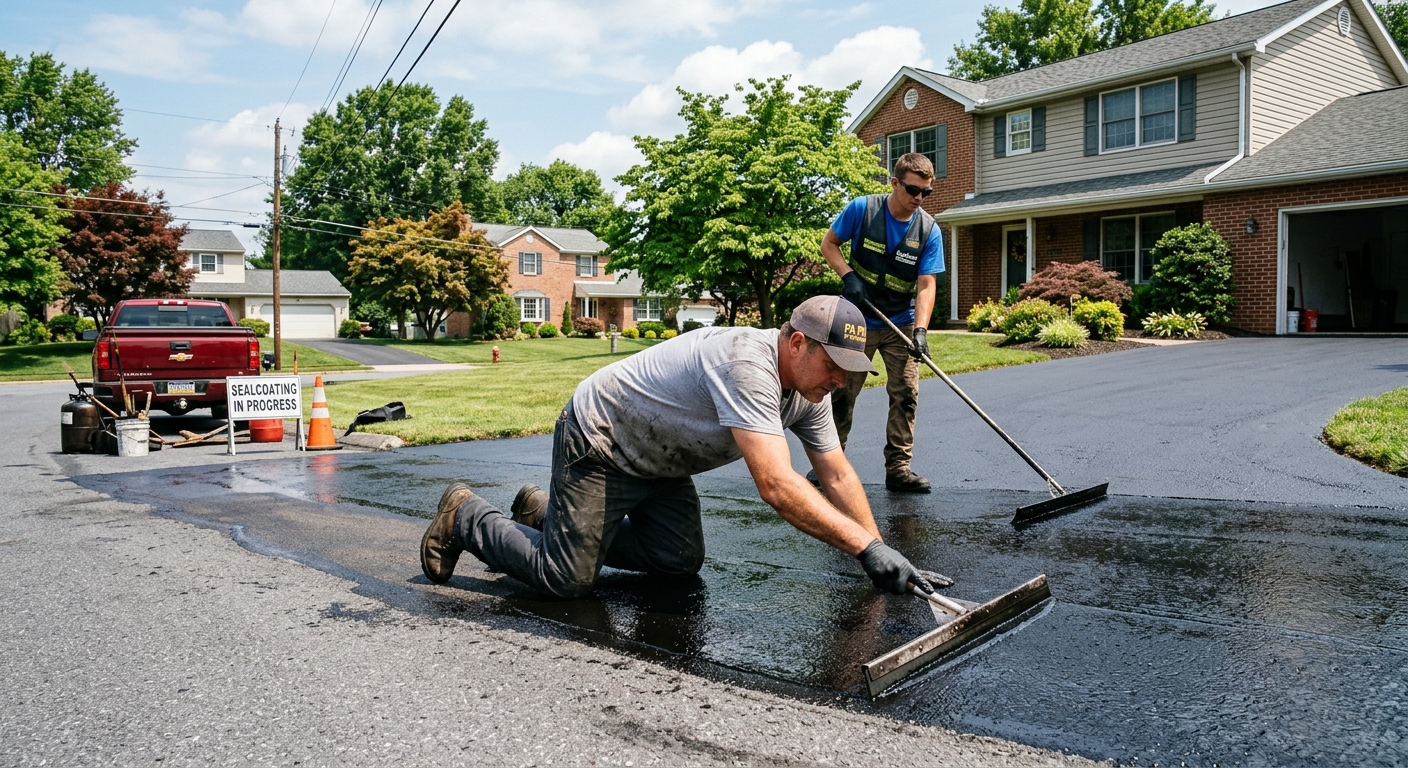
What a new driveway costs in Chippewa
In Chippewa, where 78.6% of homes are single-family and the homeownership rate is a high 84.0% (U.S. Census Bureau, ACS 2024), driveways are a real, year-in and year-out expense. The rolling hills, heavy freeze-thaw cycles, and local clay and shale soils all shape how your new drive performs—and what it costs. While top-layer material is the part you see, most of what you pay for in a driveway goes into what’s underneath: excavation, base stone, grading, and proper drainage. This means that price differences between Contractor A and B usually hide in whether they excavate deep enough, use enough compacted aggregate, and drain water away from your house—or not. Two driveways can look identical on day one, but one can fall apart within five years if shortcuts are taken under the surface.
Driveway costs in Chippewa reflect this hidden work. The table below shows the different paving options, what they are good for, how long they last under Beaver County conditions, and what you can expect to pay:
| Service |
Best for |
Lifespan |
Price range |
| Asphalt — full replacement with new base |
failed base, structural cracking |
20–30 yrs |
$3,700–$9,500 |
| Asphalt overlay / resurfacing |
sound base, surface cracking only |
8–15 yrs |
$1,600–$4,800 |
| Sealcoating — single application |
preventive maintenance on sound asphalt |
2–4 yrs |
$200–$750 |
| Concrete — new installation |
long service life, low maintenance |
30–50 yrs |
$5,300–$12,500 |
| Crack filling and patching |
isolated cracks under a quarter inch |
1–3 yrs |
$200–$800 |
| Gravel driveway |
rural, budget, long runs |
5–10 yrs with upkeep |
$900–$3,500 |
Estimates for a typical Chippewa driveway. Square footage and base condition drive these figures more than material choice.
Comparing materials in southwestern Pennsylvania
For Chippewa and the rest of Beaver County, the choice between asphalt and concrete comes down to our climate and your willingness to maintain. Freeze-thaw cycling here is intense—clay and shale soils hold moisture, the frost depth reaches 36 inches, and winter lows hit 8 °F. Asphalt is the workhorse in these conditions because it flexes. When the ground heaves and settles, asphalt bends just enough to keep from splitting wide open. If installed on a properly built base, it runs 20 to 30 years with sealcoating every 3–4 years.
Concrete, by contrast, can last 30 to 50 years, but only if you keep salt-based de-icers off it in winter—which is a strict rule homeowners rarely follow in practice. In places like southwestern Pennsylvania that rely on de-icing salt, concrete usually fails from surface spalling and scaling, not cracking, and it does so long before its theoretical lifespan. It also comes with a cost premium. Unless you are meticulous about winter care and strongly prefer a rigid surface, asphalt is the lower-risk, lower-headache option here.
Pavers and gravel are both legitimate alternatives in the right context. Interlocking pavers cost more, but unlike concrete, individual units can be replaced as they settle or stain. Gravel is ideal for rural, longer driveways where drainage is critical and where topdressing every couple of years is expected—not neglected.
| Option |
Installed cost |
Maintenance |
Freeze-thaw performance |
Lifespan |
| Asphalt — new install |
$3,700–$9,500 |
sealcoat every 3–4 yrs |
excellent, flexes |
20–30 yrs |
| Asphalt — overlay |
$1,600–$4,800 |
same |
good if base is sound |
+8–15 yrs |
| Concrete |
$5,300–$12,500 |
low, avoid de-icing salt |
fair, spalls with salt |
30–50 yrs |
| Pavers |
$8,500–$12,500 |
individual units replaceable |
good, settles gradually |
25–50 yrs |
| Gravel |
$900–$3,500 |
top-dress every 2–3 yrs |
excellent drainage |
indefinite with upkeep |
Local soil, drainage and driveway lifespan
Driveways in Chippewa and its neighboring Beaver County communities sit on a base of clay, glacial till, and shale. Each one poses unique challenges. Clay subgrades hold water and aren’t forgiving—when saturated, they heave during winter freezes and slump in the thaw. Shale drains better, but can fracture under repeated wetting and drying. Glacial till includes everything from boulders to silt, and the unpredictability can cause uneven settlement if the base isn’t thick enough or compacted well.
The frost depth here is 36 inches, and the freeze-thaw cycles are severe. That means the sub-base needs to be deep and well-drained, or else water trapped underneath will push up and break apart even the best asphalt or concrete drive. Surface water management—getting water off the driveway quickly and moving it away from the house—isn’t optional, it’s crucial in this region. If your house is from the 1940–1970 mill era around Beaver Falls or Aliquippa, your original driveway may never have had a proper modern base beneath it; standards back then were minimal and sloped sites sometimes meant working around rock or soft spots the old-fashioned way. This makes custom grading solutions common today, especially for narrow and sloped runs common to those mid-century parcels.
Overlay, patch or full replacement?
In Chippewa, most repaving jobs come down to one question: is your base solid, or has it failed? You can tell more from the cracks and low spots than from anything visible on the surface. If you see alligator cracking—a network of small, blocky cracks over a wide area—the base is shot. Any overlay, no matter how thick, will fail right along with it, usually within a year or two. Isolated linear cracks often just mean normal aging; these can be filled and sealed. Depressions or “birdbaths” that hold water point to subgrade movement, not a surface issue, and require excavation and proper base rebuilding. Crumbling edges are a sign of little to no edge support and often precede wholesale unraveling. Potholes indicate water has already eaten through the top and entered the base, so simple patching is only a band-aid. If a contractor suggests an overlay with no base probing, they haven’t checked the actual failure. Overlaying a bad base is money burned.
| What you see |
Likely cause |
Right fix |
Cost |
| Isolated cracks under 1/4 inch |
surface aging |
crack fill and seal |
$200–$750 |
| Alligator cracking over a wide area |
base failure |
full replacement |
$3,700–$9,500 |
| Depressions holding water |
subgrade movement |
excavate and rebuild that area |
$3,700–$5,800 |
| Crumbling edges |
no edge support |
edge repair, consider curbing |
$400–$1,500 |
| Potholes |
water into the base |
full-depth patch, then assess |
$250–$900 |
| Faded but sound surface |
oxidation only |
sealcoat |
$200–$750 |
What a real paving quote contains
When you get a paving estimate in Chippewa, insist on seeing the details in writing. The square footage to be paved sets the price. Excavation: how deep, and is disposal of old material included? The base: what aggregate (stone) is used, and how many inches thick—never take “proper base” as an answer. Compaction: is it done in layers, and how is it checked? The asphalt: how many courses, and what is the compacted thickness in inches?
Drainage and grading are musts—how will water leave your drive, and where will it go? There should be line items for edge support and, if necessary, curb or border treatment. The quote should list cleanup and restoration at the driveway’s sides. Last, look at the payment schedule—legitimate contractors take a modest deposit and the balance at completion, not all up front. The warranty should spell out exactly what is covered; most exclude cracking (and almost all exclude “settlement”). If a quote is a single line and a final price, you can’t compare it—and this is the single most common way folks end up paying too much for too little base.
| Line item |
What to look for |
Red flag if… |
| Area |
measured square footage stated |
eyeballed or absent |
| Excavation |
depth and disposal included |
'we'll pave over it' |
| Base |
aggregate type and depth in inches |
'proper base' |
| Compaction |
method, and done in lifts |
not mentioned |
| Asphalt |
courses and compacted depth |
'3 inches' unqualified |
| Drainage |
slope and water direction stated |
silent |
| Warranty |
what is covered and what is excluded |
verbal only |
| Payment |
modest deposit, balance on completion |
full cash up front |
Base preparation: the part you pay for and never see
The real substance of a driveway in Chippewa is built from the ground up, starting where you’ll never see it, in the subgrade. On our local clay, glacial till, or shale, we start by stripping away topsoil and loose fill, grading for drainage, and compacting directly in the subgrade itself. Over this comes a compacted aggregate base—usually #57 or #8 limestone or similar—laid in lifts (layers) to a depth appropriate for the soil type and use, typically 6–8 inches for passenger car traffic in Beaver County.
This base layer is absolutely critical in heavy freeze-thaw regions like ours. Frost heave happens when water in the subgrade freezes and expands, lifting the driveway unevenly and breaking the surface from below. Clay soils here make this far more likely if the base is too thin or doesn’t drain right. That’s why you can’t cheap out and expect the surface to save you. If water is trapped or the stone base is under-compacted, the cracks show up a few winters later—often after the warranty is up.
Shortcuts? They’re always under your feet. Skipping excavation, laying new asphalt over soft or broken base, throwing down three inches of loose stone without compaction, or failing to grade for runoff—these are where lowball quotes “save” you money, and why some drives only last a handful of years. Get base depth and aggregate type in inches, and compaction in lifts, in the quote. If those lines are missing or left vague, walk away. This is not where to gamble; the base is what you truly buy when you hire a paving contractor in Chippewa.
Driveway permits, approaches and stormwater rules
In much of Beaver County, including Chippewa, simply resurfacing or sealcoating a driveway within its existing footprint does not generally require a township permit. If you’re only patching, sealing or resurfacing an existing drive, you likely save a call to the code office. But if you are building new or enlarging the paved area—as in Beaver Borough—a building or zoning permit may be required. Always check with your local code enforcement office if the job involves more than surface replacement.
The segment where the driveway meets the public street, known as the “approach,” is a special case. In Beaver County, if your driveway connects to a state route, PennDOT District 11-0 makes the call; highway occupancy permits for approaches fall under their authority, not the township or borough. It’s often overlooked and can stall or complicate a project if skipped.
Expanding an impervious surface (concrete or asphalt) can mean new stormwater requirements or runoff controls. Even if permits aren’t triggered, you are still liable if new runoff damages a neighbor’s property. For contractor selection, Pennsylvania requires Home Improvement Contractor (HIC) registration for jobs over $500—you can verify at hic.attorneygeneral.gov. All employers must carry workers’ compensation insurance, and you can check via WCAIS (wcais.pa.gov).
Frequently asked questions — driveway paving in Chippewa
Does sealcoating fix cracks?
Sealcoating in Chippewa is intended as preventive maintenance, not a repair for cracks. It refreshes the drive's appearance and protects against water and sun, but it will not fill or structurally repair cracks—especially anything wider than a hairline. For cracks under a quarter inch, crack filling is the right approach first. Sealcoating alone on a cracked drive can look better for a few months, but the gaps will soon telegraph through and water will still work its way into the base, especially with the freeze-thaw cycles we see here. For small cracks, expect to pay $200–$750 for proper filling and sealcoating. Anything larger needs further repair.
What are the signs of a failing driveway base?
In Chippewa, the most reliable signs of a failing driveway base (not just worn surface) are alligator cracking—a bumpy network of small, blocky cracks across wide areas—depressions that trap standing water after rain (birdbaths), and recurring potholes even after patching. Crumbling edges and sections with obvious settlement or severe shoving mean the base material underneath has shifted or lost support, often due to our local clay and shale soils holding water and heaving with the seasons. Full replacement is often needed at this point, with costs in the $3,700–$9,500 range depending on size and sitework.
How long before I can drive on a new asphalt driveway?
After having a new asphalt driveway installed in Chippewa, you should wait at least three full days before driving a regular passenger vehicle on it—longer if possible when temperatures are hot. For trucks, trailers, or rollout dumpsters, wait at least a full week. Our hilly terrain and hot summer days mean surface curing can vary; parking too soon in the same spot can cause indentations or scuffs. Asphalt will firm up over the next month, but is most susceptible to damage early on. A typical full replacement costs $3,700–$9,500, and protecting that surface in the first week is one of the easiest ways to extend its life.
What does an asphalt overlay cost in Chippewa?
For a driveway in Chippewa where the base is still solid, an asphalt overlay or resurfacing runs between $1,600–$4,800 for most single-family drives. Overlay is only a good choice when the base hasn’t failed—if there’s widespread alligator cracking, heaving, or rutting, money spent on overlay is wasted. Always ask your contractor to probe for base stability before choosing this route. Overlaying on a bad base will only last a couple years, while a proper overlay over a sound base can give you another decade or more of service.
How much does a concrete driveway cost in Chippewa?
Concrete driveway installation in Chippewa typically ranges from $5,300–$12,500 depending on size, site prep, slope, and edge treatment. While concrete can last decades in this part of Beaver County, it’s crucial to understand that our freeze-thaw cycles and salt-based winter care make surface spalling and cracking commonplace unless you avoid de-icing salt entirely. Concrete does offer a crisp, long-lived finish and is valued for low maintenance where salt use is controlled, but most homeowners here end up using salt and reducing its effective life.
Are pavers worth the cost in southwestern Pennsylvania?
Pavers are an option in Chippewa when you want a decorative, resilient drive and are willing to pay the premium—typical installs run $8,500–$12,500. Unlike solid concrete slabs, individual units can be replaced if they shift or stain, and their interlocking nature allows gradual settling rather than abrupt cracking. In our climate, freeze-thaw cycling means some re-leveling may eventually be needed, but repairs are much easier. However, pavers demand careful base preparation and edging, and without it they’ll suffer from heaving and weed growth. Not for every budget, but with proper installation, they can last as long as concrete and look sharp the whole time.
Do I need an approach permit where my driveway meets the road?
If your drive in Chippewa meets a state route (numbered highway), a separate approach or “highway occupancy” permit is required—this is issued by PennDOT District 11-0, not the local township office. For drives on municipal streets, check with your township or borough code office—per Beaver Borough’s policy, any new or expanded approach can require a permit. Neglecting this step can result in stoppages or forced changes to your project. These requirements exist because improper approaches can damage curbs, utilities, or hinder drainage to the roadway. The permit cost is usually minor compared to the price of your new driveway, which ranges from $3,700–$9,500 for asphalt full replacement.
How deep should the aggregate base be here?
In this part of Beaver County, thanks to clay, shale, and glacial till soils plus a frost depth of 36 inches, your aggregate (stone) base for a driveway should be at least 6 inches after compaction—8 inches is better for heavier vehicles or poor drainage areas. Skimping on base depth is the most common cause of early drive failure, especially with all the freeze-thaw movement we see in Chippewa. Good contractors specify both aggregate type and final compacted thickness in their bids. For a typical full driveway job costing $3,700–$9,500, most of what you’re buying is what’s below the surface.
Are door-to-door pavers a problem in Chippewa?
Yes—door-to-door pavers occasionally pass through Chippewa offering “leftover asphalt” or “one-day deals” at prices that seem too good to be true, sometimes below $1,600–$4,800 for a job that should cost much more. These operators rarely build proper bases, skip compaction, and often lack both Home Improvement Contractor registration and workers’ compensation insurance (as required in Pennsylvania). Homeowners have little recourse after shoddy or unfinished jobs. Always verify registration at hic.attorneygeneral.gov and insist on a written contract as the law requires before allowing work to begin.