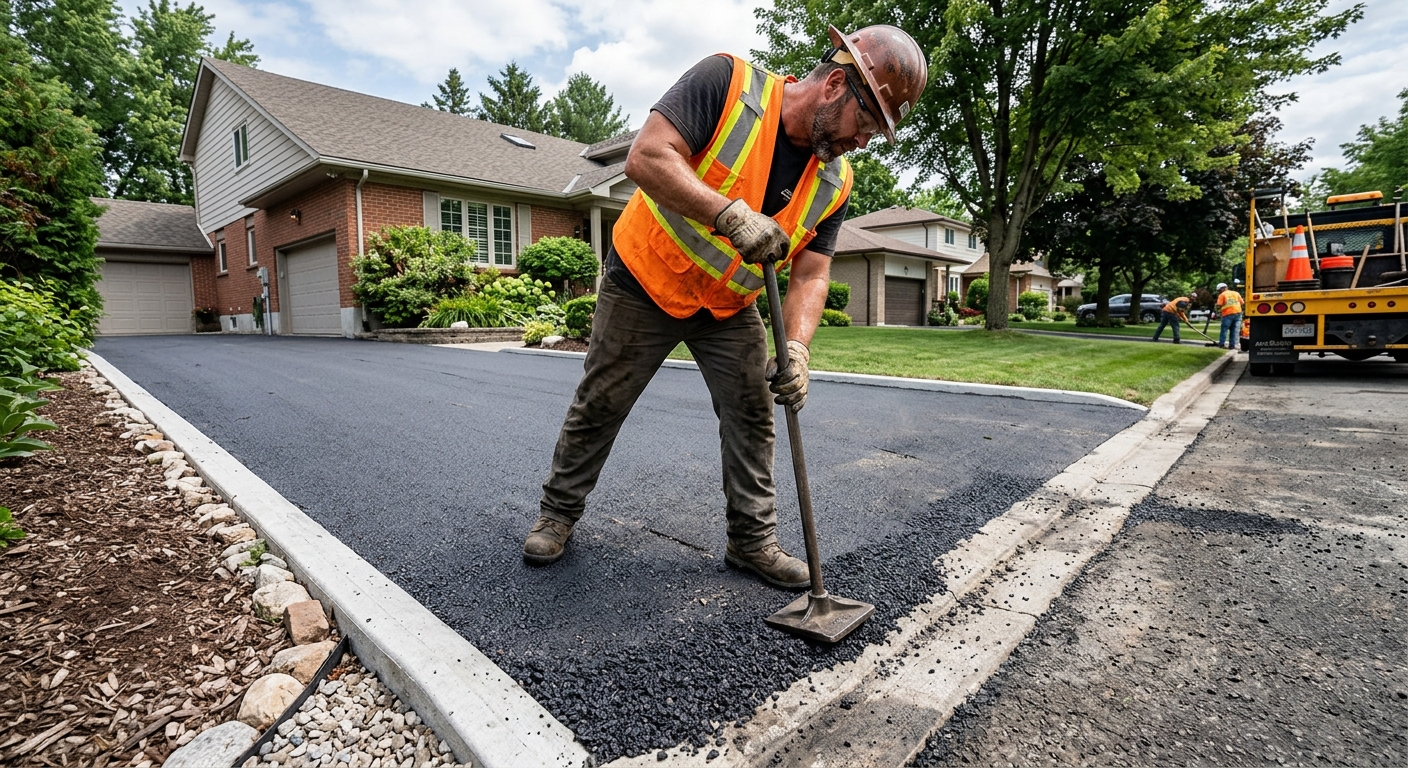
What a new driveway costs in Richland
In Richland, with over half of homes being single-family and an 86.8% homeownership rate (U.S. Census Bureau, ACS 2024), driveway paving is one of the more routine — and quietly expensive — projects you’ll face as an owner. This is true whether the property is a 1950s ranch, a newer colonial, or a rural holdout lane. Driveway pricing here is shaped by our southeastern Pennsylvania freeze-thaw cycles and by what lies beneath: glacial till and silty clay in the soil, which can demand thicker stone bases and careful drainage especially in Lower Bucks. Most of the cost difference between bids doesn’t show up in the surface you see — it’s underfoot, in excavation depth, stone base, and whether the builder put their money into proper compaction or just a thicker blacktop layer.
A typical asphalt replacement in Richland runs $3,800–$9,700, with overlays starting around $1,600. Sealcoating maintenance remains affordable if your base is sound. When comparing quotes, remember that the finish can look identical at first — but a thin base or cheap edge work will show its failure in a couple of winters, not in the weeks after install.
| Service | Best for | Lifespan | Price range |
| Asphalt — full replacement with new base |
failed base, structural cracking |
20–30 yrs |
$3,800–$9,700 |
| Asphalt overlay / resurfacing |
sound base, surface cracking only |
8–15 yrs |
$1,600–$4,900 |
| Sealcoating — single application |
preventive maintenance on sound asphalt |
2–4 yrs |
$225–$750 |
| Concrete — new installation |
long service life, low maintenance |
30–50 yrs |
$5,400–$13,000 |
| Crack filling and patching |
isolated cracks under a quarter inch |
1–3 yrs |
$200–$800 |
| Gravel driveway |
rural, budget, long runs |
5–10 yrs with upkeep |
$900–$3,500 |
Estimates for a typical Richland driveway. Square footage and base condition drive these figures more than material choice.
How to tell if the base is gone
Most homeowners in Richland can spot surface cracks or weeds, but it’s the unseen stone base that matters most. Contractors have a financial incentive in either direction — some pitch an overlay when you need a full replacement, others oversell a dig-out for a driveway that’s just oxidized. Here’s how to check yourself, before you make one of the costliest decisions for your property:
Alligator cracking (interconnected cracks like a reptile’s skin) across a wide area means the stone base has failed. Any patch on top will fail with it — overlays here are just buying a fresh look for a brief spell. Isolated linear cracks are usually surface age, not structural. Shallow depressions or “birdbaths” where water lingers signal subgrade movement, especially in our freeze-thaw climate, and require digging out that section. Crumbling edges mean the original install used no solid edge support. Potholes show water already entered the stone base — critical in areas with silty clay, which holds water right by the base.
An overlay on a failed base is money gone. If a contractor quotes without popping a core or digging a test hole, they haven’t really checked. Insist on a clear diagnosis — here’s what to look for:
| What you see | Likely cause | Right fix | Cost |
| Isolated cracks under 1/4 inch |
surface aging |
crack fill and seal |
$225–$750 |
| Alligator cracking over a wide area |
base failure |
full replacement |
$3,800–$9,700 |
| Depressions holding water |
subgrade movement |
excavate and rebuild that area |
$3,800–$5,900 |
| Crumbling edges |
no edge support |
edge repair, consider curbing |
$400–$1,500 |
| Potholes |
water into the base |
full-depth patch, then assess |
$250–$900 |
| Faded but sound surface |
oxidation only |
sealcoat |
$225–$750 |
Driveway permits, approaches and stormwater rules
In Richland, you typically do not need a building permit just to repave an existing driveway in the same dimensions — so long as you’re not expanding it, you can often skip the trip to the township office. However, where your driveway meets the public road (called the “approach”), different rules apply. On state routes in Bucks County, a PennDOT District 6 Highway Occupancy permit is required for any new or modified driveway approach, not just major construction. Homeowners often overlook this, assuming the driveway permit covers the whole run — it does not.
If you’re expanding your driveway, adding extra width, or changing its shape, the township may require a zoning and stormwater review. Extra impervious surface means more runoff, and re-grading can make you liable if you send more water onto a neighbor’s property — a real issue in Bucks with frequent drainage complaints.
Always verify that any contractor you hire has active Home Improvement Contractor (HIC) registration, as required by the Pennsylvania Office of Attorney General for contracts above $500. Check at hic.attorneygeneral.gov. Pennsylvania employers must carry workers' compensation, which you can check via WCAIS (wcais.pa.gov); this is your protection if anyone is injured on your job.
Comparing paving estimates in Richland
A fair paving estimate in Richland is a document you can read line by line — not just a lump sum at the bottom. Reputable contractors will list the exact square footage measured, the excavation and base specs, the type and depth of aggregate, how many inches of hot-mix asphalt in each course, edge treatment, grading/drainage plans, and how they’ll leave the lawn edge and property. Payment schedule should require only a small deposit up front (as permitted under the Home Improvement Consumer Protection Act), and there should be a written warranty specifying what is and is not covered — most notably, few cover new cracks.
If a proposal is just one sentence with a total price, you cannot compare it, no matter how friendly or well-intentioned the contractor seems. This is the single leading cause of Bucks County homeowners overpaying for work that fails too soon.
| Line item | What to look for | Red flag if… |
| Area |
measured square footage stated |
eyeballed or absent |
| Excavation |
depth and disposal included |
'we'll pave over it' |
| Base |
aggregate type and depth in inches |
'proper base' |
| Compaction |
method, and done in lifts |
not mentioned |
| Asphalt |
courses and compacted depth |
'3 inches' unqualified |
| Drainage |
slope and water direction stated |
silent |
| Warranty |
what is covered and what is excluded |
verbal only |
| Payment |
modest deposit, balance on completion |
full cash up front |
The paving season in southeastern Pennsylvania
Driveway paving in Richland is not a year-round business; it is strictly limited by temperature and material availability. Our winters are marked by a design low of 14 °F, and when those seasons hit, asphalt plants across Bucks County and the Delaware Valley shut down. Paving mix cools too quickly below 50 °F — once this happens, trying to lay an asphalt driveway results in a surface that never compacts properly, stays porous, and fails far sooner than it should.
Concrete has its own tough rule: if it can’t cure above freezing, it’s at risk for surface scaling and poor strength. This means most driveway work here is booked between late April and early November. In the summer, contractors stay booked out, especially through June and July. If a paving crew offers to build your driveway in a mild December or March, this should be a red flag for standards.
Shoulder seasons are where you can catch the best combination of price and crew availability. Our local material supply, thanks to nearby quarries, keeps pricing stable, but no one can “get you in” much outside the standard window — the plants simply aren’t open, and cold weather shortens the work year.
Drainage: the failure nobody plans for
Water destroys more Richland driveways than any traffic load ever will. The first line of defense is proper grading; without it, even the thickest slab or base will eventually fall apart. A residential driveway should pitch away from structures at a minimum 1–2% slope, which translates to a 1/8"–1/4" drop per foot. Flat driveways trap water; in this region’s moderate freeze-thaw climate, that water seeps into the base, then freezes and expands, resulting in heaves and deep cracks by spring.
A cross-slope or a crown can help keep water from pooling down the midline or at the edges. If your driveway slopes toward your house or garage — common on older properties — a surface regrade or trench drain may be required. For runs surrounded by heavy clay (common in Bucks County near the river), surface runoff and subgrade drainage matter even more, since saturated soils don’t let water drain down and away.
Where grading alone cannot carry water away, a channel or trench drain can move it to a safe outlet. “Daylighting” that outlet — running the pipe out to a visible discharge — beats a buried dry well in clay-rich soil, which rarely drains as intended. Remember: sending your runoff directly onto a neighbor’s property invites both complaints and real liability, regardless of permit status.
Asphalt or concrete for a Richland driveway?
The choice between asphalt and concrete for your Richland driveway is not just about price — it’s rooted in climate and how each surface handles our southeastern Pennsylvania winters. Asphalt, with its natural flexibility, tolerates freeze-thaw cycles and the moderate heaving that comes each spring. It bends, recovers, and resists major cracks — the classic “good fit” for Bucks County.
Concrete is rigid. When it works, it lasts decades longer than asphalt — but our salt-heavy winters are not kind to it. Road salt, tracked from driveways and streets, causes scaling and spalling, especially where snow sits and melts repeatedly. The truth: unless you can avoid salt-based de-icers on your own property, concrete’s impressive life can be sharply reduced. Almost no homeowner in a suburban community actually keeps that promise for long.
Pavers offer a top-tier appearance and can handle freeze-thaw well since their joints allow for movement. Gravel remains a practical budget option, especially for longer rural drives, and with proper grading and maintenance, can handle runoff and freezing better than some cheap asphalt installs.
| Option | Installed cost | Maintenance | Freeze-thaw performance | Lifespan |
| Asphalt — new install |
$3,800–$9,700 |
sealcoat every 3–4 yrs |
excellent, flexes |
20–30 yrs |
| Asphalt — overlay |
$1,600–$4,900 |
same |
good if base is sound |
+8–15 yrs |
| Concrete |
$5,400–$13,000 |
low, avoid de-icing salt |
fair, spalls with salt |
30–50 yrs |
| Pavers |
$8,600–$13,000 |
individual units replaceable |
good, settles gradually |
25–50 yrs |
| Gravel |
$900–$3,500 |
top-dress every 2–3 yrs |
excellent drainage |
indefinite with upkeep |
Frequently asked questions — driveway paving in Richland
Why does my driveway have depressions that hold water?
Depressions — sometimes called “birdbaths” — form when the stone base or subgrade settles unevenly, often under the weight of parked vehicles or due to water pooling. In Richland, where glacial till and silty clay soils are common, these soft spots develop more quickly if drainage isn’t managed. The real culprit is water: when it collects, penetrates the asphalt, and then freezes during winter, it expands, breaking down the support underneath. Eventually, the surface slumps into the weak spot. Fixing this means cutting out the affected area, rebuilding the base, and patching with hot mix — a targeted repair priced around $3,800–$5,900 for a serious case. Spot fixes are worthwhile if the problem is limited, but widespread depressions signal it’s time to consider a complete replacement.
Is gravel a cheaper option in Richland?
Gravel is the most affordable paving solution you’ll find in Richland, especially if your driveway is long or heavily trafficked by nonpassenger vehicles. Installation costs fall in the $900–$3,500 range, depending on length and grading needs. Gravel drains exceptionally well in our local soil, which is helpful for managing freeze-thaw issues. You’ll need to budget for periodic top-dressing every couple years to keep it smooth and rut-free, and dust or loose stone is part of the deal. While gravel can’t match the finished appearance of asphalt or concrete, for rural or semi-rural properties — or when you want a quick, low-commitment fix — it’s an honest, workable solution in much of Bucks County.
How thick should asphalt be for a residential driveway in Richland?
A proper asphalt driveway in Richland should have at least 4 inches of compacted hot-mix asphalt over 6 to 8 inches of well-compacted, crushed stone base. The stone base is crucial, since Richland’s silty clay and glacial till require solid support to prevent settling during freeze-thaw cycles. Thinner sections may save money up front, but they are a false economy in Bucks County’s climate — they’re more likely to crack, rut, or develop potholes after a few winters. For a standard two-car driveway, expect to pay $3,800–$9,700 for new asphalt with a properly installed base.
How much does it cost to widen a driveway?
Widening an existing driveway in Richland usually costs less than a complete replacement, but the price depends on how much new excavation and stone base are required. Generally, you’re looking at the same rate per square foot as the rest of your drive. For example, adding a single-car parking bay might cost $1,600–$4,900, comparable to an asphalt overlay, if the subgrade is good. If new base or significant grading is needed for drainage, it will be closer to the higher end of that window or above. Always check for local zoning or permit requirements before you start, especially if you’re changing the impervious surface area.
How many freeze-thaw cycles does Richland get?
Richland sees dozens of freeze-thaw cycles each year, a direct result of our moderate winters and humid climate. These cycles matter because water that seeps through cracks and sits in the base will expand when frozen, causing heaving, cracking, and deterioration. It’s the main reason Bucks County driveways, especially those put down over poorly drained or thin stone bases, fail sooner than expected. Although there’s no exact number for a single winter, it’s enough that driveway replacements (typically $3,800–$9,700 for full asphalt) should always factor freeze-thaw movement into design and material choice here.
Do I need a permit to repave a driveway in Richland?
If you’re repaving your driveway in its existing footprint in Richland, you generally do not need a new building permit. Most Bucks County municipalities only require permits for new or expanded driveways, not resurfacing old ones. However, if your driveway meets a state route, you’ll need a Highway Occupancy permit for the approach from PennDOT District 6. Ignore permit needs and you risk delays or having to tear up new work. For projects over $500, you must have a written contract under Pennsylvania law, and your contractor must be registered with the Attorney General.
What is the difference between crack filling and sealcoating?
In Richland, crack filling and sealcoating are two key maintenance strategies, but they do different jobs. Crack filling targets specific cracks wider than 1/8" but less than 1/4", using hot-pour or cold-pour material to slow water intrusion and limit base damage. Sealcoating is a thin surface treatment that protects the whole drive from ultraviolet rays and minor surface oxidation but won’t fix cracks or structural issues. Think of crack fill as preventive dentistry — targeted work; sealcoat as sunscreen for the asphalt. Crack fill service usually starts around $225–$750, while a full sealcoat typically lands in a similar range. Done together, they can add years to a still-sound driveway here.
Can I pave over my existing driveway?
Paving over an existing Richland driveway, called overlay or resurfacing, can be a smart way to save money if the stone base and existing asphalt are in solid condition — which means no widespread alligator cracking, depressions, or base movement. The rough price for an asphalt overlay runs $1,600–$4,900. But overlays fail fast if the base underneath is already compromised; you’re hiding the problem, not fixing it. Before deciding, a reputable contractor should core-sample or dig a test hole to check the condition underneath — if they don’t, find someone else. Overlay is not a fix for fundamental structural issues in this climate.
How long before I can drive on a new asphalt driveway?
In Richland, it’s safest to wait at least 2–3 days before driving on new asphalt. You can walk on it after 24 hours, but vehicle traffic too soon can cause scarring, depressions, or even ripples, especially in warmer summer weather when the surface remains softer. For the first couple weeks, avoid parking in the same spot or turning wheels sharply while stationary. Waiting ensures your investment — which could run $3,800–$9,700 for a new asphalt drive — performs and lasts as intended. If temperatures soar right after install, consider waiting a bit longer. Your contractor will give the best timing based on local conditions.