What a new driveway costs in Coatesville
Coatesville homeowners face a different driveway decision than most. Only about one in five homes here are single-family, and the homeownership rate sits below 40% (U.S. Census Bureau, ACS 2024). That means for the houses that do have driveways, the investment per property tends to be higher and the quality of construction varies — especially in older blocks built before the 1980s. Add in southeastern Pennsylvania’s freeze-thaw cycles and a subgrade that often sits over limestone and dolomite, and your real concern is what lies beneath the blacktop, not just the surface you see.
Much of the price difference between two quotes for the “same” job comes down to what’s below the surface — excavation, thickness and compaction of the base, and the attention to drainage detail. You can't judge that from the curb, but it's the difference between a driveway that lasts decades and one that cracks in a couple years.
| Service |
Best for |
Lifespan |
Price range |
| Asphalt — full replacement with new base |
failed base, structural cracking |
20–30 yrs |
$3,800–$9,900 |
| Asphalt overlay / resurfacing |
sound base, surface cracking only |
8–15 yrs |
$1,650–$4,900 |
| Sealcoating — single application |
preventive maintenance on sound asphalt |
2–4 yrs |
$225–$750 |
| Concrete — new installation |
long service life, low maintenance |
30–50 yrs |
$5,500–$13,000 |
| Crack filling and patching |
isolated cracks under a quarter inch |
1–3 yrs |
$200–$800 |
| Gravel driveway |
rural, budget, long runs |
5–10 yrs with upkeep |
$900–$3,500 |
Estimates for a typical Coatesville driveway. Square footage and base condition drive these figures more than material choice.
What's under the asphalt matters more than the asphalt
Any driveway in Coatesville is only as good as what’s under the surface. From the bottom up, you have untouched subgrade (the native soil), then a compacted aggregate base, then finally your surface asphalt or concrete. Each layer has to do its job — distributing load, draining water, and resisting the effects of Central Chester County’s freeze-thaw cycles.
Here, with subgrade often on limestone and dolomite, settlement is a real risk and ground shifts can show up as reflective cracks if the base is thin or loose. The real killer is frost heave. Come winter, any water trapped in the subgrade expands when it freezes, lifting the driveway unevenly and cracking the surface from below. Once water gets through, the process compounds every year. That’s why, in Chester County, base depth and drainage aren’t just formalities — they’re essential for a decent service life.
Cheap quotes almost always skip in the same places: not excavating deep enough to remove soft or wet soils, skimping on the aggregate base, skipping compaction, or just laying new asphalt right over a failed or heaved original. None of this is visible on paving day. It’s obvious by year three, when cracks, settling, or potholes start cropping up.
For a reliable driveway here, you should insist— in writing — on at least 6–8 inches of compacted, 2A modified crushed stone aggregate beneath asphalt, compacted in multiple lifts with a vibratory roller, not all at once. If you hear “no need to excavate” or “we’ll just put a topper,” be prepared to pay again soon.
What you need before paving in Coatesville
For most homes in Coatesville, redoing your driveway within its existing footprint won’t require a building permit — Chester County townships commonly allow resurfacing or interior full-depth replacement without filing, as long as you’re not within the road right-of-way. That removes a headache for most, but there’s a catch: the driveway approach, where it meets the street, usually does need a separate permit. If your driveway connects to a state route, you’ll need a Highway Occupancy driveway approach permit from PennDOT Engineering District 6-0. Local township code offices handle permits for driveways meeting township roads. For any work in the public right-of-way, check with your township before starting, especially for expansions or rerouting.
If you expand your driveway or add impervious area, Chester County’s fragmented stormwater rules come into play. Adding more runoff, or grading so it flows onto your neighbor’s property, can bring consequences regardless of what your permit says. Sheet runoff that leaves your property isn’t just inconsiderate — it’s a liability.
Whoever you hire must have a valid Home Improvement Contractor (HIC) registration — verify this at hic.attorneygeneral.gov. For any crew, workers’ compensation insurance is mandatory by state law. Ask for proof, and double-check through the WCAIS system (wcais.pa.gov) before signing a contract.
The honest case for and against sealcoating
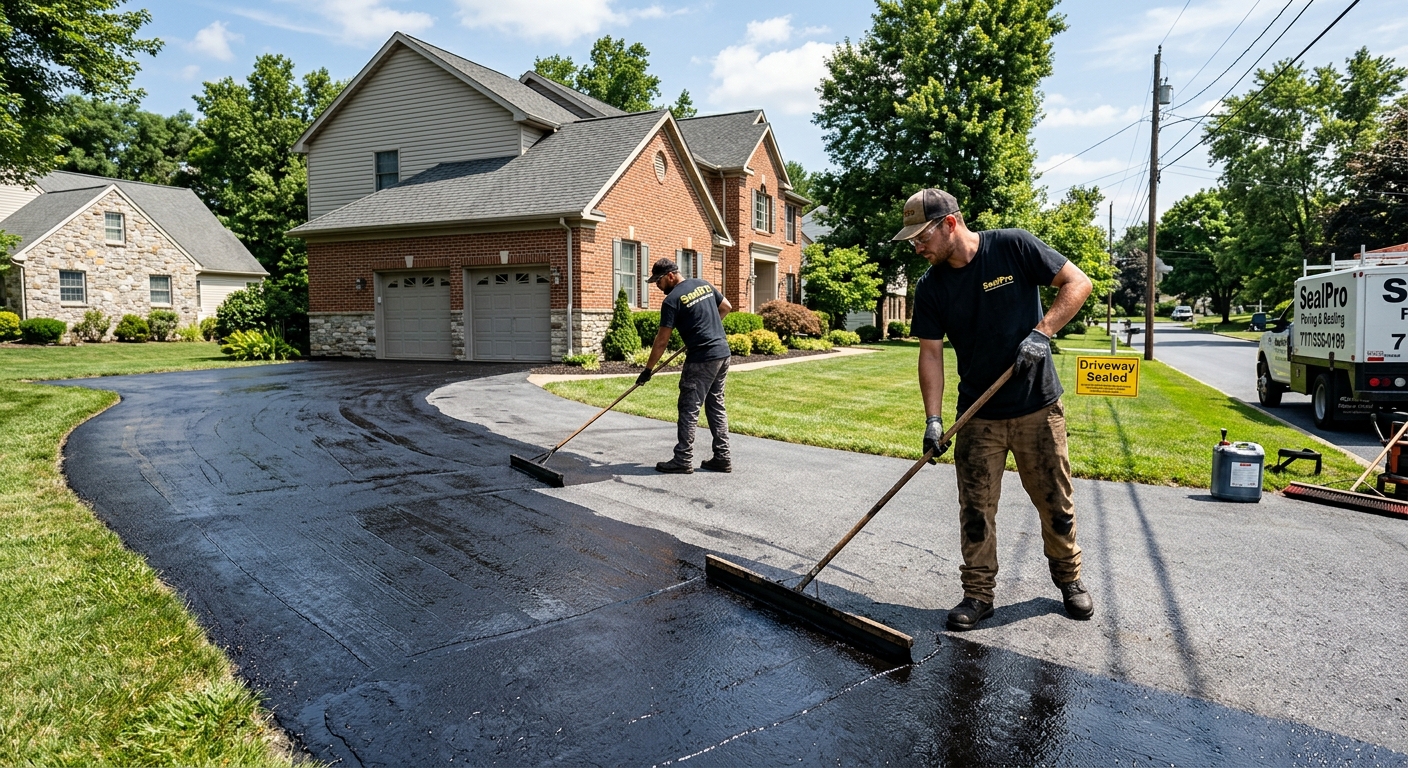
Sealcoating in Coatesville has its place — and its limitations. It’s sold as a cure for everything, but what it really provides is a sacrificial surface coat that slows oxidation from sun and keeps surface oils, gas, and de-icers from soaking into your asphalt. It does make your driveway look fresh, and on a sound base, it buys time by keeping water (and UV) from breaking down the asphalt binder too quickly.
What it doesn’t do is add strength. It will not prevent deeper cracks, stop base movement, or restore life to an asphalt driveway that is already failing. If the base is bad, sealcoating is only a cosmetic fix.
The truth few contractors admit: sealing too often — especially “special” offers every spring — builds up layers that crack and peel, ultimately trapping moisture and speeding deterioration. On a newly paved drive, you must let the asphalt cure for a few months (at least) before sealing, or you’ll trap volatiles that cause soft spots and peeling.
For most Coatesville properties, a reasonable sealcoating interval is every 2–4 years. The first application should wait until the blacktop is fully cured. Crack filling is actually more important for long-term health than sealing. A proper crack filler is hot rubberized sealant, not a thin spray or cold pour.
If a price is well below $225, you’re probably just buying a water-thin surface spray that looks good for a few months, then peels at the first freeze.
Local soil, drainage and driveway lifespan
Coatesville sits atop limestone and dolomite bedrock, which changes how a driveway performs. These soils are prone to settlement because of the underlying bedrock’s natural voids and shifts. Water can channel through the limestone, undermining the aggregate base if it’s too thin or not well compacted. Asphalt and concrete need a thicker, well-drained base here than in neighboring counties where glacial till or heavier clay dominates.
The region’s frost depth of 30 inches and regular freeze-thaw cycles make water management essential. If water gets trapped above the limestone and freezes, expect heaving and early cracking. Large tracts near Exton and West Goshen, built from the 1960s through 1980s, rarely got a modern base; many older driveways were laid straight onto marginal fill or even directly on subgrade with only a skim of stone.
If your house was built before the 1980s, your best bet for a durable result is a full-depth replacement with new base, not just a top-layer overlay.
Caring for a new Coatesville driveway
If you want your new driveway to last in Coatesville, the most important (and cheapest) step is crack filling before water can get into the base. Once water reaches the stone layer, every freeze-thaw cycle will push the cracks open further and lead to potholes.
Keep the driveway edges supported with soil or sod to prevent edge breakage. Make sure gutters, downspouts, and yard grading keep water moving away from the pavement. Avoid parking dumpsters or leaving jack stands in one spot: concentrated loads will dimple asphalt (they may even crack concrete).
With new asphalt, don’t park on it or turn steering wheels while stationary for 2–3 days in warm weather; longer if it’s cool. It needs time to harden.
On de-icing: Avoid salt on concrete — it will pit and spall the surface. Instead, use calcium magnesium acetate or plain cat litter for traction, though both cost more. On asphalt, salt won’t do much direct harm, but rapid melting followed by freezing accelerates surface wear and opens cracks. Shovel early and don’t let meltwater pond.
Grading and water management on a Coatesville driveway
Water is behind almost every driveway failure I see in Coatesville. Getting the slope and drainage right isn’t a finishing touch — it’s what protects your investment. A minimum slope of 2% (about a quarter-inch per foot) away from the house or garage keeps water moving. Your choices are a crowned surface (center higher, sheds both ways) or a cross-slope to one side.
If your driveway slopes toward the garage or home — a common problem with older houses — you’re asking for water intrusion and foundation headaches. Where grade can’t be corrected directly, install trench or channel drains at the low point, and make sure their outlets “daylight” out into your yard, or route them to dry wells that won’t back water up into the base.
Freeze-thaw cycles throughout southeast PA mean water trapped under the driveway will freeze, expand, and lift the pavement — the start of most potholes and cracks. With the local limestone and dolomite subgrades, poor drainage can also trigger soil settlement below your base, creating even faster failures.
Redirecting water onto a neighbor’s property is a quick way to start a dispute or even see legal action, regardless of your permit. Plan to keep runoff on your lot, and manage it with grading and subsurface drains if need be.
Frequently asked questions — driveway paving in Coatesville
Does road salt damage driveways in Coatesville?
Salt has different effects depending on the surface. On concrete driveways in Coatesville, repeated salt application will attack the surface, causing scaling and pitting, especially where freeze-thaw cycles are common, as they are here. On asphalt, salt is less aggressive, but rapid melting and refreezing can worsen cracks and potholes, shortening the lifespan. If your driveway is new or you’ve invested in a full replacement with new base — $3,800–$9,900 for asphalt or $5,500–$13,000 for concrete — it’s wise to use alternative de-icers like calcium magnesium acetate, or plain sand for traction, especially during the first few winters. Proper grading and early shoveling also reduce the need for harsh de-icers.
Should I repair or replace my Coatesville driveway?
The answer depends on your base. If you have widespread, deep cracks, settlement, or potholes, especially in a Coatesville neighborhood where many homes date from the 1960s–80s, a patch or overlay is only a band-aid. With a failed base, only a full-depth replacement ($3,800–$9,900 for asphalt) gives you a long-term fix. Small, isolated cracks and minor edge damage can sometimes be handled with crack filling and patching ($200–$800). If your base is holding up and only the surface layer is showing age, an overlay ($1,650–$4,900) can add years for less. But don’t throw good money after bad on a compromised base — it’ll cost more in the long run.
How deep should the aggregate base be here?
In central Chester County, including Coatesville, subgrades are dominated by limestone and dolomite that settle unpredictably if not properly bridged. For residential driveways, insist on a base depth of at least 6–8 inches of 2A modified crushed stone, compacted in multiple lifts. This is deeper than you’d need in places with denser, more stable soils but is justified here by the freeze-thaw cycles and local bedrock conditions. Skimping here is the surest way to see cracks and settling within a few years, even if you paid for a premium surface. If your quote doesn’t specify base thickness, push for details before you sign, especially given install prices of $3,800–$9,900 for a full asphalt replacement.
How much does it cost to widen a driveway?
Widening a driveway in Coatesville means new excavation and base, matching the existing surface elevation, and possibly additional drainage. The cost depends on how many feet you want to add, but as a rule, expect at least $3,800 for a significant extension with new base — sometimes more if your project triggers permit or stormwater reviews. For small widenings, like adding a strip for a second car door, numbers might start under $2,000 if drainage is straightforward. Don’t forget: tying in new paving with old, especially for asphalt, requires careful seam work, and matching your old driveway’s condition can be the tricky (and costly) part.
What causes driveway cracks in Coatesville?
Most driveway cracks in Coatesville come from two sources: base movement and water infiltration. Our region’s repeated freeze-thaw cycles expand and contract water trapped beneath the surface, leading to both heaving and settling — especially common on limestone and dolomite soils with less consistent support. Poor original base prep (thin or uncompacted stone), neglected drainage, and surface damage from plowing or heavy loads speed up the problem. Preventing cracks starts with a thick, well-drained base, prompt crack filling, and good grading. Anything less, especially on driveways dating to the 1960s–80s, means you’ll be paying for repairs or overlays at $1,650–$4,900 far sooner than you should.
What does an asphalt overlay cost in Coatesville?
Overlaying an asphalt driveway in Coatesville, assuming the base is sound and there’s no deep settling or root damage, generally runs $1,650–$4,900 for a typical-sized residential drive. This gives you 8–15 years of usable life, but is only suitable if your underlying base is meeting standards. If the base is compromised, overlays are a short-term fix, and you’re likely looking at recurring cracks and repairs. Since haul distances are short thanks to nearby quarries and asphalt plants, pricing here is competitive, but don’t let that push you into a project that won’t last. Always have the base checked before deciding on an overlay.
Does sealcoating fix cracks?
No, sealcoating will not fix cracks in a Coatesville driveway. It’s a surface treatment, not a structural repair. Sealers do improve appearance and limit minor oxidation or oil stains, but they cannot bond or waterproof a driveway that already has open cracks. Those simply let water in below the surface, worsening freeze-thaw damage. For cracks under a quarter inch wide, hot rubberized crack filling (typically $200–$800 for a round of repairs) is the right first step. Only after filling should you consider sealcoating ($225–$750) — and only on a sound surface. Any sealcoating applied over unfilled cracks or a failing base is just temporary camouflage.
How long does a driveway installation take?
For most Coatesville homes, a full-depth asphalt replacement usually takes 2–3 days on-site, plus some curing time before use. Day one is excavation and base, day two is paving, with curing and fine details (edges, cleanup) overlapping. Concrete installations need longer — generally 3–4 days including setup and final finishing, plus at least 7 days’ wait before parking on it. Scheduling is flexible here since local aggregate and asphalt supplies are close by and delays are rare. Overlay or sealcoating projects ($1,650–$4,900 and $225–$750 respectively) can often be done in a day or less. Always allow extra time for weather delays, especially in the spring and fall when freeze-thaw swings are still possible.
Do I need a permit to repave a driveway in Coatesville?
In most Coatesville neighborhoods, resurfacing or fully replacing your driveway within its existing footprint does not require a building permit — this is typical in Chester County townships. However, if your work extends into the public right-of-way or you’re rebuilding the driveway approach where it meets the street, you will likely need a permit, possibly from PennDOT Engineering District 6-0 for state roads. Expanding the driveway or altering the drainage can also bring stormwater review requirements. Always check with your local township code office before starting. For all jobs over $500, Pennsylvania law requires a signed written contract and a Home Improvement Contractor registration.