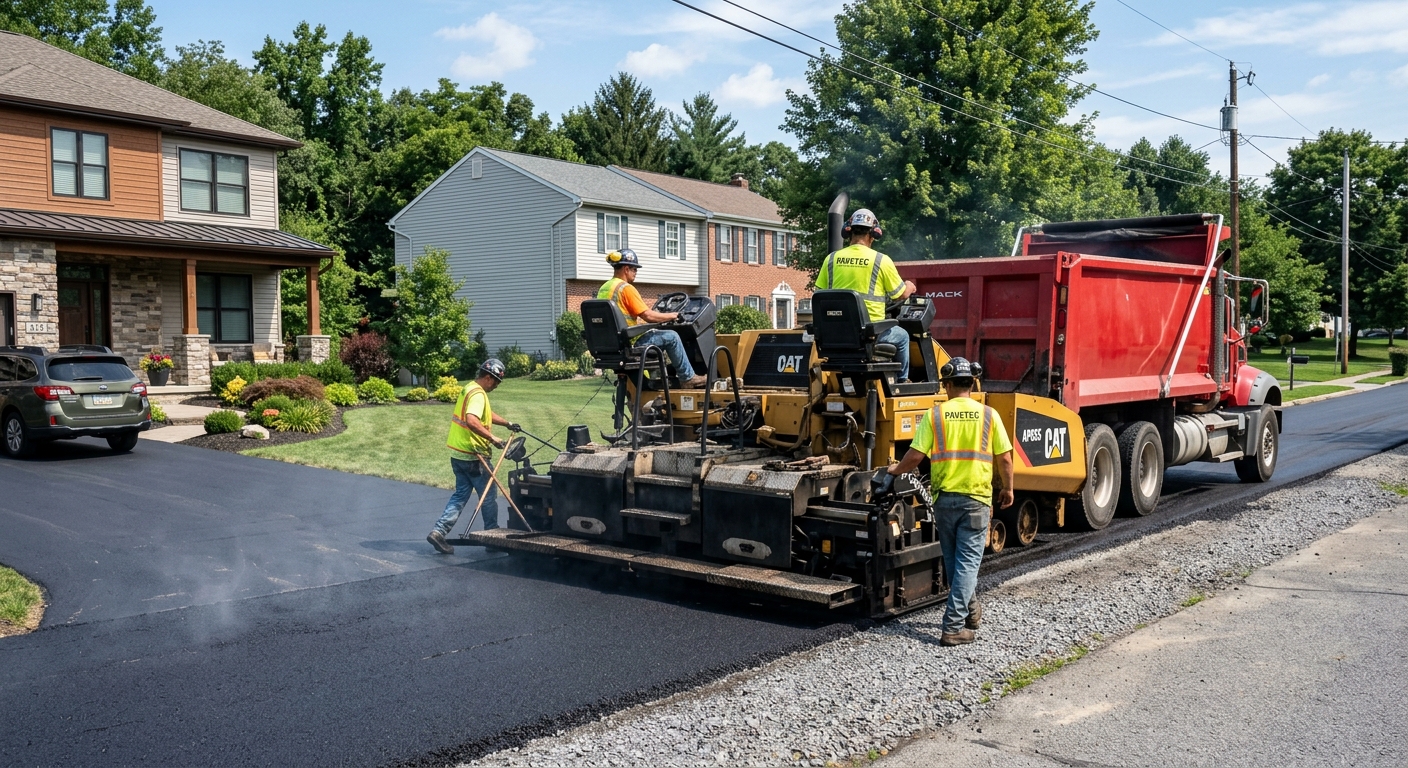
What a new driveway costs in Dallas
In Dallas, Pennsylvania, most homes are single-family (69.7%) and the vast majority are owner-occupied (76.6%), making driveway paving a common project and one that typically adds value. For local homeowners, replacing or upgrading a driveway is more than just curb appeal—it preserves access through Luzerne County’s long winters and rainy spring thaws.
Driveway paving costs here reflect two facts many overlook: Luzerne County sits on glacial till and shale, which means subgrade moves if not handled right, and winters bring harsh freeze-thaw swings. This combination is rough on asphalt or concrete unless the base is built thick and drains well. Most price differences between paving bids depend less on the asphalt itself than on what goes underneath—how deep the crew excavates, how much stone base is used, and whether the compaction is done right. These steps get covered up, so the lowest quote often misses the work you can't see—until cracks and dips show up in a few years.
| Service |
Best for |
Lifespan |
Price range |
| Asphalt — full replacement with new base |
failed base, structural cracking |
20–30 yrs |
$3,600–$9,200 |
| Asphalt overlay / resurfacing |
sound base, surface cracking only |
8–15 yrs |
$1,550–$4,600 |
| Sealcoating — single application |
preventive maintenance on sound asphalt |
2–4 yrs |
$200–$700 |
| Concrete — new installation |
long service life, low maintenance |
30–50 yrs |
$5,100–$12,000 |
| Crack filling and patching |
isolated cracks under a quarter inch |
1–3 yrs |
$200–$800 |
| Gravel driveway |
rural, budget, long runs |
5–10 yrs with upkeep |
$900–$3,500 |
Estimates for a typical Dallas driveway. Square footage and base condition drive these figures more than material choice.
Permits and approvals for paving in Dallas
If you are resurfacing or patching a driveway in Dallas, and the work stays within your current footprint, you typically do not need a building permit — Hazleton, another Luzerne County municipality, does not require permits for patching as long as drainage is unchanged. But if you’re expanding, replacing, or altering the layout so the impervious area increases, local municipalities such as Wilkes-Barre may require a zoning or building permit. These permit requirements vary town by town across Luzerne County, so always check with your local code or zoning office before starting work.
The driveway approach is a separate issue. When you tie into a state route in Luzerne Borough, for example, it’s PennDOT District 4—not your local municipal office—that issues a Highway Occupancy Permit. This is easy to miss and will hold up final inspection if overlooked.
Stormwater management is another hurdle. Adding impermeable surface can trigger runoff regulations, and pushing water onto a neighbor’s land—whether permitted or not—opens you up to a civil claim. Good drainage is both a legal and practical necessity here, given our late winter freeze that aggravates foundation issues.
Who you hire matters, too: any contract over $500 in Pennsylvania requires a registered Home Improvement Contractor. You can (and should) verify this at hic.attorneygeneral.gov. Employers must furnish workers’ compensation, and verification is available via WCAIS (wcais.pa.gov). Don’t rely on a contractor’s word—check both before you sign.
How to tell if the base is gone
Your base holds everything together, but base failure hides under the surface—easy for a contractor to miss or misrepresent. You can perform a basic self-diagnosis in Dallas before calling for bids. If you see “alligator cracking” (dense cracks making a scaly pattern) across more than a single spot, that usually signals deep base failure. Overlays on this base waste money; the cracks will reflect back in a season or two. Isolated, straight cracks signal surface aging and are often fixed by crack filling and resealing.
Depressions that collect water—what contractors call “birdbaths”—usually mean the subgrade has shifted, a common problem on Luzerne County’s glacial till soils. Edge crumbling points to poor or missing base support along the edge. Potholes mean water has already reached and weakened the base, and a patch is only a bandage until the root cause is fixed.
If a contractor recommends an overlay without probing down to the subgrade, that’s a red flag. Repairs are either band-aids or permanent—no in-between when the base is in question.
| What you see |
Likely cause |
Right fix |
Cost |
| Isolated cracks under 1/4 inch |
surface aging |
crack fill and seal |
$200–$700 |
| Alligator cracking over a wide area |
base failure |
full replacement |
$3,600–$9,200 |
| Depressions holding water |
subgrade movement |
excavate and rebuild that area |
$3,600–$5,600 |
| Crumbling edges |
no edge support |
edge repair, consider curbing |
$400–$1,500 |
| Potholes |
water into the base |
full-depth patch, then assess |
$250–$900 |
| Faded but sound surface |
oxidation only |
sealcoat |
$200–$700 |
Changing the footprint of a Dallas driveway
When you widen your driveway for a second vehicle, extend to a detached garage, or add a new parking pad in Dallas, you’re not just paving—you’re building new foundation. These projects always require a fresh stone base over undisturbed subgrade. The seam where new and old meet will always be a future weak point, so build it right to avoid cracks and settling at the joint in Luzerne County’s freeze-thaw cycle.
Every new square foot of impervious surface can trigger local runoff rules or stormwater management requirements, especially if the extension shifts where your water drains. If your new approach connects to a state road in Luzerne Borough, PennDOT District 4’s permit is mandatory. Don’t start digging until all permits are confirmed, even for items like widening for another car—some towns may have setback or side-yard limitations, which matter in Dallas with its small-lot housing stock.
Lastly, if you’re converting a gravel run to asphalt, expect to excavate out any loose or organic material—shortcuts here show up as depressions and cracks after one winter. Always plan for a full new base, not just a topping.
What's under the asphalt matters more than the asphalt
Your driveway in Dallas is only as good as what’s beneath it. The basic assembly is: undisturbed subgrade soil at the bottom, then a compacted aggregate (crushed stone) base, then your finished asphalt or concrete. Each layer’s purpose is to spread vehicle load to the layer below. If your base is too thin, or poorly compacted, even the thickest asphalt will crack and shift—especially with Luzerne County’s glacial till and shale soil, which move easily under water and freezing.
The northeast Pennsylvania climate adds another stress—deep freezes, high snow load, and a frost depth of 36 inches. Frost heave happens when water in the subgrade freezes in winter, pushing slab or asphalt upward. When the ice melts, the ground settles back unevenly, leaving cracks, low spots, and sometimes buckled pavement. The cure is a thick, well-drained base—never less than 8 inches compacted 2A modified stone for asphalt—to keep water moving away from the drive and prevent subgrade saturation. In glacial till areas, a 10–12 inch base isn’t excessive.
If a quote shows unusually low pricing, expect one or more shortcuts: minimal excavation, laying new asphalt over failed pavement, too-thin base, or base that’s not compacted in “lifts” (thin layers compressed individually). Bad prep isn’t visible when the crew packs and leaves, but you’ll see the results by year three—cracks, dips, weeds sprouting through. Always demand in writing: base depth in inches (not “4 inches, more if needed”—set an exact number), the aggregate type (2A modified stone for Luzerne County soils), and confirmation that compaction is done in lifts.
Finding a legitimate paver in Luzerne County
With a saturated paving market in Luzerne County, good contractors stand out by having roots—usually a physical business address, company-owned equipment, and supplier relationships with local Wilkes-Barre or Hazleton plants. Ask which asphalt plant they buy from; if they can’t name it, you’re speaking with a broker at best.
Always verify their Home Improvement Contractor registration at hic.attorneygeneral.gov and workers’ compensation coverage via WCAIS. For any contract above $500—even a two-car overlay—state law requires it.
- Home Improvement Contractor (HIC) registration verified online
- Workers’ compensation coverage checked on WCAIS
- Company address (not a PO box or mobile)
- Owned, local paving equipment (not all rental or out-of-town)
- At least three references from 3+ years ago, in Luzerne County
- Willing to explain base prep and drainage plan
- Supplier relationships—can name their local asphalt plant
- Contract includes exact base depth and aggregate spec
- Describes compaction process in lifts
- Written contract covering all work and warranty
- Accepts check or card, not cash-only
- Provides current proof of insurance on request
Red flags include a lack of paperwork, vague or verbal estimates, refusal to name a supplier, reliance on rental equipment, and no track record in Luzerne County. If you can’t verify them against the registry and they dodge detailed questions, move on.
How paving fraud actually operates
Paving attracts fly-by-night groups for one reason: the job is visible from the street; the problems appear years later, after your check is cashed and their phone’s disconnected. Dallas and other Luzerne County towns see scams ramp up every spring because the market is saturated and rural, making property-to-property verification harder. Some common hustles:
“Leftover asphalt from a job down the road”—there’s never enough left to do another full job right. “Only today at this price”—if you hesitate, they vanish. Unmarked trucks with out-of-state plates, cash-up-front requirements, or verbal-only quotes with no written scope. Watch for thin, oil-based spray passed off as commercial sealcoating, sometimes sold door-to-door.
Under Pennsylvania law (the Home Improvement Consumer Protection Act), a written contract is required for any home paving over $500, and you get a three-business-day right to cancel. Don’t sign away this right and don’t put cash down for “discount” materials. Never let a contractor offer to “waive” your insurance deductible on repairs—it’s illegal, and a sure sign you’re being hustled.
These scams die fast when you take five minutes to verify the contractor’s HIC registration online, demand a written contract, and insist on a reference from a job at least three years old in Luzerne County. All legitimate contractors expect this.
Frequently asked questions — driveway paving in Dallas
How much does driveway paving cost in Dallas?
In Dallas, Pennsylvania, the price to pave a residential asphalt driveway ranges broadly depending on condition and size, but most full replacements with new crushed stone base fall between $3,600–$9,200. Resurfacing—meaning a new layer over a sound base—is notably cheaper, usually $1,550–$4,600. Concrete options run higher, and minor repairs are less. Your actual cost is mostly determined by driveway square footage and the depth of preparation required for our local glacial till soil. Unlike some regions, cutting corners here leads to rapid cracking and rutting within a couple winters. Always demand details on the scope of prep work included in every bid; the differences are under the surface.
Do I need a permit to repave a driveway in Dallas?
In most of Dallas and surrounding Luzerne County, a simple resurfacing or patch that doesn’t alter your driveway’s size or drainage pattern won’t trigger the need for a municipal permit. However, if you plan to enlarge the footprint, pour new concrete, or change where your driveway connects to a public road, permits from your municipality—or in Luzerne Borough, from PennDOT District 4 for state roads—are required. Fines for skipping this step can be steep, and you risk being forced to remove work that isn’t compliant. Permitting protects you from future drainage and property line disputes, which are common in our older, high-density neighborhoods. In short: for just patching or sealing, likely no permit; for new layout or approach, check before you start.
Is an overlay worth it or should I start over?
In Dallas, overlays have a place—but only on driveways with a solid, unmoving base. If your base is intact and you just have surface cracking, a new asphalt layer can give 8–15 years of use ($1,550–$4,600). If the base is failing—indicated by widespread alligator cracking, deep depressions, or edge crumbling—an overlay is money wasted. Those underlying issues will telegraph right through, sometimes before your first Luzerne County winter is even over. Always have the base checked before anyone quotes an overlay, and ask the contractor to core or dig a small section if there’s any doubt. In Dallas’ climate and soils, peace of mind is worth the cost of a replacement when the base goes.
Why does my driveway have depressions that hold water?
Depressions, or “birdbaths,” in Dallas driveways usually point to subgrade settlement—which is especially common here because of our glacial till and shale soils. Water pools in these low spots, penetrates cracks, and worsens freeze-thaw cycles, leading to faster base failure and driveway cracks. Sometimes it’s from heavy trucks or installers using too little or poorly compacted stone base. Fixing a depression means excavating and rebuilding the affected area with the right base ($3,600–$5,600 if widespread). Simple patching won’t solve the problem long-term in this environment, with our harsh winters and frost depth. Always ask that all soft or loose soil be removed and replaced with compacted 2A modified stone in local repairs.
How thick should asphalt be for a residential driveway in Dallas?
In Dallas, where frost heave and shifting soils are facts of life, you should never accept an asphalt driveway poured less than 3 inches thick—measured after compaction. But thickness of the stone base below is even more important. For Luzerne County soils (glacial till and shale), a minimum of 8 inches of compacted 2A modified stone is standard, but 10–12 inches isn’t overkill and may save you money on repairs later. The combined structure protects against rutting, heave, and cracking during our deep winter freezes. If your quote only mentions the asphalt surface and not the full assembly, ask for specifics; underbuilt bases are why most driveways here fail within ten years.
When can I seal a brand new asphalt driveway?
For Dallas homeowners, patience pays off: don’t seal a new asphalt driveway until it has cured for at least 90 days in warm weather, or one full winter if you finish late in the season. Early sealing traps oils that slow down proper hardening, leading to scuffing and stains. Our climate—with long, cold winters—means the curing process can stretch out, so plan for a first sealcoating in late spring or early summer rather than rushing right after installation. Expect to pay $200–$700 depending on driveway size. Regular sealing every 2–4 years keeps cracks from starting, particularly important with freeze-thaw in Luzerne County.
Is gravel a cheaper option in Dallas?
In Dallas, gravel remains the budget-friendly choice—especially for long rural runs or where historic homes restrict paving. You’ll spend $900–$3,500 for a typical install, which is less than even a resurfaced asphalt drive ($1,550–$4,600). Gravel’s main downside is ongoing maintenance: annual replenishment and grading are needed, since our wet springs and snows move material around, and local glacial soils can be soft. Still, for low-traffic areas or if you want a temporary access improvement until you’re ready to commit to paving, gravel is an honest option in Luzerne County.
What kind of soil is under Dallas driveways?
Dallas sits in a zone dominated by glacial till and underlying shale. This local soil is silty, holds water, and moves with freeze-thaw cycles. For driveways, that means there’s always a risk of rutting, settling, or frost heave without a thick, compacted stone base (usually 8–12 inches of 2A modified stone). If your base isn’t built for local conditions, your investment—even at $3,600–$9,200—may not last the way it should. This is why Dallas contractors almost never cut corners on base prep if they plan to put their sign in your yard.
How long does a driveway installation take?
The actual paving itself, barring weather, usually takes one to two days for an average two-car Dallas driveway. Preparation—grading, base installation, and any drainage work—adds another day or two, for a total of 2–4 days on-site. Concrete drives can require longer cure times before vehicles can use them. Add extra time if you’re expanding the footprint or correcting drainage. Scheduling in Luzerne County can be tight during peak season, and weather holds things up in spring and late fall, thanks to our high precipitation and low temps. Even so, a full replacement project in Dallas should rarely disrupt your access for more than a few days, especially if your contractor keeps their own equipment and materials close by. Expect to pay $3,600–$9,200 for a full replacement within this time frame.