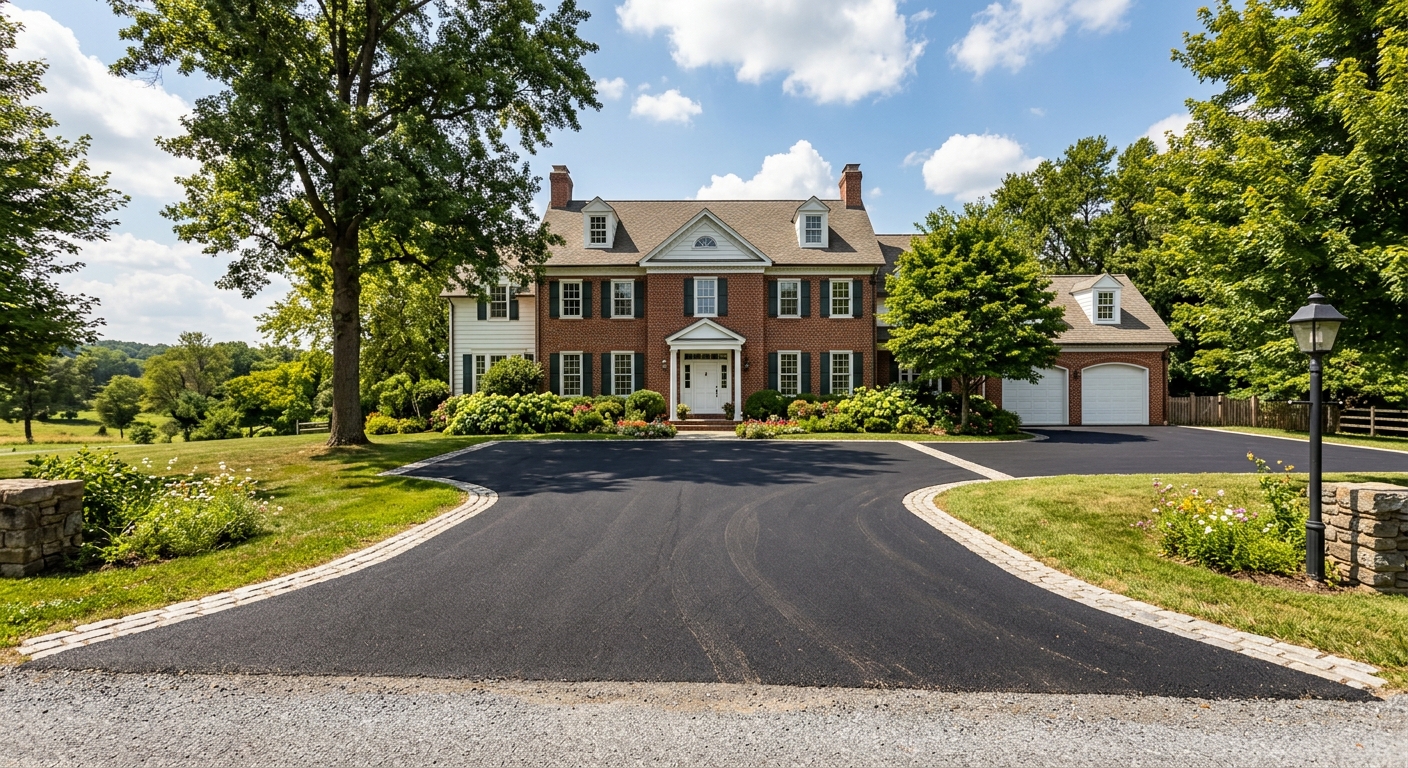
What a new driveway costs in Washington
In Washington, Lehigh County — where 82.6% of homes are single-family and over 92% are owner-occupied (U.S. Census Bureau, ACS 2024) — a driveway is a core investment, not just a decorative feature. In this region, the true cost of driveway paving isn’t just about the asphalt or concrete you see, but what’s hidden underneath. Pennsylvania’s climate in Lehigh County means deep winters, high snow loads, and frequent freeze-thaw cycles, which will exploit any shortcut below the surface. Your neighbor’s quote may sound far cheaper, but if it skips excavation or under-sizes the gravel base, it won’t last. Worn-out 1950s–1970s driveways are common here, and most have taken decades of heavy use that’s compromised their base. Especially over the limestone in western Lehigh County, voids and settling demand much more base prep and compaction than you’d need in other parts of the country. Don’t get sold on a “good price” for what’s really a thin overlay where you need full reconstruction.
| Service |
Best for |
Lifespan |
Price range |
| Asphalt — full replacement with new base |
failed base, structural cracking |
20–30 yrs |
$3,600–$9,300 |
| Asphalt overlay / resurfacing |
sound base, surface cracking only |
8–15 yrs |
$1,550–$4,600 |
| Sealcoating — single application |
preventive maintenance on sound asphalt |
2–4 yrs |
$200–$700 |
| Concrete — new installation |
long service life, low maintenance |
30–50 yrs |
$5,100–$12,500 |
| Crack filling and patching |
isolated cracks under a quarter inch |
1–3 yrs |
$200–$800 |
| Gravel driveway |
rural, budget, long runs |
5–10 yrs with upkeep |
$900–$3,500 |
Estimates for a typical Washington driveway. Square footage and base condition drive these figures more than material choice.
What to put in a Washington paving contract
If you want a driveway in Washington to last, you need more than just a price—ask for the specification details in writing. As tempting as it is to shop by dollar signs, in Lehigh County’s freeze-thaw climate, undersized or poorly compacted driveways might look fine for a year or two, then heave, rut, or crack. Because our ground frost reaches 36 inches, and the Poconos routinely see strong winter events, what lies under your driveway has to perform through harsh cycles of freezing and thawing. A quote that simply says, “three inches of blacktop,” misses the real question: three inches before or after compaction? If it’s a single pour, not layered in lifts, it can break up in no time. Good contractors in Lehigh County will itemize aggregate base depth, compaction method, and the kind of asphalt or concrete they’ll actually use. If nobody spells these things out, you’re gambling with your money.
- Excavation depth (inches below finished grade)
- Aggregate base thickness (after compaction)—minimum 6–8" for asphalt here
- Type and gradation of base stone (e.g., 2A modified or crusher run limestone)
- Number of lifts for base and asphalt (not just one thick layer)
- Compaction method for each layer (plate or roller, pound rating)
- Binder course thickness (as compacted—usually 2–2.5")
- Surface/wear course thickness (as compacted—typically 1.5–2")
- Asphalt mix designation (e.g., PennDOT 9.5mm or 19mm Superpave)
- Edge treatment: to prevent crumbling (topsoil berm, curbing, or boxed asphalt edge)
- Drainage provisions: pitch, crown, and any surface grading to shed water
Getting thirty years out of a driveway
In Lehigh County, the difference between a driveway that lasts five years and one that lasts thirty isn’t magic—it's maintenance and a bit of design discipline. The most effective and cost-efficient step is crack filling before water has a chance to seep into the base layers. Neglect this, and Pennsylvania’s freeze-thaw cycles will force open the cracks, let in even more water, and set up base failure. Keep your driveway’s edges supported, as unsupported edges break off first. Don’t park dumpsters or jack stands directly on the pavement; point loads create indentations and break the surface. After a new installation, avoid parking or sharp wheel turns on the asphalt for a few days—especially in summer—since the surface is still curing and easily marred. Keep gutters and stormwater away from the drive; even the best paving fails if water is allowed to flow over or stand on it.
For de-icing, take care: salt damages concrete quickly, causing scaling and flaking. On asphalt, salt pellets speed the melt-freeze cycle, intensifying freeze-thaw damage rather than preventing it. Sand or calcium magnesium acetate are safer (and pricier) alternatives, but nothing works better and costs less than steady snow removal and routine crack sealing. In eastern Pennsylvania winters, maintenance isn’t optional if you want to avoid full replacement at today’s rates ($3,600–$9,300 for asphalt, $5,100–$12,500 for concrete).
Driveway permits, approaches and stormwater rules
If you’re repaving or resurfacing your existing asphalt driveway in most Lehigh County townships, you can usually skip the permit process—as long as you’re not expanding, relocating, or adding a curb cut. Allentown does require zoning and building review for new driveways or changes to the footprint, but simpler overlays outside of city limits rarely trigger permitting. That said, enlarging your driveway or installing a new one is another story, always check with your township’s code office to avoid issues.
Permits are not only about where the driveway is, but especially where it meets the public street. For driveways entering state roads, you’ll need an approach permit from PennDOT District 5-0, not just your local township. Failing to arrange this first can mean redoing curb cuts at your expense.
Stormwater is a real concern: adding more paved area can trigger requirements for on-site water management, and directing runoff onto a neighbor’s property in Lehigh County opens you up to liability, whether you pulled a permit or not. Document drainage plans with your contractor. When hiring, verify your contractor’s Home Improvement Contractor (HIC) registration at hic.attorneygeneral.gov, and make sure every employee who works on your property is covered by workers’ compensation—checkable through Pennsylvania’s WCAIS system.
Asphalt or concrete for a Washington driveway?
Choosing between asphalt and concrete in Washington means thinking hard about how northeastern Pennsylvania’s climate treats each. Asphalt’s flexibility makes it the most forgiving under the region’s severe freeze-thaw cycles and high winter snow loads, letting it deform with ground movement instead of cracking outright. Concrete is rigid, and while it can last twice as long, the catch is harsh: de-icing salt, common on Lehigh County driveways, will cause the surface to spall and flake. That’s the main reason most pre-1980 concrete in this region looks battered. You can avoid damage by not using salt—few actually do, which turns that “long lifespan” into wishful thinking if winters are icy.
Asphalt driveways cost less initially ($3,600–$9,300 installed) and can be resurfaced for far less ($1,550–$4,600). Concrete costs more up front ($5,100–$12,500), but if you can avoid salt and keep up with sealing, it can outlast two asphalt cycles. For owners who want almost zero upkeep, pavers are a premium option with repairable individual sections, but expect a much steeper price and labor. Gravel is a practical solution for rural or long driveways, with unmatched drainage, but it means routine maintenance and little curb appeal in higher-density neighborhoods.
| Option |
Installed cost |
Maintenance |
Freeze-thaw performance |
Lifespan |
| Asphalt — new install |
$3,600–$9,300 |
sealcoat every 3–4 yrs |
excellent, flexes |
20–30 yrs |
| Asphalt — overlay |
$1,550–$4,600 |
same |
good if base is sound |
+8–15 yrs |
| Concrete |
$5,100–$12,500 |
low, avoid de-icing salt |
fair, spalls with salt |
30–50 yrs |
| Pavers |
$8,200–$12,500 |
individual units replaceable |
good, settles gradually |
25–50 yrs |
| Gravel |
$900–$3,500 |
top-dress every 2–3 yrs |
excellent drainage |
indefinite with upkeep |
How to tell if the base is gone
In Lehigh County, where you can’t see what’s under your driveway, diagnosing the base condition is about reading visible clues. Alligator cracking—those areas that look like reptile skin—mean the base has failed across a broad area, and no overlay will last. Isolated straight cracks suggest just surface aging, so repairs and sealcoating can buy time. Depressions or “birdbaths” collect water and almost always point to base movement, typical in western Lehigh County over limestone voids. Crumbling along the edges? That’s usually from a lack of support, not from poor-quality asphalt. Potholes mean water has breached the surface and is attacking the base or subgrade, and patching is a temporary fix at best if water issues are not addressed.
A trustworthy contractor will check the base by probing, sometimes even cutting a test hole. If the recommendation is a quick overlay without seeing how thick the base is, be wary; you’re paying for a band-aid on a bone break. Below are some tells and the fixes that make financial sense in Washington right now.
| What you see |
Likely cause |
Right fix |
Cost |
| Isolated cracks under 1/4 inch |
surface aging |
crack fill and seal |
$200–$700 |
| Alligator cracking over a wide area |
base failure |
full replacement |
$3,600–$9,300 |
| Depressions holding water |
subgrade movement |
excavate and rebuild that area |
$3,600–$5,700 |
| Crumbling edges |
no edge support |
edge repair, consider curbing |
$400–$1,500 |
| Potholes |
water into the base |
full-depth patch, then assess |
$250–$900 |
| Faded but sound surface |
oxidation only |
sealcoat |
$200–$700 |
Drainage: the failure nobody plans for
Water is the silent wrecking crew beneath almost every failed driveway in Lehigh County. Putting in the right slope isn’t just tidying up at the end—it makes the difference between decades of good service and quick failure. The regional minimum is a 2% slope—about a quarter inch per foot—for surface runoff. In most driveways, you want either a crowned profile (high in the center, draining to both sides) or a gentle cross-slope. If your driveway slopes toward the house or garage, you're fighting not just puddles but possible foundation and water intrusion problems.
Trench or channel drains are sometimes the only real fix if you can’t reshape the grade, but they cost more up front and can clog if not properly maintained. Water should exit (daylight) at a lower point or, if that’s not possible, into a dry well designed for the local soil. In limestone areas of Lehigh County, sudden settling can show where natural drainage isn't possible and soils are too porous to hold engineered solutions.
Directing runoff onto your neighbor’s ground isn’t just unneighborly—it’s a liability, even if the municipality signs off. Even small drainage mistakes will speed up failure here, as water that sneaks beneath the pavement freezes, expands, and heaves the structure above. Local permitting may ignore it, but you shouldn’t.
Frequently asked questions — driveway paving in Washington
Can I pave over my existing driveway?
In Washington and throughout Lehigh County, you can sometimes pave over your existing driveway if the underlying base is still intact and there’s only surface cracking or fading. Overlays, technically called “resurfacing,” cost less than a full replacement — usually $1,550–$4,600 for a typical job. But here’s the warning: overlaying an asphalt drive that has alligator cracking, big depressions, or potholes is almost always money thrown away, since the old damage will break through the new surface quickly in our freeze-thaw cycles. A good contractor in Washington should core or dig a test hole to check your base first; anyone skipping this is not working in your best interest.
What does compaction in lifts mean?
Good driveway construction in Washington means laying both aggregate and asphalt in separate “lifts” or layers and compacting each one independently. This is necessary because compacting a thick layer all at once leaves soft spots, especially with the 36-inch frost depth we face in Lehigh County. For example, your contract should spell out a base stone installed in two or more lifts and finished asphalt in at least two lifts (binder and surface course). Finished depths after compaction should be 4–6 inches for base stone and 3–4 inches for new asphalt, not just “putting down three inches.” These details are vital for a long-lasting result — without them, your job could fail early, forcing a full replacement at today's rates ($3,600–$9,300 for asphalt replacement).
Do I need a permit to repave a driveway in Washington?
If you’re just repaving or resurfacing your existing driveway in Washington or surrounding Lehigh County townships — with no changes to the location, width, or curb cut — you usually do not need a building permit. This is a money and time saver for many area homeowners. However, expanding your driveway, changing its footprint, or cutting a new approach to the street is a different matter and can require local or even PennDOT permitting. Always check with your township code office to be sure. For driveways onto state routes, expect a separate approach permit even if no building permit is needed for the work itself. Overlooking these steps could mean delays or problems when selling your home.
Does Washington have local asphalt plants?
Yes, Washington and greater Lehigh County are served by regional asphalt plants and local quarries, as the area sits in the heart of the Lehigh Valley supply network. This means haul distances for materials are short, which keeps both material costs and scheduling delays in check. Whether you’re paying for a full new asphalt drive ($3,600–$9,300) or just a small overlay, you’re not at the mercy of trucking in mix from hours away. That’s a big advantage of living in this saturated contractor market in eastern Pennsylvania.
When can I seal a brand new asphalt driveway?
In Pennsylvania’s climate, including Washington, you should wait at least 60–90 days before applying any sealcoat to a new asphalt driveway. Asphalt needs this window to cure and let oils evaporate, especially with our longer heating and cooling cycles. Sealing too soon will trap oils, making the surface soft and prone to tracking. Once cured, sealcoating every few years is an inexpensive form of protection, with single applications running $200–$700 depending on driveway size. Be patient; starting maintenance too early does more harm than good.
How long does a driveway installation take?
A typical driveway replacement or new installation in Washington usually takes two to four days, depending on weather and site conditions. This includes excavation, preparing and compacting the stone base, and laying asphalt or pouring concrete. Asphalt can be driven on in 1–3 days after completion, while concrete needs at least a week before parking vehicles. Keep in mind, weather delays are common during wet or very hot periods in Pennsylvania, so scheduling flexibility is smart. Rushed jobs rarely last in our freeze-thaw cycle — a thorough process is worth waiting for, especially at today’s rates ($3,600–$9,300 for asphalt, $5,100–$12,500 for concrete).
How much does a concrete driveway cost in Washington?
Concrete driveways in Washington typically cost between $5,100–$12,500 depending on size, driveway layout, and site preparation needs. This higher upfront cost compared to asphalt reflects both material expense and the labor involved in excavation, forming, and finishing concrete to standards that handle Lehigh County’s 40-psf snow loads and deep frosts. Concrete is much less maintenance, but it absolutely must be protected from salt and routine freeze-thaw abrasion, which are common here. Consider your long-term plans: concrete costs more to install but may require fewer major repairs over a 30–50-year life span.
Why are paving quotes in Washington so different from each other?
The big variation between paving quotes in Washington boils down to what you can’t see — base preparation, compaction, thickness, and drainage. Because most of the labor and material is buried, a thinner base, single-layer asphalt, or skipping lifts can undercut price by thousands, but costs far more when it fails early. That’s why the difference between the low and high end for a new asphalt driveway is so wide ($3,600–$9,300). The only way to compare quotes fairly is to demand written details: depth after compaction, number of layers, base stone type, and drainage design. Otherwise, the lower price may actually be the far more expensive choice in the long run, especially given our demanding freeze-thaw cycles in northeastern Pennsylvania.
What are the signs of a failing driveway base?
Washington homeowners should watch for wide-spread alligator cracking, “birdbaths” or depressions holding water, edge crumbling, or chronic potholes. Each of these signals not just surface wear, but real movement or loss of integrity in the underlying base. Isolated straight cracks may only indicate aging asphalt, fixable for a few hundred dollars, but anything bigger points to base failure. Full replacement is the only lasting solution when the base goes — at Lehigh County rates, expect $3,600–$9,300 for asphalt, or patch jobs for individual problem areas. The message: don’t pay for overlays or sealcoats on a failing base, because it won’t delay the inevitable in our local soil and climate conditions.