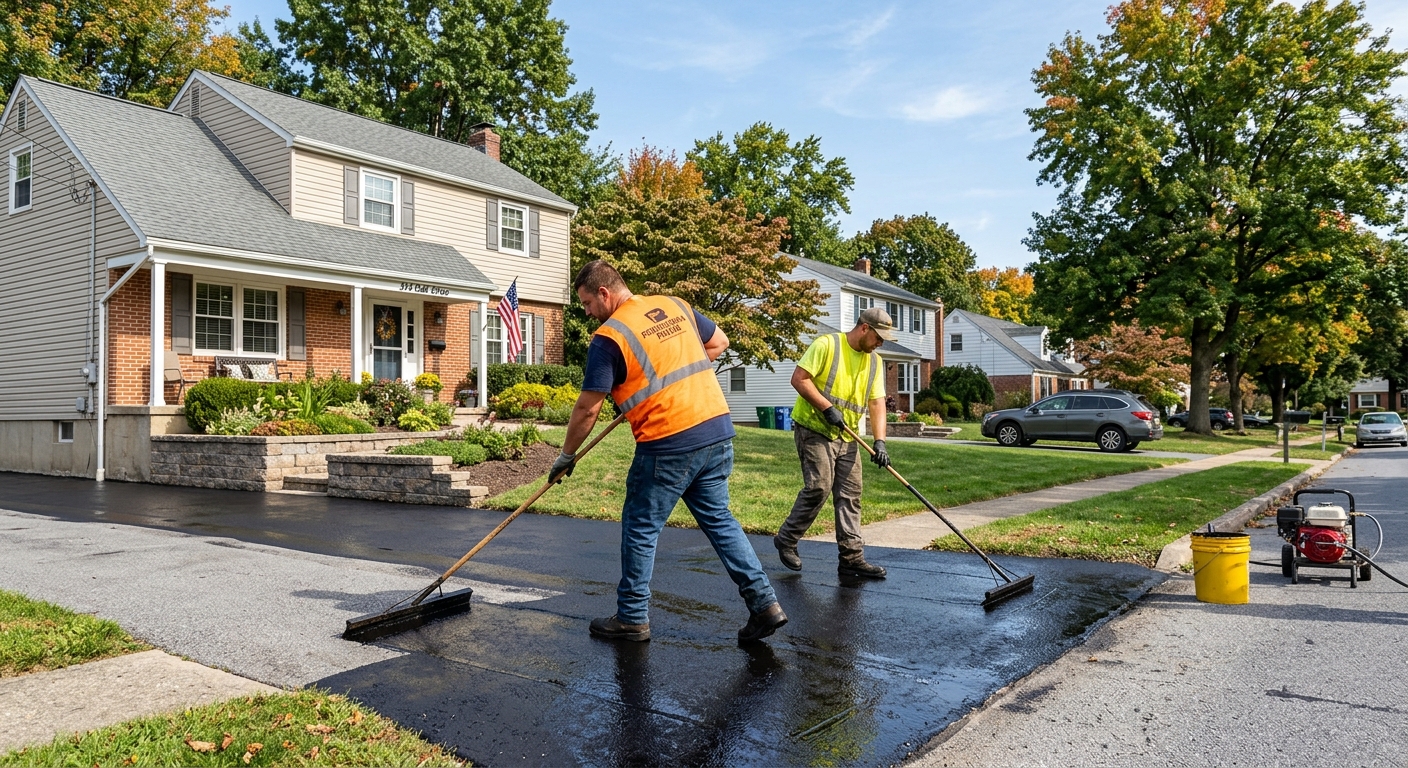
Driveway paving costs in Concord — 2026
Concord stands apart from many places, since more than half its homes are single-family (55.0%) and nearly three-quarters are owner-occupied (70.9%). For most in Concord, a driveway is not just a patch of blacktop but an investment tied to the value and function of their property. The price of driveway work here is shaped as much by what lies beneath as by what you see on the surface. Underneath the visible layer, Delaware County’s driveways rest on either glacial till or compacted urban fill, both of which require extra attention to base preparation to stand up to the region’s winter freeze-thaw cycles and occasional pounding rains. The upshot: the biggest cost driver between two bids often isn’t the paving you see, but the unseen depth, drainage details, and base thickness below. A lower quote often means shallower excavation or skipped base prep—trouble that may not show until the third or fourth winter. Spending a little more for proper base work is not just an upgrade—it’s protection against future heaving and cracking that afflict driveways across southeastern Pennsylvania.
| Service |
Best for |
Lifespan |
Price range |
| Asphalt — full replacement with new base |
failed base, structural cracking |
20–30 yrs |
$4,000–$10,000 |
| Asphalt overlay / resurfacing |
sound base, surface cracking only |
8–15 yrs |
$1,700–$5,100 |
| Sealcoating — single application |
preventive maintenance on sound asphalt |
2–4 yrs |
$225–$800 |
| Concrete — new installation |
long service life, low maintenance |
30–50 yrs |
$5,600–$13,500 |
| Crack filling and patching |
isolated cracks under a quarter inch |
1–3 yrs |
$200–$800 |
| Gravel driveway |
rural, budget, long runs |
5–10 yrs with upkeep |
$900–$3,500 |
Estimates for a typical Concord driveway. Square footage and base condition drive these figures more than material choice.
Beyond replacement: layout changes
Many Concord driveways are simply replaced in place, but there are good reasons to alter the layout: adding a parking pad for a teen driver, widening a narrow run to fit two cars, pushing back to reach a new garage, or replacing a rutted gravel drive with low-maintenance asphalt. Any of these projects means you’re breaking new ground, not just resurfacing. New footprints require excavation down to undisturbed glacial till or urban fill, then building up a full-depth aggregate base—more expensive than overlaying an existing path, but critical for stability. Be aware, the seam where new and old paving meet will always be a point of weakness and may need extra care to prevent future cracking.
In Concord, increasing your paved area may trigger stormwater review—especially since added impervious surface can cause runoff issues for neighbors or local streams. In some townships within Delaware County, any significant addition can require a permit, not only for the work but for stormwater compliance. For approaches—the part connecting driveway to street—permits come from PennDOT District 6 for state routes or your local township for all other public roads. Setback rules may limit how close you can pave to a property line, so always check with your local code office before starting. If you’re thinking expansion, get input up front to avoid regulatory headaches and permanent drainage headaches down the line.
Drainage: the failure nobody plans for
In Concord, water is the real adversary of any driveway, not just wear and tear. Good paving starts and ends with getting water off and away: failing here is why many local driveways buckle or crumble long before their time, especially as freeze-thaw cycles set in from late fall through spring. A minimum slope—at least 2% (about a quarter inch per foot)—is needed to keep water moving. For most driveways, a crown down the middle or a steady cross-slope works, but trouble starts fast if your drive slopes toward your garage or house. In those cases, trench drains or channel drains are sometimes the only fix where you can’t regrade.
Concord’s base is typically glacial till or fill, both of which have heavy clay that holds water tight against the base. When surface water collects there, it seeps into the sub-base, then freezes. Over time, this expands and heaves the driveway, cracking it from underneath. Installing daylight drains (letting water run out to a lower grade) is best, but sometimes there’s no exit and a dry well is needed. Both are better than letting water pond, which is what leads to the alligator cracking and potholes you often see locally. One last point: you cannot simply run your runoff onto a neighbor’s land—even if the township approves your plan, it’s still your liability if you create problems for the folks next door. Always solve drainage on your own parcel.
Numbers, not adjectives
Choosing a paving contractor in Concord means thinking past sales language and focusing on hard numbers. When someone says, “We’ll put down three inches of blacktop,” ask: “Three inches before or after compaction?” Because the answer changes what you get—in this trade, volume shrinks by up to a third once the roller goes over it. In southeastern Pennsylvania, where our frost depth runs 30 inches and freeze-thaw cycles are routine, shallow bases and thin lifts (layers) crack early, especially over glacial till or compacted urban fill. Standards that work in milder areas just do not last here; cutting depth is a false economy.
Paving quotes in Delaware County should always commit to numbers in writing, not just “heavy duty” or “thick base.” That’s your defense: if it’s not on paper, it won’t be in the ground. Demand the specifics in the contract—and don’t be shy about it. Here are the points every Concord homeowner should require:
- Total excavation depth (inches below final grade)
- Aggregate base depth after compaction
- Type and gradation of base stone (e.g., 2A modified, not just “gravel”)
- Compaction method (mechanical, not just by dump truck tires)
- Number of compaction lifts used for the base
- Binder (base) course depth—compacted, not loose
- Surface course depth—compacted, not loose
- Mix designation (PennDOT or ASTM-grade, e.g., ID-2 for surface)
- Edge treatment (tapered asphalt, concrete, or clean cut)
- Drainage plan (how and where water will exit)
Why Concord driveways fail from the bottom up
Every driveway in Concord, no matter how good it looks the day it’s paved, gets its strength from what’s underneath. The proper assembly is threefold: start with undisturbed subgrade (in Concord, usually glacial till or dense fill), build a thoroughly compacted aggregate base, and then finish with asphalt. Each layer has a job: asphalt spreads the weight of cars, base spreads the weight to the ground, and the subgrade supports everything. If the base is shortchanged—too thin, soft, or poorly compacted—the driveway will fail early, often in three to six winters.
Why is this such an issue here? Southeastern Pennsylvania’s heavy clay mixes and glacial till hold water like a sponge. Our winters bring frequent freeze-thaw cycles, making moisture freeze beneath your driveway. When water in the subgrade freezes, it expands—this is frost heave—and shoves the entire slab upward and often unevenly. The asphalt cracks from underneath, and by the time you see it, the process is well underway.
Poor preparation is the heart of the cheapest bids. Instead of full excavation, some contractors lay new asphalt right over old, failed base, or skip compaction in lifts (layer by layer, compacting each one). Sometimes they use the wrong stone or not enough of it. You won’t see the effect on day one, but in three years, you’ll see depressions, edge crumbling, and spreading cracks. Demand in writing: at least 6–8 inches of compacted 2A modified aggregate base, proof it was compacted in 3–4 inch lifts, and confirmation no soft spots or organic material remain. These are the numbers that buy longevity in a Concord driveway—and without them, you’re paying for a short-term fix.
Why driveways behave differently in Concord
In Concord and the rest of Delaware County, what’s under a driveway is mostly glacial till or compacted urban fill—materials that hold onto water much longer than stone or sand. The consequence is obvious by winter: freeze-thaw cycles push and lift softer sections, cracking asphalt from below, and leaving visible dips or ridges. That’s why base depth and compaction matter more here than in neighboring Chester or Montgomery counties that have more porous soils.
In addition, much of the housing stock in Concord’s inner-ring suburbs was built from 1920 to 1960. Back then, driveways often went right over fill or whatever subsoil was handy—rarely the engineered base we’d require now. In those older neighborhoods, shared driveways are common and resurfacing may be routine, but real drainage correction or base rebuilding is often overdue. Expect that an existing driveway might not have the base thickness (6–8 inches compacted aggregate) or the proper slope to ward off pooling and crack formation. Upgrading means digging deeper—and while it costs more up front, it’s the difference between a pavement that rides out a Delaware County winter and one that buckles before its time.
Permits and approvals for paving in Concord
If you’re just repaving your current residential driveway in Concord and you’re not changing its size or footprint, you likely do not need a building permit. That saves paperwork and surprises for most homeowners. However, the moment you enlarge, extend, or otherwise change your driveway, that can trigger a permit requirement—especially if you add impervious surface, since stormwater runoff is a big concern in parts of Delaware County.
The driveway approach—where your paving ties into the street—nearly always needs a separate permit and inspection. In Concord, if your driveway connects to a state-managed road, that means a Highway Occupancy Permit from PennDOT District 6. Local township offices handle permits for approaches on their own roads. This step is often overlooked and can delay completion if not handled up front.
Remember, even if the township approves your new square footage, you cannot direct runoff onto a neighbor’s property; it’s a liability regardless of the permit. Get drainage right and keep water on your side of the line.
Whoever you hire for the job should have active Home Improvement Contractor (HIC) registration from the Pennsylvania Office of Attorney General—verify at hic.attorneygeneral.gov. If the crew is larger than a one-person operation, check that they carry Pennsylvania-mandated workers’ compensation insurance (wcais.pa.gov). These steps are your best protection against financial surprises if something goes wrong.
Frequently asked questions — driveway paving in Concord
How often should I sealcoat my driveway in Concord?
In Concord’s climate, with humid summers and moderate freeze-thaw cycles, good asphalt needs a sealcoat about every 2 to 3 years to weather well. This gives the surface a layer of protection against salt, rain, and UV light, all of which take a toll on driveways here. Waiting too long lets cracks develop, which means water can reach the base, and you’re looking at bigger repairs down the line. Sealcoating isn’t a solution for major cracks or wear—it’s preventive maintenance to get the most out of your investment. For a typical single application, expect to pay $225–$800, with most driveways on the smaller side closer to the low end of that range. Keep in mind, freshly paved driveways shouldn’t be sealed for the first six months to allow the asphalt to cure. Sticking to this cycle will help your driveway last longer, especially given how Concord’s climate speeds up surface wear.
Are there stormwater rules on paving in Concord?
Absolutely. In Concord and the rest of Delaware County, stormwater management comes up every time you enlarge or add a new paved area. Once you increase the impervious surface, you’re responsible for where rainwater ends up. Even if your project’s footprint doesn’t need a building permit, adding enough new asphalt or concrete will get the code office interested, often triggering requirements for on-site infiltration—like dry wells or trenches—so runoff doesn’t go straight to the neighbor or the street. Not following these guidelines can leave you personally liable for drainage issues, even if you “pass” inspection. These rules exist because of our local soil and the flooding risks during coastal storm remnants. It’s better to address drainage right away, rather than pay to fix a failing driveway (or a lawsuit) later. If you’re budgeting a driveway expansion, factor in that drainage work can add to the final cost, which is often reflected in driveway replacement bids of $4,000–$10,000 in Concord.
What does compaction in lifts mean?
Compaction in lifts is how quality paving is done in the Concord area, due to our challenging base soils and freeze-thaw winters. Rather than dumping all base stone or asphalt at once, your contractor places it in layers—called “lifts”—no thicker than 3 to 4 inches at a time, then compacts each one separately. This ensures the base is dense throughout, not just on top. If you try to compact a thick layer in one go, only the surface gets dense and the bottom remains soft—leading to future settlement and cracks. Don’t let anyone tell you this step is optional here. The added labor is why some cheaper bids skip it, but you pay for it later. A solid installation using proper lifts is reflected in longer-lasting jobs—reflected in the 20–30 year lifespan for a full replacement at $4,000–$10,000. Always ask if your crew is compacting each lift, and get it in writing.
Are door-to-door pavers a problem in Concord?
Door-to-door paving “crews”—often showing up with out-of-state plates and leftover asphalt—still make their rounds in Concord, just as they do across Delaware County each spring and summer. They offer cut-rate pricing and urge you to “take advantage of extra material,” but rarely show valid Home Improvement Contractor (HIC) registration, and almost never have workers’ compensation coverage. If anything goes wrong, you’ll have little recourse. Remember, contracts over $500 must be in writing by Pennsylvania law, with a three-day cancellation period. Door-to-door operators typically aren’t willing to provide this. Legitimate driveways at Concord’s prices can’t be done for “just a couple thousand,” with even the simplest overlay coming in around $1,700–$5,100. Always verify your contractor at hic.attorneygeneral.gov before signing anything—or better yet, turn such offers down flat.
What does an asphalt overlay cost in Concord?
An asphalt overlay—also called resurfacing—is the cost-effective choice when your existing driveway base is solid and just the surface is worn or cracked. In Concord, you’ll see overlays priced between $1,700–$5,100 for a typical residential driveway, with most coming in near the middle for a standard two-car width. The final price depends on square footage and whether any patching or adjustment is needed at the edges or garage apron. If you get a quote at the low end, double-check that the prep is thorough and that it includes repairing isolated base failures—otherwise, the overlay won’t last its intended 8–15 years, especially with our freeze-thaw cycles loosening poorly bonded layers. Never overlay a driveway that has deep alligator cracks or obvious settling—that’s money wasted, and you’ll be back for a full replacement much sooner.
Is gravel a cheaper option in Concord?
Gravel can save you a lot up front, especially if you have a long run or just need a basic parking area. Many properties around Concord still have gravel, especially outside the denser neighborhoods. Price-wise, expect a new gravel drive to run $900–$3,500 depending on length, shape, and whether you’re just topping up or building new. But before choosing gravel, know that our glacial till and clay soils don’t drain fast. Without regular regrading, pits and ruts will fill with water—worsened by freeze-thaw, which can turn your drive into a muddy mess each spring. Gravel driveways need annual upkeep: fresh stone, weed control, and compaction. For a modest suburban Concord property, asphalt is significantly less hassle, even if it costs more at first. Gravel works well for access roads or temporary parking far from the street; for daily, close-in use, weigh those maintenance hours carefully.
How far ahead should I book a paver in Concord?
Delaware County’s paving season runs April to late October, but schedules fill fast—especially in Concord, where local demand is fed by a high homeownership rate and an older housing stock in need of upgrades. If you want a quality crew (with local references, insurance, and HIC registration), start looking two to three months before your target date. For jobs scheduled in late spring and early fall, you might be able to book sooner; but for concrete or large expansions, four months gives you the best pick of contractors. If a crew offers next-week work on short notice during peak season, ask why—they may have cancellations, or you may not want what the “open slot” means for their business. With prices from $4,000–$10,000 for a replacement, take the time to review references, insurance, and permitting up front. That’s time well spent in this market.
Why does my driveway have depressions that hold water?
Low spots and puddles are common complaints in Concord, and they almost always trace back to either settling base or improper slope. Our glacial till and fill soils are notorious for trapping moisture. If the base wasn’t compacted thoroughly, or if topsoil or soft spots weren’t removed, the driveway settles unevenly in the first few years. Once depressions form, water starts pooling, leading to freeze-thaw damage each winter—and the problem gets worse quickly. Repeated puddling dissolves the fine particles in the base, further weakening the spot. Sometimes, badly set edges or vehicle ruts are to blame, especially in older installations with thin asphalt. Leveling puddles may mean spot base repair or even partial replacement, not just an asphalt skim coat. For Concord, proper drainage planning from the start—combined with a well-compacted base (6–8 inches)—prevents these headaches. Sometimes it’s worth spending for a proper fix, with crack filling and patching jobs ranging from $200–$800 depending on severity.
Asphalt or concrete for a Concord driveway?
Both materials can serve a Concord property well, but your priorities matter. Asphalt is popular here: it’s flexible, easier to repair after freeze-thaw movement, and quicker to install. The up-front cost is lower, with replacements in the $4,000–$10,000 range. Concrete, on the other hand, is tougher and lasts longer (30–50 years), but is more expensive—$5,600–$13,500 for new installation—and slow to cure, so expect to wait before using it. In glacial till and clay soils, concrete benefits from a thicker, well-drained base and can heave or crack if water control isn’t perfect. Asphalt is more forgiving if minor settlement occurs. If you don’t mind ongoing maintenance (occasional sealing and crack filling), and want to reduce initial spend, asphalt wins out. For ultimate longevity and less routine care, lean toward concrete—just ensure drainage and base prep get as much attention as the slab itself.