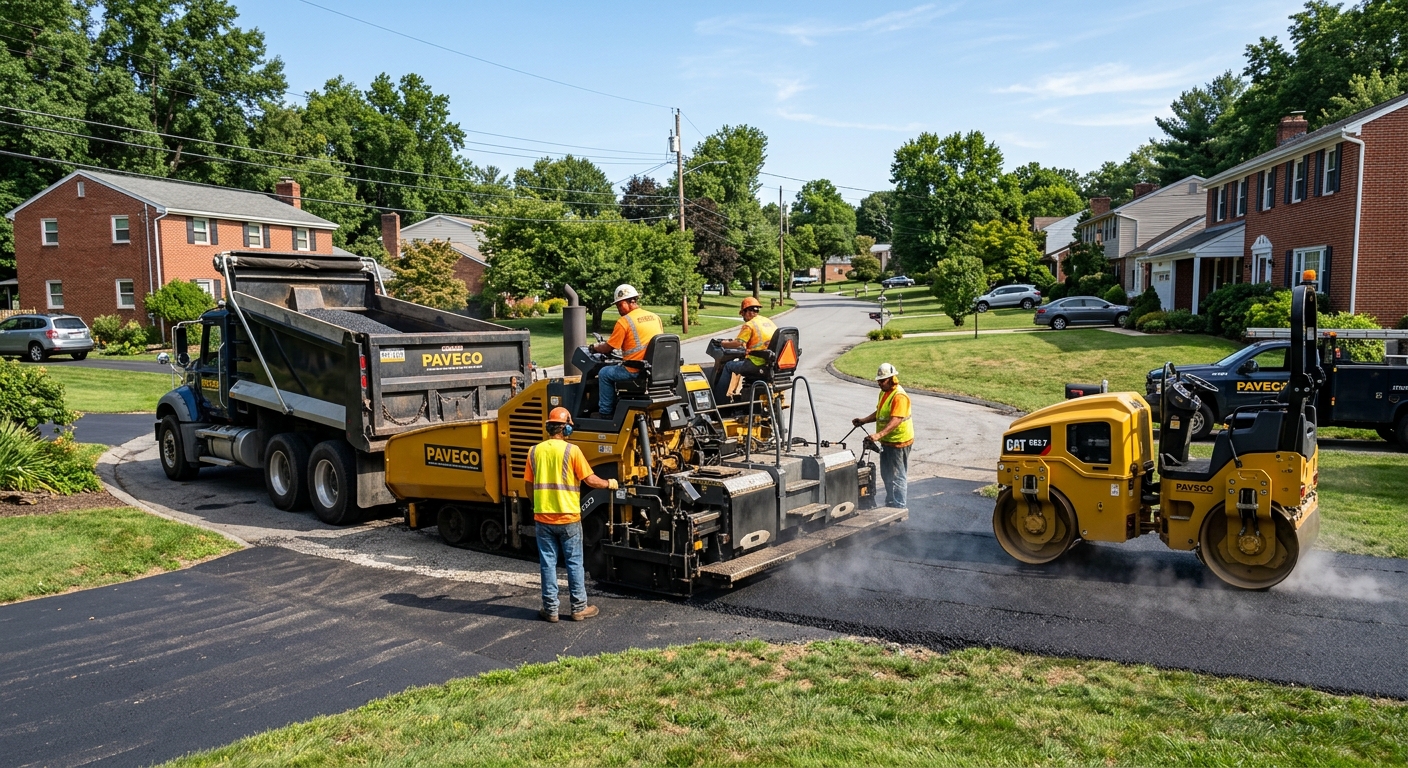
What a new driveway costs in Coraopolis
In Coraopolis, more than half of households own their homes, and single-family houses account for about 61% of local residences (U.S. Census Bureau, ACS 2024). For those homeowners, a driveway replacement or upgrade isn’t a routine repair — it’s one of the few big-ticket exterior investments where the work must stand up to southwestern Pennsylvania’s tough freeze-thaw climate and heavy, local clay and shale soil. If you get quotes for a new driveway and see a big price spread, recognize that most of what you’re paying for is below the surface — in the site prep, subgrade compaction, and the thickness and quality of the base. Skimping on the invisible essentials nearly guarantees heaving, settling, or cracks after a few winters. The sticker price you see only tells part of the story; trustworthy contractors build the base up for Coraopolis hillsides, not just the surface.
| Service |
Best for |
Lifespan |
Price range |
| Asphalt — full replacement with new base |
failed base, structural cracking |
20–30 yrs |
$3,300–$8,500 |
| Asphalt overlay / resurfacing |
sound base, surface cracking only |
8–15 yrs |
$1,400–$4,200 |
| Sealcoating — single application |
preventive maintenance on sound asphalt |
2–4 yrs |
$200–$650 |
| Concrete — new installation |
long service life, low maintenance |
30–50 yrs |
$4,700–$11,500 |
| Crack filling and patching |
isolated cracks under a quarter inch |
1–3 yrs |
$200–$800 |
| Gravel driveway |
rural, budget, long runs |
5–10 yrs with upkeep |
$900–$3,500 |
Estimates for a typical Coraopolis driveway. Square footage and base condition drive these figures more than material choice.
Overlay, patch or full replacement?
You don’t need fancy tools to figure out what your driveway really needs — just a keen eye and a few minutes. The root cause determines whether you should overlay, patch, or start over completely. Alligator cracking (a pattern that looks like reptile skin, usually across wide areas) means the base underneath has failed — in Coraopolis, that often happens when heavy vehicles and freeze-thaw cycles break down the clay or shale subgrade. No overlay will survive over a failed base; that money is thrown away. Isolated straight cracks are mostly age-related and suitable for crack filling and sealcoating. Depressions or low spots (“birdbaths”) signal that parts of the base or subgrade have settled — a full cut-out and rebuild is needed. Edge crumbling means the base didn’t extend all the way out. Potholes are water's signature: it’s already made its way below the asphalt, softening the foundation. Whenever a contractor quotes an overlay without probing the base with a core sample or at least some digging, you’re not getting a real answer — only a guess. Push for clarity.
| What you see |
Likely cause |
Right fix |
Cost |
| Isolated cracks under 1/4 inch |
surface aging |
crack fill and seal |
$200–$650 |
| Alligator cracking over a wide area |
base failure |
full replacement |
$3,300–$8,500 |
| Depressions holding water |
subgrade movement |
excavate and rebuild that area |
$3,300–$5,200 |
| Crumbling edges |
no edge support |
edge repair, consider curbing |
$400–$1,500 |
| Potholes |
water into the base |
full-depth patch, then assess |
$250–$900 |
| Faded but sound surface |
oxidation only |
sealcoat |
$200–$650 |
Maintenance that actually works
Keeping your driveway going in Coraopolis comes down to four key things: sealing cracks before they let water into the base (that’s #1, and the cheapest), backing the driveway’s edges so cars and plows don’t break them down, making sure water drains off and away (gutters, downspouts, and proper slope), and never letting a point load — like a jack or steel dumpster wheels — sit for long on the asphalt. New asphalt needs weeks to cure before you park, especially before turning your wheels while stationary, or you’ll rut and scar the surface. Salt is a fact of winter in southwestern Pennsylvania, but it’s hard on concrete — over time, it can cause flaking and surface scaling. On asphalt, salt isn’t as corrosive but the real problem is freeze-thaw: melting snow and then a deep freeze at night works water down into every tiny flaw, so shoveling promptly is a good investment. Alternatives like calcium chloride are less damaging to concrete but cost more. Sand is safe but leaves cleanup in spring. If you do nothing else for maintenance, fill cracks before winter and protect your edges.
What a real paving quote contains
Comparing paving quotes in Coraopolis means looking beyond the bottom line. Start with the measured square footage on paper — not a guess. A real quote spells out how deep the old driveway will be excavated, where the debris will go, the type and thickness of the new aggregate base, how it’s compacted (and in how many lifts), and the makeup of the asphalt courses (binder and surface), including compacted depth after roller passes. Edge details matter — ask how far the base extends past the finished asphalt. Grading isn’t an afterthought: the slope and runoff plan prevents puddling and future cracks as our local freeze-thaw cycles do their work. Cleanup and lawn restoration should be listed, too. Payment schedules in Pennsylvania should mean a modest deposit, with most payment on completion, and contracts over $500 must be in writing by law. Lastly, warranties are rarely as broad as people think; most will exclude cracking, even though that’s the failure that matters. A one-line total with no specifics? You can’t compare it, and it’s how homeowners end up paying for work that’s doomed to fail.
| Line item |
What to look for |
Red flag if… |
| Area |
measured square footage stated |
eyeballed or absent |
| Excavation |
depth and disposal included |
'we'll pave over it' |
| Base |
aggregate type and depth in inches |
'proper base' |
| Compaction |
method, and done in lifts |
not mentioned |
| Asphalt |
courses and compacted depth |
'3 inches' unqualified |
| Drainage |
slope and water direction stated |
silent |
| Warranty |
what is covered and what is excluded |
verbal only |
| Payment |
modest deposit, balance on completion |
full cash up front |
How often should a Coraopolis driveway be sealed?
Sealcoating gets marketed hard in Coraopolis, but most of what’s out there is designed to sell you frequent reapplications. Here’s the practical truth: sealcoating protects the asphalt binder from sun, air, and oil, and revives faded color, but it does not add strength or fix underlying base issues. If your driveway is structurally sound, a good sealcoat every 2–4 years helps prevent oxidation and minor surface cracks from becoming big problems — but more frequent applications don’t give added benefit and can actually do harm. When sealant layers build up year after year, they’re prone to peeling and cracking off in sheets, especially with our region’s harsh freeze-thaw swings. Never seal new asphalt until it’s fully cured — that typically means waiting at least 6–12 months after installation.
Costwise, expect a quality single application in Coraopolis to run $200–$650, with square footage being the biggest variable. Proper crack filling matters more than just slapping on sealer — it keeps water out of the base, which is what actually limits your driveway's life. Watch out for low-ballers selling quick spray-on jobs: these are so thin they wash away in months, offering little value. If you’re quoted much below $200–$650 for a multi-car driveway, the odds are you’ll be paying again soon.
Changing the footprint of a Coraopolis driveway
If you’re adding width for a second car, running a new driveway to a detached garage, putting in a turnaround, or converting a gravel drive to asphalt, the project shifts from simple resurfacing to new construction. Any time you expand, the new area has to be excavated down, the clay and shale subgrade compacted, and a proper base installed to match southwestern Pennsylvania’s freeze-thaw cycles. The joint between new and old will always be a weak spot prone to cracking, so quality prep and a tight seam matter.
Be aware: expanding your driveway increases your impervious surface, which affects stormwater runoff. Local ordinances may set limits or require drainage controls, especially if you’re close to a neighboring property. Setback rules also apply if you're moving the edge nearer to your boundary. And if your new section connects to a public road or alters a curb or sidewalk, that triggers a permit with the relevant authority, not just the borough. Plan time and budget for these steps — and for base work that's just as robust as for a full replacement.
Permits and approvals for paving in Coraopolis
If you're just resurfacing or replacing your driveway in the same footprint on private property in Coraopolis, a building permit usually isn’t required — saving you paperwork and fees. But anytime the work touches the approach (where your driveway meets the road), involves a new curb cut, or alters a sidewalk or apron, a separate permit is likely needed, and may come from a municipal agency or PennDOT District 11-0 if your driveway meets a state route. These requirements make sense for Coraopolis’s hilly terrain and drainage patterns. If you’re expanding the footprint at all, you may also trigger local stormwater management rules — adding impervious area means you can’t direct runoff onto your neighbor’s lot, no matter who says it’s allowed. Always use a contractor with valid Home Improvement Contractor (HIC) registration, which you can check via the Pennsylvania Office of Attorney General's online system (hic.attorneygeneral.gov). Every employer must also provide valid workers’ compensation coverage — confirm through WCAIS (wcais.pa.gov). These steps save frustration and liability down the line.
Frequently asked questions — driveway paving in Coraopolis
How many freeze-thaw cycles does Coraopolis get?
The Coraopolis area sees some of the highest freeze-thaw cycling in Pennsylvania, thanks to Allegheny County’s hilly landscape and cold, damp winters. While the exact count shifts yearly, plan for dozens of cycles, with overnight temperatures moving above and below freezing consistently from November into March. These shifts are hard on all pavement — water seeps into hairline cracks, freezes, expands, and breaks up both the surface and base over time. This means even a driveway installed perfectly can develop issues within a few years if it isn’t built on a well-compacted base suited for local clay and shale soils. Routine maintenance like crack filling ($200–$650) can hold off major repairs by keeping water out before freezing weather arrives.
Is an overlay worth it or should I start over?
Whether an asphalt overlay is worth it on your Coraopolis driveway comes down to what’s under the existing surface. If the base is stable (no deep cracks, no major depressions, and only minor surface aging), an overlay can add 8–15 years of life for a typical cost of $1,400–$4,200. But if you see alligator cracking across wide areas or significant settlement, these are signs of base failure caused by our region’s rough winters and hilly clay subgrade. In that case, overlaying is just postponing the inevitable and wasting your money. Full replacement, though more expensive ($3,300–$8,500), is the only fix for a failed base.
Can I cancel a paving contract I signed at my door?
In Pennsylvania, the Home Improvement Consumer Protection Act (HICPA) gives you the right to cancel a paving contract you signed at your home within three business days. This applies in Coraopolis and anywhere in the state, and it doesn’t matter whether you paid a deposit or work hasn’t started. Contractors are required by law to notify you of this right in writing. If you don’t see that language on your contract for a job over $500, it’s a red flag. To cancel, send a written notice (keep a copy for your records) within three business days. You should receive a refund of any deposit you paid. If the contractor pushes you to waive your rights or backdates the contract, walk away.
Why are paving quotes in Coraopolis so different from each other?
The spread in driveway paving quotes across Coraopolis comes down to what gets buried below the surface. High contractor density in Allegheny County means competition, but not all bids include the same excavation depth, subgrade prep, or aggregate base thickness — and on Coraopolis hills, short-cutting these steps guarantees early failure. Some quotes leave out critical items or rely on vague language like “proper base.” Others lowball by paving over old material, which reduces labor and disposal but results in heaving and cracks in a few years. A detailed quote that spells out every layer (with square footage and depths) is necessary to truly compare value. Don’t be fooled by a bottom-line price of $3,300–$8,500 if you don’t know exactly what’s included.
What is the difference between binder and surface course?
Both binder and surface courses are necessary for quality asphalt paving in Coraopolis. The binder course is the structural middle layer, made with larger aggregate and less sand — it provides strength against heavy vehicles and our area’s freeze-thaw cycles. The surface course is the top layer: finer, smoother, and designed for water runoff and appearance. Poor-quality work sometimes skips the binder or uses a single thick pour, which leaves your driveway vulnerable to potholes and cracking within a few seasons. Always ensure a multi-layer build: after compaction, you’ll want something like 2 inches of binder and 1–1.5 inches of surface. This layered approach, included in a replacement job at $3,300–$8,500, stands up much better to the demands of Coraopolis winters and hills.
Why are my driveway edges crumbling?
Crumbling edges on an asphalt driveway in Coraopolis nearly always mean there’s not enough base material extending past the edge, or that runoff has washed away surrounding soil. Our region’s driveways often see edge decay because installation crews sometimes stop the stone base short to save material, leaving unsupported asphalt that can’t handle winter plow blades, vehicle tires, or erosion from hills and rain. Once the edge loses support, the surface cracks and chunks break away. The right fix is to extend the base and repair the edge (usually $400–$1,500), and if it keeps recurring, consider adding a curb or solid vegetative support next to the apron.
How much does a concrete driveway cost in Coraopolis?
A new concrete driveway in Coraopolis typically costs between $4,700–$11,500 for a standard residential layout. The range is wide because slope, length, site access, and required base thickness vary on our hilly sites, and the amount of surface area directly affects price. Concrete lasts longer than asphalt (30–50 years with reasonable care), resists oil and fuel better, and requires less frequent maintenance, but is sensitive to winter deicers and needs proper expansion joints to stand up to the freeze-thaw cycles found in Allegheny County. Decorative finishes (like stamping or coloring) sit at the higher end of the range. Ask for a detailed quote listing base prep and finish, and be skeptical of anything that comes in much lower — shortcuts on Coraopolis slopes rarely pay off.
What is the difference between crack filling and sealcoating?
Crack filling and sealcoating are both maintenance services for asphalt in Coraopolis, but they’re not interchangeable. Crack filling focuses on keeping water and debris out of actively opening or wide cracks. This is especially critical before winter, since our area’s freeze-thaw cycles can turn tiny gaps into potholes in a single season. Sealcoating, on the other hand, is a surface treatment that protects against oxidation and minor spills, makes the pavement look fresh, and slows overall aging. It’s not a repair — sealcoating alone won’t stop cracks from widening or keep out moisture. Combining both is best: fill cracks first to block water, then sealcoat to protect the surface. Expect to pay around $200–$650 for each service on a standard driveway.
Can asphalt be laid in cold weather?
In Coraopolis, the paving season is governed by our regional climate. Asphalt can technically be laid in cooler weather — but temperature, not just season, is what matters. Below 50°F, compaction becomes difficult and seams won’t bond well, leading to raveling and premature failure, especially on the shaded drives common on Coraopolis hillsides. The clay and shale subgrade typical of the area also becomes too soft to compact properly as fall and winter set in. Professional contractors avoid scheduling new installations late in the season unless a brief, unexpected warm spell hits. Emergency repairs are possible in lower temps, but they’re usually just band-aids. For the best, longest-lasting jobs — overlays at $1,400–$4,200 or replacements at $3,300–$8,500 — hold off until spring or summer.