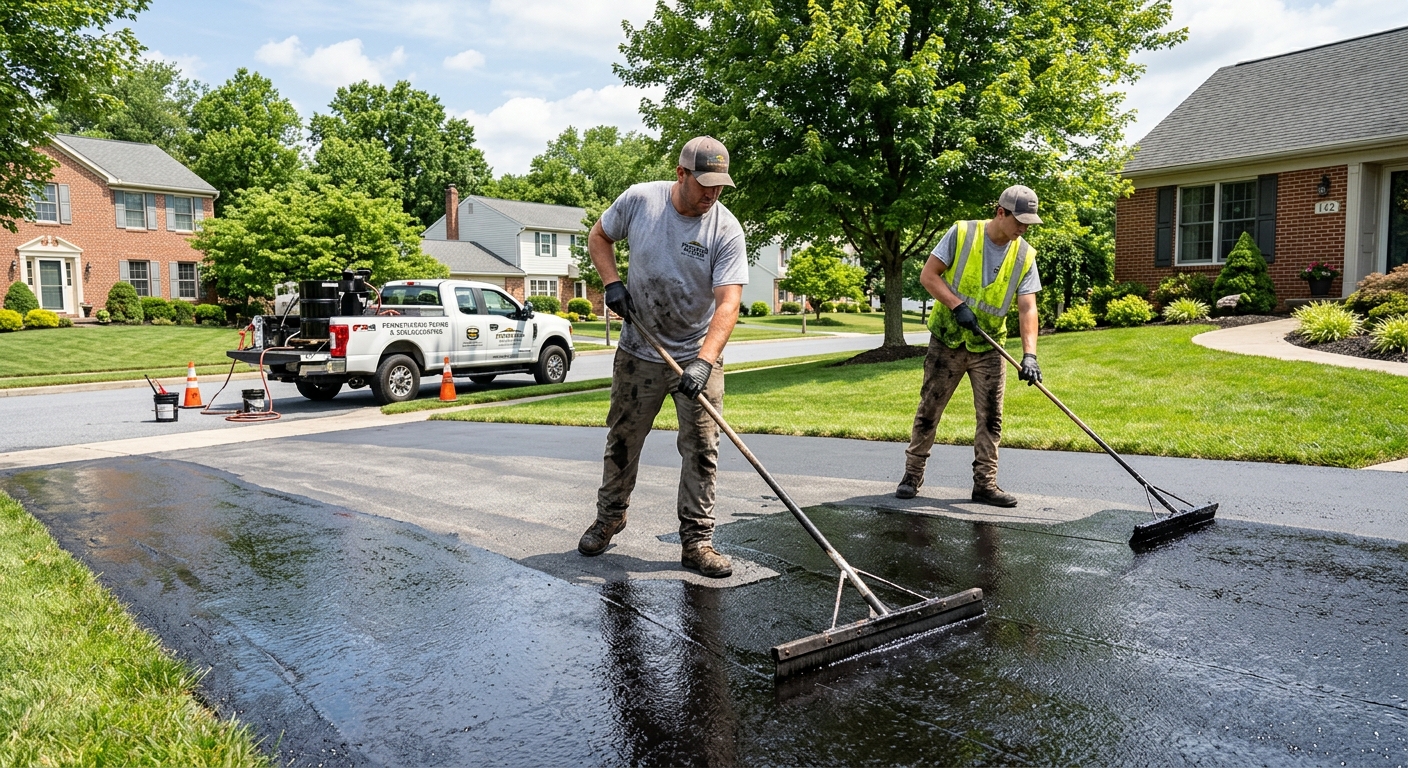
Driveway paving costs in Mount Joy — 2026
Mount Joy is a community where the numbers matter: more than three out of four homes are owner-occupied, and nearly 60% are single-family properties (U.S. Census Bureau, ACS 2024). For most homeowners here, a driveway isn’t a minor expense. What you pay for paving in Mount Joy depends less on the top black coating than on the work that's buried under it. In south-central Pennsylvania, freeze-thaw cycling destroys any driveway that skimps on excavation or base construction. Especially on limestone soils common in areas near East Hempfield, shortcuts underground mean big surface failures later.
Most of the difference in cost between two Mount Joy paving quotes comes from what’s out of sight. If you see a price that seems suspiciously low, that means shallower excavation, less or poorer aggregate, or insufficient compaction—all invisible once paved. Surface appearance is only part of the story; real durability is built from the subgrade up.
| Service | Best for | Lifespan | Price range |
| Asphalt — full replacement with new base |
Failed base, structural cracking |
20–30 yrs |
$3,700–$9,500 |
| Asphalt overlay / resurfacing |
Sound base, surface cracking only |
8–15 yrs |
$1,600–$4,700 |
| Sealcoating — single application |
Preventive maintenance on sound asphalt |
2–4 yrs |
$200–$750 |
| Concrete — new installation |
Long service life, low maintenance |
30–50 yrs |
$5,300–$12,500 |
| Crack filling and patching |
Isolated cracks under a quarter inch |
1–3 yrs |
$200–$800 |
| Gravel driveway |
Rural, budget, long runs |
5–10 yrs with upkeep |
$900–$3,500 |
Estimates for a typical Mount Joy driveway. Square footage and base condition drive these figures more than material choice.
How paving fraud actually operates
Paving attracts more than its fair share of scam operators in a rural county like Lancaster because much of the work is visible from the street, but the real quality is hidden underneath. The most common frauds are old and still effective: the “leftover material” pitch (I’m working nearby, let me do your drive cheap), “today-only” pricing, unmarked trucks with plates from out of the county or state, demands for cash or a big deposit up front, and a handshake deal with no written scope or price. Their favorite low-investment scam is a quick oil-based spray labeled as sealcoating that does nothing for the driveway, but leaves a shiny surface that soon flakes off.
Mount Joy’s moderate density means fewer neighbors as witnesses or sources of local referrals, making it an easier target for itinerant crews. If someone wants to rush you, the law in Pennsylvania is on your side. The Home Improvement Consumer Protection Act (HICPA) requires a written contract for any job over $500, which includes nearly all paving work. You have three business days to cancel that contract, no questions asked, and no legitimate contractor will refuse to honor it. Waiving an insurance deductible for storm damage is flatly illegal under state law.
The quick checks: verify Home Improvement Contractor (HIC) registration at hic.attorneygeneral.gov, confirm workers’ compensation coverage at WCAIS (wcais.pa.gov), get your quote in writing, and never pay cash to someone who just knocked. Five minutes now can save you years of headache and thousands in repairs.
The specifications to demand in writing
If you want your driveway to last in Mount Joy, ask every contractor for detailed specifications in writing before you sign. In this part of Lancaster County, freeze-thaw cycling plus local soils—especially limestone in some areas—mean you need a thicker base than a southern climate would require. Don’t accept a quote that just says “three inches of asphalt.” Is that the loose depth before compaction, or the finished depth after? The difference is significant: a three-inch uncompacted mat can compress to closer to two inches after rolling, and that’s asking for early failure.
Pay closest attention to base construction and compaction methods. Poor base prep is the leading cause of premature cracking, rutting, and edge breakup in south-central Pennsylvania. Demanding the right numbers up front is your best protection against shortcuts you’ll only discover when it’s too late.
- Total excavation depth, measured from finished grade
- Aggregate base material (type and gradation)
- Aggregate thickness and method of compaction
- Whether base is installed and compacted in multiple lifts
- Asphalt binder course depth—compacted, not loose
- Asphalt wearing/surface course depth—compacted
- Mix designations for all asphalt used (spec number)
- Edge treatment—tapered, supported, or with edge restraints
- Pavement slope for drainage (cross slope or crown spec)
- Joint locations and treatment (especially for concrete or overlays)
The paving season in south-central Pennsylvania
Paving isn’t a year-round business in Mount Joy or anywhere in Lancaster County. Our winter design temperature is 12 °F, with strong freeze-thaw cycles and over 5,000 annual heating degree days to contend with. Simply put, asphalt can’t be installed below a certain threshold—if the base or air is too cold, the hot mix cools before it is compacted, resulting in a porous, short-lived driveway. Local asphalt plants shut down for the winter, often from late November to March, so even the material is unavailable. Concrete faces a similar issue: it cannot cure properly below freezing, and any attempt to pour or finish below that point risks surface failure and scaling.
The peak paving window in Mount Joy runs from April through early November. Shoulder seasons (April, May and October) usually have more crew availability, and you may see better pricing then. Expect a July or August slot to book out weeks in advance. If a contractor offers to pave your drive after the plants have shut down or on a freezing day, that’s a sign to walk away—they are either cutting corners, or planning to use leftover, subpar material.
Proximity to local asphalt plants around Lancaster helps a bit with scheduling, but don’t be rushed into a late-season job. In this climate, missing the window by even a week can undo your whole investment.
Which surface survives Mount Joy winters
The number one enemy of driveways in Mount Joy is freeze-thaw cycling. Asphalt tolerates these ground movements much better than concrete: its flexibility allows it to bend and settle slightly when the soil heaves from frost, avoiding major cracks. Concrete, on the other hand, is rigid and can crack or spall, especially on driveways exposed to heavy snow and de-icing salt—a common scenario in Lancaster County’s winters. The reality is that salt, not just temperature, is what kills most concrete driveways here, by attacking the surface and causing scaling or flaking. If you go concrete, you have to avoid salt-based de-icers. Most homeowners say they will, but few stick to it during an icy stretch.
Here, concrete costs more upfront, but lasts much longer if it survives its first 10 winters. Asphalt has a shorter life, but is both less costly to repair and more forgiving of subgrade movement. Pavers are excellent for decorative options or when settling is expected, as individual units can be reset. Gravel is practical for rural and long driveways, but it does need more frequent maintenance.
| Option | Installed cost | Maintenance | Freeze-thaw performance | Lifespan |
| Asphalt — new install |
$3,700–$9,500 |
Sealcoat every 3–4 yrs |
Excellent, flexes |
20–30 yrs |
| Asphalt — overlay |
$1,600–$4,700 |
Same |
Good if base is sound |
+8–15 yrs |
| Concrete |
$5,300–$12,500 |
Low, avoid de-icing salt |
Fair, spalls with salt |
30–50 yrs |
| Pavers |
$8,400–$12,500 |
Individual units replaceable |
Good, settles gradually |
25–50 yrs |
| Gravel |
$900–$3,500 |
Top-dress every 2–3 yrs |
Excellent drainage |
Indefinite with upkeep |
Sealcoating: what it does and what it doesn't
Sealcoating is overpromoted, but it’s not totally pointless. In Mount Joy, what it’s really for is shielding asphalt from sun, oxidation, gasoline or oil drips, and gradual water damage—plus it darkens faded patches and evens up the look. But sealcoating will not fix structural flaws, stop sinking, or make a cracked, failing drive “like new.” It’s a preventive maintenance pass, not a permanent fix or an upgrade.
The big thing few say out loud: too much sealcoating, or sealing too soon after fresh asphalt installation, does more harm than good. Layers build up and start to crack, peel, or trap the solvents trying to evaporate out of new pavement. In Mount Joy, a good rhythm is sealing every three to four years—never every year. Let new asphalt cure for at least one full season, often longer, before the first sealing.
Crack filling is actually the higher-value maintenance; it stops water intrusion that worsens freeze-thaw damage. For both, quality matters: a $200 “spray and go” job is usually just colored water, thin oil, or diluted material that won’t last even a full winter. A legitimate, brush-applied sealcoat from a registered contractor should run $200–$750 and truly protect—anything drastically cheaper buys you nothing but a short-lived shine.
What you need before paving in Mount Joy
If you’re repaving or resurfacing an existing private driveway in a township in Lancaster County, you usually do not need a permit—there’s no street opening or right-of-way paperwork unless you’re altering the connection to the public road. But as soon as your project involves changing the curb, extending the driveway, or building a new approach, you need a permit. In Lancaster city, driveway approaches and curb cuts are handled by the City of Lancaster Bureau of Engineering. State roads fall under PennDOT District 8-0 for approach work.
You should also think about drainage. Expanding hard surface area can trigger stormwater runoff requirements—ignoring proper drainage or dumping runoff onto a neighbor’s property can turn into a civil issue, regardless of your permit status. On some limestone sites, thicker bases and careful grading matter just as much as bureaucracy.
Before hiring anyone, check their Home Improvement Contractor (HIC) registration at hic.attorneygeneral.gov—required for all contracts over $500 by state law. For crews with employees, workers’ compensation coverage can be verified quickly at WCAIS (wcais.pa.gov). These are statewide rules put in place to protect you as a homeowner, not just the contractor.
Frequently asked questions — driveway paving in Mount Joy
What does an asphalt overlay cost in Mount Joy?
An asphalt overlay in Mount Joy generally costs between $1,600–$4,700 as of 2026, with most standard single-family driveways falling closer to the middle of that range. Whether your project comes out on the low or high end depends largely on the total square footage, but the real factor is your driveway’s existing base. If your base is solid, with only minor surface cracking, resurfacing is a good value and adds another 8–15 years of life. If the base is compromised, an overlay is cheap up front but prone to big failures here thanks to our freeze-thaw cycles. Always ask for a base inspection and don’t let anyone sell you an overlay if there’s standing water, major depressions, or soft spots. Mount Joy’s climate puts added stress on resurfaced asphalt—so be sure it’s the right fit for your drive.
Are door-to-door pavers a problem in Mount Joy?
Yes, transient or door-to-door pavers are a well-known problem in Mount Joy and across Lancaster County. The county’s mix of suburban and rural areas, with fewer neighbors around to compare notes, makes it easy for out-of-town crews to disappear after a shoddy job. Beware of anyone offering a so-called deal with leftover materials, today-only discounts, or requiring cash up front. These operators rarely supply a written contract or proof of Home Improvement Contractor registration, both of which are required for any job over $500 under Pennsylvania law. Always check references, confirm credentials at hic.attorneygeneral.gov, and never agree to work on short notice just because they “have materials left.” Taking five minutes to verify can save you thousands on repairs down the road.
How deep should the aggregate base be here?
In Mount Joy and the wider Lancaster County region, you need a thicker aggregate base than many other climates require. For asphalt, a minimum of 6–8 inches of compacted crushed stone is standard; on limestone-heavy soils, especially in nearby East Hempfield, you should target the upper end of that range or even more. This thicker base is what protects against frost heave and rutting caused by our pronounced freeze-thaw cycles. Don’t accept any quote that can’t state the specified base depth and compaction method in writing. Skimping here is the main reason cheaper driveways fail early—no surface treatment or thicker topcoat can compensate for an undersized base, especially with Mount Joy’s variable and sometimes soft soils.
How much does driveway paving cost in Mount Joy?
Typical driveway paving costs in Mount Joy are in line with the rest of Lancaster County for 2026. A full asphalt replacement, including excavation and new stone base, ranges from $3,700–$9,500, with most projects around $5,800 depending on size and site conditions. For concrete, expect $5,300–$12,500. Overlay and resurfacing options fall between $1,600–$4,700 if your base is sound. The price is mainly driven by square footage and—more importantly—the condition of the existing base. Trying to save by skipping base repairs is a false economy here, as the first major frost cycle will expose any shortcut.
Are there stormwater rules on paving in Mount Joy?
Yes, stormwater runoff needs to be on your radar any time you pave or expand a driveway in Mount Joy. While resurfacing an existing drive usually doesn’t require a permit in most Lancaster County townships, expanding the footprint or changing where water runs off can trigger stormwater management requirements. And even where permits aren’t required, Pennsylvania law holds you responsible if you redirect runoff onto your neighbor’s property—which can turn into a liability issue quickly. For projects that significantly increase impervious surface, check with the township or the City of Lancaster Bureau of Engineering before starting. It’s always easier to do the grading and drainage the right way the first time rather than fight standing water or complaints later on.
What causes concrete to spall or flake in Mount Joy?
The most common cause of concrete spalling or flaking in Mount Joy is de-icing salt use during winter. Our climate’s strong freeze-thaw cycles already stress concrete driveways, and when salt is added, it attacks the surface, leading to surface chipping and scaling. Lesser causes include improper curing (pouring when too cold), using the wrong mix design, or water ponding. Concrete can last 30–50 years here when poured correctly and cared for, but regular use of salt-based de-icers will quickly reduce that. If you want a concrete drive, stick to sand or calcium chloride for ice, and avoid rock salt entirely. Repairs for spalling seldom restore a driveway to “like new” condition, so initial prevention is key.
Can asphalt be laid in cold weather?
No, asphalt can’t be successfully laid in cold weather in Mount Joy. Hot-mix asphalt needs to be installed within a temperature window—typically above 45°F for both the base and air temperature. Below this, the mix cools too quickly and proper compaction can’t be achieved, resulting in a weak, short-lived surface. Local asphalt plants around Lancaster close each winter, usually from late November through March, meaning material isn’t even available. Anyone proposing to pave during freezing temperatures is either using leftover or reheated mix, or isn’t going to deliver a job that will hold up. For best results, schedule your project between April and October when both conditions and material are right.
Are pavers worth the cost in south-central Pennsylvania?
Pavers are more expensive up front—expect $8,400–$12,500 for a standard Mount Joy drive—but can be worth it in certain situations. They have two big advantages here: their flexibility helps accommodate minor settling or freeze-thaw heaves without developing big cracks, and if a section sinks or shifts, you can lift and reset just those units. Their main drawback is weed growth in the joints without routine maintenance, and snow shoveling can be trickier. Pavers are best for decorative drives or areas where appearance is key. For most homeowners in Mount Joy, asphalt or concrete remains the best value, unless your site or style calls for something else.
When can I seal a brand new asphalt driveway?
In Mount Joy’s climate, you should wait at least one full season—often six months to a year—before sealcoating a new asphalt driveway. The asphalt needs ample time to finish curing and allow excess volatiles to escape. Sealing too early traps these oils, resulting in soft spots and peeling that rapid temperature changes will expose. This is especially important in places with our freeze-thaw cycles. Many contractors recommend waiting until the following spring or summer after installation. For cost, a first-time quality sealcoat is in the $200–$750 range for a typical single-family drive here—avoid cut-rate offers, especially for a brand new surface. Your patience will pay off in longer pavement life and fewer maintenance headaches.