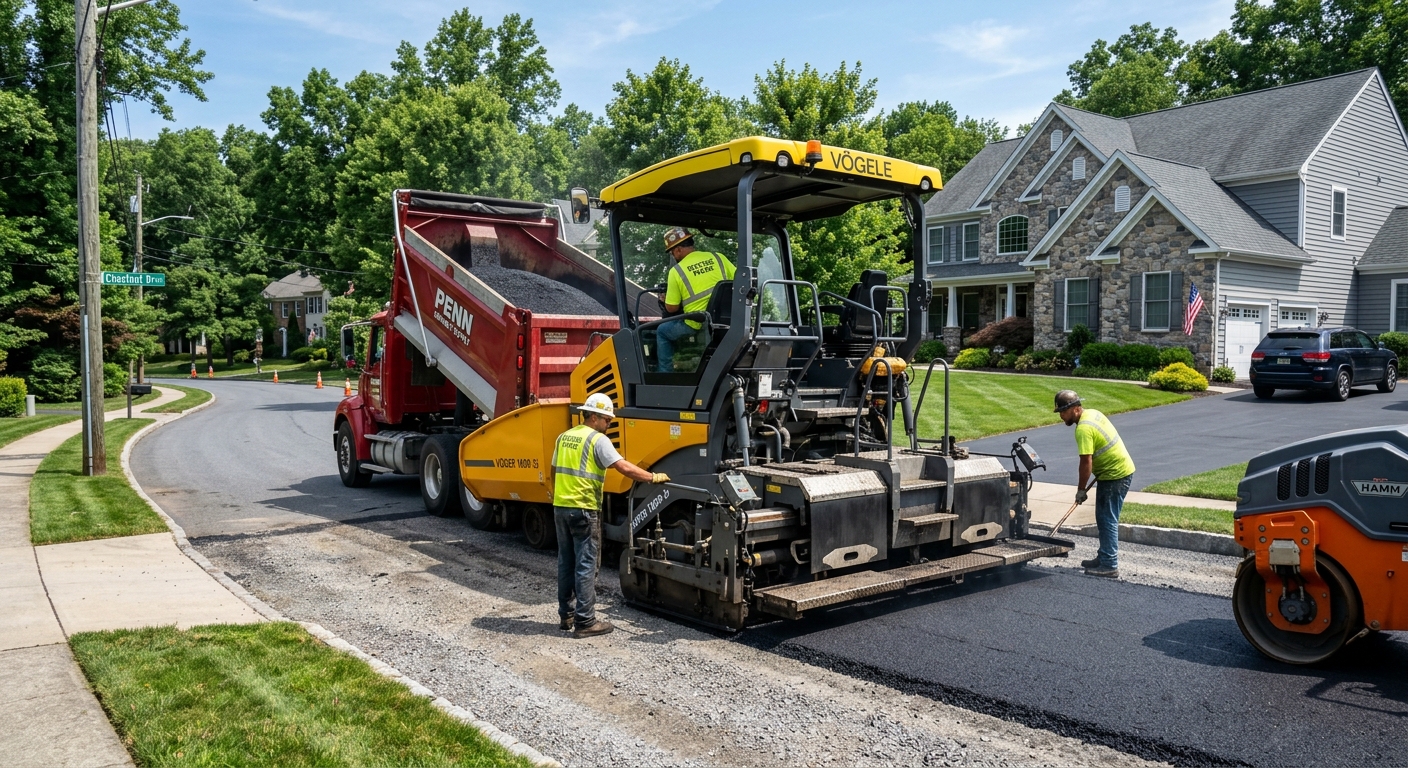
What a new driveway costs in North Coventry
In North Coventry, a typical driveway project comes with a meaningful price tag—a reality of owning a single-family home in a township where nearly 7 out of 10 homes are detached and 73.2% of residents own their homes (U.S. Census Bureau, ACS 2024). For most homeowners, replacing or resurfacing a driveway won’t be something you do more than once or twice. The overall investment is controlled less by the surface material than by what lies underneath: the base and subgrade that support everything above. Central Chester County’s mix of limestone and dolomite bedrock means that base thickness and compaction matter more here than in places with sandy soils. Our region’s moderate freeze-thaw cycles only amplify this, as water can infiltrate weak spots, causing heaving and settlement if the base is insufficient or poorly drained.
Most of the price difference between paving quotes is literally underneath your feet. Two good-looking driveways may perform very differently, depending on base construction you can't see. While material choices—like asphalt versus concrete—do affect cost, don't let surface appearances alone drive your decision.
| Service |
Best for |
Lifespan |
Price range |
| Asphalt — full replacement with new base |
failed base, structural cracking |
20–30 yrs |
$3,800–$9,900 |
| Asphalt overlay / resurfacing |
sound base, surface cracking only |
8–15 yrs |
$1,650–$4,900 |
| Sealcoating — single application |
preventive maintenance on sound asphalt |
2–4 yrs |
$225–$750 |
| Concrete — new installation |
long service life, low maintenance |
30–50 yrs |
$5,500–$13,000 |
| Crack filling and patching |
isolated cracks under a quarter inch |
1–3 yrs |
$200–$800 |
| Gravel driveway |
rural, budget, long runs |
5–10 yrs with upkeep |
$900–$3,500 |
Estimates for a typical North Coventry driveway. Square footage and base condition drive these figures more than material choice.
How to tell if the base is gone
The condition of your driveway’s base decides everything: its lifespan, your final cost, and whether repairs will actually hold. Fortunately, you can do your own first check before a contractor even sets foot on your property. Wide areas of alligator cracking—the tight, interconnected pattern like a reptile's back—almost always mean the base has failed. In North Coventry, given the freeze-thaw cycles and our limestone-rich subgrade, these cracks will only widen and multiply. You can patch or overlay, but that is short-term thinking; an overlay on top of a failed base is money burned.
If you only see a few linear cracks (those that are straight, not spiderwebbed), that usually means surface aging, not structural failure. Depressions where water sits, called “birdbaths,” signal the ground below has shifted and water has compromised the base. Crumbling or missing edges mean the original base never extended to the edge, a common shortcut in older driveways. Potholes show water has already made it through to the base, and unless that area is cut out and rebuilt, patching only masks the issue.
If a contractor quotes resurfacing or overlay without physically probing or cutting to check your base, they have not checked the only thing that matters long-term. Surface fixes on a failed base will not last in North Coventry’s climate—period.
| What you see |
Likely cause |
Right fix |
Cost |
| Isolated cracks under 1/4 inch |
surface aging |
crack fill and seal |
$225–$750 |
| Alligator cracking over a wide area |
base failure |
full replacement |
$3,800–$9,900 |
| Depressions holding water |
subgrade movement |
excavate and rebuild that area |
$3,800–$6,000 |
| Crumbling edges |
no edge support |
edge repair, consider curbing |
$400–$1,500 |
| Potholes |
water into the base |
full-depth patch, then assess |
$250–$900 |
| Faded but sound surface |
oxidation only |
sealcoat |
$225–$750 |
Which surface survives North Coventry winters
Choosing between asphalt and concrete in North Coventry means weighing freeze-thaw performance and how you use the driveway, not just the sticker price. This part of southeastern Pennsylvania experiences moderate freeze-thaw cycles, with a winter design temperature of 14°F. Asphalt is flexible—it gives slightly with ground movement—so it doesn’t crack as easily in these conditions. That’s why it’s the default for most homes here. If the base is right, an asphalt driveway can handle two to three decades of use with just a sealcoat every few years.
Concrete, on the other hand, is rigid and can last longer—sometimes up to 50 years—but it’s sensitive to salt. The spalling and surface scaling you see on old concrete in Chester County usually comes from salt-based de-icers, not from bad pours. Concrete costs more, asking for $5,500–$13,000 for a new installation, and if you use salt regularly, expect to see damage long before its typical lifespan.
Pavers offer a middle route: attractive and long-lasting, easy to repair but usually at the upper end of the price scale. Gravel remains best for rural or steep drives—great drainage, low cost, but dusty and not everyone likes grading every couple years.
| Option |
Installed cost |
Maintenance |
Freeze-thaw performance |
Lifespan |
| Asphalt — new install |
$3,800–$9,900 |
sealcoat every 3–4 yrs |
excellent, flexes |
20–30 yrs |
| Asphalt — overlay |
$1,650–$4,900 |
same |
good if base is sound |
+8–15 yrs |
| Concrete |
$5,500–$13,000 |
low, avoid de-icing salt |
fair, spalls with salt |
30–50 yrs |
| Pavers |
$8,800–$13,000 |
individual units replaceable |
good, settles gradually |
25–50 yrs |
| Gravel |
$900–$3,500 |
top-dress every 2–3 yrs |
excellent drainage |
indefinite with upkeep |
Driveway permits, approaches and stormwater rules
In North Coventry Township, the rules are straightforward if you know where to look: most residential driveway repaving or resurfacing projects that keep the driveway within its existing footprint do not require a township driveway permit. That means if you are simply replacing what you already have, you save yourself paperwork. However, if your project involves tying into a public road, changing the width, adding parking, or working in the right-of-way, you will need a driveway permit from the township—and for driveways connecting to state routes, permits must come from PennDOT Engineering District 6-0. Many homeowners don’t expect this dual system, but it applies throughout Chester County.
Adding or widening a driveway may also trigger stormwater requirements, as expanding impervious surface changes how runoff crosses your property. Even with permits in hand, you cannot redirect stormwater onto a neighbor’s land—that’s a liability with or without township approval.
When hiring a contractor, check for valid Pennsylvania Home Improvement Contractor (HIC) registration at the Attorney General’s registry (hic.attorneygeneral.gov), and make sure they carry workers’ compensation that can be verified in WCAIS (wcais.pa.gov). Written contracts are required by the Home Improvement Consumer Protection Act for any job over $500.
Drainage: the failure nobody plans for
Most driveways in North Coventry fail because of water. Proper grading isn’t the final touch—it’s central to a driveway’s lifespan. Your driveway needs a minimum slope of 2% (about a quarter inch per foot) away from structures to shed water quickly. Crowning—where the center of the driveway is highest—or a cross-slope can both work, depending on layout. If the driveway slopes toward your garage or entry door, you are asking for water problems. A trench or channel drain at the bottom of the slope, tied to proper daylighting or a dry well, is often the only fix in tight lots.
Chester County’s freeze-thaw cycles punish poor drainage. When water gets under the pavement and freezes, it heaves and breaks the surface—this is even worse over heavy clay soils, but in central Chester County, limestone and dolomite mean any ponded water drains vertically unless held in by clay lenses or compacted fill.
Do not try to “fix” draining by sending water onto a neighbor; that creates more problems and liability regardless of what the township says. If there’s one place not to skimp, it’s the base prep and drainage—the cost of getting it wrong always exceeds the savings.
Why you can't pave in February
In North Coventry, winter closes down driveway paving, no exceptions. Hot-mix asphalt must be laid and compacted while the material is hot—if the ground or air are too cold, the mix cools too rapidly, leading to a weak, porous surface that won’t last through a single Chester County winter. With local winter design temperatures down to 14°F, area asphalt plants simply shut down, usually from late November until at least March. Even if a plant were open, the quality wouldn’t justify the expense.
Concrete has its own limits. It needs steady temperatures well above freezing for at least a few days to cure properly; cold weather curing is a specialized process that’s rarely worth it for a residential drive.
If you want the best scheduling and price leverage, book in the shoulder seasons—April through June and September through October. Summer is the busiest time; reputable crews are booked by early spring for peak months. If a contractor offers to pave your driveway in late November or February, know that proper materials simply may not be available or the result will be compromised. In Chester County, patience beats a bad pour every time.
Local soil, drainage and driveway lifespan
Central Chester County, including North Coventry, is built over limestone and dolomite bedrock. This matters because those geologies drain rapidly in places, but areas with clay lenses or compacted fill can trap water right beneath your driveway base. Limestone-rich subsoil also means heavier aggregate bases are required—thicker than you’d see in the sandy soils west of Harrisburg, for example. This wasn’t always enforced decades ago: large tracts built during the 1960s through 1980s, especially around Exton and West Goshen, often went in with minimal base prep, which is why so many now require full-depth replacement rather than simple overlays.
Combined with the region’s moderate freeze-thaw cycle and a frost depth of 30 inches, subgrade preparation is the divide between a 30-year driveway and one that fails after a few seasons. If your home predates the improved standards, double-check what’s actually under your asphalt or concrete before resurfacing. Settlement, reflective cracking, and drainage failures nearly always trace back to skimping on base and grading for the specific limestone soils here in North Coventry.
Frequently asked questions — driveway paving in North Coventry
What does an asphalt overlay cost in North Coventry?
Overlaying your existing asphalt driveway in North Coventry typically costs between $1,650–$4,900. This price range reflects area trends—our local market is competitive, and shorter hauls from quarries and asphalt plants near Downingtown and Coatesville keep material costs stable. The exact number depends on your driveway size and, most importantly, the condition of your base. An overlay is only advised if your current asphalt is structurally sound underneath—think surface cracking, not alligator cracking or deep depressions. Remember, doing an overlay over a weak base is throwing money away in Chester County’s freeze-thaw climate. Make sure your contractor inspects and, if needed, probes the base before quoting a job.
Asphalt or concrete for a North Coventry driveway?
In North Coventry, the choice between asphalt and concrete comes down to how you use your driveway and your appetite for maintenance. Asphalt costs less—$3,800–$9,900 for a full replacement—with a 20–30 year expected life if maintained. It flexes with freeze-thaw cycles, which suits our climate well. Concrete lasts even longer, up to 50 years, but costs more up front—$5,500–$13,000—and is vulnerable to salt damage. Chester County sees plenty of winter de-icer use, and most concrete failures here are from spalling due to salt, not cracking. If you can commit to not using salt-based de-icers and want decades of low maintenance, concrete is viable. Otherwise, asphalt is the more forgiving option for our local conditions.
How deep should the aggregate base be here?
For North Coventry’s limestone and dolomite soils, six to eight inches of compacted, clean aggregate base is the real minimum. Shallower bases were common in original 1960s–1980s subdivisions, leading to the failures we see today as driveways reach the end of their lives. The subgrade here drains better than heavy clay areas, but pockets of clay or shallow bedrock need extra prep—sometimes up to twelve inches if there’s settlement risk. If your contractor proposes anything less than six inches for a full-depth rebuild (which costs $3,800–$9,900), that’s a red flag for Chester County standards.
How often should I sealcoat my driveway in North Coventry?
Sealcoating is preventive maintenance, not a cure. In North Coventry, you should plan to sealcoat every three to four years—often enough to keep UV and water from drying out and cracking the asphalt, but not so often the coating becomes a slick layer. With our humid summers and winter salts, a properly applied sealcoat—at $225–$750—extends driveway life without breaking the bank. If the surface still repels water and is dark in color, you may be able to go another season; over-sealing is just as wasteful as under-sealing.
Are there stormwater rules on paving in North Coventry?
Yes, and they matter more than most homeowners realize. Expanding or adding a driveway in North Coventry—especially if it involves adding impervious area—can trigger stormwater requirements through the township. Every addition of hard surface influences runoff patterns, and both township and PA codes require that you do not direct stormwater onto a neighbor's land. Even if you stay within existing footprint for a simple redo (e.g., an asphalt overlay at $1,650–$4,900), best practice is to ensure positive drainage and keep water away from foundations and property lines. Ignoring this can create liability, especially given our region’s storm-driven rain events.
Why are paving quotes in North Coventry so different from each other?
The main reason for wildly different quotes in North Coventry is what’s included below the surface—base depth, aggregate quality, and drainage. With driveways, 90% of your long-term success is invisible, especially in our limestone-heavy soils that need a thick, well-compacted base. Two quotes for what appears to be the same job—say, a full asphalt replacement at $3,800–$9,900—may differ thousands because one skips on base prep and grading. Always make sure your proposals specify base depth and what will happen if soft spots or clay pockets are found. The cheapest bid often means corners cut where you’ll never see them—until the cracks appear.
How long should an asphalt driveway last in North Coventry?
A properly built asphalt driveway in North Coventry should last 20–30 years, provided it was installed on a sound, thick base and gets routine sealcoating every few years ($225–$750). Our region’s moderate freeze-thaw cycles stress even good driveways, and salt use in winter can accelerate wear if cracks are not kept sealed. Driveways placed on minimal or improper bases—as was common in 1960s–1980s tract homes—tend to show edge failure, settlement, or alligator cracking within 10–15 years. Full replacement, when needed, is worth the investment for the long term.
Does North Coventry have local asphalt plants?
While North Coventry itself doesn’t host an asphalt plant, the dense network of plants and quarries just east—in Downingtown and Coatesville—means supply is never a constraint here. This is good news for scheduling and pricing; haul distances are short, and fresh hot-mix is always available when conditions are right. That’s one reason why paving costs in North Coventry remain competitive, with overlays typically running $1,650–$4,900 and full replacements $3,800–$9,900. Unlike some rural Pennsylvania counties, you’re unlikely to be delayed for lack of material.
When is the best time of year to pave in North Coventry?
The best window to pave in North Coventry is late spring through early fall—typically April through October. Local asphalt plants are open and material quality is at its best. Concrete and asphalt both need temperatures well above freezing to set correctly, and spring/fall's moderate weather means crews can work efficiently without rushing against the clock like in midsummer. Summer is the busiest time and slots fill quickly. If you want your pick of crew and maybe better pricing, aim for the shoulder seasons. Anyone offering to pave in late fall or winter is a red flag; the result will simply not last, and you might end up paying for a fix much sooner than the normal $3,800–$9,900 replacement cycle.