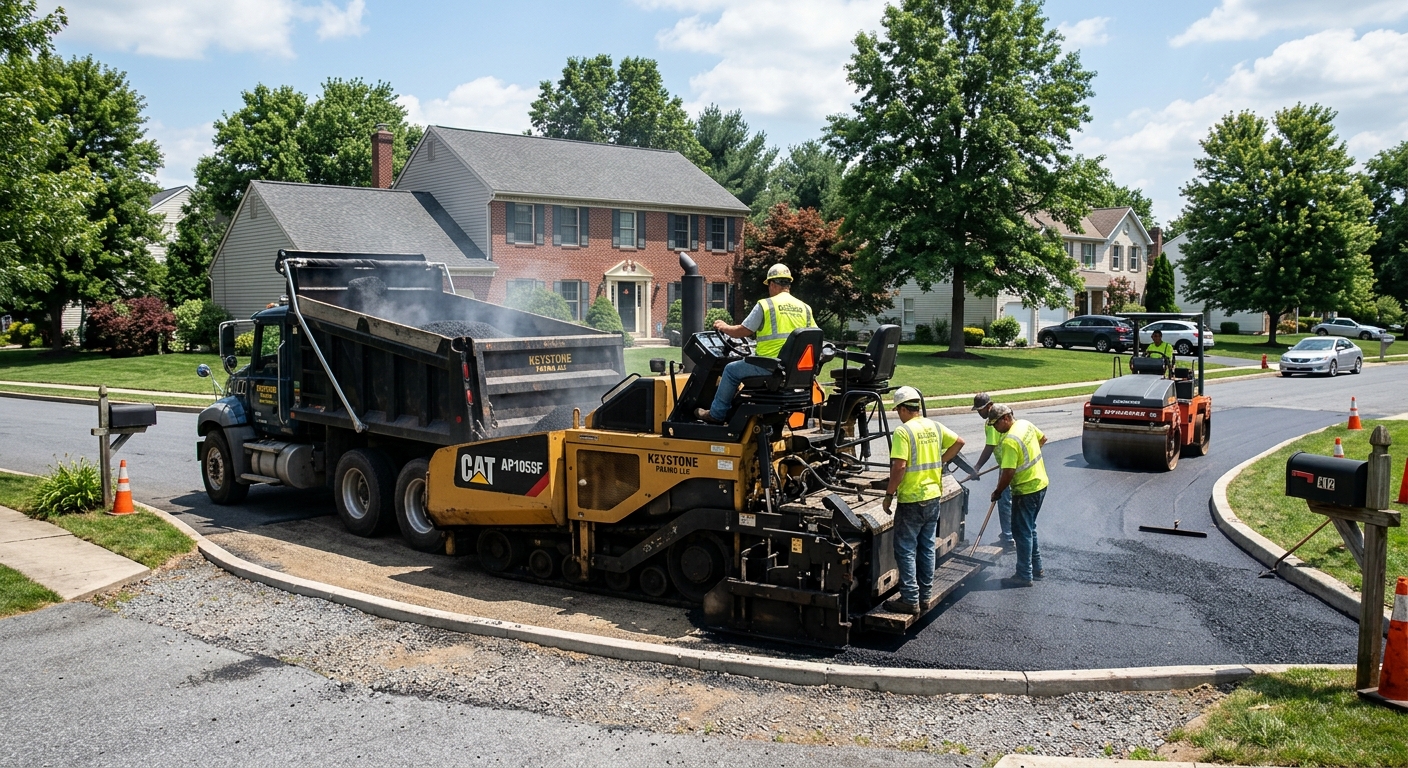
What a new driveway costs in Corry
When it comes to driveway replacement or paving in Corry, the decision is squarely a single-family homeowner’s concern—88.3% of homes here were built before 1980, and 67.4% are owner-occupied (U.S. Census Bureau, ACS 2024). Most of these homes are on lots large enough for driveways, but installation and upkeep are far from uniform. Corry’s climate brings deep winter freezes and spring thaws, which combine with Erie County’s glacial till and clay soils to make proper base construction critical. You rarely see issues right away, but what determines the cost—and the life of your driveway—is buried where you can’t see it. Two contractors might describe similar asphalt, but one might dig for a proper new base, while another takes shortcuts and relies on an old, compromised subgrade. You rarely discover which quote was right until a few years in, making it essential to know what’s under the surface.
| Service |
Best for |
Lifespan |
Price range |
| Asphalt — full replacement with new base |
failed base, structural cracking |
20–30 yrs |
$3,200–$8,300 |
| Asphalt overlay / resurfacing |
sound base, surface cracking only |
8–15 yrs |
$1,400–$4,100 |
| Sealcoating — single application |
preventive maintenance on sound asphalt |
2–4 yrs |
$175–$650 |
| Concrete — new installation |
long service life, low maintenance |
30–50 yrs |
$4,600–$11,000 |
| Crack filling and patching |
isolated cracks under a quarter inch |
1–3 yrs |
$200–$800 |
| Gravel driveway |
rural, budget, long runs |
5–10 yrs with upkeep |
$900–$3,500 |
Estimates for a typical Corry driveway. Square footage and base condition drive these figures more than material choice.
Permits and approvals for paving in Corry
If you are resurfacing or repairing an existing residential driveway in Corry without touching the public sidewalk or expanding the entrance, you generally do not need a building permit. However, any work involving the driveway approach—where your driveway meets the public road—usually does require a permit. In Erie County, driveways connecting to state highways need a permit from PennDOT District 1. Municipalities handle curb cuts onto local streets; for example, in the City of Erie, a new or reconstructed driveway apron or curb cut across a public sidewalk must be permitted by the City Engineer.
If you choose to widen your driveway or add new impervious surface, be aware that Erie County’s heavy clay soils make stormwater runoff management a concern. Local rules may not require a stormwater permit for minor work, but directing runoff onto a neighbor or spilling water across sidewalks and roads can create a liability regardless of permits. It's wise to direct drainage inward or to a suitable area on your property.
For any paving job over $500, Pennsylvania requires a written contract under the Home Improvement Consumer Protection Act. Anyone hired must hold a Pennsylvania Home Improvement Contractor registration (verify at hic.attorneygeneral.gov) and carry workers’ compensation insurance (search via WCAIS). Verifying these saves you headaches if there is a problem.
Corry's ground and what it means for paving
Corry and greater Erie County sit atop glacial till and lakeplain clays. Clay retains water, swells when wet, and shrinks when dry—problems in themselves, but made worse by Corry’s deep frosts (36 inches frost depth and winter lows averaging 5 °F). Inadequate stone bases over clay or till won’t last here. You may have noticed driveways in older Corry neighborhoods with ruts or heaving after winter; that’s almost always due to thin, poorly compacted bases that can’t stop freeze-thaw cycles from turning clay subsoils into sponges each spring.
Homes built from 1940-1970 often came with narrow, single-car driveways, rarely with a deep aggregate base. Many were widened or overlaid after the fact without correcting the subgrade. If you’re planning a new or replacement driveway, expect to pay for excavation to 12–16 inches (not just a shallow scrape) and a thick, compacted base of clean aggregate to withstand Corry’s extremes. Don’t let a contractor talk you into a light-duty spec borrowed from less demanding counties—our soil and winter demand better.
Diagnosing a failing Corry driveway
Before spending on resurfacing or replacement, assess your driveway honestly. Surface cracks less than 1/4 inch wide—especially if they run straight—are cosmetic. They can be sealed and the surface coated. But if you see a web of alligator cracking over wide areas, or if you find depressions that hold water, those point to base and subgrade failure. Edge crumbling is a giveaway there’s no support. Potholes mean water has washed out the stone beneath, and any overlay without full repair is wasted.
If a contractor recommends resurfacing but hasn't probed beneath the surface (with a test dig or core), they’re guessing. An overlay on a failing base won’t last two freeze-thaw cycles in Corry. Don’t pay twice for the same work—know the signs, and don’t let anyone “sell” you on a quick fix unless the base is sound.
| What you see |
Likely cause |
Right fix |
Cost |
| Isolated cracks under 1/4 inch |
surface aging |
crack fill and seal |
$175–$650 |
| Alligator cracking over a wide area |
base failure |
full replacement |
$3,200–$8,300 |
| Depressions holding water |
subgrade movement |
excavate and rebuild that area |
$3,200–$5,100 |
| Crumbling edges |
no edge support |
edge repair, consider curbing |
$400–$1,500 |
| Potholes |
water into the base |
full-depth patch, then assess |
$250–$900 |
| Faded but sound surface |
oxidation only |
sealcoat |
$175–$650 |
What a real paving quote contains
A trustworthy paving quote in Corry covers the specifics: measured (not guessed) square footage, actual excavation depth, type and thickness (in inches) of aggregate base, how compaction is done (ideally in several lifts), asphalt binder and surface course thickness as compacted (because “three inches” laid can compact to two), edge treatment (curbing or tamped edge), grading details for drainage, and how your lawn or landscape will be restored. Payment terms should be straightforward—a small deposit, balance on completion. Warranty terms need to specify what is and isn’t covered. Most exclude new cracks, despite what many homeowners expect.
If you’re handed a one-line proposal and total, you cannot compare it to another quote and are likely to overpay for underbuilt work. Make sure every quote details these items, so you’re truly comparing apples to apples.
| Line item |
What to look for |
Red flag if… |
| Area |
measured square footage stated |
eyeballed or absent |
| Excavation |
depth and disposal included |
'we'll pave over it' |
| Base |
aggregate type and depth in inches |
'proper base' |
| Compaction |
method, and done in lifts |
not mentioned |
| Asphalt |
courses and compacted depth |
'3 inches' unqualified |
| Drainage |
slope and water direction stated |
silent |
| Warranty |
what is covered and what is excluded |
verbal only |
| Payment |
modest deposit, balance on completion |
full cash up front |
What to put in a Corry paving contract
If you want your driveway to last in Corry, focus on contract specs, not just price. Pennsylvanian freeze-thaw and Erie County’s clay soils demand more than the bare minimum. Your contract should specify every relevant detail:
Excavation depth should be in inches. The aggregate base has to be a stated material (often AASHTO #57 stone or similar) at a real, measured thickness—nothing vague like "standard base." Compaction must be done in lifts and specified that way, especially over clay. Asphalt thickness should be the compacted depth, not simply “as laid.” Surface and binder course thickness should be separated out and mix designations listed. Edge treatment means stating whether you're getting tamped edges or a hard curb. All drainage slopes must be mapped: in Erie County’s climate, standing water means an early death for new paving. If a contract just says “we’ll put down three inches,” ask if that’s compacted or laid thickness—here, that can be the difference between a driveway that lasts twenty years and one that cracks in five.
- Excavation depth in inches
- Aggregate base thickness and material
- Base compaction method and layers
- Compacted asphalt thickness (not just laid)
- Binder and surface course thickness stated separately
- Asphalt mix type/designation
- Edge treatment (tamped edge or curb details)
- Drainage direction and finished slope
- Details on cleanup and restoration
- Written warranty with inclusions and exclusions
The paving season in northwestern Pennsylvania
Timing a driveway project in Corry is not negotiable—the climate makes that decision for you. Hot-mix asphalt requires warm weather, or it can’t be properly placed and compacted. When temperatures drop below 50 °F routinely—often by mid to late October—local asphalt plants shut down for the season, so there’s simply no fresh mix available. Similarly, concrete needs above-freezing temperatures at night to cure properly, ruling out any work during the heart of Erie County’s long, cold winters (design winter temperature is 5 °F, with lake-effect snow common).
That means the true paving window is usually from late April through October. Crews are busiest June–August. You’ll get better scheduling flexibility and sometimes more competitive bids in late spring and early fall. If a contractor wants to pave in November or March, be skeptical; laying asphalt or pouring concrete in cold weather here leads to premature failure.
Aggregate is supplied locally around Erie, so material delays are rare—the local quarries and plants keep costs stable, letting timing and weather dictate the work. Plan ahead and book early. Rushing work in cold or wet conditions is almost guaranteed to reduce your driveway’s life significantly.
Frequently asked questions — driveway paving in Corry
When can I seal a brand new asphalt driveway?
Sealing a fresh asphalt driveway in Corry—or anywhere in Erie County—should wait at least 90 days, and ideally a full season. The asphalt needs time to finish curing and let out solvents, especially in a climate with our range of temperatures. If you seal too soon, you trap these volatiles, leading to a soft surface prone to scuffing. Wait until late summer or fall if your driveway was installed in spring. For a typical single application, plan on spending $175–$650. Once sealed, stick to a 2-4 year schedule, rather than over-applying.
Are there stormwater rules on paving in Corry?
Expanding your driveway in Corry can bring runoff challenges. Erie County’s clay soils don’t absorb water quickly, so adding impervious surface can mean water ends up where it doesn’t belong—neighbor’s yards or public rights-of-way. Municipal rules vary, but local authorities may require grading plans for major expansions or new approaches. Even without formal regulation, you’re liable if runoff causes damage. For most maintenance or simple resurfacing (such as an asphalt overlay at $1,400–$4,100), formal permits aren’t triggered. But always ensure water flows safely onto your own lot.
Are door-to-door pavers a problem in Corry?
Yes—they pop up in Corry every season, offering what seem like bargain rates for leftover asphalt. These transient crews don’t provide written contracts, usually lack the Pennsylvania Home Improvement Contractor registration, and disappear if there’s a problem. In Pennsylvania, any paving job over $500 legally requires a contract and contractor registration (verify at hic.attorneygeneral.gov). They rarely excavate or address the clay subgrade beneath, so the driveways fail quickly. If an outfit is promising next-day work for cash, walk away—it’s the most common local complaint after springtime.
Why are my driveway edges crumbling?
Corry’s older driveways often crumble at the edges because of a lack of edge support—no curb, tamped edge, or widening beyond the base. When edges get driven over or freeze-thaw action works under a thin base, that’s when you see chunks breaking away. Local soils and our deep frost mean unsupported edges deteriorate more quickly than in milder regions. To fix this, consider an edge repair (typically $400–$1,500), with options for a tamped edge or a masonry curb to lock things in.
How thick should asphalt be for a residential driveway in Corry?
For Erie County and Corry’s clay soils and winter freeze, the minimum compacted asphalt thickness should be 3 inches—split into a 2-inch binder and 1-inch surface course, both measured compacted. The aggregate base should be no less than 6–8 inches of clean stone, with proper compaction every few inches. This is more than in mild climates, but it’s necessary to prevent heaving and rutting. A thinner section, though cheaper, won’t last through our winter cycles. A full-depth rebuild like this runs $3,200–$8,300 depending on size.
When is the best time of year to pave in Corry?
The true paving season in Corry is from late April through October. Before or after that, the cold keeps asphalt from achieving proper compaction, and local plants aren’t open. Most contractors are booked heavily in mid-summer. You can get on the schedule—and sometimes better pricing—by planning for late spring or early fall. Never hire a crew offering to pave in the cold months; those jobs rarely survive even two winters here. Sealcoating, likewise, is best done in late spring or early fall at $175–$650 per application.
Is gravel a cheaper option in Corry?
Gravel is the lowest-cost way to get a usable driveway in and around Corry, and it’s well-suited to rural sites or long runs off the main road. For $900–$3,500 installed, you get a surface that drains well if built on a thick enough base. However, expect to add gravel every couple of years and deal with regular grading to smooth ruts formed by the freeze-thaw cycle and our heavy clay. It’s not maintenance-free, but it is often more forgiving of ground movement than cheap asphalt.
What does an asphalt overlay cost in Corry?
An asphalt overlay in Corry—where a new layer is added onto a base that’s still structurally sound—typically costs $1,400–$4,100 depending on the area and prep work needed. But overlays are only appropriate if the existing base isn’t moving or breaking up. If cracks run deep or the driveway flexes, an overlay is only a band-aid and won’t survive a few freeze-thaw cycles. Be wary of contractors offering overlays without testing the base, especially with our local soils.
Asphalt or concrete for a Corry driveway?
Asphalt is more common in Corry and Erie County, mainly because it’s less expensive up front—$3,200–$8,300 for a full replacement—and stands up well if built with a proper base. Concrete costs more initially ($4,600–$11,000), but offers longer life and less maintenance. However, concrete needs to be thick and properly air-entrained to avoid freeze-thaw damage in local soils. Both options require a quality base layer because of our clay and freeze cycles. Choose based on your budget, maintenance preference, and whether you want the curb appeal of concrete or the flexibility of asphalt.