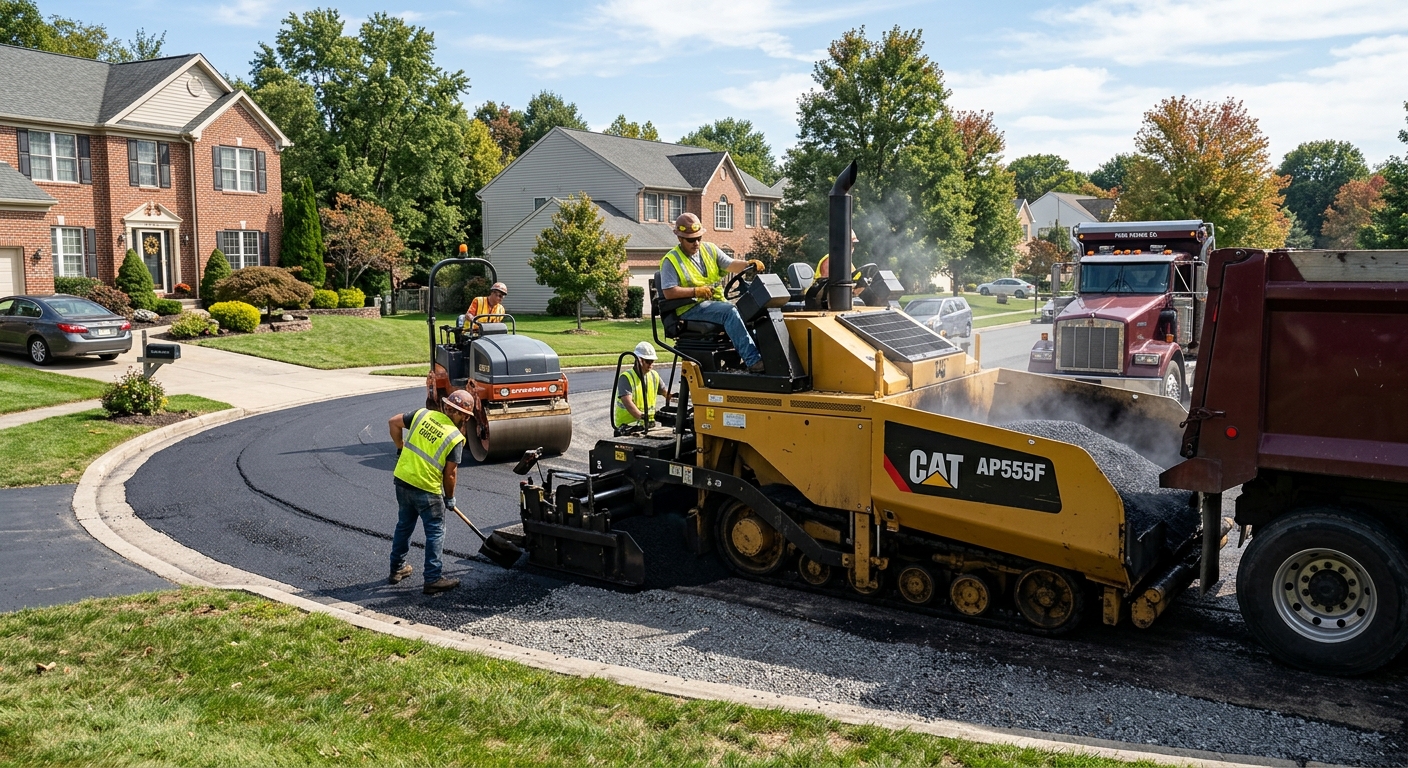
Driveway paving costs in Cranberry — 2026
Cranberry, like much of Venango County, is made up mostly of single-family homes—over 75% of the housing stock (U.S. Census Bureau, ACS 2024)—and a large share of homeowners (70.2%) handle their own exterior maintenance expenses. That means driveway paving and maintenance is a common concern here, especially when dealing with driveways attached to houses built between 1940 and 1960, where drive slopes and widths are often less than ideal after decades of settling and repairs.
The real cost drivers for paving in this area aren’t always visible: most of what you’re paying for is what’s buried underneath. Venango County soils are usually glacial till and shale, and the region's harsh freeze-thaw cycle can make a thin or improperly built base fail in just a few years. If one quote is far cheaper than another, odds are that savings come from scrimping on excavation, aggregate depth, or compaction process—none of which you’ll see on the surface, but you’ll notice in the form of cracks and potholes before the driveway’s lifespan is up. The distance from local asphalt plants (often Meadville or Clarion) means there’s also a cost penalty on materials, especially if an out-of-county crew tacks on travel charges.
| Service |
Best for |
Lifespan |
Price range |
| Asphalt — full replacement with new base |
failed base, structural cracking |
20–30 yrs |
$3,300–$8,500 |
| Asphalt overlay / resurfacing |
sound base, surface cracking only |
8–15 yrs |
$1,400–$4,200 |
| Sealcoating — single application |
preventive maintenance on sound asphalt |
2–4 yrs |
$200–$650 |
| Concrete — new installation |
long service life, low maintenance |
30–50 yrs |
$4,700–$11,500 |
| Crack filling and patching |
isolated cracks under a quarter inch |
1–3 yrs |
$200–$800 |
| Gravel driveway |
rural, budget, long runs |
5–10 yrs with upkeep |
$900–$3,500 |
Estimates for a typical Cranberry driveway. Square footage and base condition drive these figures more than material choice.
Numbers, not adjectives
In Cranberry and the rest of Venango County, what you pay for a driveway should always match up to exactly what you’re getting below the surface. Most “cheap” driveways fail early because the job skimped on excavation depth, skipped proper aggregate base, or skimmed the asphalt thickness. Statements like “we’ll put down three inches” mean nothing unless you know whether that’s measured after compaction—material loses a lot of thickness once it’s compacted, and contractors here (and everywhere) know most homeowners can’t measure that change themselves.
Our freeze-thaw cycles are severe, and the area’s glacial till and shale soils don’t shed water well without enough base stone. Shallow excavation might work in a drier, warmer region, but here you need more depth to beat frost heave and rutting. Don’t accept vague descriptions—get actual numbers and require them in the contract.
- Excavation depth in inches (what gets removed, not just covered)
- Type and thickness of new aggregate base, as compacted
- Aggregate specification (size, type, e.g., “2A modified”)
- Base compaction method (roller type, passes, done in lifts)
- Binder course (first asphalt layer) thickness, as compacted
- Surface course thickness, as compacted, and mix type (e.g., “ID-2 wearing”)
- Edge treatment (tapered edge or concrete restraint, not just dropped flush)
- Pavement grading for drainage, with minimum 2% cross-slope or crown
- Clean-up and restoration (how the lawn edge and any disturbed areas are left)
- Warranty length, and exactly what failures it includes or excludes
Comparing paving estimates in Cranberry
When comparing estimates in Cranberry, line-by-line details matter far more than price alone. Look for the square footage measured—not just an “average” number. You want to see excavation depth, disposal of old material, base stone type and thickness, compaction details, and clear separation for each asphalt course—always listed as compacted thickness. Pay close attention to grading and drainage solutions, especially for driveways set on settled, slope-prone ground common with our area’s housing stock.
Don’t accept “proper base, three inches of asphalt.” That’s nothing you can check or compare. Demand specifications in writing. Make sure the payment schedule protects you—a legitimate contractor asks for a modest deposit, then the balance on approval. Most warranties look robust on the surface but exclude the cracks or pot holes that people rightfully dread—check for that in the fine print. A vague, one-line quote is impossible to compare and almost always leads to overpaying for a thin, short-lived driveway.
| Line item |
What to look for |
Red flag if… |
| Area |
measured square footage stated |
eyeballed or absent |
| Excavation |
depth and disposal included |
'we'll pave over it' |
| Base |
aggregate type and depth in inches |
'proper base' |
| Compaction |
method, and done in lifts |
not mentioned |
| Asphalt |
courses and compacted depth |
'3 inches' unqualified |
| Drainage |
slope and water direction stated |
silent |
| Warranty |
what is covered and what is excluded |
verbal only |
| Payment |
modest deposit, balance on completion |
full cash up front |
Grading and water management on a Cranberry driveway
In Cranberry, driveway grading is not just a detail—it’s what determines how long your surface lasts. Our local freeze-thaw cycles are hard on pavement, but it’s water trapped in or under the driveway that does the real damage. A driveway should have a minimum slope of 2% (about a quarter-inch per foot) to keep water moving and make sure it never sits on the surface. Many driveways here need a crown down the center, especially on wider runs, so water sheds both directions. Sometimes a cross-slope away from the house is better, especially where the design doesn’t allow for a crown.
The most costly mistake: a driveway sloping toward your garage or foundation. If the grade can’t be fixed during paving, trench drains or channel drains are non-negotiable—these capture water at the critical spot and move it away, usually to daylight (an outlet downhill) or, in rare cases, a dry well on bigger lots. Our typical glacial till and shale soils are slow to drain, so water lingers under the base, freezes, and heaves the entire structure—this starts superficial, but you see the cracks and dips multiply every winter. Newly resurfaced driveways on heavy clay are even more vulnerable: poor drainage will cut their lifespans in half.
Never direct new runoff onto your neighbor’s land. Liability follows the water, not the permit. Good contractors design the grade to suit your property, the subsoil, and your local microclimate, every time.
What you need before paving in Cranberry
For most homeowners in Cranberry Township and rural Venango County, repaving your existing driveway in the same footprint does not require a municipal building permit—especially true for resurfacing or replacing a gravel or asphalt drive within the current edges. However, the approach (where your driveway connects to a PA state route) does require a PennDOT Highway Occupancy Permit, issued through District 1. Expanding or relocating a driveway in Oil City can also require a permit from the city’s Code Enforcement Office, especially within the street right-of-way.
If you plan to widen, lengthen, or regrade in a way that increases impervious surface area, you may trigger stormwater management requirements and can be held responsible for any runoff issues—especially if water ends up on a neighboring property. Permits don’t shield you from liability for flooding your neighbor’s lawn or basement; good drainage design remains your responsibility.
Before signing a contract, verify the contractor’s Home Improvement Contractor (HIC) registration at hic.attorneygeneral.gov. Ask for proof of workers' compensation coverage and verify it through WCAIS (wcais.pa.gov). For homes built before 1978, federal law requires EPA Lead RRP certification for any work that disturbs painted surfaces—check the registry if you have concerns. And keep in mind: Pennsylvania’s Home Improvement Consumer Protection Act requires a written contract for any job over $500 and gives you the legal right to cancel within three business days.
How paving fraud actually operates
Paving is one of the classic trades for traveling scammers, largely because the finished product looks fine at first glance and the real problems don’t show up for years. In a rural county like Venango, and Cranberry especially, you’ve got just enough distance between homes and not enough local contractors—making it easier for out-of-area crews to sell “deals” without being recognized or tracked if things go bad.
The common scams? “Leftover material” from a nearby job is always a script to get you to say yes to work you haven’t prepared or priced. “Today-only pricing” is pressure—legitimate contractors here can schedule your job out, and don’t need to beg you for quick cash. Watch for unmarked trucks with out-of-county plates; travel surcharges aside, these crews rarely stick around if there’s a problem. Anyone demanding all cash up front or refusing to offer a written contract is likely to skip key steps—thin, unbound base layers, minimal compaction, or a “sealcoat” that’s little more than oil, gone with the first rain. Verbal quotes are impossible to enforce. These are how most Venango County customers get left with failing driveways and no recourse.
Pennsylvania law exists for this reason: you are entitled to a written contract on any paving job over $500, plus a 3-day cancellation period. Don’t let anyone talk you into waiving this right or paying your homeowner’s deductible for storm damage up front—those are also illegal.
Five-minute checks: confirm HIC registration at hic.attorneygeneral.gov, verify workers’ compensation at wcais.pa.gov, insist on a written contract, and never pay more than 1/3 down. That defeats almost every paving scam in Cranberry and Venango County.
Comparing materials in northwestern Pennsylvania
Material choice in Cranberry isn’t just about looks or upfront price—it’s about how your driveway handles the reality of snow, salt, and hard winters. Asphalt is the dominant pick here for one main reason: it’s flexible enough to move with our region’s constant freeze-thaw cycles, and recovers from ground shifts across the glacial till and shale common under Venango County driveways. Asphalt will deform slightly but rarely cracks outright, which is why even a mid-priced install can survive 20 to 30 years if the base is well-built.
Concrete, on the other hand, is a great option for longevity—if you never use de-icing salt. It’s rigid and can outlast asphalt by decades, but in our snow belt, de-icing is not optional and even the highest quality concrete will eventually spall or scale from repeated salt exposure. That’s why most concrete failures here are from the top down, not the bottom up: salt splashes from car tires and shovels do more long-term harm than ground movement ever will.
Pavers combine the looks of brick with some flexibility, and are best where appearance and easy spot repairs are the priority. Gravel is still a legitimate choice for long, rural runs, driveways with heavy truck use, or low-traffic entrances—especially where cost trumps appearance.
| Option |
Installed cost |
Maintenance |
Freeze-thaw performance |
Lifespan |
| Asphalt — new install |
$3,300–$8,500 |
sealcoat every 3–4 yrs |
excellent, flexes |
20–30 yrs |
| Asphalt — overlay |
$1,400–$4,200 |
same |
good if base is sound |
+8–15 yrs |
| Concrete |
$4,700–$11,500 |
low, avoid de-icing salt |
fair, spalls with salt |
30–50 yrs |
| Pavers |
$7,500–$11,500 |
individual units replaceable |
good, settles gradually |
25–50 yrs |
| Gravel |
$900–$3,500 |
top-dress every 2–3 yrs |
excellent drainage |
indefinite with upkeep |
Frequently asked questions — driveway paving in Cranberry
How thick should asphalt be for a residential driveway in Cranberry?
In Cranberry, a residential asphalt driveway should have at least 6 to 8 inches of compacted aggregate base below the surface to account for the region’s frost depth and typical subsoil, which is usually glacial till or shale. On top of that, you want two courses of asphalt: a binder course of about 2 inches and a surface (wearing) course of another 1.5 to 2 inches, both measured after compaction. That means your total asphalt thickness, not just as-laid but once it’s rolled tight, should be at least 3 to 4 inches. Anything less might be fine in a milder area, but our freeze-thaw and heavy driveway traffic demand more. Cutting corners below the surface won’t be obvious on day one, but you’ll pay for it in repairs long before you hit the typical $3,300–$8,500 replacement cost. Always ask for these numbers in your contract.
Are door-to-door pavers a problem in Cranberry?
Yes, door-to-door pavers and itinerant paving crews are a real issue in Cranberry and across Venango County. Our thin contractor market makes the area a target for operators offering “today-only” deals, “leftover asphalt from a nearby job,” and low up-front prices with cash demands. These crews often disappear before problems show up—like cracks or ruts—in a year or two. Pennsylvania homeowners have legal protections: any driveway job over $500 requires a written contract under state law, and you have three business days to cancel. Always check HIC registration and workers’ comp (see above), insist on clear specs, and never sign or pay until you’re sure.
When is the best time of year to pave in Cranberry?
The ideal window for paving in Cranberry is late spring through early fall. Temperatures need to be warm enough for the asphalt or concrete to properly cure and compact—a minimum of 50°F and rising is best for asphalt, which makes May through September the sweet spot most years. Our local climate, with severe winters and frequent freeze-thaw cycles, means early or late season paving can result in premature cracking or separation if the material doesn’t cure fully. Schedules fill up fast, so expect higher demand (and sometimes higher prices) during these months—a typical asphalt replacement runs $3,300–$8,500 in-season. Don’t rush for “off-season” discounts unless you trust the contractor and the weather.
Are pavers worth the cost in northwestern Pennsylvania?
For Cranberry homeowners, concrete pavers offer durability and easy spot repairs, making them a good option if appearance is a top priority. Well-installed pavers handle freeze-thaw cycles almost as well as asphalt because the joints can flex and the individual bricks can be reset if frost heave occurs. The big trade-off is cost: pavers typically run $7,500–$11,500, much higher than asphalt or even poured concrete for the same area. If you’re willing to put in the initial investment and keep up with occasional reset work, pavers give long service life. But for most budgets and needs, asphalt remains the practical choice in our region.
What does an asphalt overlay cost in Cranberry?
In Cranberry, an asphalt overlay or resurfacing job—where a new layer of asphalt is laid over a sound existing base—typically costs between $1,400–$4,200. The actual figure depends on the total square footage and how much prep work is needed (patching low areas, filling cracks, and cleaning). Overlays can add 8 to 15 years of life to a driveway that isn’t structurally failing below the surface. If your base is bad or the surface is alligatored, a full replacement is needed—a pricier fix. Keep in mind: overlays save money in the short run but will not outlast a full-depth replacement in Venango County’s climate.
How much does a concrete driveway cost in Cranberry?
For a new concrete driveway in Cranberry, you’ll see prices from $4,700–$11,500 depending on driveway size, site conditions, and any required regrading or drainage work. Concrete lasts far longer than asphalt—30 to 50 years is realistic here—but only if you avoid de-icing salts (our winters make this hard for most). Costs are higher than asphalt not just for the material, but because concrete needs more site prep and cannot flex with frost-heave: if the ground shifts significantly, it can crack or spall. For most local homes, asphalt is the value choice, but concrete is unmatched for low-maintenance if winter salting can be avoided.
Is sealcoating a scam?
Sealcoating is not a scam if done properly and for the right reasons. In Cranberry, where asphalt suffers under UV, rain, and freeze-thaw, a professionally applied sealcoat can extend the lifespan of a sound driveway by sealing hairline cracks and protecting against oxidation. However, the “spray and run” types who charge low “today-only” prices for a thin oil spray are the problem—these “jobs” wash off or wear out fast and do nothing for cracks or base defects. A single application should run $200–$650 for a typical driveway. Stick with established contractors using commercial-grade material, and walk away from anyone who can “seal” your driveway for a suspiciously low price.
Why are my driveway edges crumbling?
In Cranberry’s climate, the common cause of crumbling asphalt edges is lack of support—either the base stone doesn’t extend wide enough, or the paving contractor didn’t roll and compact the edge properly. Freeze-thaw cycles and runoff from our typical soils add to the damage, steadily breaking down the edge where it’s unsupported and trafficked. Cheap or rushed jobs sometimes just drop the asphalt flush with the grass—these fail quickest. To fix it, the proper way is to cut back the edge, add and compact base, then patch with hot asphalt. It’s a cost, but cheaper than full replacement—usually under $800 for limited repair.
How do I verify a paving contractor in Pennsylvania?
Homeowners in Cranberry and anywhere in Pennsylvania can (and should) verify any paving contractor with two simple checks. First, look up their Home Improvement Contractor (HIC) registration at hic.attorneygeneral.gov; this is required for any job over $500, and only registered firms can pull proper contracts. Second, ask for proof of workers' compensation insurance, then confirm at wcais.pa.gov. Anyone who can’t provide both or objects to you checking is a risk. For homes built before 1978, also check the EPA Lead RRP listing for safe work around old paint. These steps take five minutes and weed out the majority of fly-by-night operators in Venango County.