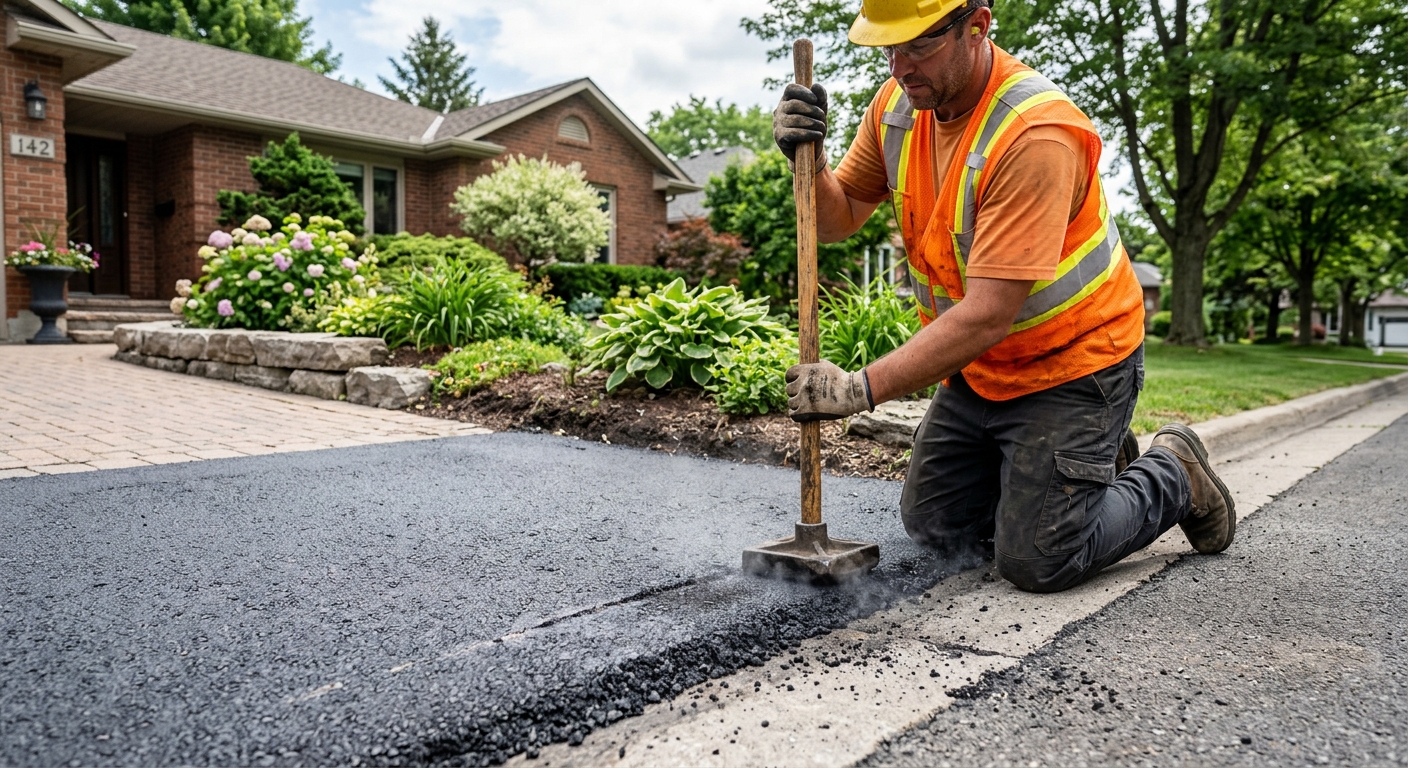
Driveway paving costs in Skippack — 2026
In Skippack, where 94.9% of households own their homes and nearly three quarters are single-family houses (U.S. Census Bureau, ACS 2024), paving or replacing a driveway is one of the largest and most noticeable exterior improvements you can make. Given the region’s moderate freeze-thaw cycles and local soils—glacial till and silty clay are common east of here—what you pay is determined as much by what’s put beneath the surface as by what you see on top. Most Skippack homeowners will compare more than one quote, and the biggest price differences often come from what is (or isn’t) being done under the asphalt or concrete: excavation, base depth, compaction, and drainage. These aren’t visible when the job is complete, but they make all the difference long-term, especially through Southeastern Pennsylvania’s freeze-thaw season. Driveways built on short cuts usually show problems by year three or four, especially if the base is thin or the old base is left in place. Material choice does matter, but without attention to base preparation, even expensive concrete won't last. Below is what realistic 2026 prices look like for Skippack driveways, including costs for routine maintenance and repair:
| Service |
Best for |
Lifespan |
Price range |
| Asphalt — full replacement with new base |
failed base, structural cracking |
20–30 yrs |
$4,200–$10,500 |
| Asphalt overlay / resurfacing |
sound base, surface cracking only |
8–15 yrs |
$1,800–$5,300 |
| Sealcoating — single application |
preventive maintenance on sound asphalt |
2–4 yrs |
$225–$850 |
| Concrete — new installation |
long service life, low maintenance |
30–50 yrs |
$5,900–$14,000 |
| Crack filling and patching |
isolated cracks under a quarter inch |
1–3 yrs |
$200–$800 |
| Gravel driveway |
rural, budget, long runs |
5–10 yrs with upkeep |
$900–$3,500 |
Estimates for a typical Skippack driveway. Square footage and base condition drive these figures more than material choice.
How often should a Skippack driveway be sealed?
Sealcoating is one of the most common maintenance services offered to homeowners in Skippack, but most people hear more pressure than honesty about how often it’s needed. Here’s the reality: sealcoating protects the surface of asphalt by shielding the blacktop binder from oxygen, sun, oil, gas, and antifreeze, and it does make a driveway look new for a season or two. What it does not do is add structural strength, solve underlying issues, or extend the life of a failing base. If you have cracks wider than a quarter inch or sinking spots, sealcoating is at best a short-term cosmetic bandage.
Worse, over-sealing—doing it every year—leads to peeling, flaky layers that actually trap moisture and speed up surface failure. Sealcoating new asphalt too soon traps chemicals before they’ve evaporated, leading to soft or sticky spots. The most honest interval for Skippack is every three or four years, waiting at least 6–12 months after new asphalt is installed before the first application. You want a method where material is squeegeed and brushed into the pores, not just a sprayed-on coat that’s little more than colored water.
Crack filling with a hot-applied rubberized product does more to slow damage than any sealing. A proper, professional sealcoat for a typical Skippack driveway costs $225–$850 and won’t include major patching or crack repair for free. Bargain-basement prices are almost always a single sprayer, a water-thin product, and no attention to cracks. Do not re-seal every year and don’t pay someone to put a layer over fresh asphalt before it cures. You’ll get a better result by sealing less often and keeping up with crack filling and keeping the surface clean.
Permits and approvals for paving in Skippack
If you are repaving or resurfacing your existing Skippack driveway, a municipal building permit usually isn’t required provided you’re not altering the footprint or pouring new concrete approaches. Most local codes require a permit only when you expand, widen, or change the curb, sidewalk, or apron—the section where your driveway meets the street. For driveways on township roads, Montgomery Township Public Works Department issues the road occupancy permit for any work at the approach, and that approval is completely separate from general building permits.
Be aware that adding pavement does increase impervious surface, and Montgomery County’s stormwater management rules are strict compared to much of the region. If your project increases runoff toward a neighbor, you can still be liable for water damage, permits or not. For large expansions, be ready for additional requirements about drainage or even engineered plans.
Pennsylvania law requires any contractor performing home improvements over $500 to have valid Home Improvement Contractor (HIC) registration, which you can check at hic.attorneygeneral.gov. Workers’ compensation coverage is mandatory for any crew with employees, and you can verify a contractor’s coverage directly through the state’s WCAIS system at wcais.pa.gov. A written contract is required over $500, and you have a 3-day right to cancel. Do not work with anyone unwilling to supply proof of HIC registration and workers’ comp in writing.
Asphalt or concrete for a Skippack driveway?
Skippack’s climate—moderate winters, humid summers, about 30 inches of frost depth—has a bigger impact on driveway performance than most homeowners realize. Asphalt is flexible: it flexes as the ground moves from freeze-thaw cycles, which means it resists cracking even when the soil beneath shifts. Concrete, on the other hand, is rigid and can outlast two or more asphalt driveways if installed well and protected—but it’s more prone to surface spalling and scaling because of de-icing salts used routinely in Pennsylvania snow. Most concrete damage here isn’t from cold: it’s from salt and repeated cycles of freeze and thaw.
Asphalt costs less initially and is easier to repair or resurface but won’t go more than 30 years in this area. Concrete costs more ($5,900–$14,000 for a new install), lasts longer if not damaged by salt—but it truly requires you to avoid salt products, a rule few owners actually keep. For most Skippack homeowners, the main reason to pick concrete is appearance or lower upkeep, not raw longevity for the cost.
Pavers (interlocking concrete or clay bricks) are an option if you want a high-end look and the ability to lift and reset sections, but they are at the top of the price range. Gravel is functional for rural lots or long runs—cost-effective but maintenance heavy.
| Option |
Installed cost |
Maintenance |
Freeze-thaw performance |
Lifespan |
| Asphalt — new install |
$4,200–$10,500 |
sealcoat every 3–4 yrs |
excellent, flexes |
20–30 yrs |
| Asphalt — overlay |
$1,800–$5,300 |
same |
good if base is sound |
+8–15 yrs |
| Concrete |
$5,900–$14,000 |
low, avoid de-icing salt |
fair, spalls with salt |
30–50 yrs |
| Pavers |
$9,500–$14,000 |
individual units replaceable |
good, settles gradually |
25–50 yrs |
| Gravel |
$900–$3,500 |
top-dress every 2–3 yrs |
excellent drainage |
indefinite with upkeep |
Comparing paving estimates in Skippack
Comparing paving quotes in Skippack means more than price-checking—what matters is what’s spelled out in writing. Start with the measured square footage, not “standard” or “typical”—you’re paying by the actual area. Make sure excavation and disposal are clear: Will they remove failed material, or just pave over it? The aggregate (stone) base should have a specified type and depth, and compaction should be listed as “in lifts,” meaning it’s compacted in layers. Asphalt work should describe courses and the compacted thickness—not just “three inches,” which can mean much less after roller compaction. Drainage and grading matter here more than most places, and good jobs will mention slope and water direction. Cleanup, lawn edge restoration, and the payment schedule—usually a small deposit with balance on completion—should be spelled out. Most paving warranties don’t cover cracking, even though that’s the failure homeowners expect to be covered. If the quote is just a one-liner with a total cost, you have no idea what you’re buying, and it cannot be compared to a detailed bid. That’s the most common way Skippack homeowners end up with driveway trouble.
| Line item |
What to look for |
Red flag if… |
| Area |
measured square footage stated |
eyeballed or absent |
| Excavation |
depth and disposal included |
'we'll pave over it' |
| Base |
aggregate type and depth in inches |
'proper base' |
| Compaction |
method, and done in lifts |
not mentioned |
| Asphalt |
courses and compacted depth |
'3 inches' unqualified |
| Drainage |
slope and water direction stated |
silent |
| Warranty |
what is covered and what is excluded |
verbal only |
| Payment |
modest deposit, balance on completion |
full cash up front |
Numbers, not adjectives
If you want a Skippack driveway that lasts through decades of freeze-thaw, don’t buy “quality” or “proper”—buy numbers in writing. The only way to compare paving quotes is by specification: how many inches are excavated, how deep is the aggregate base, what’s the stone type, how is it compacted, and what is the course thickness of the asphalt measured after it’s rolled. The difference between “three inches” as laid and “three inches” after compaction can be more than 25%—and many contractors quietly lay it thin. Mix designations, like 9.5mm or 19mm PennDOT-approved mix, matter too. Edge restraint (to prevent breakup at the sides) needs to be spelled out.
In southeastern Pennsylvania, where frost can reach down 30 inches, and local clay and silt soils hold water, base depths will need to be thicker—and more carefully compacted—than in warmer states. This is not the place to skimp on preparation. If all you get is “we’ll put down three inches of blacktop,” you have no idea what you’re really paying for. Ask for the following specifics, in writing, before you sign:
- Excavation depth (in inches, from existing grade)
- Aggregate base depth and material type (2A modified, crushed stone, etc.)
- Compaction method (type of roller, compaction in lifts)
- Binder course depth after compaction
- Surface course depth after compaction
- Mix designation (e.g., PennDOT 9.5mm or 19mm)
- Edge treatment (tapered, raised, or retained)
- Drainage plan (direction, slope in percent)
- Cleanup and topsoil repair details
- Warranty terms, in writing, with exclusions listed
Why Skippack driveways fail from the bottom up
The structure of every Skippack driveway—new or replacement—starts underground. From the bottom up, it’s subgrade (native soil), compacted stone aggregate, then the paving: asphalt, concrete, gravel or pavers. Each layer is meant to distribute the weight of vehicles so the surface doesn’t flex or crack. But in Pennsylvania’s freeze-thaw belt, with silty clay and glacial till soils common, proper base depth is what really determines lifespan. When the base is too thin or not compacted tightly in lifts, water seeps in, freezes, expands, and lifts (heaves) the pavement. The result is cracking, sunken spots, and potholes—usually starting by year three or four, just after the cheap warranty runs out.
Frost heave happens here because local soils hold water. Thirty inches of frost is not uncommon. When that moisture in the subgrade freezes, it expands and pushes the entire slab upward in odd spots. Even a thick asphalt or concrete top layer will split if the base below moves. Drainage is just as crucial: if water sits under the pavement, it will find a way to freeze and cause damage. Cutting corners is easy—skip excavation, reuse a failing base, or skimp on stone. It’s invisible the day you pay, but you’ll see the results by the third winter.
For Skippack driveways, demand in writing: at least 6–8 inches of compacted 2A modified stone base (go thicker if clay is present), subgrade compacted before the base goes in, and compaction in 2–3 inch lifts with a heavy roller, not just a plate tamper. That’s the bare minimum for long-term survival in Montgomery County’s climate and soils. Anything less, and you’ll be paying again far too soon.
Frequently asked questions — driveway paving in Skippack
Is an overlay worth it or should I start over?
In Skippack, an asphalt overlay—where a new layer is placed over an existing blacktop—can make sense if your base is still solid and you only have surface-level cracks or minor wear. Overlays cost less, from $1,800–$5,300, and typically extend life by 8–15 years. But if your driveway is sinking, has deep alligator cracks, or water doesn’t drain off properly, a full replacement is the only real fix. Most overlays that fail early do so because the underlying problem (like a soft or poorly compacted base) wasn’t addressed. In Montgomery County’s climate, with lots of freeze-thaw cycles, putting new asphalt over a bad base is just postponing the cost. Have the base condition checked—if it’s spongy, loose, or crumbles, don’t waste money resurfacing.
Why are paving quotes in Skippack so different from each other?
Differences in Skippack paving quotes almost always come down to what you can’t see: excavation depth, the thickness and quality of the stone base, compaction method, and precise specifications for paving material. Some crews just pave over the old, failed base; others dig, haul, and rebuild properly. The price swing from these shortcuts can be thousands of dollars—sometimes for work that looks identical when new. For example, two bids for a full-depth asphalt replacement might both be in the $4,200–$10,500 range, but one could have half the base depth or poor drainage. The only way to compare is by itemized specification, not just the bottom line. Always get details in writing.
What causes driveway cracks in Skippack?
Most driveway cracks in Skippack start from below, not from the surface. Our moderate freeze-thaw cycles make water in the subgrade freeze, expand, and push upwards. Silty clay soils found in parts of Montgomery County can’t drain well, amplifying the effect. That’s why driveways with thin or uncompacted stone bases crack within a few winters. Tree roots, overloaded vehicles, and neglected cracks that admit water can also contribute, but subgrade movement remains the leading cause. Regular crack filling ($200–$800) keeps small problems from spreading, but no surface repair will succeed if the base is weak or wet. Prevention means a well-built base and attention to drainage from the start.
Can I cancel a paving contract I signed at my door?
Yes—a Pennsylvania paving contract signed at your home, including in Skippack, must include a 3 business-day right of cancellation under state law. This is part of the Home Improvement Consumer Protection Act, which covers any deal over $500. If you signed with a door-to-door operator and have second thoughts, you’re legally entitled to cancel in writing within the window, even if work hasn’t started. Never give a full payment up front—legitimate contractors in Montgomery County structure payments with a small deposit and the bulk on completion (for example, for a job in the $4,200–$10,500 range, a deposit is typically 10–20%). If a contractor is reluctant to provide a contract with these rights listed, walk away.
How much does it cost to widen a driveway?
In Skippack, widening a driveway involves excavation, building new base, and matching the surface to your existing drive. Expect prices to be similar to new installation costs: asphalt widening is generally in the $4,200–$10,500 range for a full replacement-sized section, though if you’re just extending by a car-width for a few feet, the number may be lower—think $1,800–$5,300 or so for smaller projects. Also, if your new width connects to a township road, you’ll likely need a separate approach permit from public works. Plan for the upper end if restoration and matching are important, or if drainage upgrades are needed.
Is sealcoating a scam?
Sealcoating isn’t a scam—it does slow down surface oxidation, improves appearance, and protects against minor spills. But in places like Skippack, you should only need it every three or four years, not annually. The scam is over-promising: door-to-door crews selling “once-a-year” treatment or offering a price far below the typical $225–$850 for a true full-coat application are usually spraying watered-down material and skipping surface prep. Sealcoating is not a cure for cracks or base failure and shouldn’t be used to revive a driveway well past its lifespan. Prioritize crack filling over surface coating if you’re on a budget.
What does compaction in lifts mean?
Compaction in lifts means each layer of aggregate base or asphalt is installed a few inches deep, then compacted before the next goes on top. In Skippack, contractors should place and compact the stone base in 2–3 inch “lifts,” not dump all the stone and roll it once. This is especially critical with our local clay soils that hold moisture. If the whole base is placed at once and only compacted on top, lower layers remain loose, leading to settling and cracks over time. A well-compacted driveway—built in lifts—lasts longer, drains better, and is less likely to develop potholes. You’ll see the benefit in driveways quoted in the $4,200–$10,500 range for complete rebuilds where specs are spelled out.
Does road salt damage driveways in Skippack?
Yes—road salt is tough on both asphalt and concrete in Skippack. Salt melts snow and ice, but it accelerates surface wear and, in concrete especially, leads to scaling and spalling (pitted, flaking spots). That’s a big reason why few concrete driveways last the full 50 years around here: our winters mean regular salting. Asphalt is more tolerant of salt, but repeated freeze-thaw cycles still attack old or poorly maintained surfaces. If you have concrete, use sand or calcium chloride instead of sodium chloride when possible, and keep the surface sealed. When pricing out options ($5,900–$14,000 for new concrete), factor in the need for careful winter care.
How far ahead should I book a paver in Skippack?
In Montgomery County’s busy paving season—late spring into fall—you’ll want to book a reputable paver in Skippack at least 4–8 weeks in advance. The county sits in a dense suburban corridor with lots of competition, but high-quality outfits often fill their season fast, especially for full replacements in the $4,200–$10,500 range. Rush jobs or “we’re in the neighborhood today” offers usually mean cut corners or fly-by-night operations. Booking ahead also gives you time to check the Home Improvement Contractor registry and arrange for any municipal permits if you’re expanding or altering the approach. Good projects are never rushed.