Dunmore paving prices by scope — 2026
In Dunmore, where 62.2% of homes are single-family and 60.5% of households are owner-occupied (U.S. Census Bureau, ACS 2024), the responsibility for paving falls squarely on homeowners rather than landlords or HOAs. Driveways here see the typical northeast Pennsylvania freeze-thaw cycle and endure decades of use, sometimes over a base that was never engineered for longevity.
What you see — the asphalt or concrete on top — is only part of the job. Most of the difference between a cheap and a proper quote is what gets done, or not done, under the surface. In Dunmore, subgrade is usually glacial till, which drains unevenly and requires careful stabilization. A surface that looks similar today can end up with a drastically different life span or repair bill depending on how the base was built up, drained, and compacted. That’s why you see price quotes for the “same job” that vary by thousands of dollars. The upfront cost isn’t always the real difference — sometimes it’s how much gets done out of sight.
| Service |
Best for |
Lifespan |
Price range |
| Asphalt — full replacement with new base |
failed base, structural cracking |
20–30 yrs |
$3,400–$8,800 |
| Asphalt overlay / resurfacing |
sound base, surface cracking only |
8–15 yrs |
$1,450–$4,400 |
| Sealcoating — single application |
preventive maintenance on sound asphalt |
2–4 yrs |
$200–$700 |
| Concrete — new installation |
long service life, low maintenance |
30–50 yrs |
$4,900–$11,500 |
| Crack filling and patching |
isolated cracks under a quarter inch |
1–3 yrs |
$200–$800 |
| Gravel driveway |
rural, budget, long runs |
5–10 yrs with upkeep |
$900–$3,500 |
Estimates for a typical Dunmore driveway. Square footage and base condition drive these figures more than material choice.
Driveway permits, approaches and stormwater rules
Most driveway repaving in Dunmore does not require a building permit if the work doesn’t change the driveway’s size or layout. If you’re simply resurfacing or replacing what’s already there, you can skip the call to city hall. But if your project changes where the driveway meets the street, widens your curb cut, or connects to a state highway, a permit is required — and not from who many expect. For driveways connecting to state roads, you’ll need approval from PennDOT District 4-0. If the work is on a local road, your municipality handles the curb cut and approach permit, not the county.
Any time you expand the impervious surface (make driveway or parking area bigger), you also need to think about stormwater. Directing runoff onto someone else’s land or public right-of-way can land you in hot water, permit or not. In older parts of Dunmore, the drainage built in the 1950s and 60s won’t meet today’s expectations for stormwater control.
If your project involves a contract over $500, your contractor must be registered with the Pennsylvania Office of Attorney General as a Home Improvement Contractor. You can check registration at hic.attorneygeneral.gov. Anyone employing workers is required to carry Pennsylvania workers' compensation insurance — you can verify this in minutes online at wcais.pa.gov.
Local soil, drainage and driveway lifespan
Under most Dunmore driveways is glacial till — a mix of clay, sand, gravel and boulders left behind by retreating glaciers. Glacial till drains unevenly, holding water in some spots while shedding it in others. This means a “one-size-fits-all” base is asking for trouble: some homes see shifting and heaving, others see settlement after heavy rains. If your neighbor’s driveway is falling apart at the edges, the soils are likely to blame as much as the age.
Regionally, the frost depth sits at 36 inches and winters are harsh, with design temperatures dropping to 4 °F. That’s enough to push moisture-laden subgrade up and down, cracking weaker pavement from below. On mid-20th-century homes — and that’s over 80% of Dunmore’s housing — the original base may be thin, un-compacted, or missing drainage stone. Many driveways built back then are now too narrow for modern vehicles, and when widened, the patchwork is only as good as how it’s tied into fresh base.
All these conditions demand a thicker, well-compacted sub-base than you’d use elsewhere. Skimping on this step means you’ll be seeing edge crumble, potholes, or alligator cracking well before you should. Get a contractor who knows Dunmore’s glacial till — and isn’t shy about digging deeper, literally.
How often should a Dunmore driveway be sealed?
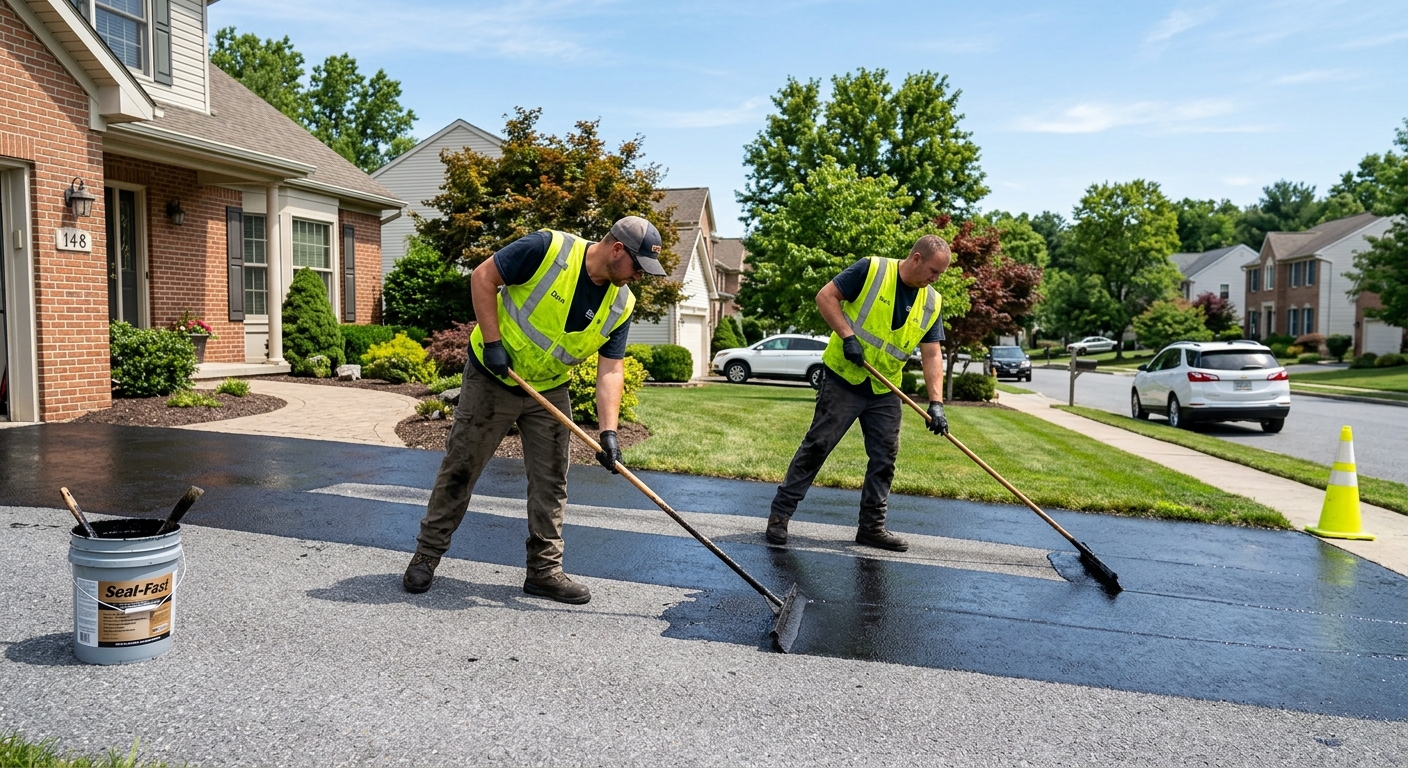
Sealcoating is often oversold in Dunmore, as everywhere, but it does have a role. It acts like sunscreen for your asphalt — blocking UV, slowing oxidation, and guarding against gasoline or oil drops that can soften and break down the surface. It also gives an attractive black finish, which may matter for curb appeal. But what sealcoating does not do is add strength, seal deep cracks, or “fix” a driveway that’s failing from underneath. If your base is compromised, no amount of surface coating is going to help.
The truth almost nobody selling the service mentions: sealcoating too often or over uncured asphalt does more harm than good. Too many layers build up, get brittle, and will actually crack and peel off, leaving your lot looking patchy and making future sealing harder. A first sealcoat should wait at least six months, sometimes a full year after paving, to let volatiles escape.
For most Dunmore driveways, every 2–4 years is a responsible interval for sealcoating — less often if the driveway sees light traffic and gets regular crack filling. The latter is more critical: filling cracks early prevents water intrusion, which is what destroys driveways here with freeze-thaw cycles. Pay attention to how the job is done: a $200 blow-and-spray is usually a watered-down emulsion, sprayed thin and gone in a season. A careful brush- or squeegee-applied coat, with proper cleaning and edge work, is what you actually want – and the price $200–$700 reflects the difference between a fly-by-night job and one with labor invested.
When paving can actually be done in Dunmore
In Dunmore, the paving season is dictated by the climate, not by the calendar. Hot-mix asphalt needs to reach your site and be compacted while it’s still above a critical temperature — usually 50°F or warmer. Below that, it cools too fast, won’t compact properly, and leaves you with a driveway riddled with pores that let in water. Given our winter design temp of 4°F and those 6,100 annual heating degree days, there are only about six workable months, usually April through October.
Asphalt plants in Northeast Pennsylvania shut down for the winter. If someone offers you “hot mix” in January or early March, it’s either recycled, cold patch, or not what you expect. Concrete has a similar constraint: it can’t be poured unless it will stay above freezing for at least a day or two, or else it won’t cure right, leaving weak spots that break under car tires.
Local quarries and asphalt plants can only operate when weather and demand line up. Spring and fall are when reputable contractors have the best availability — but summer is when everyone is booked solid and prices are at their peak. If you get an offer to pave on a week’s notice in late November in Dunmore, you’re better off waiting. Paving too cold means your money goes down the drain, and a new surface that fails early costs much more in repairs later.
Numbers, not adjectives
When reviewing paving quotes in Dunmore, push past the sales talk and look for numbers. Between our variable glacial till subgrade and the deep frost line (36 inches), cutting corners on thickness, materials, or compaction is a recipe for fast failure. Many old driveways here failed because there was no real base — just a few inches of stone or even compacted fill. The difference between a job that lasts and one that crumbles is almost always in the specifics, not the brand or the promise.
"Three inches of asphalt" can mean almost anything if you don’t specify — as compacted, or as laid? Compacted, asphalt will shrink 10–20%. Some contractors quote before compaction (looks good on paper), others after (what you actually get to keep). Demand that every depth (base and asphalt) is specified as compacted. The base needs not just depth but real compaction, in lifts (layers), and stone that matches the drainage needs of Dunmore’s soils.
- Excavation depth (from surface to undisturbed subgrade)
- Base stone type and gradation (e.g., 2A modified stone)
- Base course thickness, as compacted
- Compaction method (plate compactor or roller, pounds per square foot)
- Number and thickness of lifts (layers) for both base and asphalt
- Binder (base) course asphalt type and thickness, as compacted
- Surface (top) course asphalt type and thickness, as compacted
- Edge treatment (how sides are supported or sealed)
- Drainage plan (how water will leave the drive and where it goes)
- Material delivery tickets if you want proof of mix and quantity
Door-knocking crews and leftover material
Driveway paving is a target for transient outfits because the job is visible from the street, the results can look fine for a season even if done wrong, and the risk of you catching a problem before they’re long gone is low. In a moderate suburban market like Lackawanna County, it’s not rare to get a knock on the door from a crew claiming they have “just enough leftover from a big job down the road.” They’ll push today-only special pricing, carry no business cards, and often arrive in unmarked trucks or with out-of-area plates. The script is the same every time: pay cash up front to save, a verbal quote scribbled on scrap paper, and the promise that the thin black spray they’re applying is real sealcoat (it’s usually diluted oil).
Every warning you’ve heard about paving comes from this kind of scam. The Home Improvement Consumer Protection Act (HICPA) requires a written contract for any job over $500, and gives you three business days to cancel, no questions asked. If anyone pressures you to waive that right or offers to skip the paperwork, walk. It is illegal for a contractor to pay or waive a homeowner’s insurance deductible in Pennsylvania, despite what anyone promises. The point of these laws is precisely to keep fast-talking, short-term operators from taking advantage of people who just want a smooth drive.
To defeat almost every paving scam, take five minutes: verify Home Improvement Contractor registration at hic.attorneygeneral.gov, check workers' compensation at wcais.pa.gov, and refuse any job that won’t give you every number and process in writing.
Frequently asked questions — driveway paving in Dunmore
What is the difference between crack filling and sealcoating?
Crack filling and sealcoating are two very different maintenance steps in Dunmore. Crack filling specifically targets open cracks in your asphalt, filling them with a flexible material to keep water out of the base — crucial in our freeze-thaw climate. If you let water in, winter does the rest, and those cracks multiply fast. Sealcoating, costing $200–$700 per application, is a surface treatment applied over the whole driveway. Its job is to protect the asphalt binder from sun, rain, and chemicals, but it doesn’t seal out water in deep or moving cracks. Good maintenance here means filling cracks first (ideally each season), then sealcoating as needed every few years, but never skipping the cracks and expecting the sealcoat alone to do the job.
What kind of soil is under Dunmore driveways?
Most Dunmore driveways are built over glacial till — a naturally mixed soil left over from the retreat of ancient glaciers. This isn’t uniform dirt; it’s a varying mix of clay, sand, gravel, and rocks. The glacial till in Lackawanna County drains unpredictably: some sections will stay soaked after rain, others dry quickly. Because of this, driveway construction here must account for drainage and extra base thickness, much more than you’d see in a milder region or over sandy soil. If you’ve noticed one part of your driveway settles more or heaves worse in winter, it’s often thanks to differences in this underlying glacial till.
Is an overlay worth it or should I start over?
In Dunmore, an asphalt overlay—where a new top layer is applied over the old—only makes sense if your existing driveway base is still solid. If you’re seeing widespread cracks, soft spots, or any sinking, an overlay is a short-term patch at best. Freeze-thaw cycles will force new cracks up through the surface. But if your base is otherwise stable, overlays can extend the life of your drive for 8–15 years at a lower cost than full reconstruction. A typical overlay here runs $1,450–$4,400, but if the base is failing, it won’t last even half that time. Bottom line: overlays are good for minor flaws, but not for correcting underlying problems common in Dunmore’s mid-century homes.
What does an asphalt overlay cost in Dunmore?
For a standard Dunmore home, an asphalt overlay costs between $1,450–$4,400. That covers prepping the surface, tack coating, and paving a new layer of hot-mix asphalt over the existing driveway, assuming the base is still solid. Most driveways in town fall near the middle of that range. Your actual price depends on size, accessibility, and edge work. If the crew discovers soft spots or major cracks in the base, they may recommend spot patching—which adds to the cost, but is often necessary thanks to our freeze-thaw winters and glacial till soils. Remember: overlays won’t fix structural or drainage problems underneath, so don’t spend here unless you’re sure the foundation is sound.
What are the signs of a failing driveway base?
In Dunmore, a failing driveway base announces itself with certain tell-tale signs: deep “alligator” cracks in clusters, sunken areas that hold water, edges that crumble or break off, and new cracks reappearing almost yearly after repairs. You might see frost heaves—raised humps after winter that drop back down in spring—or small potholes that keep coming back even after patching. These symptoms are especially common here due to glacial till soils and deep freeze cycles. If you notice more than just shallow surface cracks, it’s likely that the underlying base has lost strength or is holding moisture. At this stage, a surface overlay or sealcoat won’t solve the issue, and a full rebuild in the $3,400–$8,800 range is usually more cost-effective than chasing repairs each year.
What does compaction in lifts mean?
“Compaction in lifts” means that your driveway base or asphalt is installed in layers—each one properly compacted before the next is placed. For example, instead of dumping six inches of stone and hoping for the best, a good contractor in Dunmore will spread it in two or three layers, packing each down with a heavy roller or plate compactor. This prevents settling and makes the base rock solid, which is critical with our deep frost line of 36 inches and glacial till soil that can shift if not compacted tight. The same applies to asphalt: two thinner lifts, each compressed, are far stronger and less prone to cracking than one thick layer. Insist on written specs that detail both the thickness and number of lifts you’re paying for, especially if you’re investing in replacement at $3,400–$8,800.
Are there stormwater rules on paving in Dunmore?
Yes—stormwater management is a real concern when paving in Dunmore. Any project that adds or expands hard surface, like a driveway or parking pad, can trigger runoff requirements set by the municipality. Even if no formal permit is needed for a simple resurfacing, you can be held responsible if stormwater from your new pavement is directed onto a neighbor’s property, causing flooding or erosion. Older local streets in Dunmore may lack modern drainage, so new driveways built to modern standards are expected to keep runoff on their own property, often using swales or drains. For approach work to a state road, especially, the rules are strict and you’ll need permitting from PennDOT. When planning new driveway work, especially if you’re considering widening, expect to address where the water goes—and budget for minor grading or drains if required. Fines or rework can cost much more than doing it right in the $3,400–$8,800 range up front.
What does sealcoating cost in Dunmore?
For a typical Dunmore driveway, expect a sealcoating price between $200–$700 per application. Where you fall in that range depends on the size of your drive, prep needed (edges, cleaning, crack filling), and whether the application is brushed on or just sprayed. Local pricing also depends on when crews are busiest—late spring and summer tend to run higher. Be wary of quotes at or below the bottom end, as these crews often use thin or diluted materials that won’t last through the first winter freeze. The best value is a careful, two-coat job with cracks filled beforehand, which helps protect your surface and buys a couple more years before your next round of maintenance.
How long does a driveway installation take?
In Dunmore, a typical driveway replacement takes two to four days, depending on the size, base work, and weather. Day one is usually removal and excavation, followed by a day or two for laying and compacting the new stone base—allowing for inspection and weather delays. Asphalt installation itself is quick, often just a few hours, but it’s the base prep that really counts. After paving, you should stay off with cars for at least 2–3 days to allow cooling and early curing, especially during hot summer peaks. For larger or more complex jobs, you might be at the high end of this time frame, and costs will reflect that—ranging from $3,400–$8,800 for asphalt and $4,900–$11,500 for concrete. Rushed jobs in this market rarely last, so a crew that takes time (and tells you why) is usually looking out for your investment.