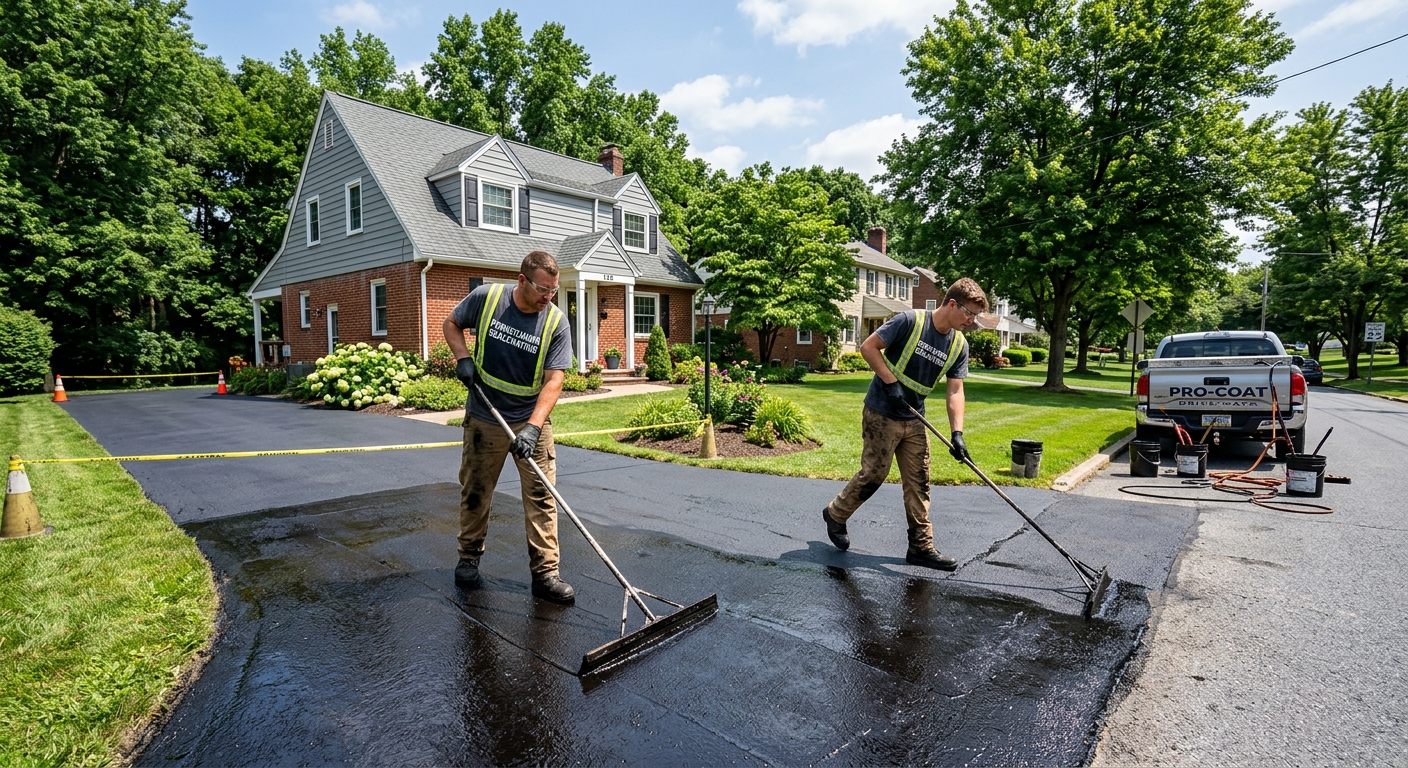
Driveway paving costs in Jackson — 2026
In Jackson, where over 83% of homes are single-family and homeownership stands at 84.2% (U.S. Census Bureau, ACS 2024), the driveway is a real investment—whether upgrading a first install or dealing with an old, cracked surface. Here, freeze-thaw cycles and pockets of clay or shale beneath the pavement mean most of the cost difference between two bids isn’t about the surface you see, but the base and prep you never do. How thick the stone, whether the fabric is used, and compaction all steer service life more than just “asphalt vs. concrete.” driveway pricing is determined less by what finish you see than by what’s buried beneath—driveways failing early in Butler County generally started with corners cut under the surface.
| Service |
Best for |
Lifespan |
Price range |
| Asphalt — full replacement with new base |
failed base, structural cracking |
20–30 yrs |
$3,800–$9,700 |
| Asphalt overlay / resurfacing |
sound base, surface cracking only |
8–15 yrs |
$1,600–$4,800 |
| Sealcoating — single application |
preventive maintenance on sound asphalt |
2–4 yrs |
$225–$750 |
| Concrete — new installation |
long service life, low maintenance |
30–50 yrs |
$5,400–$13,000 |
| Crack filling and patching |
isolated cracks under a quarter inch |
1–3 yrs |
$200–$800 |
| Gravel driveway |
rural, budget, long runs |
5–10 yrs with upkeep |
$900–$3,500 |
Estimates for a typical Jackson driveway. Square footage and base condition drive these figures more than material choice.
Changing the footprint of a Jackson driveway
If you’re widening your driveway for a second vehicle, adding a turn-around, extending to a detached garage, or planning to pave a gravel entrance, you’re facing more than a simple replacement. Any project that changes a driveway’s footprint in Jackson means building a new aggregate base over undisturbed, often clay-heavy or shale subgrade. This base has to be thicker and better-compacted than most people expect, especially in the northern Butler County soil. The joint where new meets old is always a weak spot—no way around it—so honest contractors will set the seam outside your most-used path when possible.
Widening or extending can trip up local rules too. In Cranberry Township, for example, new or expanded residential driveways connecting to a public street typically require a zoning or driveway permit. Impervious surface limits may dictate just how much paved surface your lot can legally hold, and setbacks prevent you from paving right up to the lot line. For additions near a state route, a PennDOT District 10 Highway Occupancy permit is needed—meaning you’re working with a different authority than for your house. Expanding your driveway could also put you on the hook for stormwater management, since extra impervious surface can mean more runoff. That runoff can’t end up in your neighbor's yard, with or without a permit—liability follows the water.
Diagnosing a failing Jackson driveway
Most homeowners in Jackson want to know if patching and resurfacing are enough, or if they’re stuck biting the bullet on a full replacement. The truth comes down to the base condition under your driveway, which is rarely obvious from the top. You can make a first-pass diagnosis yourself: alligator cracking (the scaly, interconnected cracks across broad areas) means the base failed—repaving or overlaying this is wasted money, since the same cracks will just reappear. Isolated linear cracks mean surface aging, and these can be filled and sealed. Depressions or “birdbaths” signal subgrade movement and demand digging out and rebuilding that section, not surface fixes. Crumbling edges mean you’ve got no edge support; curbing or widening the stone shoulder fixes this. Potholes are a sign water has gotten down to the base, requiring a full-depth patch at minimum, and possibly a replacement.
If a contractor offers an overlay without inspecting the base (which means probing below the surface), they haven’t looked—and it’s your money they’re risking. It costs more upfront to fix structural problems, but doing patchwork on a failed base will have you back redoing the whole job within a few years.
| What you see |
Likely cause |
Right fix |
Cost |
| Isolated cracks under 1/4 inch |
surface aging |
crack fill and seal |
$225–$750 |
| Alligator cracking over a wide area |
base failure |
full replacement |
$3,800–$9,700 |
| Depressions holding water |
subgrade movement |
excavate and rebuild that area |
$3,800–$5,900 |
| Crumbling edges |
no edge support |
edge repair, consider curbing |
$400–$1,500 |
| Potholes |
water into the base |
full-depth patch, then assess |
$250–$900 |
| Faded but sound surface |
oxidation only |
sealcoat |
$225–$750 |
What a real paving quote contains
When you get a driveway quote in Jackson, it should be detailed—otherwise, you have no way to compare. The essentials: the measured square footage of your drive, not a guess. Excavation details (how deep, and where the material is going). Aggregate type and depth for your base, spelled out in inches. Compaction method—should be in layers, not all at once. Asphalt courses (base and top), each listed by compacted thickness. Edge treatment for support. Grading and drainage—how water will run off and where. Cleanup—lawn repair and debris haul-off. Payment schedule: no more than a modest deposit, with the bulk paid after the work is done and you can see it. And a written warranty—making clear what is covered (most exclude cracks, the failure that worries people most).
If a bid is a single number with no details, you’re being asked to trust more than you should. This kind of “blank check” is the most common way Jackson homeowners overpay for thin, underbuilt work.
| Line item |
What to look for |
Red flag if… |
| Area |
measured square footage stated |
eyeballed or absent |
| Excavation |
depth and disposal included |
'we'll pave over it' |
| Base |
aggregate type and depth in inches |
'proper base' |
| Compaction |
method, and done in lifts |
not mentioned |
| Asphalt |
courses and compacted depth |
'3 inches' unqualified |
| Drainage |
slope and water direction stated |
silent |
| Warranty |
what is covered and what is excluded |
verbal only |
| Payment |
modest deposit, balance on completion |
full cash up front |
Driveway permits, approaches and stormwater rules
In Jackson, repaving a driveway in its existing footprint typically does not require a building permit. For example, in Butler Township, resurfacing a residential driveway without changing its size is commonly done without a permit—so if you’re keeping the old layout, you’re likely in the clear and can skip the trip to the township office.
However, where your driveway meets the public road—the approach—does require attention. For driveways connecting to a state route, PennDOT District 10 is the permitting authority for a Highway Occupancy permit. For additions or new driveways on township roads, your local township’s office will handle the permit. This is a different office than your house’s code authority, and many homeowners miss this completely when planning a project.
Expanding your driveway or paving new areas can also put you on the hook for stormwater management. More paved surface means more runoff, and new or enlarged driveways may trigger requirements for drainage and runoff control. Purposeful grading is not optional: if your runoff ends up on your neighbor’s property, you’re liable even if you hold every permit in hand.
Contractors must have an active Home Improvement Contractor (HIC) registration with the Pennsylvania Office of Attorney General for jobs over $500—verify at hic.attorneygeneral.gov. Workers’ compensation insurance is also mandatory for any employer, and can be checked at WCAIS (wcais.pa.gov).
How often should a Jackson driveway be sealed?
Most advice on driveway sealing comes from people who sell it, so here’s the practical side for Jackson. Sealcoating helps protect asphalt’s binder from oxygen, UV, oil, and fuel—plus, it improves that dark, new look. But it does not add structural strength, cure deep cracks, or fix base failure; sealing is purely a surface treatment. Sealing too often, especially in this area where hard winters and freeze-thaw are the rule, leads to excess buildup. That buildup cracks and peels, leaving your surface looking worse within a year or two.
Your first sealcoat should only go down after the new asphalt has cured—usually three to twelve months. After that, every two to four years is plenty for the Jackson climate, especially since clogged, brittle layers cause more harm than good. A quick spray-on sealcoat that comes in well under $225 is unlikely to help; you want the material applied by hand at the edges and properly squeegeed to get coverage. Cheap spray jobs usually skip the prep—no cleaning or crack fill—which is what actually extends driveway life. Crack filling should take priority: water is the true enemy, and sealing cracks before water reaches the base is the most cost-effective maintenance there is in western Pennsylvania.
$225–$750 is normal for a quality single sealcoat here. If someone quotes much below this, you’re likely getting a thin coat that won’t last one winter.
Maintenance that actually works
The single most important maintenance step for a Jackson driveway is filling cracks as soon as they appear—especially those bigger than a hairline. This stops water from penetrating to the base, which is what really shortens a driveway’s life in the freeze-thaw cycles that define this part of Butler County. Next comes keeping the driveway edges supported, either by building up gravel shoulders or using concrete curbing, since unsupported edges are prone to crumbling and let water in.
Grading is your next focus: always move water away from the pavement and foundation. Avoid parking heavy loads—jack stands, dumpsters—in one spot, as point loads cause depressions and cracks, especially while the surface is still curing. With new asphalt, wait at least 1–2 weeks before parking and avoid turning wheels in place for at least a month during hot weather.
For de-icing, salt is harsh on concrete driveways, accelerating surface scaling and spalling. On asphalt, salt isn’t as destructive to the surface but does worsen freeze-thaw cycling by causing more melt-refreeze events. Sand or calcium magnesium acetate (CMA) are less harmful options, but they cost a bit more and need to be swept up in spring to avoid tracking. For most homeowners, moderation with salt is the answer, especially across Jackson’s 30 psf ground snow and frequent winter swings.
Frequently asked questions — driveway paving in Jackson
What slope does a driveway need for drainage?
For a Jackson driveway, you want a minimum slope of 2% (about 1/4 inch per foot) away from buildings and toward the street or drainage swale. This is especially important here in southwestern Pennsylvania because heavy rain and snowmelt, combined with clay-rich soils, can quickly create puddles and send water toward your foundation if the grade isn’t right. If you’re doing new paving or a full replacement (which can run $3,800–$9,700), your contractor should spell out their plan for drainage on the quote—watch for this, because poor grading during installation is one of the top causes of driveway failure in this region.
How do I verify a paving contractor in Pennsylvania?
In Pennsylvania, paving contractors doing jobs over $500 must register as Home Improvement Contractors (HIC) with the Pennsylvania Office of Attorney General. Always verify your contractor’s registration at hic.attorneygeneral.gov—it takes minutes and protects your right under the Home Improvement Consumer Protection Act (HICPA). Ask for proof of workers’ compensation insurance as well, which you can check at wcais.pa.gov. In Jackson, these two checks matter most. Don’t rely on business cards or promises. Without a valid HIC number, your written contract (mandatory for jobs over $500) means little, and you lose consumer protections, like your three-day right to cancel.
How much does it cost to widen a driveway?
In Jackson, widening a driveway—say, to fit a second car—usually runs similar to building a brand-new section, since you need full-depth excavation and a new aggregate base over undisturbed soil. Figure on $3,800–$9,700 for full-width replacement, but for simple widening the range is commonly $1,600–$4,800 for a paved strip alongside the old (depending on size, base, and permits). Keep in mind, the seam where new meets old is always a weak point, so matching the thickness and compaction from your original drive is essential or the new section will settle and crack faster.
Does Jackson have local asphalt plants?
Yes—Jackson and the rest of Butler County benefit from having local quarries and asphalt plants along Route 8 and Route 422. This keeps haul distances short and costs lower for both residential and commercial paving. For most Jackson homeowners, it means you aren’t paying extra for trucking in material from Pittsburgh, and asphalt can be laid while it’s still hot—which is critical for a strong surface. So, the price of a full replacement (typically $5,900) here compares well with other Pittsburgh metro suburbs, due partly to this local supply advantage.
How often should I sealcoat my driveway in Jackson?
In Jackson, don’t buy into the idea of annual sealcoating—it’s not only unnecessary but can harm the driveway by causing buildup that cracks and peels. Here, sealing every two to four years is plenty, assuming your base is sound and cracks are handled as they appear. The first application should only go down after the new asphalt has cured for several months. Expect to pay around $225–$750 per application. If someone’s quoting much less, they’re likely cutting corners on prep or applying too thin a coat, both of which shorten rather than extend your driveway’s useful life.
How long does a driveway installation take?
Most driveway resurfacing and full replacements in Jackson are completed in one to three days, depending on site conditions and weather. A full-depth asphalt replacement (in the $3,800–$9,700 range) typically takes two days: one to excavate and install the base, another to lay and compact the asphalt. Concrete installations take longer—up to one week including cure time. Add a few extra days if drainage work, grading, or bad weather intervene. Always let new asphalt cure—wait at least 1–2 weeks before parking vehicles, more during cold or damp spells, to get the longest life from the surface.
What causes driveway cracks in Jackson?
In Jackson, driveway cracks most often start with water infiltration—especially in freeze-thaw season. The clay-heavy or shale subgrade up here means that water lingering in small cracks can freeze, heave, and break apart the surface from below. Edge breakdown happens where there’s little support, and surface oxidation (just from age and sun) makes the binder brittle over time. Cheap overlays or skimped base thickness, sadly, are also a culprit. That’s why crack filling (a modest $225–$750 job every few years) is the best investment you can make to interrupt this cycle before it gets expensive.
Asphalt or concrete for a Jackson driveway?
Both have a place in Jackson. Asphalt costs less up front and handles ground movement and winter plowing well—expect $3,800–$9,700 for a full install. Asphalt is forgiving if you need patches later and is easily crack-filled. Concrete is pricier (typical install around $8,600) but lasts longer—up to 50 years—and stays cooler in the sun. In freeze-thaw zones like western Pennsylvania, concrete must be sealed and de-iced carefully to avoid surface damage. On hilly or curved drives, asphalt may be safer since it offers more traction in snow and slush. In the end, base preparation and drainage matter more than the material.
How much does driveway paving cost in Jackson?
For a typical single-family home in Jackson, a new asphalt driveway installation with excavation and new base will run $3,800–$9,700 depending mostly on square footage and what your subgrade demands. Resurfacing over a sound base starts lower, at $1,600–$4,800. A full concrete driveway install ranges from $5,400–$13,000. Preventive maintenance, like crack filling and sealcoating, is usually $225–$750 per visit. Since driveways here in Butler County see freeze-thaw cycles and base movement, always make sure your quote spells out the real base work—surface fixes alone won’t last.