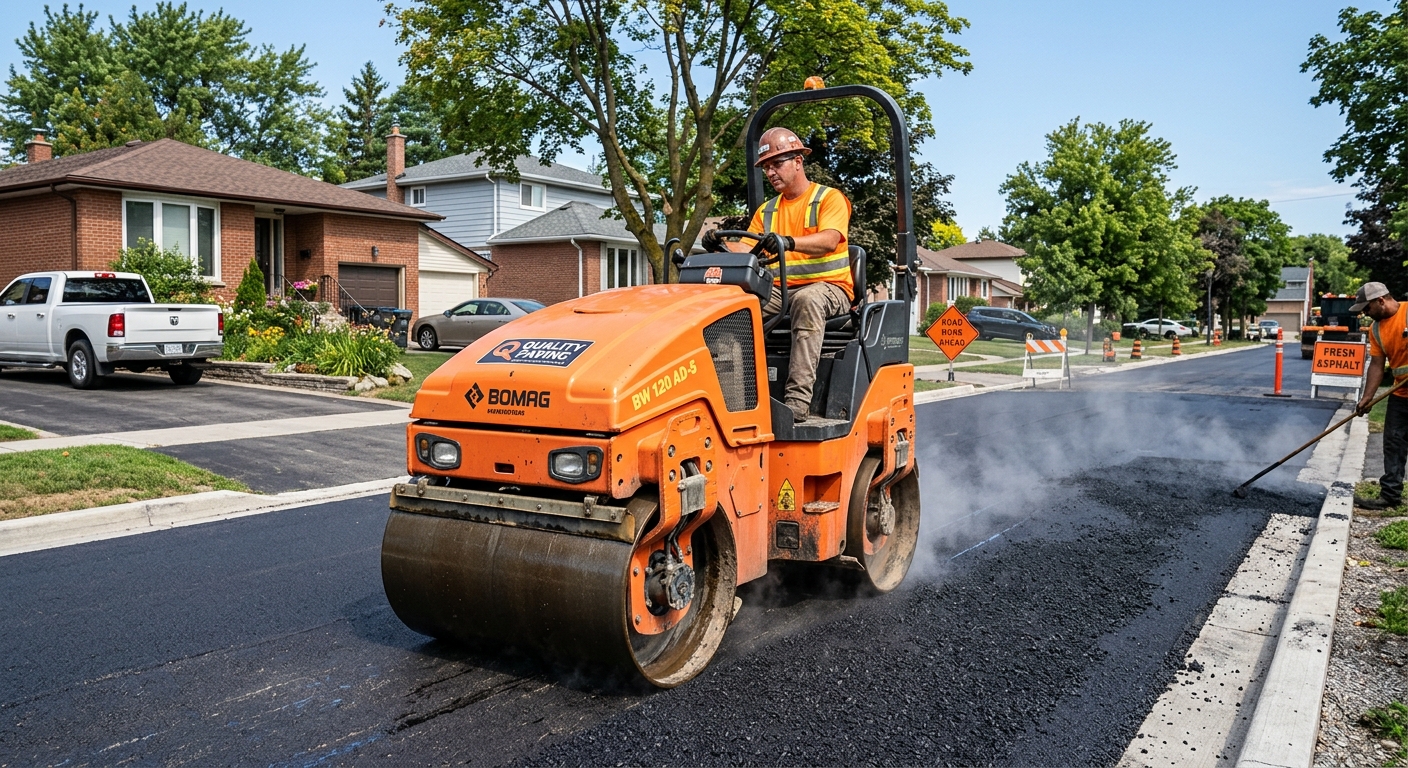
Driveway paving costs in East Huntingdon — 2026
For East Huntingdon homeowners, most of whom live in single-family homes (62.8% of housing) and actually own their property (78.2% owner-occupied, U.S. Census Bureau, ACS 2024), driveway replacement and maintenance is a direct responsibility. The region’s heavy freeze-thaw cycle, hilly terrain, and a subgrade of clay and shale drive both the frequency of repairs and the total cost. The biggest price differences you’ll see between paving quotes usually hide beneath the surface, in how the base is built and how drainage gets handled — rarely the material, and rarely anything visible at a glance.
Cutting costs on preparation, or hiring someone who does, is like buying a new roof but skipping the underlayment. With asphalt especially, a cheap quote that skips base reconstruction on clay or shale will nearly always mean paying more to fix cracks, heave, and rutting within a few winters. On the other hand, if the base is sound, you don’t want to be upsold a full rip-out when resurfacing will serve with routine maintenance and crack repair.
| Service |
Best for |
Lifespan |
Price range |
| Asphalt — full replacement with new base |
failed base, structural cracking |
20–30 yrs |
$3,300–$8,400 |
| Asphalt overlay / resurfacing |
sound base, surface cracking only |
8–15 yrs |
$1,400–$4,200 |
| Sealcoating — single application |
preventive maintenance on sound asphalt |
2–4 yrs |
$175–$650 |
| Concrete — new installation |
long service life, low maintenance |
30–50 yrs |
$4,700–$11,000 |
| Crack filling and patching |
isolated cracks under a quarter inch |
1–3 yrs |
$200–$800 |
| Gravel driveway |
rural, budget, long runs |
5–10 yrs with upkeep |
$900–$3,500 |
Estimates for a typical East Huntingdon driveway. Square footage and base condition drive these figures more than material choice.
Local soil, drainage and driveway lifespan
The base under nearly every East Huntingdon driveway is a mix of heavy clay and shale. Clay is notorious for holding water; when combined with the 36-inch frost depth in Westmoreland County, it’s a recipe for heaving and cracking through winter. Shale doesn’t drain especially well either, so both require a thicker, well-compacted stone base compared to what you’d find across the state line or even in the sandier soils near the rivers. If you cut corners on the base, you will see rutting and frost heave within just a few freeze-thaw seasons.
Most houses in North Huntingdon and Hempfield were built after 1960, so when you see a driveway needing work, odds are decent the original install was only to the minimum standard for a new subdivision. Older tract homes often came with a thin, nominal base — sometimes just enough to get past inspection back then. That’s why resurfacing is such a common ask: the pavement on top wears out, but the base is still recoverable if it hasn’t been soaked and pumped by years of bad drainage. If your house has never had drainage corrections or a full-depth base rebuild, expect to hear it as a recommendation from pavers who’ve worked in this area for a while.
Driveway permits, approaches and stormwater rules
In most of Westmoreland County, including Hempfield Township and the area around East Huntingdon, you don’t need a municipal building permit just to repave or seal an asphalt driveway in its existing footprint. That’s one of the few breaks you get — in fact, Hempfield Township doesn’t require a permit for sealcoating an existing asphalt drive at all. But the rules change when you alter the approach: where your driveway meets a public road. Any work that touches a state-maintained road (route number signs, not just main streets) requires an approach permit from PennDOT District 12, handled through the Westmoreland County maintenance office. Many homeowners miss this and end up with surprise violations or stop-work notices.
Stormwater and runoff rules are a separate headache. Expanding impervious surfaces, like adding width or a parking pad, can trigger stormwater management requirements: think retention swales, drains, or sometimes even engineered plans if you’re close to a waterway. No matter what the township says, if you direct runoff onto your neighbor’s lawn, you could be liable if it causes damage — the permit only lets you build, not create problems for someone else.
For your protection, any contractor you hire for a job over $500 must be registered with the Pennsylvania Office of Attorney General under the Home Improvement Contractor (HIC) program (verify at hic.attorneygeneral.gov), and every employer must carry workers’ compensation insurance in Pennsylvania. You can verify coverage through WCAIS (wcais.pa.gov). Don’t take their word for it; look it up yourself. Only pay by written contract, as required by state law.
Widening, extending or adding a parking pad
If you’re planning to widen your existing driveway for a second car, extend it to reach a detached garage, or add a new turnaround or parking pad in East Huntingdon, recognize that you’re no longer in “simple replacement” territory. Any new paved footprint sits on undisturbed subgrade, which — in our regional clay and shale — means careful excavation and a deeper, compacted base. That old base under your existing pavement won’t extend into the new wing, and the seam where new meets old will always be a permanent weak point. Expect more frequent maintenance along that joint in the years ahead.
Adding impervious surface can also put you within the crosshairs of stormwater management and zoning rules. Setback requirements might limit how close you can pave to the lot line, so it’s best to check with the municipality before work starts. If the new paving impacts the approach at the road, especially on a state highway, you’ll need to get an approach permit from the PennDOT District 12 office — don’t leave this as an afterthought, or you may pay to rip out work.
Finally, doing this type of work with the right drainage plan in place is critical. Water running off a widened drive and onto your neighbor’s property isn’t just poor design — it’s a real legal risk in this county.
Where the water goes
Water causes more driveway failures in East Huntingdon than any other single factor. Grading isn’t just a finishing detail — it’s what keeps your driveway from crumbling in winter. Asphalt and concrete both need a minimum slope of 2 percent (about a quarter inch per foot) to shed water. Crowning works for wide driveways, sending water to both sides; narrower drives are better with a consistent cross-slope. If your driveway slopes toward your garage or house, water will always find the path of least resistance — sometimes straight into your foundation — and repairs rarely last if you don’t correct the grade.
Where grade can’t be changed, channel drains or trench drains across the base of the slope can catch and redirect water. The outlet — daylighting to the lawn, a drainage swale, or sometimes a shallow dry well — matters as much as the pipe, since heavy clay holds water against your base, creating ice lenses in the freeze-thaw cycle. That expands, heaves, and ultimately shatters the drive by springtime.
Shale subgrade slows drainage, and clay holds water. Both demand overbuilt bases, well compacted, with French drains or underdrains in the trickiest spots. Remember that rerouting runoff onto your neighbor’s property brings legal liability, even if the permit is silent. Plan for where the water will go — now and ten years from now — or you’ll be fixing more than driveways.
What a real paving quote contains
Comparing driveway quotes in East Huntingdon comes down to specifics. A solid paving quote states the measured square footage, not just a guessed width and length. It should specify how deep they’ll excavate and whether disposal is included. For our heavy clay/shale base, depth of compacted aggregate matters — two inches too shallow, and you’ll be patching after one rough winter. The quote should state aggregate type and depth, compaction method (and how many lifts), asphalt course and compacted depths, and what’s being done at the edges. Drainage and grading must be spelled out, not left as “as needed.” Finally, the cleanup — don’t assume they’ll restore the lawn along the new edge unless it’s there in writing.
Payment terms should be a modest deposit (never more than a third up front by law), with balance paid after job completion. Warranties should be clear about what is and isn’t covered; almost every paving warranty in Westmoreland County excludes cracking, which surprises new homeowners. If you receive a one-line quote — just a dollar total, no specs — it can’t be compared to anything and is the most common way locals overpay for underbuilt work.
| Line item |
What to look for |
Red flag if… |
| Area |
measured square footage stated |
eyeballed or absent |
| Excavation |
depth and disposal included |
'we'll pave over it' |
| Base |
aggregate type and depth in inches |
'proper base' |
| Compaction |
method, and done in lifts |
not mentioned |
| Asphalt |
courses and compacted depth |
'3 inches' unqualified |
| Drainage |
slope and water direction stated |
silent |
| Warranty |
what is covered and what is excluded |
verbal only |
| Payment |
modest deposit, balance on completion |
full cash up front |
Finding a legitimate paver in Westmoreland County
A legitimate paving contractor for East Huntingdon must have Pennsylvania Home Improvement Contractor (HIC) registration from the Office of Attorney General — check hic.attorneygeneral.gov before hiring. Workers’ compensation insurance is mandatory; verify coverage at the state portal (WCAIS). Don’t settle for a business that operates from a cell phone and mailbox; you want a paver with a verifiable business address, owned (not rented) heavy equipment, and a paper trail in Westmoreland County. Good references come from jobs done three or more years ago, not just last summer. Ask what asphalt plant they buy from — in Hempfield Township, the plants are local; a contractor who dodges that question is likely a broker or out-of-town operation. Local shippers handle the stone for Unity or Penn Township jobs, so someone who can’t name a Greensburg-area supplier is a warning sign. Always insist on a written contract, as required under HICPA, with the right to cancel within three business days.
- Check HIC registration at hic.attorneygeneral.gov
- Verify workers’ comp insurance at WCAIS (wcais.pa.gov)
- Ask for a local business address (not just PO box or cell)
- Prefer contractors with owned heavy equipment
- References from at least three years ago
- Ability to name their local asphalt plant
- Line-item written proposal with square footage and depths
- No big upfront deposits; state law limits them
- Clear description of drainage plan
- Cleanup and lawn restoration spelled out
- Warranty: in writing, and clear about exclusions
- No “free upgrades” or “waived deductibles” — these are illegal or misleading offers
Red flags include high-pressure sales, verbal estimates only, refusal to itemize, and inability to provide insurance or registration verification. If you feel rushed or pressured, walk away. In this market, honest contractors have nothing to hide.
Frequently asked questions — driveway paving in East Huntingdon
Can asphalt be laid in cold weather?
In East Huntingdon, paving season generally runs from late March through October, when daytime temperatures are reliably above 50°F. Technically, PennDOT specs allow hot mix asphalt laid down to about 40°F, but with our local freeze-thaw cycle and heavy clay subgrade, cold-weather work increases the risk of poor compaction and seams that never heal. Paving in cold weather often results in premature cracking and delamination. If a contractor offers an unusually cheap job late in the fall or very early in the spring, think twice — you’ll likely pay for early failure. For the best durability, especially when paying $3,300–$8,400 for a full replacement, wait for stable, warm weather and hold your contractor to proper compaction standards.
Do I need a permit to repave a driveway in East Huntingdon?
Most East Huntingdon homeowners can repave their existing driveway without pulling a municipal permit, especially in Hempfield Township, as long as you’re not expanding the footprint or altering drainage. However, if your project will change the approach — the section of driveway that meets a state road — you must get an approach permit from PennDOT District 12. Expanding the impervious surface, such as widening or adding a parking pad, may also involve stormwater or zoning review. Always double check with your township, since the rules are different if you touch public sidewalks or curbs. For basic sealcoating or resurfacing jobs (costing $1,400–$4,200), you’re usually clear to proceed, but get clarity before breaking ground on extensions or expansions.
How deep should the aggregate base be here?
Because East Huntingdon sits over a mix of clay and shale, with a required frost depth of 36 inches, industry best practice is to place at least 6–8 inches of compacted crushed stone under any asphalt driveway. On hills or where clay holds water, many Westmoreland County pros bump that up to 10–12 inches for extra insurance. Less than this, especially on the clay soils found throughout the Greensburg area, will almost always mean frost heave and rutting within a few years. Even for overlays, careful patching of soft spots is critical. Your total base-plus-asphalt thickness should reflect the climate and subgrade, not just a price point like $3,300–$8,400 for a replacement.
Is gravel a cheaper option in East Huntingdon?
For rural homes or long driveways set back from the road in East Huntingdon and Unity Township, a gravel driveway can be a smart budget choice. Initial installation runs $900–$3,500, much less than asphalt or concrete, and repairs are simple. The tradeoff: regular grading and fresh gravel every few years, more weed control, and plenty of dust. Gravel isn’t the right fit for newer subdivisions, where property values favor paved drives and homeowners’ associations may have rules against it. But if you just need something drivable without investing heavily, and drainage is managed up front, gravel is still the region’s best bang for the buck over shorter runs.
Can I pave over my existing driveway?
If your current driveway is showing surface cracks but the base remains stable — no major depressions, soft spots, or heaving — resurfacing with an asphalt overlay is both common and cost-effective in East Huntingdon. Many post‑1960 tract houses built in Hempfield and North Huntingdon have driveways that are sound below but rough up top, making them perfect candidates. Overlay work typically costs $1,400–$4,200. But if there’s extensive base failure, your money is better spent on a full replacement. Paving contractors should probe and check for soft pockets before making a recommendation. Don’t let anyone talk you into a quick overlay if the subgrade isn’t solid — it’ll just lead to early failure.
Why are my driveway edges crumbling?
Crumbling edges on East Huntingdon driveways almost always trace back to unconfined or poorly compacted asphalt. Our region’s heavy freeze-thaw cycles, mixed with a clay and shale subgrade, push water into the weakest spots. Without proper edge treatment — sometimes a second pass of hand tamping or installing edge stone — the asphalt can’t resist breaking down as vehicles roll over it. This is especially obvious on older installs from the large tract subdivisions built post-1960, where speed sometimes won out over lasting quality. Regular crack filling ($200–$800) helps delay further damage, but only proper construction and sealing at install keeps those edges intact for the long haul.
How much does a concrete driveway cost in East Huntingdon?
Concrete driveways deliver a long service life with low maintenance, making them a popular upgrade for East Huntingdon homes, especially in newer neighborhoods looking to boost resale value. Installation costs typically run $4,700–$11,000, depending on driveway size, thickness, and site prep needed for our local clay and shale base. While concrete costs more upfront than asphalt, its 30–50-year lifespan means fewer replacements down the line. For homes that were built before 1980 (over half the local stock), a proper new base is just as essential for concrete as it is with asphalt — skipping this step leads to cracking and settlement no matter what.”
How often should I sealcoat my driveway in East Huntingdon?
For a typical asphalt driveway in East Huntingdon, sealcoating every 2–4 years is the sweet spot. The region’s freeze-thaw cycles and summer sun break down the binder in asphalt, causing raveling and brittleness if left exposed. Sealcoating forms a barrier against water and helps flex with small cracks, especially critical given our clay soils and winter salt use. You can expect to spend $175–$650 per application, much less than the cost of major patching or a full overlay. Just don’t seal before new asphalt has had at least a full season to cure, or you risk peeling and poor adhesion.
What kind of soil is under East Huntingdon driveways?
Under most driveways in East Huntingdon, you’ll find a mix of dense clay and layers of shale. Clay is notorious for holding water like a sponge, making drainage and a thick aggregate base crucial for any successful paving job. Shale doesn’t drain well either, leading to slow drying after rain or snow melt, which can leave driveways sitting wet for days. These soil conditions directly contribute to frost heave, rutting, and cracking, particularly if the base is too thin or poorly compacted. Any paving estimate above $3,300–$8,400 for a full replacement should specifically mention excavation and base depth to address these local realities.